Thinking and working like a scientist
Students learn how to ask testable questions, plan safe experiments, and measure carefully with metric tools. They practice these habits all year, not just in one unit.
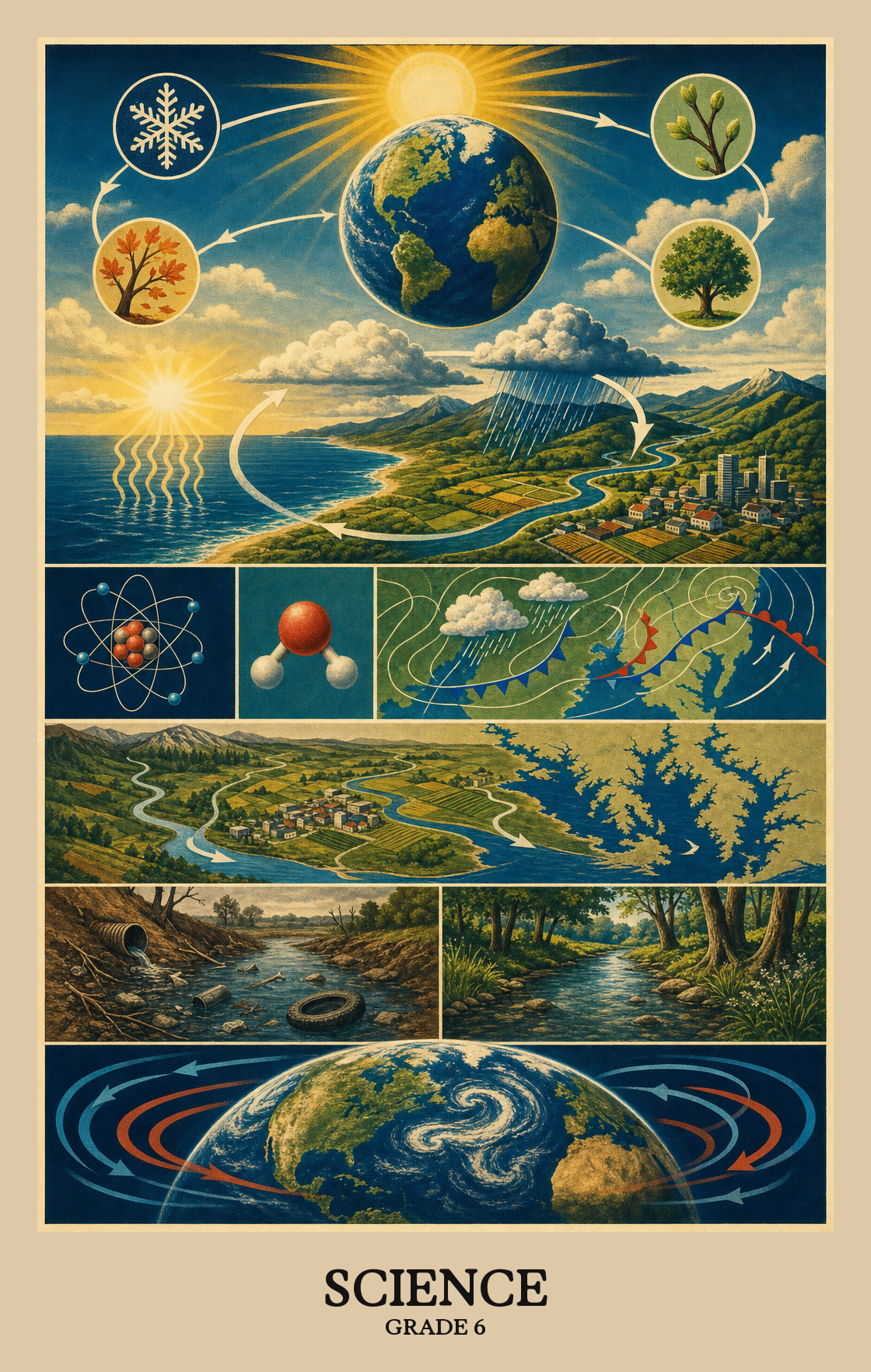
This is the year science zooms out to the whole planet and the solar system around it. Students learn what atoms are and how they combine to make everything around them, and they trace how energy from the sun moves through air, water, and weather. They also study how people affect natural resources and what choices help protect them. By spring, students can explain why we have seasons, read a basic weather map, and describe how a local river drains into the Chesapeake Bay.
Students learn how to ask testable questions, plan safe experiments, and measure carefully with metric tools. They practice these habits all year, not just in one unit.
Students study how the sun, planets, and moon move and pull on each other. They explain why we have day and night, the moon's changing shape, the seasons, and tides.
Students learn that everything is built from tiny atoms with smaller parts inside. They read chemical symbols, see how atoms join to make new substances, and use simple equations to show changes.
Students trace energy from the sun into food, fuel, and weather. They see how heat travels by radiation, conduction, and convection, and how energy changes from one form to another in daily life.
Students explore why water is special, how it changes between ice, liquid, and steam, and how the air around us creates weather. They read weather maps and notice how oceans shape climate.
Students follow rainwater across the land into rivers and the Chesapeake Bay. They look at how people use natural resources and weigh the tradeoffs in choices about energy, pollution, and conservation.
Scientists and engineers follow a set of shared practices to ask questions, test ideas, and make sense of evidence. In sixth grade, students learn and use these same practices across every science topic they study.
Students ask testable questions about the natural world and frame problems clearly enough to investigate or solve. This is the starting point for any experiment or engineering project.
Students learn to ask focused questions that identify which factor they are changing in an experiment and which factor they are measuring in response.
Students learn to make a testable prediction about an experiment, then identify which variable they change on purpose and which one they measure to see what happened.
Students identify a problem and suggest a practical fix for it, explaining why their idea could work.
Students design a test or experiment to answer a question, then run it, collect data, and record what happens.
Students plan and run their own investigations, either alone or with a group. They identify what they're changing, what they're keeping the same, and what they're comparing, then handle any chemicals or equipment safely.
Students practice spotting which data-collection methods give reliable results and which don't. They look at how a measurement was taken or an observation was recorded and decide whether the approach was accurate enough to trust.
Students measure length, mass, and volume using metric units like centimeters, grams, and milliliters. They choose the right tool for the job, whether that's a ruler, a balance scale, or a graduated cylinder.
Students pick materials and build a working device meant to solve a real problem. The focus is on making something functional, not just drawing a plan.
Students look at data from an experiment and decide what it means. They spot patterns, question whether the results make sense, and use what they find to support or challenge a conclusion.
Students sort and arrange collected data to spot patterns, like noticing that temperature rises every time a certain variable changes. Finding that pattern is the first step toward explaining why it happens.
Students turn raw numbers into bar graphs, line graphs, or scatter plots, then read those visuals to spot patterns and draw conclusions.
Students look at data collected by different groups on the same question, then explain where the results agree and where they differ.
Students look at test results or measurements to figure out what worked, what didn't, and what to change next in a design.
Students write a conclusion based on their data, then examine whether that conclusion actually holds up. They look for gaps, consider other explanations, and decide what the evidence really supports.
Students write explanations that show how one thing affects another, such as how changing temperature changes the speed of a reaction. They back up that connection with observations or measurements from their investigation.
Students build written explanations for science questions using real evidence, whether from their own experiments or from credible sources they've researched.
Students come up with more than one solution to a problem, then compare those options against the same requirements and limits to decide which works best.
Students build diagrams, drawings, or physical replicas to explain how something works or predict what will happen. The model stands in for the real thing so ideas can be tested and shared.
Students build or interpret scale models to figure out how far apart things really are. A model of the solar system, for example, shows how distances that seem small on paper translate to millions of miles in space.
Students build and update diagrams or other visual models to explain why something happens in nature and to predict what might happen next.
Models help explain how something works, but no model is perfect. Students look at what a model gets wrong or leaves out, and explain where it falls short.
Students read science sources, judge whether the information is reliable, and share what they found in writing or discussion.
Students read science articles and textbooks to pull out facts, data, and explanations they can use in their own work.
Students pull facts from several sources, then check whether each one is trustworthy, accurate, and written without an agenda before using the information in their work.
Students build a written or spoken argument and back it up with actual data from experiments or observations, not just opinion or guesswork.
| Standard | Definition | Code |
|---|---|---|
| The student will demonstrate an understanding of scientific and engineering… | Scientists and engineers follow a set of shared practices to ask questions, test ideas, and make sense of evidence. In sixth grade, students learn and use these same practices across every science topic they study. | 6.1 |
| asking questions and defining problems | Students ask testable questions about the natural world and frame problems clearly enough to investigate or solve. This is the starting point for any experiment or engineering project. | 6.1.a |
| ask questions to determine relationships between independent and dependent… | Students learn to ask focused questions that identify which factor they are changing in an experiment and which factor they are measuring in response. | 6.1.a.i |
| develop hypotheses and identify independent and dependent variables | Students learn to make a testable prediction about an experiment, then identify which variable they change on purpose and which one they measure to see what happened. | 6.1.a.ii |
| offer simple solutions to design problems | Students identify a problem and suggest a practical fix for it, explaining why their idea could work. | 6.1.a.iii |
| planning and carrying out investigations | Students design a test or experiment to answer a question, then run it, collect data, and record what happens. | 6.1.b |
| independently and collaboratively plan and conduct observational and… | Students plan and run their own investigations, either alone or with a group. They identify what they're changing, what they're keeping the same, and what they're comparing, then handle any chemicals or equipment safely. | 6.1.b.i |
| evaluate the accuracy of various methods for collecting data | Students practice spotting which data-collection methods give reliable results and which don't. They look at how a measurement was taken or an observation was recorded and decide whether the approach was accurate enough to trust. | 6.1.b.ii |
| take metric measurements using appropriate tools | Students measure length, mass, and volume using metric units like centimeters, grams, and milliliters. They choose the right tool for the job, whether that's a ruler, a balance scale, or a graduated cylinder. | 6.1.b.iii |
| use tools and materials to design and/or build a device to solve a specific… | Students pick materials and build a working device meant to solve a real problem. The focus is on making something functional, not just drawing a plan. | 6.1.b.iv |
| interpreting, analyzing | Students look at data from an experiment and decide what it means. They spot patterns, question whether the results make sense, and use what they find to support or challenge a conclusion. | 6.1.c |
| organize data sets to reveal patterns that suggest relationships | Students sort and arrange collected data to spot patterns, like noticing that temperature rises every time a certain variable changes. Finding that pattern is the first step toward explaining why it happens. | 6.1.c.i |
| construct, analyze, and interpret graphical displays of data | Students turn raw numbers into bar graphs, line graphs, or scatter plots, then read those visuals to spot patterns and draw conclusions. | 6.1.c.ii |
| compare and contrast data collected by different groups and discuss… | Students look at data collected by different groups on the same question, then explain where the results agree and where they differ. | 6.1.c.iii |
| use data to evaluate and refine design solutions | Students look at test results or measurements to figure out what worked, what didn't, and what to change next in a design. | 6.1.c.iv |
| constructing and critiquing conclusions and explanations | Students write a conclusion based on their data, then examine whether that conclusion actually holds up. They look for gaps, consider other explanations, and decide what the evidence really supports. | 6.1.d |
| construct explanations that includes qualitative or quantitative relationships… | Students write explanations that show how one thing affects another, such as how changing temperature changes the speed of a reaction. They back up that connection with observations or measurements from their investigation. | 6.1.d.i |
| construct scientific explanations based on valid and reliable evidence obtained… | Students build written explanations for science questions using real evidence, whether from their own experiments or from credible sources they've researched. | 6.1.d.ii |
| generate and compare multiple solutions to problems based on how well they meet… | Students come up with more than one solution to a problem, then compare those options against the same requirements and limits to decide which works best. | 6.1.d.iii |
| developing and using models | Students build diagrams, drawings, or physical replicas to explain how something works or predict what will happen. The model stands in for the real thing so ideas can be tested and shared. | 6.1.e |
| use scale models to represent and estimate distance | Students build or interpret scale models to figure out how far apart things really are. A model of the solar system, for example, shows how distances that seem small on paper translate to millions of miles in space. | 6.1.e.i |
| use, develop, and revise models to predict and explain phenomena | Students build and update diagrams or other visual models to explain why something happens in nature and to predict what might happen next. | 6.1.e.ii |
| evaluate limitations of models | Models help explain how something works, but no model is perfect. Students look at what a model gets wrong or leaves out, and explain where it falls short. | 6.1.e.iii |
| obtaining, evaluating | Students read science sources, judge whether the information is reliable, and share what they found in writing or discussion. | 6.1.f |
| read scientific texts, including those adapted for classroom use, to obtain… | Students read science articles and textbooks to pull out facts, data, and explanations they can use in their own work. | 6.1.f.i |
| gather, read, and synthesize information from multiple appropriate sources and… | Students pull facts from several sources, then check whether each one is trustworthy, accurate, and written without an agenda before using the information in their work. | 6.1.f.ii |
| construct, use, and/or present an argument supported by empirical evidence and… | Students build a written or spoken argument and back it up with actual data from experiments or observations, not just opinion or guesswork. | 6.1.f.iii |
Everyday energy sources like sunlight, food, and fuel don't just sit still. Students learn how energy moves and changes form, turning from light into heat or motion into sound.
Most of Earth's energy sources trace back to the sun. Coal, oil, wind, and flowing water all exist because sunlight drove the processes that created them.
Earth absorbs energy from the sun and releases it back into space. Students learn how that balance drives weather, ocean currents, and the conditions that keep living things alive.
Heat moves from place to place in three ways: through direct contact between objects, through the flow of liquids or gases, and through invisible waves that can travel even through empty space.
Students trace how energy changes form, like chemical energy in a battery becoming light in a bulb, to understand why some energy gets wasted and how to use it more wisely.
| Standard | Definition | Code |
|---|---|---|
| The student will investigate and understand that there are basic sources of… | Everyday energy sources like sunlight, food, and fuel don't just sit still. Students learn how energy moves and changes form, turning from light into heat or motion into sound. | 6.4 |
| the sun is important in the formation of most energy sources on Earth | Most of Earth's energy sources trace back to the sun. Coal, oil, wind, and flowing water all exist because sunlight drove the processes that created them. | 6.4.a |
| Earth's energy budget relates to living systems and Earth's processes | Earth absorbs energy from the sun and releases it back into space. Students learn how that balance drives weather, ocean currents, and the conditions that keep living things alive. | 6.4.b |
| radiation, conduction | Heat moves from place to place in three ways: through direct contact between objects, through the flow of liquids or gases, and through invisible waves that can travel even through empty space. | 6.4.c |
| energy transformations are important in energy usage | Students trace how energy changes form, like chemical energy in a battery becoming light in a bulb, to understand why some energy gets wasted and how to use it more wisely. | 6.4.d |
Atoms are the tiny building blocks that make up every solid, liquid, and gas around us. Students learn what atoms are, how they combine to form different materials, and why everything in the physical world is made of the same basic pieces.
Atoms are the tiny building blocks of everything around us. Students learn that each atom contains even smaller parts: a center made of protons and neutrons, with electrons moving around the outside.
Every element is made of its own type of atom. Carbon atoms, iron atoms, and oxygen atoms each look and behave differently from one another, and that difference is what makes each element unique.
Elements are the basic building blocks of matter, and each one has a shorthand symbol scientists use worldwide. For example, O stands for oxygen and Fe stands for iron.
When atoms join together, they share or transfer electrons, creating electrical forces that lock them into a new substance with different properties than the original atoms had.
Chemical formulas are shorthand labels for compounds. Students learn that H2O means water and CO2 means carbon dioxide, reading the letters and numbers as a recipe that shows which elements are bonded together.
Chemical equations are shorthand for showing what happens during a chemical reaction. Students learn to read and write them to track which substances go in and which new substances come out.
A handful of elements, like oxygen, carbon, and silicon, make up most of what students find in the ground, the ocean, the air, and in living things. The rest of the periodic table exists in much smaller amounts.
| Standard | Definition | Code |
|---|---|---|
| The student will investigate and understand that all matter is composed of atoms | Atoms are the tiny building blocks that make up every solid, liquid, and gas around us. Students learn what atoms are, how they combine to form different materials, and why everything in the physical world is made of the same basic pieces. | 6.5 |
| atoms consist of particles, including electrons, protons | Atoms are the tiny building blocks of everything around us. Students learn that each atom contains even smaller parts: a center made of protons and neutrons, with electrons moving around the outside. | 6.5.a |
| atoms of a particular element are similar but differ from atoms of other… | Every element is made of its own type of atom. Carbon atoms, iron atoms, and oxygen atoms each look and behave differently from one another, and that difference is what makes each element unique. | 6.5.b |
| elements may be represented by chemical symbols | Elements are the basic building blocks of matter, and each one has a shorthand symbol scientists use worldwide. For example, O stands for oxygen and Fe stands for iron. | 6.5.c |
| two or more atoms interact to form new substances, which are held together by… | When atoms join together, they share or transfer electrons, creating electrical forces that lock them into a new substance with different properties than the original atoms had. | 6.5.d |
| compounds may be represented by chemical formulas | Chemical formulas are shorthand labels for compounds. Students learn that H2O means water and CO2 means carbon dioxide, reading the letters and numbers as a recipe that shows which elements are bonded together. | 6.5.e |
| chemical equations can be used to model chemical changes | Chemical equations are shorthand for showing what happens during a chemical reaction. Students learn to read and write them to track which substances go in and which new substances come out. | 6.5.f |
| a few elements comprise the largest portion of the solid Earth, living matter… | A handful of elements, like oxygen, carbon, and silicon, make up most of what students find in the ground, the ocean, the air, and in living things. The rest of the periodic table exists in much smaller amounts. | 6.5.g |
Students learn how the sun, planets, moons, and other objects in our solar system are arranged and how they affect one another through gravity, orbits, and other forces.
Matter fills every part of the solar system, from the rock and metal packed into planets to the thin gas and dust drifting between them. Students learn where different types of matter are found and why the solar system is not mostly empty space.
Planets range from tiny to enormous, and each one travels its own path around the sun. Closer planets complete that loop faster; farther ones take much longer.
Gravity pulls objects toward each other. That constant pull keeps planets circling the sun and moons circling planets, bending their path into an orbit instead of a straight line into space.
Scientists once thought the sun moved around Earth. Students learn how observations, tools, and new evidence gradually changed that picture into the solar system model we use today.
Relationships between the sun, Earth, and the moon shape what we see in the sky every day. Students study how the positions of these three bodies explain seasons, moon phases, tides, and eclipses.
Students compare Earth to other planets by looking at its atmosphere, water, and surface conditions. Those features make Earth the only planet in our solar system known to support life.
Earth's rotation on its axis causes day and night. The side of Earth facing the sun has daytime, while the opposite side is in darkness.
Students learn why the moon appears to change shape each night. As Earth and the moon orbit the sun, sunlight hits the moon from different angles, making it look like a crescent, a half circle, or a full circle from Earth.
Earth's tilt keeps one hemisphere aimed more toward the sun for part of the year, giving it summer while the other has winter. As Earth orbits, that tilt shifts which half gets the most direct sunlight, which is what drives the seasons.
Tides happen because the moon's gravity pulls on Earth's oceans. Students learn why coastal water levels rise and fall roughly twice a day as the moon orbits Earth.
| Standard | Definition | Code |
|---|---|---|
| The student will investigate and understand that the solar system is organized… | Students learn how the sun, planets, moons, and other objects in our solar system are arranged and how they affect one another through gravity, orbits, and other forces. | 6.2 |
| matter is distributed throughout the solar system | Matter fills every part of the solar system, from the rock and metal packed into planets to the thin gas and dust drifting between them. Students learn where different types of matter are found and why the solar system is not mostly empty space. | 6.2.a |
| planets have different sizes and orbit at different distances from the sun | Planets range from tiny to enormous, and each one travels its own path around the sun. Closer planets complete that loop faster; farther ones take much longer. | 6.2.b |
| gravity contributes to orbital motion | Gravity pulls objects toward each other. That constant pull keeps planets circling the sun and moons circling planets, bending their path into an orbit instead of a straight line into space. | 6.2.c |
| the understanding of the solar system has developed over time | Scientists once thought the sun moved around Earth. Students learn how observations, tools, and new evidence gradually changed that picture into the solar system model we use today. | 6.2.d |
| The student will investigate and understand that there is a relationship… | Relationships between the sun, Earth, and the moon shape what we see in the sky every day. Students study how the positions of these three bodies explain seasons, moon phases, tides, and eclipses. | 6.3 |
| Earth has unique properties | Students compare Earth to other planets by looking at its atmosphere, water, and surface conditions. Those features make Earth the only planet in our solar system known to support life. | 6.3.a |
| the rotation of Earth in relationship to the sun causes day and night | Earth's rotation on its axis causes day and night. The side of Earth facing the sun has daytime, while the opposite side is in darkness. | 6.3.b |
| the movement of Earth and the moon in relationship to the sun causes phases of… | Students learn why the moon appears to change shape each night. As Earth and the moon orbit the sun, sunlight hits the moon from different angles, making it look like a crescent, a half circle, or a full circle from Earth. | 6.3.c |
| Earth's tilt as it revolves around the sun causes the seasons | Earth's tilt keeps one hemisphere aimed more toward the sun for part of the year, giving it summer while the other has winter. As Earth orbits, that tilt shifts which half gets the most direct sunlight, which is what drives the seasons. | 6.3.d |
| the relationship between Earth and the moon is the primary cause of tides | Tides happen because the moon's gravity pulls on Earth's oceans. Students learn why coastal water levels rise and fall roughly twice a day as the moon orbits Earth. | 6.3.e |
Water behaves differently from most liquids, and students learn why that matters. They study how water's unusual properties shape weather, ecosystems, and the systems people build to move, store, and use it.
Water dissolves more substances than almost any other liquid on Earth. Students learn why water earns the nickname "universal solvent" and what that means for oceans, soil, and the human body.
Students learn what makes water behave the way it does, including why it expands when it freezes, why certain things dissolve in it, and why it sticks to surfaces.
Heating or cooling a substance can change its form. Students learn how adding or removing heat causes water to freeze, melt, or evaporate, and why that same process drives phase changes in other materials.
Water slowly breaks down rocks by seeping into cracks, freezing, and wearing away surfaces over time. Students learn how this kind of weathering shapes the land around us.
Large bodies of water, like oceans and lakes, absorb heat in summer and release it in winter, keeping nearby land from getting too hot or too cold.
Water powers farms, electric plants, and public water systems. Students learn why protecting and managing freshwater supplies matters for everyday life.
Air is a real substance with measurable properties like temperature, pressure, and humidity. Students study how Earth's atmosphere is layered and how those layers change with weather, altitude, and energy from the sun.
Air is a mixture of invisible gases, mainly nitrogen and oxygen, with small amounts of carbon dioxide and other compounds mixed in.
Students describe the atmosphere's physical traits: how thick it is, what it's made of, and how pressure and temperature change at different altitudes.
The atmosphere does not stay the same from ground to sky. As altitude increases, air pressure drops and temperature shifts in ways that affect weather, flight, and how we breathe.
Moving air carries thermal energy from place to place, and that movement shapes local weather. Students learn why wind, temperature, and storm patterns are connected rather than separate events.
Students read weather data like temperature, air pressure, and humidity to forecast what conditions are likely coming. Meteorologists use patterns in those measurements to predict rain, wind, and temperature changes before they arrive.
Weather maps show where cold and warm fronts are moving, where storm systems are forming, and what the temperature and precipitation look like across a region. Students learn to read those maps to understand what the weather is doing and why.
Watersheds are areas of land where rain and snowmelt drain into the same river, lake, or bay. Students trace how the shape of the land directs water flow and how land and water work together in a single connected system.
A watershed is all the land that funnels rainfall and snowmelt into one river, lake, or bay. Students learn to identify the boundaries of a watershed and explain how land use affects what flows into that water.
Students learn that Virginia is divided into several watersheds, each shaped by its own rivers, ridges, and drainage patterns that funnel rainfall toward different bodies of water.
An estuary is where a river meets the ocean, mixing fresh and salt water. The Chesapeake Bay is one of the largest estuaries in the country, and students learn why it matters for fish, wildlife, clean water, and the people who live near it.
Students study how rain, runoff, farming, and pollution all affect the health of a watershed, the network of land and water that drains into a single river or lake.
Students explore how human activity affects land, water, and air, then look at how citizens and lawmakers make decisions about energy use and environmental protection.
Students learn why natural resources like fresh water, soil, and forests matter and why people work to protect them before they run out or get damaged.
Resources like sunlight and wind renew on their own, while coal and oil take millions of years to replace. Students learn how people manage both kinds to avoid running out.
Students learn why polluted air and water make people sick, and how communities set rules to keep both clean enough to be safe.
Students learn how different energy sources, from power lines to fuel, can cause injuries or long-term health problems. They study why safety rules around electricity, radiation, and heat exist.
Students learn how choices like erosion barriers, buffer zones, and land-use rules can prevent damage to soil and water before a hazard starts.
Conservation policies protect natural resources, but they come with tradeoffs. Students weigh what a policy costs against what it saves, like jobs lost versus land preserved, to decide whether the benefit is worth the price.
| Standard | Definition | Code |
|---|---|---|
| The student will investigate and understand that water has unique physical… | Water behaves differently from most liquids, and students learn why that matters. They study how water's unusual properties shape weather, ecosystems, and the systems people build to move, store, and use it. | 6.6 |
| water is referred to as the universal solvent | Water dissolves more substances than almost any other liquid on Earth. Students learn why water earns the nickname "universal solvent" and what that means for oceans, soil, and the human body. | 6.6.a |
| water has specific properties | Students learn what makes water behave the way it does, including why it expands when it freezes, why certain things dissolve in it, and why it sticks to surfaces. | 6.6.b |
| thermal energy has a role in phase changes | Heating or cooling a substance can change its form. Students learn how adding or removing heat causes water to freeze, melt, or evaporate, and why that same process drives phase changes in other materials. | 6.6.c |
| water has a role in weathering | Water slowly breaks down rocks by seeping into cracks, freezing, and wearing away surfaces over time. Students learn how this kind of weathering shapes the land around us. | 6.6.d |
| large bodies of water moderate climate | Large bodies of water, like oceans and lakes, absorb heat in summer and release it in winter, keeping nearby land from getting too hot or too cold. | 6.6.e |
| water is important for agriculture, power generation | Water powers farms, electric plants, and public water systems. Students learn why protecting and managing freshwater supplies matters for everyday life. | 6.6.f |
| The student will investigate and understand that air has properties and that… | Air is a real substance with measurable properties like temperature, pressure, and humidity. Students study how Earth's atmosphere is layered and how those layers change with weather, altitude, and energy from the sun. | 6.7 |
| air is a mixture of gaseous elements and compounds | Air is a mixture of invisible gases, mainly nitrogen and oxygen, with small amounts of carbon dioxide and other compounds mixed in. | 6.7.a |
| the atmosphere has physical characteristics | Students describe the atmosphere's physical traits: how thick it is, what it's made of, and how pressure and temperature change at different altitudes. | 6.7.b |
| properties of the atmosphere change with altitude | The atmosphere does not stay the same from ground to sky. As altitude increases, air pressure drops and temperature shifts in ways that affect weather, flight, and how we breathe. | 6.7.c |
| there is a relationship between air movement, thermal energy | Moving air carries thermal energy from place to place, and that movement shapes local weather. Students learn why wind, temperature, and storm patterns are connected rather than separate events. | 6.7.d |
| atmospheric measures are used to predict weather conditions | Students read weather data like temperature, air pressure, and humidity to forecast what conditions are likely coming. Meteorologists use patterns in those measurements to predict rain, wind, and temperature changes before they arrive. | 6.7.e |
| weather maps give basic information about fronts, systems | Weather maps show where cold and warm fronts are moving, where storm systems are forming, and what the temperature and precipitation look like across a region. Students learn to read those maps to understand what the weather is doing and why. | 6.7.f |
| The student will investigate and understand that land and water have roles in… | Watersheds are areas of land where rain and snowmelt drain into the same river, lake, or bay. Students trace how the shape of the land directs water flow and how land and water work together in a single connected system. | 6.8 |
| a watershed is composed of the land that drains into a body of water | A watershed is all the land that funnels rainfall and snowmelt into one river, lake, or bay. Students learn to identify the boundaries of a watershed and explain how land use affects what flows into that water. | 6.8.a |
| Virginia is composed of multiple watershed systems which have specific features | Students learn that Virginia is divided into several watersheds, each shaped by its own rivers, ridges, and drainage patterns that funnel rainfall toward different bodies of water. | 6.8.b |
| the Chesapeake Bay is an estuary that has many important functions | An estuary is where a river meets the ocean, mixing fresh and salt water. The Chesapeake Bay is one of the largest estuaries in the country, and students learn why it matters for fish, wildlife, clean water, and the people who live near it. | 6.8.c |
| natural processes, human activities | Students study how rain, runoff, farming, and pollution all affect the health of a watershed, the network of land and water that drains into a single river or lake. | 6.8.d |
| The student will investigate and understand that humans impact the environment… | Students explore how human activity affects land, water, and air, then look at how citizens and lawmakers make decisions about energy use and environmental protection. | 6.9 |
| natural resources are important to protect and maintain | Students learn why natural resources like fresh water, soil, and forests matter and why people work to protect them before they run out or get damaged. | 6.9.a |
| renewable and nonrenewable resources can be managed | Resources like sunlight and wind renew on their own, while coal and oil take millions of years to replace. Students learn how people manage both kinds to avoid running out. | 6.9.b |
| major health and safety issues are associated with air and water quality | Students learn why polluted air and water make people sick, and how communities set rules to keep both clean enough to be safe. | 6.9.c |
| major health and safety issues are related to different forms of energy | Students learn how different energy sources, from power lines to fuel, can cause injuries or long-term health problems. They study why safety rules around electricity, radiation, and heat exist. | 6.9.d |
| preventive measures can protect land-use and reduce environmental hazards | Students learn how choices like erosion barriers, buffer zones, and land-use rules can prevent damage to soil and water before a hazard starts. | 6.9.e |
| there are cost/benefit tradeoffs in conservation policies | Conservation policies protect natural resources, but they come with tradeoffs. Students weigh what a policy costs against what it saves, like jobs lost versus land preserved, to decide whether the benefit is worth the price. | 6.9.f |
Alternate assessment program for eligible students with significant cognitive disabilities, covering state-tested grades and subjects.
Sixth graders study the solar system, the sun and moon, atoms and matter, energy, water, air and weather, and how humans affect the environment. They also practice asking questions, running experiments, and using evidence to explain what they find.
Talk about the weather forecast, the moon's shape, or where tap water comes from. Five minutes of real questions at dinner builds more curiosity than a worksheet. When students wonder about something, help them look it up in two sources and compare.
Students should be able to name what they changed, what they measured, and what they kept the same. They should record numbers with metric units, graph the results, and say what the data shows. Neat handwriting matters less than clear variables.
Many teachers start with practices and measurement, then move to space and the sun-Earth-moon system, then atoms and matter, then energy, and finish with water, air, watersheds, and human impact. That order lets earlier ideas about energy and matter support the later Earth units.
Moon phases, seasons, and the difference between rotation and revolution trip students up every year. Atom structure and reading chemical formulas also need extra practice. Plan a short review loop on these before moving on.
Push for explanations instead of labels. Ask why the moon looks different tonight, or why a cold glass sweats on a hot day. Getting students to talk through the reasoning matters more than naming every part.
By spring, students should explain day and night, moon phases, and seasons in their own words. They should read a simple weather map, describe what atoms are made of, and design a basic experiment with variables. They should also back up claims with evidence.
Plan for hands-on investigation most weeks, even if it is short. Students need repeated practice measuring with metric tools, recording data, and graphing results. One careful investigation a week beats a big lab once a month.
Strong sixth graders leave able to read a science article, pull out the main claim, and judge whether the evidence is solid. Keep practicing graph reading and metric measurement over the summer with recipes, maps, or sports stats.