Thinking and working like a scientist
Students learn how real science gets done. They ask testable questions, design careful experiments, take measurements with tools like microscopes, and back up their conclusions with evidence instead of guesses.
This is the year science zooms in on living things, from the tiny cells inside a leaf to the whole pond they live in. Students look at plant and animal cells under microscopes, trace how food and energy move through a food web, and study how traits pass from parents to offspring through DNA. By spring, they can explain how a change in habitat, like a drought or new predator, ripples through an entire ecosystem.
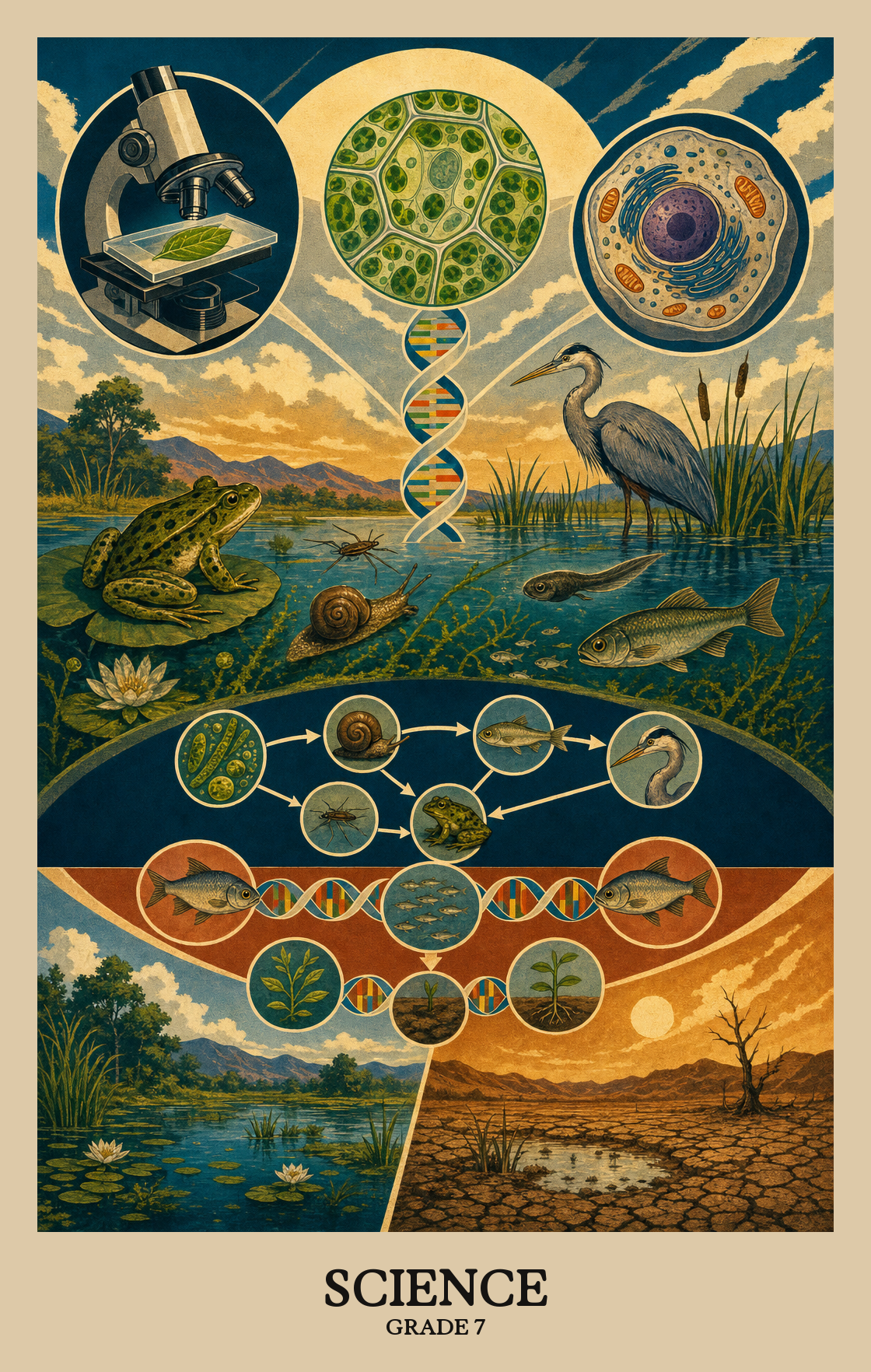
Students learn how real science gets done. They ask testable questions, design careful experiments, take measurements with tools like microscopes, and back up their conclusions with evidence instead of guesses.
Students zoom in on the smallest unit of life. They learn what cells are made of, how plant and animal cells differ, how cells divide to grow and reproduce, and how water and nutrients move in and out.
Students follow energy from sunlight into living things. They study how plants make food through photosynthesis, how cells release energy from that food, and how living things are organized from single cells up to whole bodies.
Students look at how living things depend on each other and on their surroundings. They trace food webs, track water and carbon cycles, and examine how predators, prey, competition, and partnerships shape who survives where.
Students see ecosystems shift through seasons, storms, and human activity. They study how habitats are disturbed, how populations grow or shrink, and how climate change and pollution ripple through living communities.
Students learn how traits pass from parents to offspring. They explore DNA, use Punnett squares to predict eye color or other traits, and look at fossils and adaptations as evidence that species change across generations.
Students plan investigations, analyze data, and build explanations about how living things work. They also design solutions to problems, using evidence to support their reasoning.
Cells are the building blocks of every living thing. Students learn that all organisms, from a single bacterium to the human body, are made of cells, and that those cells carry out the basic work of staying alive.
Living things are built in layers, from tiny cells up to tissues, organs, and whole body systems. Students explore how each level is organized and how those layers work together to keep an organism alive.
Chemical reactions inside living things move energy from one place to another. Students learn how plants capture energy from sunlight and how cells release energy from food.
Living things like plants and animals and nonliving things like sunlight, water, and temperature all shape an ecosystem. Students explore how changes to any of these factors can ripple through and affect the living community.
Living things in an ecosystem depend on each other to survive. Students explore how changes to one population, like a drop in prey or the arrival of a new predator, ripple through the rest of the community.
Adaptations are traits that help a living thing survive where it lives. Students study how an animal's body shape, coloring, or behavior gives it an edge in finding food, avoiding predators, or handling the local climate.
Living things and their environments don't stay the same. Students study how ecosystems shift, populations grow or shrink, and individual organisms respond to changes around them.
Students examine how human actions, such as building roads or farming, change the balance of local ecosystems. They look at what those changes mean for the plants, animals, and resources that depend on each other.
Reproduction passes genetic information from parents to offspring. Students explore how traits are inherited, why offspring resemble but don't perfectly copy their parents, and how this process keeps species going across generations.
Over generations, groups of animals or plants can grow, shrink, or shift as their environment changes. Students study what drives those changes, from food supply to predators to disease.
| Standard | Definition | Code |
|---|---|---|
| The student will demonstrate an understanding of scientific and… | Students plan investigations, analyze data, and build explanations about how living things work. They also design solutions to problems, using evidence to support their reasoning. | LS1 |
| The student will investigate and understand that all living things are composed… | Cells are the building blocks of every living thing. Students learn that all organisms, from a single bacterium to the human body, are made of cells, and that those cells carry out the basic work of staying alive. | LS 2 |
| The student will investigate and understand that there are levels of… | Living things are built in layers, from tiny cells up to tissues, organs, and whole body systems. Students explore how each level is organized and how those layers work together to keep an organism alive. | LS 3 |
| The student will investigate and understand that there are chemical processes… | Chemical reactions inside living things move energy from one place to another. Students learn how plants capture energy from sunlight and how cells release energy from food. | LS 4 |
| The student will investigate and understand that biotic and abiotic factors… | Living things like plants and animals and nonliving things like sunlight, water, and temperature all shape an ecosystem. Students explore how changes to any of these factors can ripple through and affect the living community. | LS 5 |
| The student will investigate and understand that populations in a… | Living things in an ecosystem depend on each other to survive. Students explore how changes to one population, like a drop in prey or the arrival of a new predator, ripple through the rest of the community. | LS 6 |
| The student will investigate and understand that adaptations support… | Adaptations are traits that help a living thing survive where it lives. Students study how an animal's body shape, coloring, or behavior gives it an edge in finding food, avoiding predators, or handling the local climate. | LS 7 |
| The student will investigate and understand that ecosystems… | Living things and their environments don't stay the same. Students study how ecosystems shift, populations grow or shrink, and individual organisms respond to changes around them. | LS 8 |
| The student will investigate and understand that relationships exist… | Students examine how human actions, such as building roads or farming, change the balance of local ecosystems. They look at what those changes mean for the plants, animals, and resources that depend on each other. | LS 9 |
| The student will investigate and understand that organisms reproduce and… | Reproduction passes genetic information from parents to offspring. Students explore how traits are inherited, why offspring resemble but don't perfectly copy their parents, and how this process keeps species going across generations. | LS 10 |
| The student will investigate and understand that populations of organisms… | Over generations, groups of animals or plants can grow, shrink, or shift as their environment changes. Students study what drives those changes, from food supply to predators to disease. | LS 11 |
Students practice turning curiosity into a clear question or a problem worth solving, which is the starting point for any science investigation or design challenge.
Students design a test to answer a science question, then run it and record what happens.
Students look at data from an investigation and explain what it shows, spot patterns, and decide whether the evidence actually supports the conclusion.
Students write a conclusion that explains what their data shows, then review other conclusions to find gaps or weak reasoning.
Students build diagrams, charts, or physical models to show how something in nature works, then use those models to explain patterns or make predictions.
Students read science articles, diagrams, and data to gather information, then decide what's reliable and share their findings clearly in writing or discussion.
| Standard | Definition | Code |
|---|---|---|
| asking questions and defining problems | Students practice turning curiosity into a clear question or a problem worth solving, which is the starting point for any science investigation or design challenge. | LS 1a |
| planning and carrying out investigations | Students design a test to answer a science question, then run it and record what happens. | LS 1b |
| interpreting, analyzing | Students look at data from an investigation and explain what it shows, spot patterns, and decide whether the evidence actually supports the conclusion. | LS 1c |
| constructing and critiquing conclusions and explanations | Students write a conclusion that explains what their data shows, then review other conclusions to find gaps or weak reasoning. | LS 1d |
| developing and using models | Students build diagrams, charts, or physical models to show how something in nature works, then use those models to explain patterns or make predictions. | LS 1e |
| obtaining, evaluating | Students read science articles, diagrams, and data to gather information, then decide what's reliable and share their findings clearly in writing or discussion. | LS 1f |
Reading a graph, running an experiment, or building a model are all part of science. Students learn to ask questions, collect data, and explain what the evidence shows, the same habits scientists and engineers use on the job.
Students ask questions about living things and define what problem needs solving before starting any investigation.
Students pick a question they can test, then predict how changing one thing (like light or temperature) will affect another. That prediction is the hypothesis.
Students spot a problem in a life science context and suggest a straightforward fix, explaining why it could work.
Students design and run experiments to answer a science question, choosing what to measure, what to change, and how to record what happens.
Planning and running experiments, both solo and with a group. Students choose what to change, what to keep the same, and what to measure, then handle lab materials safely.
Students look at different ways data can be gathered in a science investigation and decide which methods give the most reliable results.
Students measure length, mass, and volume in metric units using tools like rulers, balances, and graduated cylinders. They also use microscopes to observe and measure objects too small to see with the naked eye.
Students look at data from an experiment and decide what it means. They spot patterns, check whether the results make sense, and draw conclusions based on what the numbers or observations actually show.
Reading a data table or graph, students look for patterns, then decide what those patterns actually mean and whether the data is strong enough to support a conclusion.
Students take data from a life science investigation and build a graph, then read it carefully enough to spot patterns or draw a conclusion.
Students look at data collected by different groups on the same question, then explain what the results have in common and where they diverge.
Students look at their results and ask what might be off. They spot where a measurement could be more exact and think about how to get a cleaner answer next time.
Students test a design, look at what the data shows, and adjust their plan to make it work better.
Students write a conclusion that explains what their data shows, then review other conclusions to spot weak reasoning or missing evidence.
Students explain how changing one thing (like temperature or light) affects another, using words or numbers to show the connection between the two.
Students build written explanations for what they observe in science, then back them up with evidence from experiments, readings, or their own lab work.
A hypothesis is an educated guess students test with evidence. A theory is a well-tested explanation backed by years of research. Students learn why calling something "just a theory" actually means scientists have strong evidence for it.
Students build diagrams, sketches, or physical replicas to represent how a living system works, then use those models to explain patterns or make predictions.
Students build or use models, such as a diagram of a cell or a simulation of a food web, to show how something in living systems works or to predict what might happen when conditions change.
Students look at a model (like a diagram of a cell or a food web) and explain what it gets wrong or leaves out. Real things are always more complex than any model can show.
Students read science texts, diagrams, and data to find reliable information, then decide what counts as good evidence and explain what they learned to others.
Students read science articles and passages to pull out facts, data, and explanations. The focus is on finding real scientific information in written form, not just getting the general idea.
Students pull facts from several sources on the same topic, then check whether each source is trustworthy, accurate, and free from bias before using it in their work.
Students build a science argument and back it up with real data they collected or observed. They explain why the evidence supports their conclusion, not just what the evidence says.
Cells are the basic building blocks of every living thing. Students learn that all life is made of one or more cells, that cells come from existing cells, and that each cell carries out the work needed to keep an organism alive.
Scientists built the cell theory over centuries by testing ideas, arguing over evidence, and revising what they thought was true. It shows students how scientific knowledge grows through observation and debate, not a single experiment or person.
Students study the parts inside a cell, like the nucleus and mitochondria, and learn what job each part does to keep the cell alive and working.
Plant and animal cells share basic parts but differ in key ways. Students compare those differences to explain why plants can make their own food and animals can't.
Cell division is how living things grow and repair themselves. One cell splits into two identical copies, adding new cells to the body or replacing ones that wear out.
Cells move water and dissolved substances in and out through osmosis and diffusion. Students learn why this constant flow keeps cells alive and working.
Living things are organized in layers, from tiny cells up through tissues, organs, and whole body systems. Students learn how each layer depends on the ones below it to keep an organism alive and functioning.
Cells are not just scattered randomly. Students learn how cells group into tissues, tissues into organs, and organs into systems, each level of organization doing a job that keeps the organism alive.
Single-celled organisms like bacteria do everything with one cell. Multicellular organisms like humans use specialized cells grouped into tissues and organs. Students compare how these structures differ across living things.
Students learn how scientists sort living things into groups based on shared traits, like body structure or cell type. A whale and a bat look nothing alike, but both nurse their young with milk, so both land in the same group.
Living things run on chemistry. Students explore how plants capture energy from sunlight and how cells release energy from food, connecting both processes to why organisms can grow, move, and stay alive.
Photosynthesis is how plants use sunlight to make their own food. Nearly every living thing depends on that process, because it sits at the base of every food chain.
Photosynthesis and cellular respiration are the two main ways living things make and use energy. Plants capture sunlight to build food, and cells break that food down to power growth, movement, and repair.
Living things like plants and animals (biotic factors) and nonliving conditions like temperature, water, and sunlight (abiotic factors) both shape how an ecosystem works. Students investigate how changes to either type can ripple through the whole system.
Carbon, water, and nitrogen cycle through living things and the environment in a loop. Students trace how those materials move from soil to plants to animals and back again.
Food webs map who eats whom in an ecosystem. Energy pyramids show how much energy passes from plants to plant-eaters to meat-eaters, with less available at each step up.
Producers (plants) make food using sunlight, consumers (animals) eat to get energy, and decomposers (fungi and bacteria) break down dead matter. These roles keep nutrients cycling through the ecosystem.
Living things in an ecosystem depend on each other to survive. Students explore how animals, plants, and other organisms affect one another through relationships like predation, competition, and symbiosis.
Predators eat prey, and that eating relationship connects species across a whole community. Students map those connections in food webs to see who eats whom and what happens when one species disappears.
Students examine how living things in the same area compete for food, water, or space when those resources run short, and how some species cooperate to share or secure what they need.
Two species living in a symbiotic relationship depend on each other to survive. A clownfish hiding in a sea anemone is one example: one or both species benefits, and neither is simply predator and prey.
A niche is the specific role an organism plays in its community: what it eats, when it's active, and how it uses resources. Filling that role without too much overlap with neighbors helps the organism survive.
Adaptations are traits that help a living thing survive where it lives. Students study how physical features and behaviors give organisms an edge in their environment.
Biotic factors are the living things in an ecosystem (plants, animals, microbes) and abiotic factors are the non-living ones (temperature, water, sunlight). Together they define whether a land, ocean, or freshwater habitat can support life.
Physical traits like thick fur or sharp claws, and behaviors like migration or camouflage, help an organism survive in its habitat. Students explore how these built-in features match the place where the organism lives.
Living things and their environments are always changing. Students study how populations grow or shrink, how communities shift after a disturbance, and why no ecosystem stays the same from one generation to the next.
Students learn how living things react to changes in their environment, like a bear eating more in fall to prepare for winter or a flower opening at sunrise.
When food, water, or space runs short, animal and plant populations shrink. When conditions improve, populations grow. Students learn to connect specific changes in an environment to the rise or fall of the living things in it.
Big disruptions change entire ecosystems. Students explore how events like rapid algae growth choking a lake, shifting temperatures across a region, or a wildfire can permanently alter what lives in an area and how that community functions.
Living things and people affect each other. Students explore how human choices, like building roads or farming land, change ecosystems, and how those changes circle back to affect the people who depend on them.
When a habitat changes, such as when a forest is cleared or a wetland drains, the populations of animals and plants living there can shrink, shift, or disappear.
When a habitat shifts (a new species arrives, a disease spreads, a forest burns), the balance between competing species changes. Students explore how those disruptions ripple through a food web and reshape which species thrive.
When living things or physical conditions in an area shift (think drought, a new predator, or rising temperatures), the whole ecosystem can change in response. Students study how those shifts ripple through food webs and habitats.
Reproduction passes traits from parents to offspring. Students explore how living things make copies of themselves and how information stored in genes gets handed down, explaining why offspring resemble their parents but are not identical.
DNA carries the instructions cells use to build proteins. Those proteins shape what an organism looks, grows, and functions like, from eye color to how tall a plant gets.
Meiosis is the cell division that creates egg and sperm cells. It shuffles a parent's traits so offspring inherit a unique mix from both parents.
Punnett squares are simple grids students use to predict the odds that offspring will inherit a particular trait. A cross between two parents fills the grid, showing how likely each combination of genes is to appear.
Over time, groups of living things change as individuals with useful traits survive and reproduce more than others. Students explore how those shifts build up across generations and what drives populations to look different from their ancestors.
Mutation, adaptation, and natural selection explain why living things change across generations. Students study how small genetic changes can spread through a population, help a species survive, or lead to extinction when conditions shift.
Fossils, DNA, and body structure comparisons all point to the same conclusion: species alive today descended from earlier forms of life. Students learn to read that evidence and explain what it shows.
Students study how traits passed down through genes, combined with pressures like drought, predators, or disease, determine which organisms survive long enough to reproduce and which don't.
| Standard | Definition | Code |
|---|---|---|
| The student will demonstrate an understanding of scientific and engineering… | Reading a graph, running an experiment, or building a model are all part of science. Students learn to ask questions, collect data, and explain what the evidence shows, the same habits scientists and engineers use on the job. | LS.1 |
| asking questions and defining problems | Students ask questions about living things and define what problem needs solving before starting any investigation. | LS.1.a |
| ask questions and develop hypotheses to determine relationships between… | Students pick a question they can test, then predict how changing one thing (like light or temperature) will affect another. That prediction is the hypothesis. | LS.1.a.i |
| offer simple solutions to design problems | Students spot a problem in a life science context and suggest a straightforward fix, explaining why it could work. | LS.1.a.ii |
| planning and carrying out investigations | Students design and run experiments to answer a science question, choosing what to measure, what to change, and how to record what happens. | LS.1.b |
| independently and collaboratively plan and conduct observational and… | Planning and running experiments, both solo and with a group. Students choose what to change, what to keep the same, and what to measure, then handle lab materials safely. | LS.1.b.i |
| evaluate the accuracy of various methods for collecting data | Students look at different ways data can be gathered in a science investigation and decide which methods give the most reliable results. | LS.1.b.ii |
| take metric measurements using appropriate tools and technologies including the… | Students measure length, mass, and volume in metric units using tools like rulers, balances, and graduated cylinders. They also use microscopes to observe and measure objects too small to see with the naked eye. | LS.1.b.iii |
| interpreting, analyzing | Students look at data from an experiment and decide what it means. They spot patterns, check whether the results make sense, and draw conclusions based on what the numbers or observations actually show. | LS.1.c |
| identify, interpret, and evaluate patterns in data | Reading a data table or graph, students look for patterns, then decide what those patterns actually mean and whether the data is strong enough to support a conclusion. | LS.1.c.i |
| construct, analyze, and interpret graphical displays of data | Students take data from a life science investigation and build a graph, then read it carefully enough to spot patterns or draw a conclusion. | LS.1.c.ii |
| compare and contrast data collected by different groups and discuss… | Students look at data collected by different groups on the same question, then explain what the results have in common and where they diverge. | LS.1.c.iii |
| consider limitations of data analysis and/or seek to improve precision and… | Students look at their results and ask what might be off. They spot where a measurement could be more exact and think about how to get a cleaner answer next time. | LS.1.c.iv |
| use data to evaluate and refine design solutions | Students test a design, look at what the data shows, and adjust their plan to make it work better. | LS.1.c.v |
| constructing and critiquing conclusions and explanations | Students write a conclusion that explains what their data shows, then review other conclusions to spot weak reasoning or missing evidence. | LS.1.d |
| construct explanations that include qualitative or quantitative relationships… | Students explain how changing one thing (like temperature or light) affects another, using words or numbers to show the connection between the two. | LS.1.d.i |
| construct scientific explanations based on valid and reliable evidence obtained… | Students build written explanations for what they observe in science, then back them up with evidence from experiments, readings, or their own lab work. | LS.1.d.ii |
| differentiate between a scientific hypothesis and theory | A hypothesis is an educated guess students test with evidence. A theory is a well-tested explanation backed by years of research. Students learn why calling something "just a theory" actually means scientists have strong evidence for it. | LS.1.d.iii |
| developing and using models | Students build diagrams, sketches, or physical replicas to represent how a living system works, then use those models to explain patterns or make predictions. | LS.1.e |
| construct and use models and simulations to illustrate, predict, and/or explain… | Students build or use models, such as a diagram of a cell or a simulation of a food web, to show how something in living systems works or to predict what might happen when conditions change. | LS.1.e.i |
| evaluate limitations of models | Students look at a model (like a diagram of a cell or a food web) and explain what it gets wrong or leaves out. Real things are always more complex than any model can show. | LS.1.e.ii |
| obtaining, evaluating | Students read science texts, diagrams, and data to find reliable information, then decide what counts as good evidence and explain what they learned to others. | LS.1.f |
| read scientific texts, including those adapted for classroom use, to obtain… | Students read science articles and passages to pull out facts, data, and explanations. The focus is on finding real scientific information in written form, not just getting the general idea. | LS.1.f.i |
| gather, read, and synthesize information from multiple appropriate sources and… | Students pull facts from several sources on the same topic, then check whether each source is trustworthy, accurate, and free from bias before using it in their work. | LS.1.f.ii |
| construct, use, and/or present an argument supported by empirical evidence and… | Students build a science argument and back it up with real data they collected or observed. They explain why the evidence supports their conclusion, not just what the evidence says. | LS.1.f.iii |
| The student will investigate and understand that all living things are composed… | Cells are the basic building blocks of every living thing. Students learn that all life is made of one or more cells, that cells come from existing cells, and that each cell carries out the work needed to keep an organism alive. | LS.2 |
| the development of the cell theory demonstrates the nature of science | Scientists built the cell theory over centuries by testing ideas, arguing over evidence, and revising what they thought was true. It shows students how scientific knowledge grows through observation and debate, not a single experiment or person. | LS.2.a |
| cell structure and organelles support life processes | Students study the parts inside a cell, like the nucleus and mitochondria, and learn what job each part does to keep the cell alive and working. | LS.2.b |
| similarities and differences between plant and animal cells determine how they… | Plant and animal cells share basic parts but differ in key ways. Students compare those differences to explain why plants can make their own food and animals can't. | LS.2.c |
| cell division is the mechanism for growth and reproduction | Cell division is how living things grow and repair themselves. One cell splits into two identical copies, adding new cells to the body or replacing ones that wear out. | LS.2.d |
| cellular transport (osmosis and diffusion) is important for life processes | Cells move water and dissolved substances in and out through osmosis and diffusion. Students learn why this constant flow keeps cells alive and working. | LS.2.e |
| The student will investigate and understand that there are levels of structural… | Living things are organized in layers, from tiny cells up through tissues, organs, and whole body systems. Students learn how each layer depends on the ones below it to keep an organism alive and functioning. | LS.3 |
| patterns of cellular organization support life processes | Cells are not just scattered randomly. Students learn how cells group into tissues, tissues into organs, and organs into systems, each level of organization doing a job that keeps the organism alive. | LS.3.a |
| unicellular and multicellular organisms have comparative structures | Single-celled organisms like bacteria do everything with one cell. Multicellular organisms like humans use specialized cells grouped into tissues and organs. Students compare how these structures differ across living things. | LS.3.b |
| similar characteristics determine the classification of organisms | Students learn how scientists sort living things into groups based on shared traits, like body structure or cell type. A whale and a bat look nothing alike, but both nurse their young with milk, so both land in the same group. | LS.3.c |
| The student will investigate and understand that there are chemical processes… | Living things run on chemistry. Students explore how plants capture energy from sunlight and how cells release energy from food, connecting both processes to why organisms can grow, move, and stay alive. | LS.4 |
| photosynthesis is the foundation of virtually all food webs | Photosynthesis is how plants use sunlight to make their own food. Nearly every living thing depends on that process, because it sits at the base of every food chain. | LS.4.a |
| photosynthesis and cellular respiration support life processes | Photosynthesis and cellular respiration are the two main ways living things make and use energy. Plants capture sunlight to build food, and cells break that food down to power growth, movement, and repair. | LS.4.b |
| The student will investigate and understand that biotic and abiotic factors… | Living things like plants and animals (biotic factors) and nonliving conditions like temperature, water, and sunlight (abiotic factors) both shape how an ecosystem works. Students investigate how changes to either type can ripple through the whole system. | LS.5 |
| matter moves through ecosystems via the carbon, water | Carbon, water, and nitrogen cycle through living things and the environment in a loop. Students trace how those materials move from soil to plants to animals and back again. | LS.5.a |
| energy flow is represented by food webs and energy pyramids | Food webs map who eats whom in an ecosystem. Energy pyramids show how much energy passes from plants to plant-eaters to meat-eaters, with less available at each step up. | LS.5.b |
| relationships exist among producers, consumers | Producers (plants) make food using sunlight, consumers (animals) eat to get energy, and decomposers (fungi and bacteria) break down dead matter. These roles keep nutrients cycling through the ecosystem. | LS.5.c |
| The student will investigate and understand that populations in a biological… | Living things in an ecosystem depend on each other to survive. Students explore how animals, plants, and other organisms affect one another through relationships like predation, competition, and symbiosis. | LS.6 |
| relationships exist between predators and prey and these relationships are… | Predators eat prey, and that eating relationship connects species across a whole community. Students map those connections in food webs to see who eats whom and what happens when one species disappears. | LS.6.a |
| the availability and use of resources may lead to competition and cooperation | Students examine how living things in the same area compete for food, water, or space when those resources run short, and how some species cooperate to share or secure what they need. | LS.6.b |
| symbiotic relationships support the survival of different species | Two species living in a symbiotic relationship depend on each other to survive. A clownfish hiding in a sea anemone is one example: one or both species benefits, and neither is simply predator and prey. | LS.6.c |
| the niche of each organism supports survival | A niche is the specific role an organism plays in its community: what it eats, when it's active, and how it uses resources. Filling that role without too much overlap with neighbors helps the organism survive. | LS.6.d |
| The student will investigate and understand that adaptations support an… | Adaptations are traits that help a living thing survive where it lives. Students study how physical features and behaviors give organisms an edge in their environment. | LS.7 |
| biotic and abiotic factors define land, marine | Biotic factors are the living things in an ecosystem (plants, animals, microbes) and abiotic factors are the non-living ones (temperature, water, sunlight). Together they define whether a land, ocean, or freshwater habitat can support life. | LS.7.a |
| physical and behavioral characteristics enable organisms to survive within a… | Physical traits like thick fur or sharp claws, and behaviors like migration or camouflage, help an organism survive in its habitat. Students explore how these built-in features match the place where the organism lives. | LS.7.b |
| The student will investigate and understand that ecosystems, communities… | Living things and their environments are always changing. Students study how populations grow or shrink, how communities shift after a disturbance, and why no ecosystem stays the same from one generation to the next. | LS.8 |
| organisms respond to daily, seasonal | Students learn how living things react to changes in their environment, like a bear eating more in fall to prepare for winter or a flower opening at sunrise. | LS.8.a |
| changes in the environment may increase or decrease population size | When food, water, or space runs short, animal and plant populations shrink. When conditions improve, populations grow. Students learn to connect specific changes in an environment to the rise or fall of the living things in it. | LS.8.b |
| large-scale changes such as eutrophication, climate changes | Big disruptions change entire ecosystems. Students explore how events like rapid algae growth choking a lake, shifting temperatures across a region, or a wildfire can permanently alter what lives in an area and how that community functions. | LS.8.c |
| The student will investigate and understand that relationships exist between… | Living things and people affect each other. Students explore how human choices, like building roads or farming land, change ecosystems, and how those changes circle back to affect the people who depend on them. | LS.9 |
| changes in habitat can disturb populations | When a habitat changes, such as when a forest is cleared or a wetland drains, the populations of animals and plants living there can shrink, shift, or disappear. | LS.9.a |
| disruptions in ecosystems can change species competition | When a habitat shifts (a new species arrives, a disease spreads, a forest burns), the balance between competing species changes. Students explore how those disruptions ripple through a food web and reshape which species thrive. | LS.9.b |
| variations in biotic and abiotic factors can change ecosystems | When living things or physical conditions in an area shift (think drought, a new predator, or rising temperatures), the whole ecosystem can change in response. Students study how those shifts ripple through food webs and habitats. | LS.9.c |
| The student will investigate and understand that organisms reproduce and… | Reproduction passes traits from parents to offspring. Students explore how living things make copies of themselves and how information stored in genes gets handed down, explaining why offspring resemble their parents but are not identical. | LS.10 |
| DNA has a role in making proteins that determine organism traits | DNA carries the instructions cells use to build proteins. Those proteins shape what an organism looks, grows, and functions like, from eye color to how tall a plant gets. | LS.10.a |
| the role of meiosis is to transfer traits to the next generation | Meiosis is the cell division that creates egg and sperm cells. It shuffles a parent's traits so offspring inherit a unique mix from both parents. | LS.10.b |
| Punnett squares are mathematical models used to predict the probability of… | Punnett squares are simple grids students use to predict the odds that offspring will inherit a particular trait. A cross between two parents fills the grid, showing how likely each combination of genes is to appear. | LS.10.c |
| The student will investigate and understand that populations of organisms can… | Over time, groups of living things change as individuals with useful traits survive and reproduce more than others. Students explore how those shifts build up across generations and what drives populations to look different from their ancestors. | LS.11 |
| mutation, adaptation, natural selection | Mutation, adaptation, and natural selection explain why living things change across generations. Students study how small genetic changes can spread through a population, help a species survive, or lead to extinction when conditions shift. | LS.11.a |
| the fossil record, genetic information | Fossils, DNA, and body structure comparisons all point to the same conclusion: species alive today descended from earlier forms of life. Students learn to read that evidence and explain what it shows. | LS.11.b |
| environmental factors and genetic variation, influence survivability and… | Students study how traits passed down through genes, combined with pressures like drought, predators, or disease, determine which organisms survive long enough to reproduce and which don't. | LS.11.c |
Scientists built the cell theory over centuries by testing, questioning, and revising earlier ideas. Students learn how that back-and-forth process of evidence and argument is how science actually works.
Cells contain smaller parts called organelles, each with a specific job. Students learn how structures like the nucleus and mitochondria keep a cell alive and working.
Plant and animal cells share most of the same basic parts, but plant cells also have a cell wall and chloroplasts. Those differences explain why plants can make their own food and hold their shape without a skeleton.
Cell division is how living things grow and repair themselves. One cell splits into two identical cells, adding new cells to replace old ones or make an organism bigger.
Cells move water and other small substances across their membranes to stay balanced. Students learn how this movement, called osmosis and diffusion, keeps cells alive and working.
| Standard | Definition | Code |
|---|---|---|
| the development of the cell theory demonstrates the nature of science | Scientists built the cell theory over centuries by testing, questioning, and revising earlier ideas. Students learn how that back-and-forth process of evidence and argument is how science actually works. | LS 2a |
| cell structure and organelles support life processes | Cells contain smaller parts called organelles, each with a specific job. Students learn how structures like the nucleus and mitochondria keep a cell alive and working. | LS 2b |
| similarities and differences between plant and animal cells determine how they… | Plant and animal cells share most of the same basic parts, but plant cells also have a cell wall and chloroplasts. Those differences explain why plants can make their own food and hold their shape without a skeleton. | LS 2c |
| cell division is the mechanism for growth and reproduction | Cell division is how living things grow and repair themselves. One cell splits into two identical cells, adding new cells to replace old ones or make an organism bigger. | LS 2d |
| cellular transport (osmosis and diffusion) is important for life processes | Cells move water and other small substances across their membranes to stay balanced. Students learn how this movement, called osmosis and diffusion, keeps cells alive and working. | LS 2e |
Cells are organized in patterns that keep living things alive. Students explore how those patterns, from a single cell to tissues and organs, make it possible for the body to grow, get energy, and respond to its surroundings.
Unicellular organisms are made of one cell that handles every job. Multicellular organisms split those jobs across specialized cells, tissues, and organs working together.
Students sort living things into groups based on shared physical traits and biological features. A shark and a dolphin may look alike, but their internal differences land them in separate categories.
| Standard | Definition | Code |
|---|---|---|
| patterns of cellular organization support life processes | Cells are organized in patterns that keep living things alive. Students explore how those patterns, from a single cell to tissues and organs, make it possible for the body to grow, get energy, and respond to its surroundings. | LS 3a |
| unicellular and multicellular organisms have comparative structures | Unicellular organisms are made of one cell that handles every job. Multicellular organisms split those jobs across specialized cells, tissues, and organs working together. | LS 3b |
| similar characteristics determine the classification of organisms | Students sort living things into groups based on shared physical traits and biological features. A shark and a dolphin may look alike, but their internal differences land them in separate categories. | LS 3c |
Photosynthesis is how plants turn sunlight into food. Nearly every animal on Earth depends on that process, because it sits at the base of every food chain.
Photosynthesis and cellular respiration are how living things make and use energy. Plants capture sunlight to build sugars, and cells break those sugars down to power growth, movement, and every other life process.
| Standard | Definition | Code |
|---|---|---|
| photosynthesis is the foundation of virtually all food webs | Photosynthesis is how plants turn sunlight into food. Nearly every animal on Earth depends on that process, because it sits at the base of every food chain. | LS 4a |
| photosynthesis and cellular respiration support life processes | Photosynthesis and cellular respiration are how living things make and use energy. Plants capture sunlight to build sugars, and cells break those sugars down to power growth, movement, and every other life process. | LS 4b |
Carbon, water, and nitrogen don't stay in one place. Students trace how these materials cycle through living things, soil, air, and water, and how those cycles keep an ecosystem running.
Food webs and energy pyramids show how energy moves from plants to animals through an ecosystem. Students learn which organisms produce energy and which ones consume it at each level of the chain.
Students learn how living things in an ecosystem depend on one another: plants make food, animals eat plants or other animals, and decomposers like fungi and bacteria break down dead material so nutrients cycle back into the soil.
| Standard | Definition | Code |
|---|---|---|
| matter moves through ecosystems via the carbon, water | Carbon, water, and nitrogen don't stay in one place. Students trace how these materials cycle through living things, soil, air, and water, and how those cycles keep an ecosystem running. | LS 5a |
| energy flow is represented by food webs and energy pyramids | Food webs and energy pyramids show how energy moves from plants to animals through an ecosystem. Students learn which organisms produce energy and which ones consume it at each level of the chain. | LS 5b |
| relationships exist among producers, consumers | Students learn how living things in an ecosystem depend on one another: plants make food, animals eat plants or other animals, and decomposers like fungi and bacteria break down dead material so nutrients cycle back into the soil. | LS 5c |
Students map out who eats whom in an ecosystem, showing how predators depend on prey to survive. A food web traces those feeding connections across the whole community of living things.
Students examine how animals and plants in the same area compete for food, water, or space when there is not enough to go around, and how some species work together to get what they need.
Two species living in a symbiotic relationship depend on each other to survive. Students examine real pairs, like clownfish and sea anemones, to see how close partnerships help one or both species stay alive.
A niche is the role an organism plays in its community: what it eats, where it lives, and how it fits with other species. When each organism fills its niche, the whole community stays in balance.
| Standard | Definition | Code |
|---|---|---|
| relationships exist between predators and prey and these relationships… | Students map out who eats whom in an ecosystem, showing how predators depend on prey to survive. A food web traces those feeding connections across the whole community of living things. | LS 6a |
| the availability and use of resources may lead to competition and cooperation | Students examine how animals and plants in the same area compete for food, water, or space when there is not enough to go around, and how some species work together to get what they need. | LS 6b |
| symbiotic relationships support the survival of different species | Two species living in a symbiotic relationship depend on each other to survive. Students examine real pairs, like clownfish and sea anemones, to see how close partnerships help one or both species stay alive. | LS 6c |
| the niche of each organism supports survival | A niche is the role an organism plays in its community: what it eats, where it lives, and how it fits with other species. When each organism fills its niche, the whole community stays in balance. | LS 6d |
Ecosystems are shaped by living things like plants and animals (biotic) and non-living conditions like temperature, water, and soil (abiotic). Students learn how these factors define land, ocean, and freshwater environments.
Physical traits and behaviors help an organism survive where it lives. A thick coat, sharp claws, or the habit of migrating before winter are all examples of adaptations that match an organism to its environment.
| Standard | Definition | Code |
|---|---|---|
| biotic and abiotic factors define land, marine | Ecosystems are shaped by living things like plants and animals (biotic) and non-living conditions like temperature, water, and soil (abiotic). Students learn how these factors define land, ocean, and freshwater environments. | LS 7a |
| physical and behavioral characteristics enable organisms to survive within… | Physical traits and behaviors help an organism survive where it lives. A thick coat, sharp claws, or the habit of migrating before winter are all examples of adaptations that match an organism to its environment. | LS 7b |
Organisms adjust their behavior and body functions when conditions around them shift. Students study how living things respond to short cycles like day and night, seasonal shifts like winter cold, and slow long-term changes in their environment.
When an environment shifts, such as a drought drying up a water source or new food arriving, animal and plant populations grow or shrink in response. Students study what drives those changes and what they mean for the rest of the ecosystem.
Big events can reshape an entire ecosystem. Students learn how nutrient buildup in water, long-term shifts in climate, and sudden disasters like floods or wildfires change what lives in a habitat and what disappears from it.
| Standard | Definition | Code |
|---|---|---|
| organisms respond to daily, seasonal | Organisms adjust their behavior and body functions when conditions around them shift. Students study how living things respond to short cycles like day and night, seasonal shifts like winter cold, and slow long-term changes in their environment. | LS 8a |
| changes in the environment may increase or decrease population size | When an environment shifts, such as a drought drying up a water source or new food arriving, animal and plant populations grow or shrink in response. Students study what drives those changes and what they mean for the rest of the ecosystem. | LS 8b |
| large-scale changes such as eutrophication, climate changes | Big events can reshape an entire ecosystem. Students learn how nutrient buildup in water, long-term shifts in climate, and sudden disasters like floods or wildfires change what lives in a habitat and what disappears from it. | LS 8c |
Changes to a habitat, like draining a wetland or clearing a forest, can shrink or displace the animal and plant populations living there. Students examine how those disruptions ripple through an ecosystem.
When one species disappears or a new one arrives, the balance shifts and other species compete differently for food, space, and resources.
Changes in living things (like plants or animals) or non-living conditions (like temperature or rainfall) can shift the balance of an entire ecosystem. Students explore how those variations ripple through food webs and habitats.
| Standard | Definition | Code |
|---|---|---|
| changes in habitat can disturb populations | Changes to a habitat, like draining a wetland or clearing a forest, can shrink or displace the animal and plant populations living there. Students examine how those disruptions ripple through an ecosystem. | LS 9a |
| disruptions in ecosystems can change species competition | When one species disappears or a new one arrives, the balance shifts and other species compete differently for food, space, and resources. | LS 9b |
| variations in biotic and abiotic factors can change ecosystems | Changes in living things (like plants or animals) or non-living conditions (like temperature or rainfall) can shift the balance of an entire ecosystem. Students explore how those variations ripple through food webs and habitats. | LS 9c |
DNA carries the instructions cells use to build proteins, and those proteins shape what an organism looks like and how it works. Students learn how traits like eye color or plant height trace back to the DNA passed down from parents.
Meiosis is the cell division that creates reproductive cells. When those cells join, traits from both parents mix and pass to the offspring.
Punnett squares are simple grids students use to predict the odds that an offspring will inherit a specific trait, like eye color or height, from its parents.
| Standard | Definition | Code |
|---|---|---|
| DNA has a role in making proteins that determine organism traits | DNA carries the instructions cells use to build proteins, and those proteins shape what an organism looks like and how it works. Students learn how traits like eye color or plant height trace back to the DNA passed down from parents. | LS 10a |
| the role of meiosis is to transfer traits to the next generation | Meiosis is the cell division that creates reproductive cells. When those cells join, traits from both parents mix and pass to the offspring. | LS 10b |
| Punnett squares are mathematical models used to predict the probability… | Punnett squares are simple grids students use to predict the odds that an offspring will inherit a specific trait, like eye color or height, from its parents. | LS 10c |
Mutation, adaptation, and natural selection explain why species change across generations or disappear entirely. Students trace how random genetic changes and environmental pressure shift what a population looks like over time.
Fossils, DNA, and body-structure comparisons all point to the same conclusion: species alive today share ancestors with species that no longer exist. Students learn to read that evidence and explain what it shows.
Students learn why some animals survive and others don't. When the environment changes, the individuals with traits that fit the new conditions are more likely to survive and pass those traits on.
| Standard | Definition | Code |
|---|---|---|
| mutation, adaptation, natural selection | Mutation, adaptation, and natural selection explain why species change across generations or disappear entirely. Students trace how random genetic changes and environmental pressure shift what a population looks like over time. | LS 11a |
| the fossil record, genetic information | Fossils, DNA, and body-structure comparisons all point to the same conclusion: species alive today share ancestors with species that no longer exist. Students learn to read that evidence and explain what it shows. | LS 11b |
| environmental factors and genetic variation, influence survivability… | Students learn why some animals survive and others don't. When the environment changes, the individuals with traits that fit the new conditions are more likely to survive and pass those traits on. | LS 11c |
Scientific and engineering practices are the habits scientists and engineers use to ask questions, plan investigations, and explain findings. Students use these same habits throughout their science work.
Students practice asking clear, testable questions about the physical world and pinpointing exactly what problem needs solving before any investigation or experiment begins.
Students practice turning curiosity into testable questions, the kind that can only be answered by observing or measuring something in the real world.
Students practice writing a testable prediction that links what they change in an experiment to what they expect to measure. For example: if the temperature rises, the reaction speeds up.
Students look at a design problem and suggest one or more practical fixes. They explain their thinking in enough detail that someone else could try the idea.
Students design a test or experiment to answer a science question, then carry it out and record what happens.
Students plan and run their own science investigations, identifying what they're changing, what they're keeping the same, and what they're measuring. They work both on their own and with classmates, and handle chemicals and equipment safely.
Students look at how data was gathered in an experiment and decide whether the method was reliable enough to trust the results.
Students measure length, mass, volume, and temperature using metric units like centimeters, grams, and milliliters. They pick the right tool for the job, whether that's a ruler, a scale, or a graduated cylinder.
Students take a science idea (like how magnets attract or heat transfers) and use it to build or test something. The goal is to see whether the design actually works the way the science predicts.
Students look at collected data to spot patterns, check whether results make sense, and decide what the evidence actually shows.
Students set up a data table to track what they changed in an experiment, what happened as a result, and how the results averaged out across repeated tries.
Students turn raw measurements into graphs, then read those graphs to spot patterns. They also think about what the data can't tell them, like whether a sample was too small or a test condition was off.
Students use math to answer science questions: calculating speed, reading data on a graph, or working out how much of something is needed for an experiment.
Students test a design, look at the results, and use what the data shows to improve it until it works as well as possible.
Students take their lab data and write a conclusion that explains what it means. Then they read other students' conclusions and point out what holds up and what doesn't.
Students build written explanations for science questions using real evidence, whether from their own experiments or from other reliable sources.
Students take data from experiments and use it to back up a scientific claim, explaining why the evidence actually supports their conclusion rather than just listing what they found.
Students look at several possible solutions to a problem, then weigh each one against the same set of requirements and limits to decide which works best.
Students sort out what makes a hypothesis different from a theory or a law: a hypothesis is an early, testable idea; a theory is a well-tested explanation backed by evidence; a law describes a pattern in nature that holds up every time.
Students build diagrams, drawings, or physical representations to explain how something works or predict what might happen next.
Students build or sketch models to show how something works, especially when the real thing is too small, too large, or too dangerous to observe directly. A diagram of an atom or a simulation of a volcano counts.
Students look at a model (like a diagram of an atom or a map of a river) and explain what it gets wrong or leaves out. Every model simplifies reality, and recognizing those gaps is part of thinking like a scientist.
Students read science sources, judge whether the information is trustworthy, and share what they find in writing, diagrams, or discussion.
Students read science articles and textbooks to find the main point or pull out specific facts and details. This is the same close-reading work students do in English class, applied to science content.
Students pull information from several sources on the same topic, then check whether each source is trustworthy, accurate, and free from bias before using it.
Students build a case for a scientific claim using real data and logical reasoning, then explain it in writing or out loud. The argument has to be backed by actual evidence, not just opinion.
Atoms are the tiny building blocks that make up everything around us. Students explore what atoms are, how they combine to form different materials, and why that explains the properties of everyday objects.
Scientists have changed their picture of the atom many times as new evidence came in. Students trace that history, from early models to the modern view of electrons, protons, and neutrons.
Students learn to read the periodic table like a reference chart. By finding an element's position on the table, they can predict how it behaves chemically and what physical traits it has, like whether it conducts electricity or bonds easily with other elements.
Kinetic molecular theory says that all particles in matter are always moving. Students use this idea to predict how substances will behave when heated, cooled, or mixed with other materials.
Matter is anything that takes up space and has mass. Students explore how substances change during physical and chemical processes, and why the total amount of matter stays the same even when it looks different.
Pure substances have specific, measurable properties like melting point, density, and how they react with other materials. Students learn to use those properties to identify and distinguish one substance from another.
Physical changes (like melting ice) and chemical changes (like burning wood) can alter how a substance looks, feels, or behaves. Students learn to tell the two types of changes apart and identify what properties shift when each happens.
Atoms bond together to form compounds. In ionic bonding, one atom gives electrons to another. In covalent bonding, atoms share electrons. Both result in a new substance with different properties than the original elements.
Balanced chemical equations show that atoms are never created or destroyed in a reaction. The same atoms that go into a reaction come out the other side, just rearranged into new substances.
Elements on the periodic table are grouped by what's inside their atoms. Students learn to read the table to identify patterns in how elements behave and relate to each other.
Reading the periodic table means finding each element's symbol, its atomic number, and its atomic mass, then locating where it sits in a row (period) or column (family). Those positions show how elements with similar properties are grouped.
Students sort elements into three groups on the periodic table: metals, metalloids, and nonmetals. Each group shares physical properties, like how well the element conducts electricity or heat.
Energy cannot be created or destroyed, only moved or changed from one form to another. Students trace how energy flows through a system and show that the total amount stays the same before and after any change.
Stored energy is energy that's ready to be used but isn't moving yet. Students explore how energy can sit in a stretched rubber band, a raised object, or a charged battery, waiting to do work.
Energy doesn't disappear when it moves or changes form. Students learn how energy transfers from one object to another and transforms from one type to another, like motion turning into heat or light.
Students study how energy changes form to power real-world systems, like turning fuel into motion or sunlight into electricity. The focus is on how those energy changes shape the choices communities make.
Waves carry energy from one place to another without moving matter along with them. Students study how waves explain everyday phenomena like sound, light, and water ripples.
Waves move energy from one place to another without moving matter along with them. Students learn the two main types: transverse waves, where the material moves up and down like a jump rope, and longitudinal waves, where it pushes and pulls like a slinky.
Mechanical waves, like sound or ocean waves, need something to travel through. They move energy by pushing and pulling through a material like air, water, or solid ground, but stop completely in empty space.
When two waves meet, they can combine to make a bigger wave, cancel each other out, or bounce back. Students learn to predict what happens at those points of interaction.
Students learn how wave energy shows up in real life, from microwave ovens and cell phones to medical imaging and music. Understanding these uses connects classroom physics to the tools people rely on every day.
Light, radio waves, and X-rays are all forms of electromagnetic radiation. Students learn what those waves have in common, how they differ in energy and wavelength, and how they travel through space.
Visible light and other forms of electromagnetic radiation travel as waves. Students learn how those waves behave, including how they reflect, bend, and spread out.
The electromagnetic spectrum runs from radio waves to gamma rays, each region carrying a different energy level. Students learn how each type, visible light, microwaves, X-rays, and others, behaves differently and where we use it in everyday life.
Exploring how pushing or pulling an object relates to how it moves. Students examine how the size of a force and the weight of an object determine whether something speeds up, slows down, or changes direction.
Students describe how an object moves by tracking where it is and how long it takes to get there. Position and time together tell the full story of motion.
Newton's three laws explain how objects start moving, speed up, slow down, and push back when force is applied. Students use these laws to predict what happens when objects collide or when a force acts on something at rest.
Electricity and magnetism follow predictable rules. Students learn how circuits work, what makes magnets attract or repel, and how the two forces connect to each other.
Static electricity happens when an object collects too much positive or negative charge. Students learn why a balloon sticks to a wall or a sock clings to a shirt after coming out of the dryer.
Some materials, like copper wire, let electricity flow through them easily. Others, like rubber or plastic, block it. Students sort materials as conductors or insulators based on how well they carry an electrical current.
Electric circuits carry energy from one place to another. Students trace how that energy moves through a circuit and identify what it powers, from a light bulb to a motor.
Magnets don't just push and pull at their surfaces. Students learn that an invisible field spreads out around a magnet, and that field explains why two magnets can attract or repel each other before they even touch.
Moving electric current creates a magnetic field around it, and a changing magnetic field can push electric current through a wire. This is the link that makes motors, generators, and speakers work.
Students explore how devices like motors, speakers, and MRI machines rely on the link between electricity and magnetism to work.
| Standard | Definition | Code |
|---|---|---|
| The student will demonstrate an understanding of scientific and engineering… | Scientific and engineering practices are the habits scientists and engineers use to ask questions, plan investigations, and explain findings. Students use these same habits throughout their science work. | PS.1 |
| asking questions and defining problems | Students practice asking clear, testable questions about the physical world and pinpointing exactly what problem needs solving before any investigation or experiment begins. | PS.1.a |
| ask questions that require empirical evidence to answer | Students practice turning curiosity into testable questions, the kind that can only be answered by observing or measuring something in the real world. | PS.1.a.i |
| develop hypotheses indicating relationships between independent and dependent… | Students practice writing a testable prediction that links what they change in an experiment to what they expect to measure. For example: if the temperature rises, the reaction speeds up. | PS.1.a.ii |
| offer simple solutions to design problems | Students look at a design problem and suggest one or more practical fixes. They explain their thinking in enough detail that someone else could try the idea. | PS.1.a.iii |
| planning and carrying out investigations | Students design a test or experiment to answer a science question, then carry it out and record what happens. | PS.1.b |
| independently and collaboratively plan and conduct observational and… | Students plan and run their own science investigations, identifying what they're changing, what they're keeping the same, and what they're measuring. They work both on their own and with classmates, and handle chemicals and equipment safely. | PS.1.b.i |
| evaluate the accuracy of various methods for collecting data | Students look at how data was gathered in an experiment and decide whether the method was reliable enough to trust the results. | PS.1.b.ii |
| take metric measurements using appropriate tools and technologies | Students measure length, mass, volume, and temperature using metric units like centimeters, grams, and milliliters. They pick the right tool for the job, whether that's a ruler, a scale, or a graduated cylinder. | PS.1.b.iii |
| apply scientific ideas or principles to design, construct, and/or test a design… | Students take a science idea (like how magnets attract or heat transfers) and use it to build or test something. The goal is to see whether the design actually works the way the science predicts. | PS.1.b.iv |
| interpreting, analyzing | Students look at collected data to spot patterns, check whether results make sense, and decide what the evidence actually shows. | PS.1.c |
| construct and interpret data tables showing independent and dependent… | Students set up a data table to track what they changed in an experiment, what happened as a result, and how the results averaged out across repeated tries. | PS.1.c.i |
| construct, analyze, and interpret graphical displays of data and consider… | Students turn raw measurements into graphs, then read those graphs to spot patterns. They also think about what the data can't tell them, like whether a sample was too small or a test condition was off. | PS.1.c.ii |
| apply mathematical concepts and processes to scientific questions | Students use math to answer science questions: calculating speed, reading data on a graph, or working out how much of something is needed for an experiment. | PS.1.c.iii |
| use data to evaluate and refine design solutions to best meet criteria | Students test a design, look at the results, and use what the data shows to improve it until it works as well as possible. | PS.1.c.iv |
| constructing and critiquing conclusions and explanations | Students take their lab data and write a conclusion that explains what it means. Then they read other students' conclusions and point out what holds up and what doesn't. | PS.1.d |
| construct scientific explanations based on valid and reliable evidence obtained… | Students build written explanations for science questions using real evidence, whether from their own experiments or from other reliable sources. | PS.1.d.i |
| construct arguments supported by empirical evidence and scientific reasoning | Students take data from experiments and use it to back up a scientific claim, explaining why the evidence actually supports their conclusion rather than just listing what they found. | PS.1.d.ii |
| generate and compare multiple solutions to problems based on how well they meet… | Students look at several possible solutions to a problem, then weigh each one against the same set of requirements and limits to decide which works best. | PS.1.d.iii |
| differentiate between a scientific hypothesis, theory | Students sort out what makes a hypothesis different from a theory or a law: a hypothesis is an early, testable idea; a theory is a well-tested explanation backed by evidence; a law describes a pattern in nature that holds up every time. | PS.1.d.iv |
| developing and using models | Students build diagrams, drawings, or physical representations to explain how something works or predict what might happen next. | PS.1.e |
| construct, develop, and use models and simulations to illustrate and/or explain… | Students build or sketch models to show how something works, especially when the real thing is too small, too large, or too dangerous to observe directly. A diagram of an atom or a simulation of a volcano counts. | PS.1.e.i |
| evaluate limitations of models | Students look at a model (like a diagram of an atom or a map of a river) and explain what it gets wrong or leaves out. Every model simplifies reality, and recognizing those gaps is part of thinking like a scientist. | PS.1.e.ii |
| obtaining, evaluating | Students read science sources, judge whether the information is trustworthy, and share what they find in writing, diagrams, or discussion. | PS.1.f |
| read scientific texts, including those adapted for classroom use, to determine… | Students read science articles and textbooks to find the main point or pull out specific facts and details. This is the same close-reading work students do in English class, applied to science content. | PS.1.f.i |
| gather, read, and synthesize information from multiple appropriate sources and… | Students pull information from several sources on the same topic, then check whether each source is trustworthy, accurate, and free from bias before using it. | PS.1.f.ii |
| construct, use, and/or present an oral and written argument supported by… | Students build a case for a scientific claim using real data and logical reasoning, then explain it in writing or out loud. The argument has to be backed by actual evidence, not just opinion. | PS.1.f.iii |
| The student will investigate and understand that matter is composed of atoms | Atoms are the tiny building blocks that make up everything around us. Students explore what atoms are, how they combine to form different materials, and why that explains the properties of everyday objects. | PS.2 |
| our understanding of atoms has developed over time | Scientists have changed their picture of the atom many times as new evidence came in. Students trace that history, from early models to the modern view of electrons, protons, and neutrons. | PS.2.a |
| the periodic table can be used to predict the chemical and physical properties… | Students learn to read the periodic table like a reference chart. By finding an element's position on the table, they can predict how it behaves chemically and what physical traits it has, like whether it conducts electricity or bonds easily with other elements. | PS.2.b |
| the kinetic molecular theory is used to predict and explain matter interactions | Kinetic molecular theory says that all particles in matter are always moving. Students use this idea to predict how substances will behave when heated, cooled, or mixed with other materials. | PS.2.c |
| The student will investigate and understand that matter has properties and is… | Matter is anything that takes up space and has mass. Students explore how substances change during physical and chemical processes, and why the total amount of matter stays the same even when it looks different. | PS.3 |
| pure substances can be identified based on their chemical and physical… | Pure substances have specific, measurable properties like melting point, density, and how they react with other materials. Students learn to use those properties to identify and distinguish one substance from another. | PS.3.a |
| pure substances can undergo physical and chemical changes that may result in a… | Physical changes (like melting ice) and chemical changes (like burning wood) can alter how a substance looks, feels, or behaves. Students learn to tell the two types of changes apart and identify what properties shift when each happens. | PS.3.b |
| compounds form through ionic and covalent bonding | Atoms bond together to form compounds. In ionic bonding, one atom gives electrons to another. In covalent bonding, atoms share electrons. Both result in a new substance with different properties than the original elements. | PS.3.c |
| balanced chemical equations model the conservation of matter | Balanced chemical equations show that atoms are never created or destroyed in a reaction. The same atoms that go into a reaction come out the other side, just rearranged into new substances. | PS.3.d |
| The student will investigate and understand that the periodic table is a model… | Elements on the periodic table are grouped by what's inside their atoms. Students learn to read the table to identify patterns in how elements behave and relate to each other. | PS.4 |
| symbols, atomic numbers, atomic mass, chemical groups | Reading the periodic table means finding each element's symbol, its atomic number, and its atomic mass, then locating where it sits in a row (period) or column (family). Those positions show how elements with similar properties are grouped. | PS.4.a |
| elements are classified as metals, metalloids | Students sort elements into three groups on the periodic table: metals, metalloids, and nonmetals. Each group shares physical properties, like how well the element conducts electricity or heat. | PS.4.b |
| The student will investigate and understand that energy is conserved | Energy cannot be created or destroyed, only moved or changed from one form to another. Students trace how energy flows through a system and show that the total amount stays the same before and after any change. | PS.5 |
| energy can be stored in different ways | Stored energy is energy that's ready to be used but isn't moving yet. Students explore how energy can sit in a stretched rubber band, a raised object, or a charged battery, waiting to do work. | PS.5.a |
| energy is transferred and transformed | Energy doesn't disappear when it moves or changes form. Students learn how energy transfers from one object to another and transforms from one type to another, like motion turning into heat or light. | PS.5.b |
| energy can be transformed to meet societal needs | Students study how energy changes form to power real-world systems, like turning fuel into motion or sunlight into electricity. The focus is on how those energy changes shape the choices communities make. | PS.5.c |
| The student will investigate and understand that waves are important in the… | Waves carry energy from one place to another without moving matter along with them. Students study how waves explain everyday phenomena like sound, light, and water ripples. | PS.6 |
| energy may be transferred in the form of longitudinal and transverse waves | Waves move energy from one place to another without moving matter along with them. Students learn the two main types: transverse waves, where the material moves up and down like a jump rope, and longitudinal waves, where it pushes and pulls like a slinky. | PS.6.a |
| mechanical waves need a medium to transfer energy | Mechanical waves, like sound or ocean waves, need something to travel through. They move energy by pushing and pulling through a material like air, water, or solid ground, but stop completely in empty space. | PS.6.b |
| waves can interact; and | When two waves meet, they can combine to make a bigger wave, cancel each other out, or bounce back. Students learn to predict what happens at those points of interaction. | PS.6.c |
| energy associated with waves has many applications | Students learn how wave energy shows up in real life, from microwave ovens and cell phones to medical imaging and music. Understanding these uses connects classroom physics to the tools people rely on every day. | PS.6.d |
| The student will investigate and understand that electromagnetic radiation has… | Light, radio waves, and X-rays are all forms of electromagnetic radiation. Students learn what those waves have in common, how they differ in energy and wavelength, and how they travel through space. | PS.7 |
| electromagnetic radiation, including visible light, has wave characteristics… | Visible light and other forms of electromagnetic radiation travel as waves. Students learn how those waves behave, including how they reflect, bend, and spread out. | PS.7.a |
| regions of the electromagnetic spectrum have specific characteristics and uses | The electromagnetic spectrum runs from radio waves to gamma rays, each region carrying a different energy level. Students learn how each type, visible light, microwaves, X-rays, and others, behaves differently and where we use it in everyday life. | PS.7.b |
| The student will investigate and understand that work, force | Exploring how pushing or pulling an object relates to how it moves. Students examine how the size of a force and the weight of an object determine whether something speeds up, slows down, or changes direction. | PS.8 |
| motion can be described using position and time | Students describe how an object moves by tracking where it is and how long it takes to get there. Position and time together tell the full story of motion. | PS.8.a |
| motion is described by Newton's laws | Newton's three laws explain how objects start moving, speed up, slow down, and push back when force is applied. Students use these laws to predict what happens when objects collide or when a force acts on something at rest. | PS.8.b |
| The student will investigate and understand that there are basic principles of… | Electricity and magnetism follow predictable rules. Students learn how circuits work, what makes magnets attract or repel, and how the two forces connect to each other. | PS.9 |
| an imbalance of charge generates static electricity | Static electricity happens when an object collects too much positive or negative charge. Students learn why a balloon sticks to a wall or a sock clings to a shirt after coming out of the dryer. | PS.9.a |
| materials have different conductive properties | Some materials, like copper wire, let electricity flow through them easily. Others, like rubber or plastic, block it. Students sort materials as conductors or insulators based on how well they carry an electrical current. | PS.9.b |
| electric circuits transfer energy | Electric circuits carry energy from one place to another. Students trace how that energy moves through a circuit and identify what it powers, from a light bulb to a motor. | PS.9.c |
| magnetic fields model the magnetic effects of certain materials | Magnets don't just push and pull at their surfaces. Students learn that an invisible field spreads out around a magnet, and that field explains why two magnets can attract or repel each other before they even touch. | PS.9.d |
| electric current and magnetic fields are related | Moving electric current creates a magnetic field around it, and a changing magnetic field can push electric current through a wire. This is the link that makes motors, generators, and speakers work. | PS.9.e |
| many technologies use electricity and magnetism | Students explore how devices like motors, speakers, and MRI machines rely on the link between electricity and magnetism to work. | PS.9.f |
Alternate assessment program for eligible students with significant cognitive disabilities, covering state-tested grades and subjects.
Students study life science. They learn how cells work, how living things get and use energy, how plants and animals depend on each other in an ecosystem, and how traits pass from parents to offspring. They also run their own experiments and learn to back up their conclusions with evidence.
Ask students to explain what they learned in their own words, using whatever is around. A houseplant, a pet, leftover food turning moldy, or a walk through the yard all connect to the year's topics. If they can teach it back to a parent, they understand it.
Students should explain how cells keep an organism alive, trace energy and matter through a food web, and use a Punnett square to predict simple traits. They should also design a fair experiment, collect data, and write a conclusion that points back to that data.
Most teachers start small and zoom out. Begin with cells and the cell theory, then move to body systems and classification, then photosynthesis and respiration, then ecosystems and populations, and finish with genetics and evolution. Lab skills and the engineering practices run through every unit.
Photosynthesis and respiration trip students up because the equations run in opposite directions and the energy story feels abstract. Genetics and Punnett squares also need repeated practice, especially telling genotype from phenotype. Plan extra time and a second pass for both.
Vocabulary matters, but the bigger goal is using it. Students should be able to look at a leaf, a pond, or a family tree and explain what is happening with the right words. Quiz them by pointing at something real and asking what is going on, not by reading definitions.
Students should plan and run several investigations across the year, not just follow recipe-style labs. That includes choosing variables, measuring with metric tools and a microscope, recording data in tables, graphing results, and writing conclusions that cite the evidence.
Strong students can read a short science article and pull out the main claim and evidence, set up a fair test with a clear independent and dependent variable, and graph and explain their data. If those habits are solid, the move into physical science next year goes smoothly.