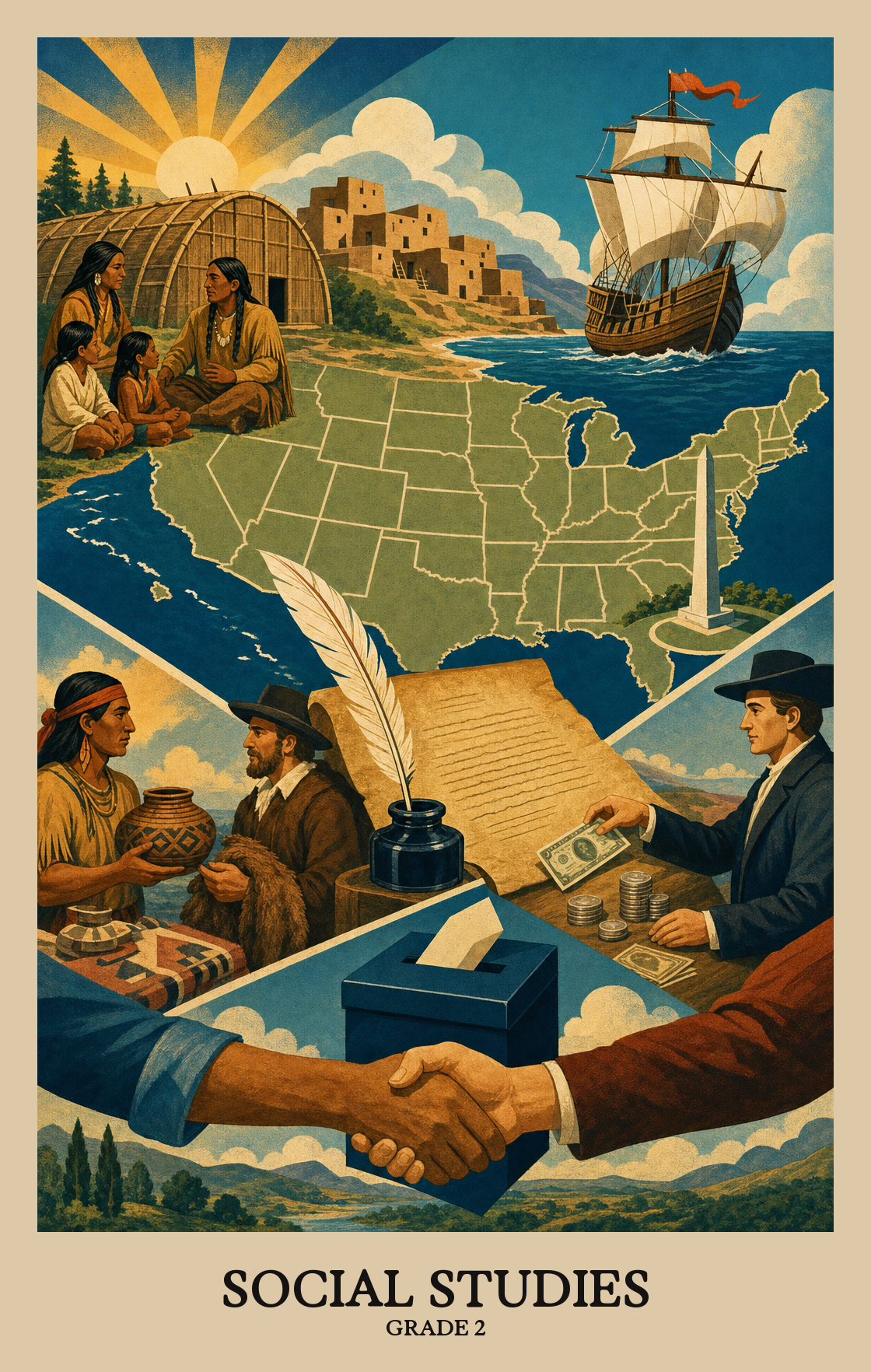
The student will apply history and social science skills to the content by
viewing and exploring information sources, including, but not limited to artifacts, primary and secondary sources, charts, graphs, and diagrams
applying geographic skills to identify and understand geographic features and connections
demonstrating curiosity and critical thinking through questioning and drawing conclusions
sequencing and organizing information
identifying similarities and differences to clarify and explain content
recognizing cause-and-effect relationships
using economic decision-making models to make informed economic decisions
practicing civility, respect, hard work, honesty, trustworthiness, and responsible citizenship skills
using content vocabulary to demonstrate comprehension
| Standard | Definition | Code |
|---|---|---|
| The student will apply history and social science skills to the content by | The student will apply history and social science skills to the content by | S.2 |
| viewing and exploring information sources, including | viewing and exploring information sources, including, but not limited to artifacts, primary and secondary sources, charts, graphs, and diagrams | S.2.a |
| applying geographic skills to identify and understand geographic features and… | applying geographic skills to identify and understand geographic features and connections | S.2.b |
| demonstrating curiosity and critical thinking through questioning and drawing… | demonstrating curiosity and critical thinking through questioning and drawing conclusions | S.2.c |
| sequencing and organizing information | sequencing and organizing information | S.2.d |
| identifying similarities and differences to clarify and explain content | identifying similarities and differences to clarify and explain content | S.2.e |
| recognizing cause-and-effect relationships | recognizing cause-and-effect relationships | S.2.f |
| using economic decision-making models to make informed economic decisions | using economic decision-making models to make informed economic decisions | S.2.g |
| practicing civility, respect, hard work, honesty, trustworthiness | practicing civility, respect, hard work, honesty, trustworthiness, and responsible citizenship skills | S.2.h |
| using content vocabulary to demonstrate comprehension | using content vocabulary to demonstrate comprehension | S.2.i |
The student will apply history and social science skills to distinguish between the rights and responsibilities that individuals have in the United States, including, but not limited to
exercising freedom of expression
exercising freedom of religion
understanding equal protection
voting for local, state, and national representatives
respecting and following laws
practicing honesty and trustworthiness
respecting the rights, beliefs, and opinions of others
The student will apply history and social science skills to understand citizenship by
identifying the benefits of being an American citizen
identifying the responsibilities of being an American citizen
The student will apply history and social science skills to explain how communities honor local and national traditions and recognize designated Virginia holidays, including but not limited to
Labor Day
Columbus Day (Yorktown Victory Day)
Election Day
Veterans Day
Thanksgiving Day;
Christmas Day
New Year’s Day
Martin Luther King, Jr. Day
George Washington Day (commonly known as Presidents’ Day)
Memorial Day
Juneteenth
Independence Day
The student will apply history and social science skills to recognize state and national symbols, including, but not limited to
locating the Virginia and United States capitals and Capitol buildings
explaining the meaning behind symbols, including, but not limited to the American flag, bald eagle, Washington Monument, Liberty Bell, and Statue of Liberty
learning about the meaning of the American flag and the words chosen in the Pledge of Allegiance and the National Anthem
| Standard | Definition | Code |
|---|---|---|
| The student will apply history and social science skills to distinguish between… | The student will apply history and social science skills to distinguish between the rights and responsibilities that individuals have in the United States, including, but not limited to | 2.1 |
| exercising freedom of expression | exercising freedom of expression | 2.1.a |
| exercising freedom of religion | exercising freedom of religion | 2.1.b |
| understanding equal protection | understanding equal protection | 2.1.c |
| voting for local, state | voting for local, state, and national representatives | 2.1.d |
| respecting and following laws | respecting and following laws | 2.1.e |
| practicing honesty and trustworthiness | practicing honesty and trustworthiness | 2.1.f |
| respecting the rights, beliefs | respecting the rights, beliefs, and opinions of others | 2.1.g |
| The student will apply history and social science skills to understand… | The student will apply history and social science skills to understand citizenship by | 2.2 |
| identifying the benefits of being an American citizen | identifying the benefits of being an American citizen | 2.2.a |
| identifying the responsibilities of being an American citizen | identifying the responsibilities of being an American citizen | 2.2.b |
| The student will apply history and social science skills to explain how… | The student will apply history and social science skills to explain how communities honor local and national traditions and recognize designated Virginia holidays, including but not limited to | 2.3 |
| Labor Day | Labor Day | 2.3.a |
| Columbus Day (Yorktown Victory Day) | Columbus Day (Yorktown Victory Day) | 2.3.b |
| Election Day | Election Day | 2.3.c |
| Veterans Day | Veterans Day | 2.3.d |
| Thanksgiving Day | Thanksgiving Day; | 2.3.e |
| Christmas Day | Christmas Day | 2.3.f |
| New Year’s Day | New Year’s Day | 2.3.g |
| Martin Luther King, Jr | Martin Luther King, Jr. Day | 2.3.h |
| George Washington Day | George Washington Day (commonly known as Presidents’ Day) | 2.3.i |
| Memorial Day | Memorial Day | 2.3.j |
| Juneteenth | Juneteenth | 2.3.k |
| Independence Day | Independence Day | 2.3.l |
| The student will apply history and social science skills to recognize state and… | The student will apply history and social science skills to recognize state and national symbols, including, but not limited to | 2.4 |
| locating the Virginia and United States capitals and Capitol buildings | locating the Virginia and United States capitals and Capitol buildings | 2.4.a |
| explaining the meaning behind symbols, including | explaining the meaning behind symbols, including, but not limited to the American flag, bald eagle, Washington Monument, Liberty Bell, and Statue of Liberty | 2.4.b |
| learning about the meaning of the American flag and the words chosen in the… | learning about the meaning of the American flag and the words chosen in the Pledge of Allegiance and the National Anthem | 2.4.c |
The student will use history and social science skills to identify the geographic location, use of resources, and contributions of Indigenous peoples past and present, including
Indigenous nations and tribes of the Eastern Woodlands
Indigenous nations and tribes of the Plains
Indigenous nations and tribes of the Southwest
understanding Tribal Sovereignty, including but not limited to the importance of land, history, and culture
The student will use history and social science skills to identify the geographic location, use of resources, and contributions of European explorers, and their influence on the development of North America, including, but not limited to the English, French, and Spanish
The student will apply history and social science skills to describe the revolutionaries who fought for America’s freedom (1764–1781), including, but not limited to
John Adams
Benjamin Franklin
Alexander Hamilton
Patrick Henry
Thomas Jefferson
James Madison (“Father of the Constitution”)
Paul Revere
George Washington (“Father of our Country”)
The student will apply history and social science skills to understand the principles of American democracy and relate them to the founding of the nation by
explaining the relationships between the colonies and Great Britain
identifying reasons for the settlement of the thirteen colonies
identifying key components of the Declaration of Independence
The student will apply history and social science skills to understand key events in United States history including, but not limited to
recognizing the reasons for moving the nation’s capital from Philadelphia to Washington, D.C., and the importance of the nation’s capital
describing the impact of the Louisiana Purchase on the westward expansion of the United States
The student will describe the contributions and roles of changemakers in United States history, including, but not limited to
Scholars and Inventors: Benjamin Franklin, Benjamin Banneker, Thomas Jefferson, George Washington Carver, Booker T. Washington, Orville and Wilbur Wright, Steve Jobs, Jonas Salk, Thomas Edison, Alexander Graham Bell, and Mary Jackson
Explorers and Adventurers: Meriwether Lewis, William Clark, and Sacagawea, Neil Armstrong, Amelia Earhart
Reformers and Champions: Abraham Lincoln, Theodore “Teddy” Roosevelt, Helen Keller, Thurgood Marshall, Rosa Parks, Jackie Robinson, Cesar Chavez, Dr. Martin Luther King, Jr., Sen. Daniel Inouye, John F. Kennedy, and Barack Obama
| Standard | Definition | Code |
|---|---|---|
| The student will use history and social science skills to identify the… | The student will use history and social science skills to identify the geographic location, use of resources, and contributions of Indigenous peoples past and present, including | 2.5 |
| Indigenous nations and tribes of the Eastern Woodlands | Indigenous nations and tribes of the Eastern Woodlands | 2.5.a |
| Indigenous nations and tribes of the Plains | Indigenous nations and tribes of the Plains | 2.5.b |
| Indigenous nations and tribes of the Southwest | Indigenous nations and tribes of the Southwest | 2.5.c |
| understanding Tribal Sovereignty, including but not limited to the importance… | understanding Tribal Sovereignty, including but not limited to the importance of land, history, and culture | 2.5.d |
| The student will use history and social science skills to identify the… | The student will use history and social science skills to identify the geographic location, use of resources, and contributions of European explorers, and their influence on the development of North America, including, but not limited to the English, French, and Spanish | 2.6 |
| The student will apply history and social science skills to describe the… | The student will apply history and social science skills to describe the revolutionaries who fought for America’s freedom (1764–1781), including, but not limited to | 2.7 |
| John Adams | John Adams | 2.7.a |
| Benjamin Franklin | Benjamin Franklin | 2.7.b |
| Alexander Hamilton | Alexander Hamilton | 2.7.c |
| Patrick Henry | Patrick Henry | 2.7.d |
| Thomas Jefferson | Thomas Jefferson | 2.7.e |
| James Madison (“Father of the Constitution”) | James Madison (“Father of the Constitution”) | 2.7.f |
| Paul Revere | Paul Revere | 2.7.g |
| George Washington (“Father of our Country”) | George Washington (“Father of our Country”) | 2.7.h |
| The student will apply history and social science skills to understand the… | The student will apply history and social science skills to understand the principles of American democracy and relate them to the founding of the nation by | 2.8 |
| explaining the relationships between the colonies and Great Britain | explaining the relationships between the colonies and Great Britain | 2.8.b |
| identifying reasons for the settlement of the thirteen colonies | identifying reasons for the settlement of the thirteen colonies | 2.8.a |
| identifying key components of the Declaration of Independence | identifying key components of the Declaration of Independence | 2.8.c |
| The student will apply history and social science skills to understand key… | The student will apply history and social science skills to understand key events in United States history including, but not limited to | 2.9 |
| recognizing the reasons for moving the nation’s capital from Philadelphia to… | recognizing the reasons for moving the nation’s capital from Philadelphia to Washington, D.C., and the importance of the nation’s capital | 2.9.a |
| describing the impact of the Louisiana Purchase on the westward expansion of… | describing the impact of the Louisiana Purchase on the westward expansion of the United States | 2.9.b |
| The student will describe the contributions and roles of changemakers in United… | The student will describe the contributions and roles of changemakers in United States history, including, but not limited to | 2.10 |
| Scholars and Inventors | Scholars and Inventors: Benjamin Franklin, Benjamin Banneker, Thomas Jefferson, George Washington Carver, Booker T. Washington, Orville and Wilbur Wright, Steve Jobs, Jonas Salk, Thomas Edison, Alexander Graham Bell, and Mary Jackson | 2.10.a |
| Explorers and Adventurers | Explorers and Adventurers: Meriwether Lewis, William Clark, and Sacagawea, Neil Armstrong, Amelia Earhart | 2.10.b |
| Reformers and Champions | Reformers and Champions: Abraham Lincoln, Theodore “Teddy” Roosevelt, Helen Keller, Thurgood Marshall, Rosa Parks, Jackie Robinson, Cesar Chavez, Dr. Martin Luther King, Jr., Sen. Daniel Inouye, John F. Kennedy, and Barack Obama | 2.10.c |
The student will apply history and social science skills to develop geographic mapping skills using world maps and globes by
locating the countries of North America and the bordering oceans
identifying major rivers, mountain ranges, lakes, and other physical features in the United States
The student will apply history and social science skills to connect geography to landmarks and historic events, including, but not limited to
Jefferson Memorial and Lincoln Memorial
Valley Forge and George Washington’s crossing of the Delaware River
Yellowstone National Park
| Standard | Definition | Code |
|---|---|---|
| The student will apply history and social science skills to develop geographic… | The student will apply history and social science skills to develop geographic mapping skills using world maps and globes by | 2.11 |
| locating the countries of North America and the bordering oceans | locating the countries of North America and the bordering oceans | 2.11.a |
| identifying major rivers, mountain ranges, lakes | identifying major rivers, mountain ranges, lakes, and other physical features in the United States | 2.11.b |
| The student will apply history and social science skills to connect geography… | The student will apply history and social science skills to connect geography to landmarks and historic events, including, but not limited to | 2.12 |
| Jefferson Memorial and Lincoln Memorial | Jefferson Memorial and Lincoln Memorial | 2.12.a |
| Valley Forge and George Washington’s crossing of the Delaware River | Valley Forge and George Washington’s crossing of the Delaware River | 2.12.b |
| Yellowstone National Park | Yellowstone National Park | 2.12.c |
The student will apply history and social science skills to understand basic economic principles by
identifying natural resources (e.g., water, soil, wood, coal), human resources (i.e., people at work), and capital resources (e.g., machines, tools, computers, buildings)
distinguishing between needs and wants
distinguishing between the use of barter and the use of money in the exchange for goods and services and describing how money makes trading easier than barter
explaining that scarcity (limited resources) requires people to make choices about producing and consuming goods and services
| Standard | Definition | Code |
|---|---|---|
| The student will apply history and social science skills to understand basic… | The student will apply history and social science skills to understand basic economic principles by | 2.13 |
| identifying natural resources | identifying natural resources (e.g., water, soil, wood, coal), human resources (i.e., people at work), and capital resources (e.g., machines, tools, computers, buildings) | 2.13.a |
| distinguishing between needs and wants | distinguishing between needs and wants | 2.13.b |
| distinguishing between the use of barter and the use of money in the exchange… | distinguishing between the use of barter and the use of money in the exchange for goods and services and describing how money makes trading easier than barter | 2.13.c |
| explaining that scarcity | explaining that scarcity (limited resources) requires people to make choices about producing and consuming goods and services | 2.13.d |