Earliest humans and first settlements
Students start with the deep past. They look at what tools, bones, and cave art reveal about early people, and how farming let groups stop moving and build the first villages.
This is the year world history zooms out to cover the whole map before 1500. Students trace how early people moved from hunting and farming to building the first cities, then study how ancient empires in Egypt, Greece, Rome, India, China, and the Americas rose and fell. They learn where the world's major religions began and how trade, war, and ideas carried them across continents. By spring, students can read a primary source, weigh it against another, and explain how geography shaped a civilization.
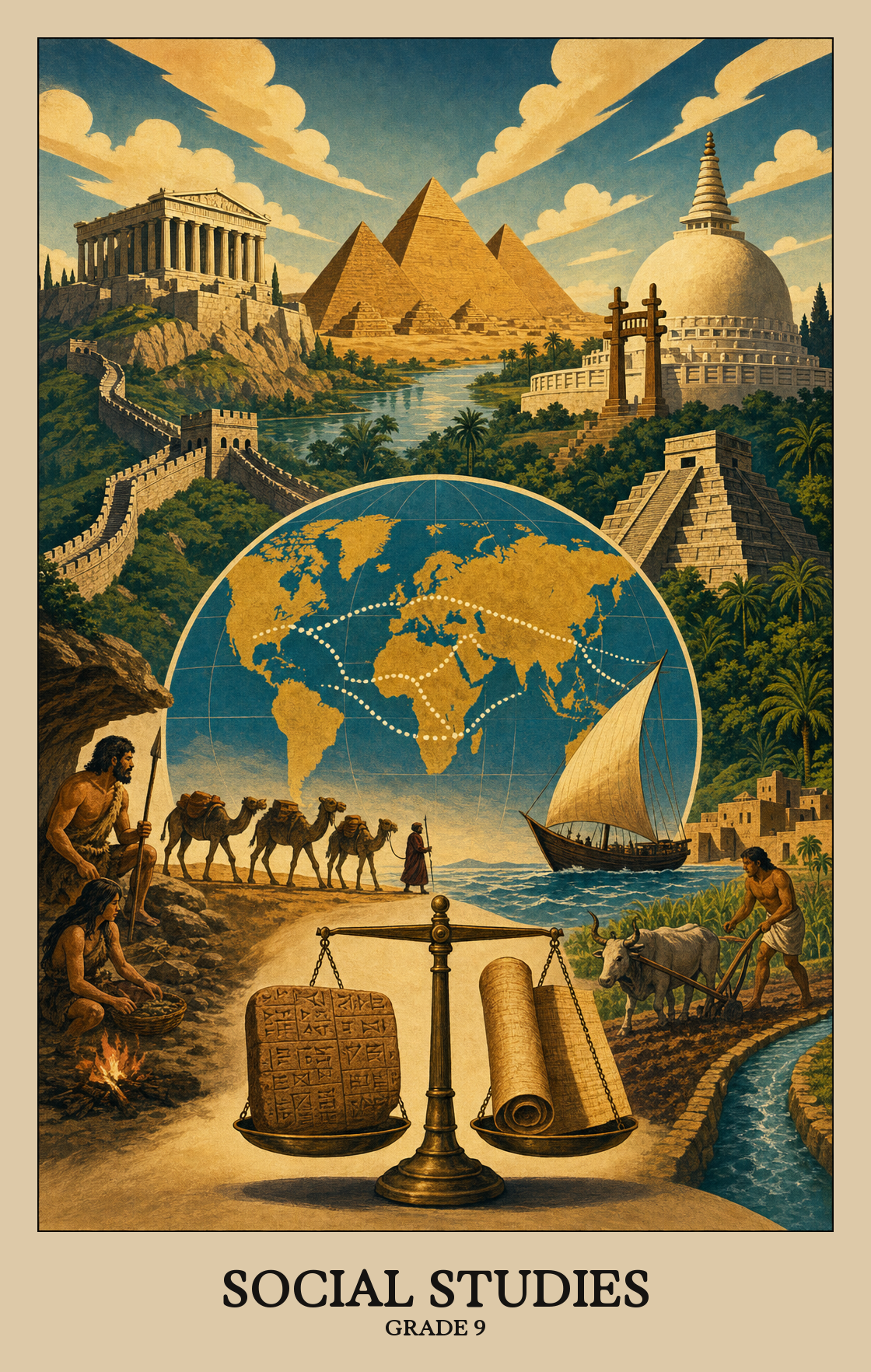
Students start with the deep past. They look at what tools, bones, and cave art reveal about early people, and how farming let groups stop moving and build the first villages.
Students study the early societies that grew along rivers in Egypt, Mesopotamia, India, and China. They look at writing, laws, trade, and the roots of Judaism, Hinduism, and Buddhism.
Students examine the rise of Persia, Greece, and Rome. They trace ideas like citizenship and democracy, the spread of Christianity, and why Roman law and art still shape life today.
Students follow the rise of Islam and the trade routes that connected Africa, Asia, and Europe. They study medieval China, Japan, the West African kingdoms of Ghana and Mali, and the Americas before contact.
Students look at feudalism, the manor, and the growth of towns after Rome fell. They study the Crusades, the Magna Carta, and the tug-of-war between kings and the Catholic church.
Students close the year with the Italian city-states and the rebirth of art, learning, and political thinking. They look at figures like Leonardo, Michelangelo, and Machiavelli and how their ideas set up the modern era.
Students use maps, timelines, primary sources, and other tools to investigate world history questions, build arguments from evidence, and connect past events to patterns they can explain in writing or discussion.
Students pull facts and details from sources like maps, photos, documents, and charts, then combine what they find to support a point about a world history event.
Reading a map or chart, students figure out why people settled, moved, or clashed in certain places, then use those patterns to predict what might happen next.
Students build an argument by pulling evidence from more than one source, then explaining how that evidence supports their point.
Students pull evidence from several sources, then build an argument or reach a conclusion based on what those sources show together. It is the work of comparing, weighing, and deciding what the evidence actually proves.
Students look at two or more groups, time periods, or ideas side by side and explain what they shared and where they differed. The comparison can cover beliefs, money, power, or daily life.
Students trace what caused a historical event and what happened as a result, then use those connections to explain why history unfolded the way it did.
Students pick a real historical decision (a trade route, a war, a crop) and map out what made it appealing, what it cost, and what happened next. The goal is to think like an economist, not just a historian.
Students practice listening to viewpoints they disagree with and responding thoughtfully. The goal is a real exchange of ideas, not just stating an opinion and stopping there.
Students pull together what they've researched and learned to create something that shows real understanding, like a written analysis, a visual, or a presentation.
Students compare two or more primary or secondary sources on the ancient world, checking who created each source and why, to spot bias or propaganda and decide which accounts to trust.
| Standard | Definition | Code |
|---|---|---|
| The student will apply history and social science skills to the content by | Students use maps, timelines, primary sources, and other tools to investigate world history questions, build arguments from evidence, and connect past events to patterns they can explain in writing or discussion. | S.WHI |
| selecting and synthesizing evidence from information sources, including | Students pull facts and details from sources like maps, photos, documents, and charts, then combine what they find to support a point about a world history event. | S.WHI.a |
| applying geographic skills to determine and predict patterns and trends of… | Reading a map or chart, students figure out why people settled, moved, or clashed in certain places, then use those patterns to predict what might happen next. | S.WHI.b |
| questioning to construct arguments, using evidence from multiple sources | Students build an argument by pulling evidence from more than one source, then explaining how that evidence supports their point. | S.WHI.c |
| investigating and analyzing evidence from multiple sources to construct… | Students pull evidence from several sources, then build an argument or reach a conclusion based on what those sources show together. It is the work of comparing, weighing, and deciding what the evidence actually proves. | S.WHI.d |
| comparing and contrasting historical, cultural, economic | Students look at two or more groups, time periods, or ideas side by side and explain what they shared and where they differed. The comparison can cover beliefs, money, power, or daily life. | S.WHI.e |
| determining cause and effect to analyze connections | Students trace what caused a historical event and what happened as a result, then use those connections to explain why history unfolded the way it did. | S.WHI.f |
| using economic decision-making models to analyze and explain the incentives for… | Students pick a real historical decision (a trade route, a war, a crop) and map out what made it appealing, what it cost, and what happened next. The goal is to think like an economist, not just a historian. | S.WHI.g |
| engaging and communicating as a civil and informed individual with… | Students practice listening to viewpoints they disagree with and responding thoughtfully. The goal is a real exchange of ideas, not just stating an opinion and stopping there. | S.WHI.h |
| developing products that reflect an understanding of research and content | Students pull together what they've researched and learned to create something that shows real understanding, like a written analysis, a visual, or a presentation. | S.WHI.i |
| contextualizing and corroborating sources to evaluate sources for… | Students compare two or more primary or secondary sources on the ancient world, checking who created each source and why, to spot bias or propaganda and decide which accounts to trust. | S.WHI.j |
Early humans lived as hunters and gatherers for hundreds of thousands of years. This standard covers how people gradually shifted to farming and settled communities, one of the biggest turning points in human history.
Archaeological evidence means the objects, bones, and tools scientists dig up to learn about the past. Students study the oldest known human remains and artifacts to figure out where early humans first lived and how they spread across the world.
Geography shaped where early humans could survive. Students explain how rivers, climate, and land features pushed hunter-gatherer groups to move, settle, or search for food in new places.
Hunter-gatherer societies survived by following animal herds and gathering wild plants rather than farming. Students describe how early humans used simple stone tools and fire to hunt, cook food, and stay warm.
Early humans stopped moving from place to place once they learned to farm and keep animals. Students trace how those skills, along with new tools and social rules, led people to build the first permanent villages.
When archaeologists dig up old tools, bones, or buildings, they sometimes rewrite what we thought we knew about early humans. Students look at real discoveries and explain how new evidence shifts our picture of ancient life.
| Standard | Definition | Code |
|---|---|---|
| The student will apply history and social science skills to describe the period… | Early humans lived as hunters and gatherers for hundreds of thousands of years. This standard covers how people gradually shifted to farming and settled communities, one of the biggest turning points in human history. | WHI.1 |
| describing the archaeological evidence of the first human and their geographic… | Archaeological evidence means the objects, bones, and tools scientists dig up to learn about the past. Students study the oldest known human remains and artifacts to figure out where early humans first lived and how they spread across the world. | WHI.1.a |
| explaining the effect that geography had on the emergence and migration of… | Geography shaped where early humans could survive. Students explain how rivers, climate, and land features pushed hunter-gatherer groups to move, settle, or search for food in new places. | WHI.1.b |
| describing characteristics of hunter-gatherer societies, including their use of… | Hunter-gatherer societies survived by following animal herds and gathering wild plants rather than farming. Students describe how early humans used simple stone tools and fire to hunt, cook food, and stay warm. | WHI.1.c |
| analyzing how technological and social developments gave rise to sedentary… | Early humans stopped moving from place to place once they learned to farm and keep animals. Students trace how those skills, along with new tools and social rules, led people to build the first permanent villages. | WHI.1.d |
| analyzing how archaeological discoveries change current understanding of early… | When archaeologists dig up old tools, bones, or buildings, they sometimes rewrite what we thought we knew about early humans. Students look at real discoveries and explain how new evidence shifts our picture of ancient life. | WHI.1.e |
Students study the first farming villages and city-states that grew up between the Tigris and Euphrates rivers. They look at how those early societies organized their governments, traded goods, and recorded laws and stories in writing.
Students locate Egypt and Nubia on a map and explain how those civilizations grew along the Nile, including how geography, trade, and culture shaped daily life and government in each region.
Students trace how the first major cities and governments grew up between the Tigris and Euphrates rivers, in the region now called Iraq. They learn why that geography made it possible for farming, trade, and complex societies to take root there first.
Students trace how the Israelite people formed as a group, what beliefs and practices shaped Judaism, and how persecution pushed Jewish communities to spread across different regions.
Students learn how the Phoenicians built a trading network across the Mediterranean, invented an alphabet that most modern alphabets descend from, and spread their culture through commerce rather than conquest.
Students trace how early civilizations in Asia built governments, organized societies, and exchanged goods with neighboring peoples. The focus is on how those choices shaped daily life across ancient China, India, and surrounding regions.
Ancient India and China grew where they did because of rivers, mountains, and coastlines. Students identify those key features on a map and explain how the land shaped where people settled, what they grew, and how their societies took root.
Students examine how ancient Indian society was organized, including the caste system that sorted people by birth into groups with different roles, rights, and occupations. They also look at cultural and political life in early India.
Students trace how Hinduism began in ancient India, what its core beliefs and practices looked like, and how the religion spread across Asia over time.
Students trace how Buddhism began in ancient India, what its core teachings say about suffering and the path to peace, and how the religion spread across Asia over centuries.
Ancient China's rise as a civilization covers how its people organized society, built governments, developed trade, and created lasting art and ideas. Students trace those changes across dynasties to explain how China became one of the ancient world's most influential cultures.
Students learn how three major Chinese philosophies shaped ancient societies. Confucianism stressed duty and family, Taoism focused on harmony with nature, and Legalism relied on strict laws and punishment to keep order.
Students study how ancient Persia and Greece built their governments, fought their wars, and shaped the ideas that later spread across Europe and the Middle East.
Students trace how mountains, seas, and coastal terrain shaped the way Persian and Greek societies built cities, traded goods, and fought wars. Geography was not just a backdrop; it drove nearly every major decision these civilizations made.
Ancient Persia was a vast empire with a complex society. Students examine how Persians organized their government, traded goods, treated conquered peoples, and built a culture that stretched from Egypt to India.
Students study how ancient Greece developed city-states with distinct ways of life, focusing on how Athens and Sparta shaped government, citizenship, and early forms of democratic rule.
Students examine why the Persian Wars and the Peloponnesian War started, then trace what each conflict changed about power, politics, and daily life across the ancient Mediterranean world.
Students examine how Alexander the Great's military campaigns spread Greek language, art, and ideas across a vast stretch of land from Egypt to Central Asia, creating a blended culture that outlasted his empire.
Students trace how ancient Greek ideas in science, philosophy, and the arts shaped the world we live in now, from how buildings look to how we reason through problems.
Rome built an empire that shaped law, language, and government across Europe. Students trace how that empire split, how the eastern half survived as Byzantium for another thousand years, and what both left behind.
Rome's location on the Tiber River and central Mediterranean coastline helped it grow into an empire. Students explain how mountains, rivers, and sea routes shaped Roman expansion, and what eventually made such a vast territory hard to hold together.
Students compare how Rome changed when it shifted from a republic, where elected leaders shared power, to an empire ruled by one person. They look at how that shift reshaped who held authority, how society was organized, and how religion fit into public life.
Students learn how the Byzantine Empire grew out of Rome's split, including why Constantinople became the new center of power and how Byzantine society, trade, and government took shape over time.
Students trace how Christianity began, spread across three continents, and split into two branches. They also look at early persecution, the Roman Empire's adoption of the faith, and how Christian beliefs shaped laws, culture, and daily life from Europe to North Africa.
Students trace how Roman ideas, including citizenship laws, engineering, and philosophy, shaped the societies that came after Rome fell. The goal is understanding which Roman practices survived and why they still matter.
Students trace how Islamic civilization grew from the Arabian Peninsula into a wide-reaching empire, examining its religious foundations, trade networks, scientific advances, and legal traditions.
The Arabian Peninsula has a harsh desert climate that shaped how people lived. Students study how geography, water sources, and land pushed some groups to settle in towns while others moved constantly in search of resources.
Students learn how Islam began, what Muslims believe, and how the faith spread across the Middle East, Africa, and beyond despite early conflict and persecution.
Students learn what the Qur'an and the Sunnah are and why they matter to Muslims. These two texts shape Islamic prayer, law, and daily habits, from how people eat and dress to how communities settle disputes.
Students trace how Muslim rule spread across parts of Africa, Europe, and Asia, and how people in those regions adopted the Arabic language and Islamic faith over time.
Muslim merchants built trade networks stretching from Asia to Africa and Europe. Students learn which goods moved along those routes, including spices, textiles, paper, and steel, and how that commerce shaped city growth across the Islamic world.
| Standard | Definition | Code |
|---|---|---|
| The student will apply history and social science skills to describe early… | Students study the first farming villages and city-states that grew up between the Tigris and Euphrates rivers. They look at how those early societies organized their governments, traded goods, and recorded laws and stories in writing. | WHI.2 |
| locating and explaining the development of Egypt and Nubia | Students locate Egypt and Nubia on a map and explain how those civilizations grew along the Nile, including how geography, trade, and culture shaped daily life and government in each region. | WHI.2.a |
| locating and explaining the development of Mesopotamia | Students trace how the first major cities and governments grew up between the Tigris and Euphrates rivers, in the region now called Iraq. They learn why that geography made it possible for farming, trade, and complex societies to take root there first. | WHI.2.b |
| describing the development of the Israelites and the origins, beliefs… | Students trace how the Israelite people formed as a group, what beliefs and practices shaped Judaism, and how persecution pushed Jewish communities to spread across different regions. | WHI.2.c |
| describing the development of the Phoenicians | Students learn how the Phoenicians built a trading network across the Mediterranean, invented an alphabet that most modern alphabets descend from, and spread their culture through commerce rather than conquest. | WHI.2.d |
| The students will apply history and social science skills to describe ancient… | Students trace how early civilizations in Asia built governments, organized societies, and exchanged goods with neighboring peoples. The focus is on how those choices shaped daily life across ancient China, India, and surrounding regions. | WHI.3 |
| analyzing the impact of geography on the development of ancient India and… | Ancient India and China grew where they did because of rivers, mountains, and coastlines. Students identify those key features on a map and explain how the land shaped where people settled, what they grew, and how their societies took root. | WHI.3.a |
| describing the social, cultural, political | Students examine how ancient Indian society was organized, including the caste system that sorted people by birth into groups with different roles, rights, and occupations. They also look at cultural and political life in early India. | WHI.3.b |
| describing the origins, beliefs, customs | Students trace how Hinduism began in ancient India, what its core beliefs and practices looked like, and how the religion spread across Asia over time. | WHI.3.c |
| describing the origins, beliefs, customs | Students trace how Buddhism began in ancient India, what its core teachings say about suffering and the path to peace, and how the religion spread across Asia over centuries. | WHI.3.d |
| describing the social, cultural, political | Ancient China's rise as a civilization covers how its people organized society, built governments, developed trade, and created lasting art and ideas. Students trace those changes across dynasties to explain how China became one of the ancient world's most influential cultures. | WHI.3.e |
| describing the influence of Confucianism, Taoism | Students learn how three major Chinese philosophies shaped ancient societies. Confucianism stressed duty and family, Taoism focused on harmony with nature, and Legalism relied on strict laws and punishment to keep order. | WHI.3.f |
| The student will apply history and social science skills to understand Persia… | Students study how ancient Persia and Greece built their governments, fought their wars, and shaped the ideas that later spread across Europe and the Middle East. | WHI.4 |
| describing the major geographic features of the region and analyzing the effect… | Students trace how mountains, seas, and coastal terrain shaped the way Persian and Greek societies built cities, traded goods, and fought wars. Geography was not just a backdrop; it drove nearly every major decision these civilizations made. | WHI.4.a |
| describing the social, cultural, political | Ancient Persia was a vast empire with a complex society. Students examine how Persians organized their government, traded goods, treated conquered peoples, and built a culture that stretched from Egypt to India. | WHI.4.b |
| describing the social, cultural, political | Students study how ancient Greece developed city-states with distinct ways of life, focusing on how Athens and Sparta shaped government, citizenship, and early forms of democratic rule. | WHI.4.c |
| evaluating the causes and consequences of the Persian and Peloponnesian wars | Students examine why the Persian Wars and the Peloponnesian War started, then trace what each conflict changed about power, politics, and daily life across the ancient Mediterranean world. | WHI.4.d |
| evaluating the significance of Alexander the Great’s conquest of Greece and the… | Students examine how Alexander the Great's military campaigns spread Greek language, art, and ideas across a vast stretch of land from Egypt to Central Asia, creating a blended culture that outlasted his empire. | WHI.4.e |
| explaining the influence of ancient Greek contributions, including | Students trace how ancient Greek ideas in science, philosophy, and the arts shaped the world we live in now, from how buildings look to how we reason through problems. | WHI.4.f |
| The student will apply history and social science skills to understand Rome and… | Rome built an empire that shaped law, language, and government across Europe. Students trace how that empire split, how the eastern half survived as Byzantium for another thousand years, and what both left behind. | WHI.5 |
| describing the influence of geography on Rome’s development and the factors… | Rome's location on the Tiber River and central Mediterranean coastline helped it grow into an empire. Students explain how mountains, rivers, and sea routes shaped Roman expansion, and what eventually made such a vast territory hard to hold together. | WHI.5.a |
| comparing and contrasting the political, social | Students compare how Rome changed when it shifted from a republic, where elected leaders shared power, to an empire ruled by one person. They look at how that shift reshaped who held authority, how society was organized, and how religion fit into public life. | WHI.5.b |
| describing the social, cultural, political | Students learn how the Byzantine Empire grew out of Rome's split, including why Constantinople became the new center of power and how Byzantine society, trade, and government took shape over time. | WHI.5.c |
| describing the origins, beliefs, customs | Students trace how Christianity began, spread across three continents, and split into two branches. They also look at early persecution, the Roman Empire's adoption of the faith, and how Christian beliefs shaped laws, culture, and daily life from Europe to North Africa. | WHI.5.d |
| explaining the influence of Rome, including | Students trace how Roman ideas, including citizenship laws, engineering, and philosophy, shaped the societies that came after Rome fell. The goal is understanding which Roman practices survived and why they still matter. | WHI.5.e |
| The student will apply history and social science skills to understand Islamic… | Students trace how Islamic civilization grew from the Arabian Peninsula into a wide-reaching empire, examining its religious foundations, trade networks, scientific advances, and legal traditions. | WHI.6 |
| identifying the physical features and describing the relationship between… | The Arabian Peninsula has a harsh desert climate that shaped how people lived. Students study how geography, water sources, and land pushed some groups to settle in towns while others moved constantly in search of resources. | WHI.6.a |
| describing the origins, beliefs, traditions, customs, persecution | Students learn how Islam began, what Muslims believe, and how the faith spread across the Middle East, Africa, and beyond despite early conflict and persecution. | WHI.6.b |
| explaining the significance of the Qur’an and the Sunnah as the primary sources… | Students learn what the Qur'an and the Sunnah are and why they matter to Muslims. These two texts shape Islamic prayer, law, and daily habits, from how people eat and dress to how communities settle disputes. | WHI.6.c |
| describing the expansion of territory under Muslim rule, the spread of Islam… | Students trace how Muslim rule spread across parts of Africa, Europe, and Asia, and how people in those regions adopted the Arabic language and Islamic faith over time. | WHI.6.d |
| describing the growth of cities and the role of merchants in Muslim society and… | Muslim merchants built trade networks stretching from Asia to Africa and Europe. Students learn which goods moved along those routes, including spices, textiles, paper, and steel, and how that commerce shaped city growth across the Islamic world. | WHI.6.e |
Students trace how Chinese civilization developed during the Middle Ages, looking at its government, trade, inventions, and contact with the wider world.
Students learn how China came back together under the Tang Dynasty and why Buddhism spread from China into Korea and Japan during that period.
Students learn how farmers, inventors, and traders in Tang and Sung dynasty China improved crop yields, developed new tools, and expanded trade networks. These changes made China one of the wealthiest and most productive societies of the medieval world.
Students examine how Confucianism shaped government, family life, and education in medieval China, then trace how scholars rethought those ideas during the Sung and Mongol periods.
Overland and sea trade connected China to distant civilizations during the Mongol and Ming eras. Students explain how those routes moved goods, ideas, and influence across Asia and beyond.
Students learn how Chinese inventions like the compass, gunpowder, and woodblock printing spread across the world and changed how people traveled, fought wars, and shared written ideas.
Students learn how China built a centralized government run by educated officials who passed rigorous written exams to earn their positions, rather than inheriting power through family connections.
Sub-Saharan kingdoms like Ghana and Mali built powerful trading empires in medieval Africa. Students examine how these civilizations grew wealthy, how they were governed, and what daily life looked like across the region.
Students learn how the Niger River and the surrounding land, from forests to grasslands to desert, shaped what people traded and where cities grew in the empires of Ghana and Mali.
Family ties, skilled trades, and local trade networks helped West African communities grow into organized towns and states. Students examine how those forces shaped the kingdoms of Ghana and Mali.
Caravans crossing the Sahara brought more than gold and salt. Students explain how that trade spread Islam into West Africa and shifted the religious and cultural life of kingdoms like Ghana and Mali.
Arabic spread across Ghana and Mali as rulers used it for laws and record-keeping, merchants used it in trade, and Islamic scholars brought it into religious life.
Stories, songs, and written records kept African history alive across generations. Students examine how griots and other storytellers passed down laws, genealogies, and cultural knowledge in Ghana and Mali before and during the Middle Ages.
Medieval Japan covers the rise of the samurai class, the shogunate system of military rule, and the cultural and religious traditions that shaped Japanese society between roughly 800 and 1600 CE.
Japan borrowed heavily from China and Korea, adopting elements of written language, Buddhism, and government structure. Students explain how that geography shaped Japanese culture during the medieval period.
Students learn about Prince Shotoku, who ruled Japan around 600 AD and introduced a new legal code and Buddhist ideas. They also look at how families and daily life were organized in Japan during his reign.
Students learn how the samurai code of loyalty and honor shaped daily life under Japan's feudal lords and generals, and how that same warrior ethic resurfaced in Japanese society and military culture a thousand years later.
Students trace how Buddhism spread from mainland Asia into Japan and changed over time, taking on local rituals, beliefs, and temple traditions that made Japanese Buddhism distinct from its origins.
Japan's Heian period produced some of the world's earliest novels, refined poetry, and theatrical traditions. Students examine how that creative burst, including Murasaki Shikibu's Tale of Genji, shaped Japanese culture in ways still visible today.
Students trace how Japan shifted from imperial court rule to military government around the 1180s, and what samurai warriors actually did, who they served, and how their code shaped daily life and power.
Medieval Europe covers roughly 500 to 1500 AD. Students examine how the Catholic Church, feudal kingdoms, and trade shaped daily life, government, and culture across Europe during those thousand years.
Students read maps of Europe and Eurasia to see how mountains, rivers, forests, and climate shaped where people settled and how they farmed, traded, and defended themselves in the Middle Ages.
Christianity spread across northern Europe after Rome fell. Students examine how the early church and monasteries carried that expansion, teaching, preserving knowledge, and building communities in regions that had no formal Roman presence.
Feudalism was medieval Europe's organizing system: kings granted land to nobles, who granted land to knights, who protected the peasants farming it. The manor, a lord's estate, was where most people lived, worked, and owed loyalty to whoever owned the land.
Towns grew larger and trade routes expanded as Europe slowly moved away from a system where most people were tied to the land. Students explain what drove that shift and what everyday life in a medieval town looked like.
Popes and kings clashed repeatedly over who held real authority in medieval Europe. Students examine those power struggles, tracing how religious and royal leaders negotiated, fought, and sometimes struck deals that shaped governments for centuries.
Students learn how medieval England began limiting royal power through documents like the Magna Carta, which established that even kings had to follow the law. These early legal ideas, including the right to a fair trial, shaped how modern governments protect individual rights.
Students examine why the Christian Church split into two branches in 1054, looking at the political rivalries and religious disagreements between church leaders in Rome and Constantinople that made reunion impossible.
Students trace why Christian rulers launched the Crusades, what happened during the campaigns, and how the wars reshaped daily life and land control for Christians, Muslims, and Jews across Europe and the Middle East.
Students trace how Christian kingdoms gradually pushed Muslim rulers out of Spain and Portugal, eventually taking control of the entire Iberian Peninsula and laying the groundwork for the Spanish and Portuguese kingdoms that would later build global empires.
The Catholic Church in medieval Europe was not just a religious institution. Students examine how it ran schools, preserved ancient texts, shaped philosophy, and held political power that rivaled kings.
Students examine the major civilizations of ancient Mexico and South America, including their governments, religions, and daily life, to understand how complex societies developed independently in the Western Hemisphere.
Students examine how the geography of Mexico, Central America, and South America shaped daily life for the Maya, Aztec, and Inca. Mountains, rainforests, and coastlines influenced what people grew, traded, and where they built their cities.
Students trace where the Aztec and Incan empires rose to power and explain how Spanish conquistadors defeated both within decades, using a mix of military force, alliances with rival groups, and disease.
Students examine the art, buildings, and storytelling traditions of the Maya, Aztec, and Inca, looking at how each civilization expressed its beliefs and history through what it built and passed down by word of mouth.
Meso-American civilizations built detailed calendars and tracked the seasons with enough precision to plan when to plant and harvest crops. Students explain how those advances in astronomy and math shaped daily agricultural life.
Students examine how Meso-American and Andean societies were organized, looking at who held power, how families lived, how wars were fought, and what religious practices shaped daily life.
| Standard | Definition | Code |
|---|---|---|
| The student will apply history and social science skills to understand the… | Students trace how Chinese civilization developed during the Middle Ages, looking at its government, trade, inventions, and contact with the wider world. | WHI.7 |
| describing the reunification of China under the Tang Dynasty and reasons for… | Students learn how China came back together under the Tang Dynasty and why Buddhism spread from China into Korea and Japan during that period. | WHI.7.a |
| describing agricultural, technological | Students learn how farmers, inventors, and traders in Tang and Sung dynasty China improved crop yields, developed new tools, and expanded trade networks. These changes made China one of the wealthiest and most productive societies of the medieval world. | WHI.7.b |
| analyzing the influences of Confucianism and changes in Confucian thought… | Students examine how Confucianism shaped government, family life, and education in medieval China, then trace how scholars rethought those ideas during the Sung and Mongol periods. | WHI.7.c |
| explaining the importance of overland trade and maritime expeditions between… | Overland and sea trade connected China to distant civilizations during the Mongol and Ming eras. Students explain how those routes moved goods, ideas, and influence across Asia and beyond. | WHI.7.d |
| tracing the historic influence of the tea trade, the manufacture of paper… | Students learn how Chinese inventions like the compass, gunpowder, and woodblock printing spread across the world and changed how people traveled, fought wars, and shared written ideas. | WHI.7.e |
| describing the development of the imperial state and the scholar-official class | Students learn how China built a centralized government run by educated officials who passed rigorous written exams to earn their positions, rather than inheriting power through family connections. | WHI.7.f |
| The student will apply history and social science skills to describe the… | Sub-Saharan kingdoms like Ghana and Mali built powerful trading empires in medieval Africa. Students examine how these civilizations grew wealthy, how they were governed, and what daily life looked like across the region. | WHI.8 |
| describing the Niger River and the relationship of vegetation zones of forest… | Students learn how the Niger River and the surrounding land, from forests to grasslands to desert, shaped what people traded and where cities grew in the empires of Ghana and Mali. | WHI.8.a |
| analyzing the importance of family, labor specialization | Family ties, skilled trades, and local trade networks helped West African communities grow into organized towns and states. Students examine how those forces shaped the kingdoms of Ghana and Mali. | WHI.8.b |
| describing the role of the trans-Saharan caravan trade in the changing… | Caravans crossing the Sahara brought more than gold and salt. Students explain how that trade spread Islam into West Africa and shifted the religious and cultural life of kingdoms like Ghana and Mali. | WHI.8.c |
| tracing the growth of the Arabic language in government, trade | Arabic spread across Ghana and Mali as rulers used it for laws and record-keeping, merchants used it in trade, and Islamic scholars brought it into religious life. | WHI.8.d |
| describing the importance of written and oral traditions in the transmission of… | Stories, songs, and written records kept African history alive across generations. Students examine how griots and other storytellers passed down laws, genealogies, and cultural knowledge in Ghana and Mali before and during the Middle Ages. | WHI.8.e |
| The student will apply history and social science skills to understand the… | Medieval Japan covers the rise of the samurai class, the shogunate system of military rule, and the cultural and religious traditions that shaped Japanese society between roughly 800 and 1600 CE. | WHI.9 |
| describing the significance of Japan’s proximity to China and Korea and the… | Japan borrowed heavily from China and Korea, adopting elements of written language, Buddhism, and government structure. Students explain how that geography shaped Japanese culture during the medieval period. | WHI.9.a |
| discussing the reign of Prince Shotoku of Japan and the characteristics of… | Students learn about Prince Shotoku, who ruled Japan around 600 AD and introduced a new legal code and Buddhist ideas. They also look at how families and daily life were organized in Japan during his reign. | WHI.9.b |
| describing the values, social customs | Students learn how the samurai code of loyalty and honor shaped daily life under Japan's feudal lords and generals, and how that same warrior ethic resurfaced in Japanese society and military culture a thousand years later. | WHI.9.c |
| tracing the development of distinctive forms of Japanese Buddhism | Students trace how Buddhism spread from mainland Asia into Japan and changed over time, taking on local rituals, beliefs, and temple traditions that made Japanese Buddhism distinct from its origins. | WHI.9.d |
| examining the ninth and tenth centuries’ golden age of literature, art | Japan's Heian period produced some of the world's earliest novels, refined poetry, and theatrical traditions. Students examine how that creative burst, including Murasaki Shikibu's Tale of Genji, shaped Japanese culture in ways still visible today. | WHI.9.e |
| analyzing the rise of a military society in the late 12th century and the role… | Students trace how Japan shifted from imperial court rule to military government around the 1180s, and what samurai warriors actually did, who they served, and how their code shaped daily life and power. | WHI.9.f |
| The student will apply history and social science skills to understand the… | Medieval Europe covers roughly 500 to 1500 AD. Students examine how the Catholic Church, feudal kingdoms, and trade shaped daily life, government, and culture across Europe during those thousand years. | WHI.10 |
| describing the geography of the European and Eurasian landmass, including… | Students read maps of Europe and Eurasia to see how mountains, rivers, forests, and climate shaped where people settled and how they farmed, traded, and defended themselves in the Middle Ages. | WHI.10.a |
| describing the spread of Christianity north of the Alps and the roles played by… | Christianity spread across northern Europe after Rome fell. Students examine how the early church and monasteries carried that expansion, teaching, preserving knowledge, and building communities in regions that had no formal Roman presence. | WHI.10.b |
| explaining the development and role of feudalism in the medieval European… | Feudalism was medieval Europe's organizing system: kings granted land to nobles, who granted land to knights, who protected the peasants farming it. The manor, a lord's estate, was where most people lived, worked, and owed loyalty to whoever owned the land. | WHI.10.c |
| describing the growth of towns and trade as Europe emerged from feudalism | Towns grew larger and trade routes expanded as Europe slowly moved away from a system where most people were tied to the land. Students explain what drove that shift and what everyday life in a medieval town looked like. | WHI.10.d |
| The student will apply history and social science skills to analyze the… | Popes and kings clashed repeatedly over who held real authority in medieval Europe. Students examine those power struggles, tracing how religious and royal leaders negotiated, fought, and sometimes struck deals that shaped governments for centuries. | WHI.11 |
| explaining the significance of developments in medieval English legal and… | Students learn how medieval England began limiting royal power through documents like the Magna Carta, which established that even kings had to follow the law. These early legal ideas, including the right to a fair trial, shaped how modern governments protect individual rights. | WHI.11.a |
| analyzing the reasons for the Great Schism in 1054 | Students examine why the Christian Church split into two branches in 1054, looking at the political rivalries and religious disagreements between church leaders in Rome and Constantinople that made reunion impossible. | WHI.11.b |
| tracing the causes and course of the Crusades and the effects on the Christian… | Students trace why Christian rulers launched the Crusades, what happened during the campaigns, and how the wars reshaped daily life and land control for Christians, Muslims, and Jews across Europe and the Middle East. | WHI.11.c |
| describing the decline of Muslim rule in the Iberian Peninsula that resulted in… | Students trace how Christian kingdoms gradually pushed Muslim rulers out of Spain and Portugal, eventually taking control of the entire Iberian Peninsula and laying the groundwork for the Spanish and Portuguese kingdoms that would later build global empires. | WHI.11.d |
| explaining the importance of the Catholic church as a political and… | The Catholic Church in medieval Europe was not just a religious institution. Students examine how it ran schools, preserved ancient texts, shaped philosophy, and held political power that rivaled kings. | WHI.11.e |
| The student will apply history and social science skills to understand the… | Students examine the major civilizations of ancient Mexico and South America, including their governments, religions, and daily life, to understand how complex societies developed independently in the Western Hemisphere. | WHI.12 |
| describing the locations, landforms | Students examine how the geography of Mexico, Central America, and South America shaped daily life for the Maya, Aztec, and Inca. Mountains, rainforests, and coastlines influenced what people grew, traded, and where they built their cities. | WHI.12.a |
| explaining how and where each empire arose and how the Aztec and Incan empires… | Students trace where the Aztec and Incan empires rose to power and explain how Spanish conquistadors defeated both within decades, using a mix of military force, alliances with rival groups, and disease. | WHI.12.b |
| describing the artistic and oral traditions and architecture in the three… | Students examine the art, buildings, and storytelling traditions of the Maya, Aztec, and Inca, looking at how each civilization expressed its beliefs and history through what it built and passed down by word of mouth. | WHI.12.c |
| describing the Meso-American achievements in astronomy and mathematics… | Meso-American civilizations built detailed calendars and tracked the seasons with enough precision to plan when to plant and harvest crops. Students explain how those advances in astronomy and math shaped daily agricultural life. | WHI.12.d |
| examining the roles of people in each society, including class structures… | Students examine how Meso-American and Andean societies were organized, looking at who held power, how families lived, how wars were fought, and what religious practices shaped daily life. | WHI.12.e |
Scholars in Italy began questioning old ideas and looking back to ancient Greek and Roman thinkers. This shift in thinking sparked new art, writing, and science across Europe and marks the start of the Renaissance.
Italian merchants and city-states grew rich from trade, which gave thinkers and artists the money and freedom to experiment with new ideas. Students examine how that wealth, along with ancient Greek and Roman ideas, sparked the Renaissance in Italy.
Italian city-states like Florence and Venice grew into powerful centers of trade and politics. Students put those events in order and explore Machiavelli's idea that rulers should be practical and tough, not just good.
Students examine what specific artists and thinkers from Renaissance Italy actually made or argued. The focus is on Leonardo da Vinci, Michelangelo, and Petrarch and why their work still matters.
| Standard | Definition | Code |
|---|---|---|
| The student will apply history and social science skills to understand the… | Scholars in Italy began questioning old ideas and looking back to ancient Greek and Roman thinkers. This shift in thinking sparked new art, writing, and science across Europe and marks the start of the Renaissance. | WHI.13 |
| determining the economic, political, philosophical | Italian merchants and city-states grew rich from trade, which gave thinkers and artists the money and freedom to experiment with new ideas. Students examine how that wealth, along with ancient Greek and Roman ideas, sparked the Renaissance in Italy. | WHI.13.a |
| sequencing events related to the rise of Italian city-states and their… | Italian city-states like Florence and Venice grew into powerful centers of trade and politics. Students put those events in order and explore Machiavelli's idea that rulers should be practical and tough, not just good. | WHI.13.b |
| analyzing the contributions of artists and philosophers of the Italian… | Students examine what specific artists and thinkers from Renaissance Italy actually made or argued. The focus is on Leonardo da Vinci, Michelangelo, and Petrarch and why their work still matters. | WHI.13.c |
High school end-of-course history and social science assessments, including World History, World Geography, and Virginia and U.S. History.
Students travel from the earliest humans through the Renaissance, stopping in places like Egypt, Greece, Rome, China, West Africa, Japan, the Americas, and medieval Europe. The focus is on how geography, religion, trade, and government shaped each society and how those societies influenced each other.
Keep a running list on the fridge with three columns: where, when, and one thing they are known for. Add a row after each unit. A simple world map printout where students mark each civilization also helps a lot in about ten minutes a week.
Most teachers spend the first quarter on early humans through the Fertile Crescent and ancient Asia, the second on Greece and Rome, the third on Islamic societies and the medieval world, and the fourth on the Americas and the lead-in to the Renaissance. Build in a week of slack before winter and spring break.
Religion shaped law, government, trade, and daily life in almost every society studied this year. Students are not asked to practice any religion, only to understand where each one started, what its main ideas are, and how it spread.
Students should be able to place major civilizations on a map and timeline, explain how geography shaped each one, and use evidence from sources to build an argument about cause and effect. They should also be able to compare two societies on questions like government, religion, or trade.
Sourcing and corroboration are the stickiest. Students can summarize a document but struggle to ask who wrote it, when, and why, and to weigh it against another source. Build short sourcing routines into every unit instead of saving them for a research project.
Read one paragraph aloud together, then ask students to say it back in their own words before moving on. For primary sources, ask three quick questions: who wrote this, when, and what were they trying to get the reader to think? Five minutes a night beats a long Sunday session.
Ready students can write a short paragraph that makes a claim and backs it up with two pieces of evidence from a document or map. They can also explain how an event in one place affected another place, such as how trade routes carried ideas between Asia, Africa, and Europe.
Some core names, places, and centuries are worth memorizing, but the bigger goal is understanding patterns, causes, and effects. A student who knows why Rome split matters more than one who can list every emperor.