Reading American literature closely
Students read American novels, plays, poems, and essays from different eras and trace big ideas like coming of age or the loss of innocence. They look at how a writer's word choices and tone shape the message.
This is the year reading and writing turn into argument. Students work through challenging American literature and dense informational texts, tracking how writers use tone, irony, and historical context to shape meaning. Their writing centers on building a real thesis, weighing counterclaims, and citing sources in MLA or APA without sliding into plagiarism. By spring, students can write a clear argumentative essay that defends a position with evidence from several sources.
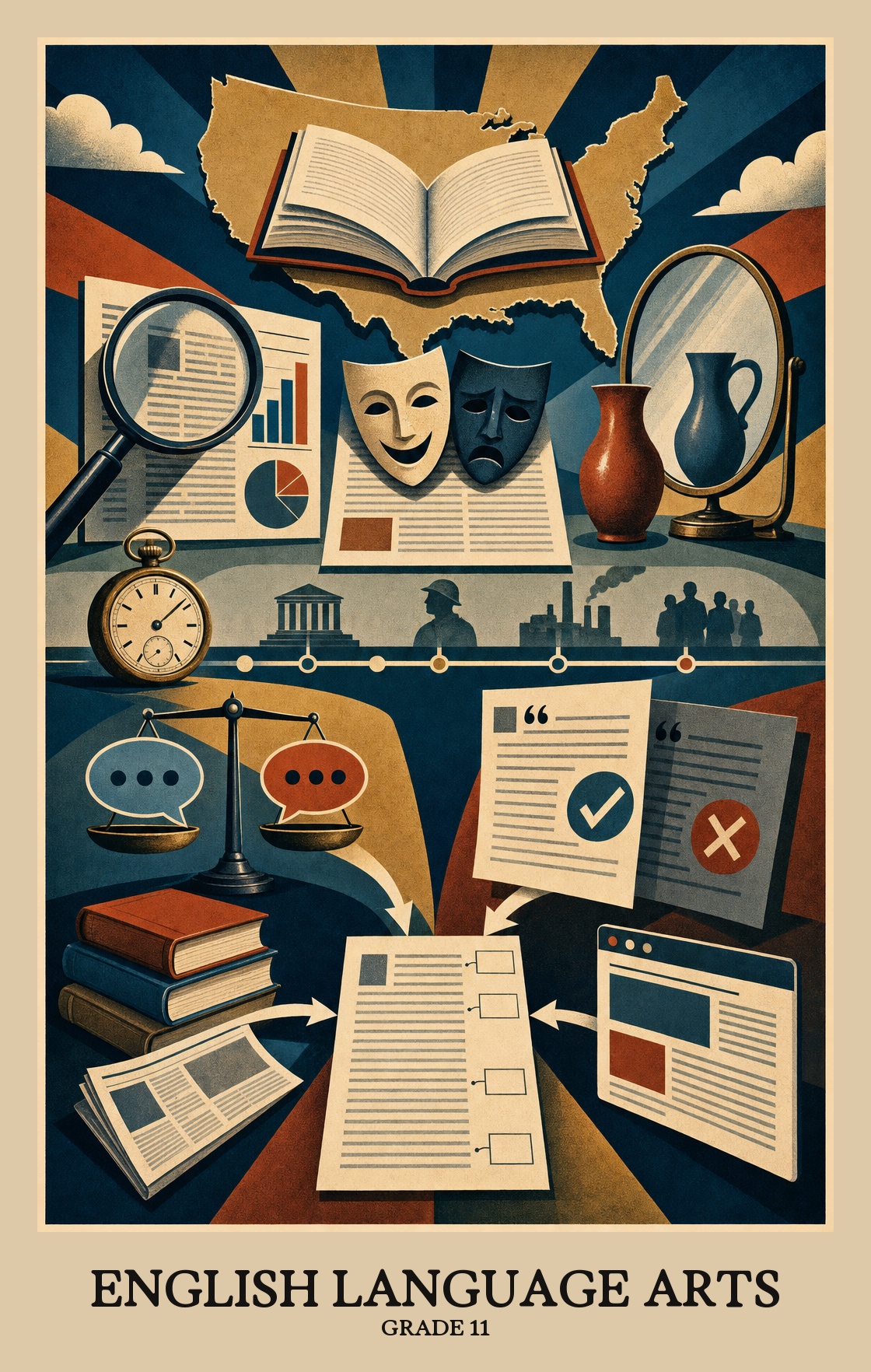
Students read American novels, plays, poems, and essays from different eras and trace big ideas like coming of age or the loss of innocence. They look at how a writer's word choices and tone shape the message.
Students write longer analytical pieces that open with a clear thesis and back it up with quotes from several sources. They learn to introduce evidence, explain why it matters, and end with a conclusion that follows the argument.
Students pick a research question, gather information from different sources, and judge which ones are credible. They cite sources in MLA or APA format and learn what counts as plagiarism, including the responsible use of AI tools.
Students build arguments that take opposing views seriously. They organize claims and counterclaims in order, weigh the evidence on each side, and respond with reasons rather than emotion.
Students read articles, technical documents, and even job or college applications. They compare how different writers handle the same topic and check whether claims hold up against other sources.
Students present research and opinions out loud, adjusting tone for the audience and using appeals like logic and emotion on purpose. They also look closely at ads, editorials, and websites to see how media shapes opinion.
Students read difficult, content-rich texts at the 11th-grade level, gather evidence from what they read, and use fix-up strategies when meaning breaks down. Wide reading across topics builds the vocabulary and knowledge students need for college and careers.
Students read challenging texts smoothly and at a steady pace, adjusting expression to match the meaning. When something doesn't make sense, they pause to reread or correct themselves until the passage clicks.
Students read challenging 11th-grade fiction and nonfiction, then answer questions that go beyond surface details: what a text says, what it implies, and whether its argument holds up.
Students pull multiple quotes or paraphrases from a challenging text to back up a claim or conclusion, and can point to exactly where in the text each piece of evidence comes from.
Students read several texts on the same topic, building enough background knowledge that new articles or books on that topic start to make more sense. The reading mix includes easier and harder pieces.
When a hard passage stops making sense, students pause and use a fix-up strategy: checking how the text is organized, summarizing what they just read, or asking a question about it. The goal is to get back on track without losing the thread.
| Standard | Definition | Code |
|---|---|---|
| The student will build knowledge and comprehension skills from reading a range… | Students read difficult, content-rich texts at the 11th-grade level, gather evidence from what they read, and use fix-up strategies when meaning breaks down. Wide reading across topics builds the vocabulary and knowledge students need for college and careers. | 11.DSR.1 |
| Read a variety of grade-level complex texts with accuracy, automaticity… | Students read challenging texts smoothly and at a steady pace, adjusting expression to match the meaning. When something doesn't make sense, they pause to reread or correct themselves until the passage clicks. | 11.DSR.1.A |
| Proficiently read and comprehend a variety of literary and informational texts… | Students read challenging 11th-grade fiction and nonfiction, then answer questions that go beyond surface details: what a text says, what it implies, and whether its argument holds up. | 11.DSR.1.B |
| When responding to text through discussions and/or writing, draw several pieces… | Students pull multiple quotes or paraphrases from a challenging text to back up a claim or conclusion, and can point to exactly where in the text each piece of evidence comes from. | 11.DSR.1.C |
| Regularly engage in reading a series of conceptually related texts organized… | Students read several texts on the same topic, building enough background knowledge that new articles or books on that topic start to make more sense. The reading mix includes easier and harder pieces. | 11.DSR.1.D |
| Use reading strategies as needed to aid and monitor comprehension when… | When a hard passage stops making sense, students pause and use a fix-up strategy: checking how the text is organized, summarizing what they just read, or asking a question about it. The goal is to get back on track without losing the thread. | 11.DSR.1E |
Students study words that show up in grade-level texts and content areas, learning how to figure out unfamiliar terms and use precise language in their reading and writing.
Students learn to figure out unfamiliar words using context clues, roots, and word parts. This applies to the complex texts, technical terms, and nuanced language common in 11th-grade reading.
Reading and writing about challenging texts, students build the kind of vocabulary that shows up in college courses, job training, and serious nonfiction. The goal is accurate use, not just recognition.
Context clues help students figure out an unfamiliar word without a dictionary. Students read the surrounding sentences to work out what a word likely means based on how it fits the passage.
Students break apart unfamiliar words by looking at roots, prefixes, and suffixes to figure out what they mean. Knowing that "bio" means life or "rupt" means break, for example, helps unlock a whole family of words.
Words can share a basic meaning but carry very different feelings. Students study near-synonyms like "clever" and "cunning" to understand what each word implies beyond its dictionary definition.
Students read phrases like "bite the bullet" or "it's raining cats and dogs" and explain what they really mean. They look at the surrounding sentences to figure out why the writer chose that expression.
Students explain what figurative phrases and references to classical literature mean, then describe how those choices shape the tone or argument of the text.
Students practice new vocabulary by using it in conversation, writing, and class discussion, not just recognizing it on a page. The goal is to make unfamiliar words stick by putting them to work.
| Standard | Definition | Code |
|---|---|---|
| The student will systematically build vocabulary and word knowledge based on… | Students study words that show up in grade-level texts and content areas, learning how to figure out unfamiliar terms and use precise language in their reading and writing. | 11.RV |
| Vocabulary Development and Word Analysis | Students learn to figure out unfamiliar words using context clues, roots, and word parts. This applies to the complex texts, technical terms, and nuanced language common in 11th-grade reading. | 11.RV.1 |
| Develop and accurately use general academic and content-specific vocabulary… | Reading and writing about challenging texts, students build the kind of vocabulary that shows up in college courses, job training, and serious nonfiction. The goal is accurate use, not just recognition. | 11.RV.1.A |
| Use context and sentence structure to clarify the meanings of words and phrases | Context clues help students figure out an unfamiliar word without a dictionary. Students read the surrounding sentences to work out what a word likely means based on how it fits the passage. | 11.RV.1.B |
| Use structural analysis of roots, affixes | Students break apart unfamiliar words by looking at roots, prefixes, and suffixes to figure out what they mean. Knowing that "bio" means life or "rupt" means break, for example, helps unlock a whole family of words. | 11.RV.1.C |
| Analyze the nuances in the meaning of words with similar denotations | Words can share a basic meaning but carry very different feelings. Students study near-synonyms like "clever" and "cunning" to understand what each word implies beyond its dictionary definition. | 11.RV.1.D |
| Explain and analyze idiomatic language in context | Students read phrases like "bite the bullet" or "it's raining cats and dogs" and explain what they really mean. They look at the surrounding sentences to figure out why the writer chose that expression. | 11.RV.1.E |
| Explain the meaning of figurative language and literary and classical allusions… | Students explain what figurative phrases and references to classical literature mean, then describe how those choices shape the tone or argument of the text. | 11.RV.1.F |
| Use newly learned words and phrases in multiple contexts, including in… | Students practice new vocabulary by using it in conversation, writing, and class discussion, not just recognizing it on a page. The goal is to make unfamiliar words stick by putting them to work. | 11.RV.1.G |
Students read poems, plays, stories, and essays from American and world literature, then point to specific lines in the text to back up what they think the writing means.
Students read a story or poem closely and explain what the text actually says, then use specific lines or details to back up their thinking about what it means.
Students trace how a big idea like loss of innocence or coming of age shows up across American stories, poems, and plays from different time periods, looking at how each era shapes that idea differently.
Students look at a single scene, chapter, or stanza and explain what job it does in the larger story: how it moves the plot forward or builds the world characters live in.
Students read specific lines of dialogue or key moments in a story and explain what those details reveal about a character's personality, motives, or values.
Plays use moments when a character speaks directly to the audience, talks to themselves, or steps outside the story. Students analyze how those choices shape what the play means and how it feels to watch.
Reading closely, students explain how an author's word choices and narrative techniques shape the meaning and tone of a literary text. Think of it as analyzing why a story feels the way it does and how the author made it happen.
Students read a poem and explain how its sounds and images work together to create a mood and reinforce what the poem is really about.
Students read a passage and examine why the author chose specific words, sentence structures, and tone. The goal is to figure out what the author believed or wanted readers to think, and how those writing choices pushed readers in that direction.
Students analyze how a writer's specific choices, like a repeated symbol or a vivid image, shape what a story means. The focus is on explaining why those choices matter, not just naming them.
Satire, sarcasm, irony, and understatement all say one thing while meaning another. Students learn to spot those gaps between what a writer writes and what the writer actually means.
Students trace how a character's choices, a story's structure, or a theme builds meaning across the whole text. They connect those pieces to explain how the author shaped the work.
Students read stories and essays from different times and places, then explain how the world the author lived in shaped the way they wrote and what they chose to say.
Students connect old myths, fables, or religious stories to modern poems, novels, or plays, looking for shared themes or character types that show up across both.
Students read a poem, novel, or other literary work and figure out what the author believed, then connect those beliefs to the historical moment or social world the author lived in.
| Standard | Definition | Code |
|---|---|---|
| The student will use textual evidence to demonstrate comprehension and… | Students read poems, plays, stories, and essays from American and world literature, then point to specific lines in the text to back up what they think the writing means. | 11.RL |
| Key Ideas and Plot Details | Students read a story or poem closely and explain what the text actually says, then use specific lines or details to back up their thinking about what it means. | 11.RL.1 |
| Analyze the development of universal themes | Students trace how a big idea like loss of innocence or coming of age shows up across American stories, poems, and plays from different time periods, looking at how each era shapes that idea differently. | 11.RL.1.A |
| Describe how a particular sentence, chapter, scene | Students look at a single scene, chapter, or stanza and explain what job it does in the larger story: how it moves the plot forward or builds the world characters live in. | 11.RL.1.B |
| Analyze how characters are revealed through particular lines of dialogue or… | Students read specific lines of dialogue or key moments in a story and explain what those details reveal about a character's personality, motives, or values. | 11.RL.1.C |
| Analyze and evaluate how dramatic conventions | Plays use moments when a character speaks directly to the audience, talks to themselves, or steps outside the story. Students analyze how those choices shape what the play means and how it feels to watch. | 11.RL.1.D |
| Craft and Style | Reading closely, students explain how an author's word choices and narrative techniques shape the meaning and tone of a literary text. Think of it as analyzing why a story feels the way it does and how the author made it happen. | 11.RL.2 |
| Interpret and analyze how the sound and imagery of poetry support the subject… | Students read a poem and explain how its sounds and images work together to create a mood and reinforce what the poem is really about. | 11.RL.2.A |
| Evaluate how authors use specific word choices, syntax, tone | Students read a passage and examine why the author chose specific words, sentence structures, and tone. The goal is to figure out what the author believed or wanted readers to think, and how those writing choices pushed readers in that direction. | 11.RL.2.B |
| Critique how authors use key literary devices | Students analyze how a writer's specific choices, like a repeated symbol or a vivid image, shape what a story means. The focus is on explaining why those choices matter, not just naming them. | 11.RL.2.C |
| Analyze the use of satire, sarcasm, irony | Satire, sarcasm, irony, and understatement all say one thing while meaning another. Students learn to spot those gaps between what a writer writes and what the writer actually means. | 11.RL.2.D |
| Integration of Concepts | Students trace how a character's choices, a story's structure, or a theme builds meaning across the whole text. They connect those pieces to explain how the author shaped the work. | 11.RL.3 |
| Explain the influence of the historical and cultural context on form, style | Students read stories and essays from different times and places, then explain how the world the author lived in shaped the way they wrote and what they chose to say. | 11.RL.3.A |
| Relate themes, patterns of events | Students connect old myths, fables, or religious stories to modern poems, novels, or plays, looking for shared themes or character types that show up across both. | 11.RL.3.B |
| Analyze how authors’ attitudes, viewpoints | Students read a poem, novel, or other literary work and figure out what the author believed, then connect those beliefs to the historical moment or social world the author lived in. | 11.RL.3.C |
Students read challenging articles, essays, and other real-world texts, then point to specific lines or passages to back up what they say the text means or shows.
Students read a nonfiction article or speech closely enough to explain the main idea and point to the exact sentences or facts that back it up.
Students read job applications, college applications, and workplace documents, then explain in their own words what each one is asking for and why.
Students read scientific or technical articles and check whether the evidence actually supports the conclusions. They compare findings across sources to confirm or question what the author claims.
Students read an author's argument, then check it against outside sources to decide whether the reasoning holds up and the evidence actually supports the claim.
Students analyze how an author's word choices, tone, and structure shape the meaning and impact of a nonfiction text. They look closely at why the author wrote it that way, not just what the author said.
Students look at how an author arranges paragraphs, headings, and details to figure out what the author is trying to prove or explain. Structure is a choice, and that choice shapes what readers take away.
Students read technical and historical texts closely, then explain what the key terms actually mean and how those terms connect to the bigger ideas in the piece.
Students read articles, speeches, and essays to spot when an author says the opposite of what they mean, exaggerates to make a point, or leaves something deliberately unclear. Then students explain what that choice does to the reader.
Students trace how specific ideas or arguments in a text connect, build on, or push back against each other. The focus is on how the author's reasoning holds together across the whole piece, not just paragraph by paragraph.
Students read two nonfiction passages on the same topic, then compare where the authors agree, where they disagree, and how each one builds to a conclusion.
Students read two nonfiction pieces side by side and compare what each one is trying to do, what information it includes, and how clearly it explains that information. One might be a news article; the other a technical manual covering the same topic.
| Standard | Definition | Code |
|---|---|---|
| The student will use textual evidence to demonstrate comprehension and… | Students read challenging articles, essays, and other real-world texts, then point to specific lines or passages to back up what they say the text means or shows. | 11.RI |
| Key Ideas and Confirming Details | Students read a nonfiction article or speech closely enough to explain the main idea and point to the exact sentences or facts that back it up. | 11.RI.1 |
| Interpret and complete an application for employment or college admission | Students read job applications, college applications, and workplace documents, then explain in their own words what each one is asking for and why. | 11.RI.1.A |
| Analyze the hypotheses, data, analysis, and/or conclusions in informational… | Students read scientific or technical articles and check whether the evidence actually supports the conclusions. They compare findings across sources to confirm or question what the author claims. | 11.RI.1.B |
| Evaluate the relevance and quality of an author’s premises, claims… | Students read an author's argument, then check it against outside sources to decide whether the reasoning holds up and the evidence actually supports the claim. | 11.RI.1.C |
| Craft and Style | Students analyze how an author's word choices, tone, and structure shape the meaning and impact of a nonfiction text. They look closely at why the author wrote it that way, not just what the author said. | 11.RI.2 |
| Examine how textual elements and organizational patterns contribute to meaning… | Students look at how an author arranges paragraphs, headings, and details to figure out what the author is trying to prove or explain. Structure is a choice, and that choice shapes what readers take away. | 11.RI.2.A |
| Analyze and interpret the key terms | Students read technical and historical texts closely, then explain what the key terms actually mean and how those terms connect to the bigger ideas in the piece. | 11.RI.2.B |
| Recognize and analyze the author’s purpose and impact of ambiguity… | Students read articles, speeches, and essays to spot when an author says the opposite of what they mean, exaggerates to make a point, or leaves something deliberately unclear. Then students explain what that choice does to the reader. | 11.RI.2.C |
| Integration of Concepts | Students trace how specific ideas or arguments in a text connect, build on, or push back against each other. The focus is on how the author's reasoning holds together across the whole piece, not just paragraph by paragraph. | 11.RI.3 |
| Analyze information within and between paired passages for similar and… | Students read two nonfiction passages on the same topic, then compare where the authors agree, where they disagree, and how each one builds to a conclusion. | 11.RI.3.A |
| Compare and contrast informational and technical texts for intent, content | Students read two nonfiction pieces side by side and compare what each one is trying to do, what information it includes, and how clearly it explains that information. One might be a news article; the other a technical manual covering the same topic. | 11.RI.3.B |
Grade 11 writing focuses on arguments and analysis. Students write to take a position, examine a text closely, or explain complex ideas, adjusting how they write based on who will read it and why.
Students practice writing for different purposes: to argue a point, to explain something clearly, or to tell a story. Each mode has its own structure and goal, and students learn when and how to use each one.
Extended writing means going beyond a paragraph to build a full, developed piece. Students plan, draft, and revise writing long enough to develop an idea with evidence and structure across multiple paragraphs.
Students write an opening paragraph that sets up the topic, states a clear position, and tells the reader what the rest of the essay will cover.
Students organize an argument so each idea connects clearly to the next, making the logic easy to follow from the opening claim to the final point.
Students pick the most useful facts, quotes, and details from several reliable sources and weave them into their writing to support the topic. The evidence fits what the audience already knows.
The final paragraph wraps up the piece by connecting back to what was explained, not just stopping. Students don't introduce new ideas at the end; they close out what they already covered.
Analyses break down a text, argument, or idea into parts to show how it works or what it means. Students support every claim with specific evidence and explain their reasoning clearly.
Students write a thesis that takes a real position and backs it up with something worth arguing, not just a fact anyone would agree with.
Students pull evidence from multiple sources to back up a single argument. They read, compare what they find, and show why their sources support their position rather than just quoting them.
Students analyze a real problem, then write a proposal that argues for a specific solution. The writing explains why the problem matters and makes a case for one clear fix.
Students arrange their argument so each claim connects clearly to the evidence behind it, address opposing views, and keep the whole piece moving in a logical order from start to finish.
Students write cover letters, personal statements, or job applications that match what a real employer or college admissions reader expects. The tone, details, and structure fit the audience.
Students practice writing in many forms, from short summaries and letters to longer narratives and critiques, adjusting their tone and approach to fit the audience and purpose.
Students organize a piece of writing so the opening draws readers in, the middle sections develop ideas in a clear order, and the closing ties everything together without just repeating what came before.
Before writing, students decide who they're writing for and what they want that reader to take away. They plan, draft, revise, and edit with that goal in mind.
Students write a single sentence that states their argument or position clearly enough that a reader knows exactly what the paper will defend. That sentence becomes the anchor for everything else in the essay.
Students organize their argument so the main claim, opposing views, and supporting evidence build on each other in a clear order. The whole piece holds together as one focused piece of writing.
Students introduce each piece of outside evidence, then explain in detail how it supports their argument. The quote or fact doesn't stand alone; students tell readers exactly what it means and why it matters.
Students practice linking paragraphs together using transition words and varied sentence structures so ideas flow clearly from one point to the next, not just within a paragraph but across the whole piece.
Students choose words carefully to say exactly what they mean, cutting vague language and replacing it with specific words that make each idea sharper and easier for a reader to follow.
Students edit their writing for grammar, punctuation, and word choice. Sentences are clear and correct before the writing is considered finished.
Students revisit a draft to sharpen what they said, fix anything that's wrong, and fill in places where the reader would want more detail.
Students read their own writing and a classmate's, then mark what works and suggest specific changes. The goal is clearer sentences and stronger evidence, not just fixing spelling.
Students review their own writing to fix grammar, word choice, and sentence structure until the piece reads clearly and fits the assignment.
Students practice writing and revising until their work meets the standard expected in a job or college setting. That means clear sentences, correct grammar, and language professional enough to hand to a boss or a professor.
| Standard | Definition | Code |
|---|---|---|
| The student will write in a variety of forms for diverse audiences and purposes… | Grade 11 writing focuses on arguments and analysis. Students write to take a position, examine a text closely, or explain complex ideas, adjusting how they write based on who will read it and why. | 11.W |
| Modes and Purposes for Writing | Students practice writing for different purposes: to argue a point, to explain something clearly, or to tell a story. Each mode has its own structure and goal, and students learn when and how to use each one. | 11.W.1 |
| Write extended pieces that | Extended writing means going beyond a paragraph to build a full, developed piece. Students plan, draft, and revise writing long enough to develop an idea with evidence and structure across multiple paragraphs. | 11.W.1.A |
| Introduce a topic clearly by providing context, presenting well-defined theses | Students write an opening paragraph that sets up the topic, states a clear position, and tells the reader what the rest of the essay will cover. | 11.W.1.A.i |
| Adopt an organizational structure that clarifies relationships among ideas and… | Students organize an argument so each idea connects clearly to the next, making the logic easy to follow from the opening claim to the final point. | 11.W.1.A.ii |
| Develop the topic through sustained use of the most significant and relevant… | Students pick the most useful facts, quotes, and details from several reliable sources and weave them into their writing to support the topic. The evidence fits what the audience already knows. | 11.W.1.A.iii |
| Provide a concluding section that follows from the information or… | The final paragraph wraps up the piece by connecting back to what was explained, not just stopping. Students don't introduce new ideas at the end; they close out what they already covered. | 11.W.1.A.iv |
| Write analyses that | Analyses break down a text, argument, or idea into parts to show how it works or what it means. Students support every claim with specific evidence and explain their reasoning clearly. | 11.W.1.B |
| Develop a thesis that demonstrates knowledgeable judgments | Students write a thesis that takes a real position and backs it up with something worth arguing, not just a fact anyone would agree with. | 11.W.1.B.i |
| Interpret and investigate evidence from various sources and texts to draw… | Students pull evidence from multiple sources to back up a single argument. They read, compare what they find, and show why their sources support their position rather than just quoting them. | 11.W.1.B.ii |
| Examine and evaluate processes and/or problems to propose solutions | Students analyze a real problem, then write a proposal that argues for a specific solution. The writing explains why the problem matters and makes a case for one clear fix. | 11.W.1.B.iii |
| Organize claims, counterclaims | Students arrange their argument so each claim connects clearly to the evidence behind it, address opposing views, and keep the whole piece moving in a logical order from start to finish. | 11.W.1.B.iv |
| Write to describe personal qualifications for potential occupational or… | Students write cover letters, personal statements, or job applications that match what a real employer or college admissions reader expects. The tone, details, and structure fit the audience. | 11.W.1.C |
| Choose appropriate modes and blend multiple forms of writing by routinely… | Students practice writing in many forms, from short summaries and letters to longer narratives and critiques, adjusting their tone and approach to fit the audience and purpose. | 11.W.1.D |
| Organization and Composition | Students organize a piece of writing so the opening draws readers in, the middle sections develop ideas in a clear order, and the closing ties everything together without just repeating what came before. | 11.W.2 |
| Plan and organize writing to address a specific audience and purpose using the… | Before writing, students decide who they're writing for and what they want that reader to take away. They plan, draft, revise, and edit with that goal in mind. | 11.W.2.A |
| Composing a thesis statement that clearly communicates the writer’s position… | Students write a single sentence that states their argument or position clearly enough that a reader knows exactly what the paper will defend. That sentence becomes the anchor for everything else in the essay. | 11.W.2.A.i |
| Organizing claims, counterclaims | Students organize their argument so the main claim, opposing views, and supporting evidence build on each other in a clear order. The whole piece holds together as one focused piece of writing. | 11.W.2.A.ii |
| Effectively contextualizing evidence from sources with proper introduction… | Students introduce each piece of outside evidence, then explain in detail how it supports their argument. The quote or fact doesn't stand alone; students tell readers exactly what it means and why it matters. | 11.W.2.A.iii |
| Applying varied transitions and sentence structures to connect ideas within… | Students practice linking paragraphs together using transition words and varied sentence structures so ideas flow clearly from one point to the next, not just within a paragraph but across the whole piece. | 11.W.2.A.iv |
| Elaborating ideas clearly through purposeful and precise word choice | Students choose words carefully to say exactly what they mean, cutting vague language and replacing it with specific words that make each idea sharper and easier for a reader to follow. | 11.W.2.A.v |
| Usage and Mechanics | Students edit their writing for grammar, punctuation, and word choice. Sentences are clear and correct before the writing is considered finished. | 11.W.3 |
| Revise writing for clarity of content, accuracy | Students revisit a draft to sharpen what they said, fix anything that's wrong, and fill in places where the reader would want more detail. | 11.W.3.A |
| Use peer- and self-evaluation to edit writing for clarity and quality of… | Students read their own writing and a classmate's, then mark what works and suggest specific changes. The goal is clearer sentences and stronger evidence, not just fixing spelling. | 11.W.3.B |
| Edit writing for appropriate conventions, style | Students review their own writing to fix grammar, word choice, and sentence structure until the piece reads clearly and fits the assignment. | 11.W.3.C |
| Write and revise to a standard acceptable both in the workplace and in… | Students practice writing and revising until their work meets the standard expected in a job or college setting. That means clear sentences, correct grammar, and language professional enough to hand to a boss or a professor. | 11.W.3.D |
Students learn when to use formal English (like in an essay or job application) and when casual language fits better (like in a text or conversation). The focus is on matching the right tone to the right situation.
Students apply grammar rules in their writing, catching errors in sentence structure, punctuation, and word choice before a piece is finished.
Verbal phrases (like "running the meeting" or "to finish early") compress ideas into fewer words. Students use them to tighten sentences and keep writing from sounding repetitive.
Students practice mixing longer, multi-clause sentences with shorter ones so their writing has a natural rhythm instead of sounding repetitive.
Active voice puts the actor first ("The coach called the play"). Passive voice flips it to emphasize the result ("The play was called"). Students learn when each choice makes a sentence land the way they intend.
Students learn the rules that keep writing clear: punctuation, capitalization, and spelling. Getting these right helps readers follow the writing without stopping to decode what the writer meant.
Students use commas, semicolons, and colons correctly when writing complex sentences. These marks separate ideas, connect related thoughts, and set up lists or explanations in ways that make writing easier to follow.
Students learn to format papers and cite sources using a standard style guide. That means consistent headings, page numbers, and references laid out exactly the way a field like English or psychology expects.
Students spell words correctly in their writing and know when to look something up to make sure. This includes using a dictionary or other reference when a word doesn't look right.
| Standard | Definition | Code |
|---|---|---|
| The student will use the conventions of Standard English when speaking and… | Students learn when to use formal English (like in an essay or job application) and when casual language fits better (like in a text or conversation). The focus is on matching the right tone to the right situation. | 11.LU |
| Grammar | Students apply grammar rules in their writing, catching errors in sentence structure, punctuation, and word choice before a piece is finished. | 11.LU.1 |
| Use verbal phrases to achieve sentence conciseness and variety in speaking and… | Verbal phrases (like "running the meeting" or "to finish early") compress ideas into fewer words. Students use them to tighten sentences and keep writing from sounding repetitive. | 11.LU.1.A |
| Use complex sentence structure to infuse sentence variety in writing | Students practice mixing longer, multi-clause sentences with shorter ones so their writing has a natural rhythm instead of sounding repetitive. | 11.LU.1.B |
| Differentiate and apply active and passive voice to convey a desired effect in… | Active voice puts the actor first ("The coach called the play"). Passive voice flips it to emphasize the result ("The play was called"). Students learn when each choice makes a sentence land the way they intend. | 11.LU.1.C |
| Mechanics | Students learn the rules that keep writing clear: punctuation, capitalization, and spelling. Getting these right helps readers follow the writing without stopping to decode what the writer meant. | 11.LU.2 |
| Use commas, semi-colons | Students use commas, semicolons, and colons correctly when writing complex sentences. These marks separate ideas, connect related thoughts, and set up lists or explanations in ways that make writing easier to follow. | 11.LU.2.A |
| Write and edit work so that it conforms to the guidelines in style manual, such… | Students learn to format papers and cite sources using a standard style guide. That means consistent headings, page numbers, and references laid out exactly the way a field like English or psychology expects. | 11.LU.2.B |
| Spell correctly, consulting reference materials to check as needed | Students spell words correctly in their writing and know when to look something up to make sure. This includes using a dictionary or other reference when a word doesn't look right. | 11.LU.2.C |
Students practice speaking clearly, listening carefully, and working through ideas with classmates. The goal is to understand content better by talking it out together, not just reading or writing alone.
Students listen carefully, speak clearly, and work with others to share and build on ideas. This standard covers the conversations, discussions, and group work students do in and out of class.
Students lead and take part in group discussions about complex topics and texts, building on each other's ideas, asking good questions, and staying focused across a full conversation.
Students practice listening carefully and speaking with a clear point in mind during class discussions, debates, and group work. The goal is to respond to what others actually said, not just wait for a turn to talk.
Group work at this level means students don't just share opinions. They listen, adjust their position when the evidence calls for it, find common ground, and make sure disagreeing views get a fair hearing before the group moves forward.
Students listen to different viewpoints and respond with specific evidence from the text or discussion, staying respectful even when they disagree.
In a class discussion or debate, students track where people agree and where they clash, then sum up both sides clearly before the group moves on.
Students find information on a topic, judge whether it is accurate and relevant, and use what holds up to complete a specific task or assignment.
Students look back on how they contributed to a small-group discussion and honestly assess what helped the group and what they would do differently next time.
Students plan and deliver spoken presentations, choosing words, structure, and delivery to fit the audience and purpose.
Students pick a topic or text and present their findings or point of view out loud to an audience. The focus is on organizing ideas clearly and speaking with enough detail that listeners can follow without reading along.
Students choose the right format for a presentation (speech, slides, video) and pull together information from multiple sources into one clear, unified message.
Students choose their words and tone to match what they're talking about and who's listening. A speech to persuade a school board sounds different from a discussion with classmates.
Students practice reading a room: adjusting their words, tone, and body language based on who is listening and what reaction they get back.
Speeches land harder when speakers back up a claim with facts, connect emotionally with the audience, and repeat key phrases on purpose. Students learn to use those moves together to make a spoken message stick.
Students take a position on an issue, then think through the strongest objections someone else might raise and respond to those objections directly in their speech or presentation.
Students watch or listen to a presentation and judge how well it holds together: whether the opening draws you in, whether the evidence actually supports the argument, and whether the ending lands.
Students combine written words with images, audio, or design to make a single, cohesive piece. The goal is for each element to do work the others can't do alone.
Students build presentations that mix words, images, sound, or video to fit a specific audience and goal. They might make a podcast, a slide deck, or a video essay depending on what the message calls for.
Reading an article, ad, or video means asking who made it, why they made it, and who it was made for. Students identify those elements and judge how well they work together.
Students track several sources at once, such as a video, a chart, and a written article, then pull the key points together into a summary or a clear stance on the topic.
Students learn to choose the right tool for the job, whether that means finding a source online, using software to build a presentation, or combining text and images. They also think carefully about how and why to use each one.
Students analyze how TV, social media, news, and advertising shape what people believe. They look at who made the message, what it leaves out, and why.
Students read ads, opinion pieces, blogs, and websites to figure out who made them and what angle they're pushing. Understanding the source helps students decide how much to trust what they're reading.
Students break down a media message (an ad, a news segment, a social post) to explain who it was made for and why. They look at what choices the creator made to get that reaction from that audience.
Students pick apart ads, news clips, and social media posts to see what words and images were chosen, what the creator was trying to do, and whether it worked on the audience.
| Standard | Definition | Code |
|---|---|---|
| The student will develop effective oral communication and collaboration skills… | Students practice speaking clearly, listening carefully, and working through ideas with classmates. The goal is to understand content better by talking it out together, not just reading or writing alone. | 11.C |
| Communication, Listening | Students listen carefully, speak clearly, and work with others to share and build on ideas. This standard covers the conversations, discussions, and group work students do in and out of class. | 11.C.1 |
| Facilitate and contribute to a range of sustained collaborative discussions… | Students lead and take part in group discussions about complex topics and texts, building on each other's ideas, asking good questions, and staying focused across a full conversation. | 11.C.1.A |
| Applying a variety of strategies to listen actively and speak purposefully… | Students practice listening carefully and speaking with a clear point in mind during class discussions, debates, and group work. The goal is to respond to what others actually said, not just wait for a turn to talk. | 11.C.1.A.i |
| Demonstrating the ability to work effectively by coming to a consensus… | Group work at this level means students don't just share opinions. They listen, adjust their position when the evidence calls for it, find common ground, and make sure disagreeing views get a fair hearing before the group moves forward. | 11.C.1.A.ii |
| Responding thoughtfully and tactfully with evidence to diverse perspectives | Students listen to different viewpoints and respond with specific evidence from the text or discussion, staying respectful even when they disagree. | 11.C.1.A.iii |
| Summarizing points of agreement and disagreement | In a class discussion or debate, students track where people agree and where they clash, then sum up both sides clearly before the group moves on. | 11.C.1.A.iv |
| Assessing, evaluating critically | Students find information on a topic, judge whether it is accurate and relevant, and use what holds up to complete a specific task or assignment. | 11.C.1.A.v |
| Using reflection to evaluate one's own role in the group process in… | Students look back on how they contributed to a small-group discussion and honestly assess what helped the group and what they would do differently next time. | 11.C.1.A.vi |
| Speaking and Presentation of Ideas | Students plan and deliver spoken presentations, choosing words, structure, and delivery to fit the audience and purpose. | 11.C.2 |
| Report orally on a topic or text or present an opinion | Students pick a topic or text and present their findings or point of view out loud to an audience. The focus is on organizing ideas clearly and speaking with enough detail that listeners can follow without reading along. | 11.C.2.A |
| Selecting the modes and purposes for presentations and synthesizing multiple… | Students choose the right format for a presentation (speech, slides, video) and pull together information from multiple sources into one clear, unified message. | 11.C.2.A.i |
| Choosing diction and tone appropriate to the topic, audience | Students choose their words and tone to match what they're talking about and who's listening. A speech to persuade a school board sounds different from a discussion with classmates. | 11.C.2.A.ii |
| Using a variety of active listening and speaking strategies, with awareness of… | Students practice reading a room: adjusting their words, tone, and body language based on who is listening and what reaction they get back. | 11.C.2.A.iii |
| Utilizing rhetorical techniques | Speeches land harder when speakers back up a claim with facts, connect emotionally with the audience, and repeat key phrases on purpose. Students learn to use those moves together to make a spoken message stick. | 11.C.2.A.iv |
| Anticipating and addressing alternative or opposing perspectives and… | Students take a position on an issue, then think through the strongest objections someone else might raise and respond to those objections directly in their speech or presentation. | 11.C.2.A.v |
| Evaluating the content and effectiveness of presentations | Students watch or listen to a presentation and judge how well it holds together: whether the opening draws you in, whether the evidence actually supports the argument, and whether the ending lands. | 11.C.2.A.vi |
| Integrating Multimodal Literacies | Students combine written words with images, audio, or design to make a single, cohesive piece. The goal is for each element to do work the others can't do alone. | 11.C.3 |
| Create, publish, and deliver multimodal presentations and pieces aimed at a… | Students build presentations that mix words, images, sound, or video to fit a specific audience and goal. They might make a podcast, a slide deck, or a video essay depending on what the message calls for. | 11.C.3.A |
| Demonstrate understanding of multimodal literacy by identifying and evaluating… | Reading an article, ad, or video means asking who made it, why they made it, and who it was made for. Students identify those elements and judge how well they work together. | 11.C.3.B |
| Monitor, organize, analyze | Students track several sources at once, such as a video, a chart, and a written article, then pull the key points together into a summary or a clear stance on the topic. | 11.C.3.C |
| Ethically, purposefully | Students learn to choose the right tool for the job, whether that means finding a source online, using software to build a presentation, or combining text and images. They also think carefully about how and why to use each one. | 11.C.3.D |
| Examining Media Messages | Students analyze how TV, social media, news, and advertising shape what people believe. They look at who made the message, what it leaves out, and why. | 11.C.4 |
| Analyze the sources and viewpoint | Students read ads, opinion pieces, blogs, and websites to figure out who made them and what angle they're pushing. Understanding the source helps students decide how much to trust what they're reading. | 11.C.4.A |
| Analyze and critique how media reach the targeted audience for specific purposes | Students break down a media message (an ad, a news segment, a social post) to explain who it was made for and why. They look at what choices the creator made to get that reaction from that audience. | 11.C.4.B |
| Analyze, compare, and contrast visual and verbal media messages for content | Students pick apart ads, news clips, and social media posts to see what words and images were chosen, what the creator was trying to do, and whether it worked on the audience. | 11.C.4.C |
Students pick a topic that interests them, read several related sources on it, and build real knowledge over time. The research connects to what they're studying in eleventh grade.
Students find sources on a topic, weigh how trustworthy and relevant each one is, then pull the most useful ideas together into a single, coherent understanding.
Students start with a research question, then sharpen or widen it as they learn more. A question that's too broad gets focused; one that's too narrow gets opened up.
Students find information from multiple sources and arrange it so the most useful details are easy to locate and compare.
Students read primary and secondary sources and judge whether each one is trustworthy, accurate, and useful for their research. They look for the author's point of view, spot conflicting information across sources, and flag any bias or faulty assumptions.
Students pull together facts and examples from several sources to back up a central argument, then address the strongest opposing view head-on.
Students pull together research from multiple sources and shape it into a finished piece of writing that meets the same standards as any other formal assignment in class.
Students learn to credit their sources correctly, whether quoting someone's exact words or paraphrasing an idea. They follow a standard format like MLA or APA to show readers exactly where each piece of information came from.
Plagiarism means using someone else's words or ideas without giving them credit. Students learn what counts as plagiarism, why it matters legally and academically, and how to gather and cite information the right way.
Students learn to use sources honestly, giving credit where it's due and flagging AI-generated content for what it is. That applies to websites, research databases, and any new tool that comes along.
| Standard | Definition | Code |
|---|---|---|
| The student will conduct research and read a series of conceptually related… | Students pick a topic that interests them, read several related sources on it, and build real knowledge over time. The research connects to what they're studying in eleventh grade. | 11.R |
| Evaluation and Synthesis of Information | Students find sources on a topic, weigh how trustworthy and relevant each one is, then pull the most useful ideas together into a single, coherent understanding. | 11.R.1 |
| Formulate and revise questions about a research topic broadening or narrowing… | Students start with a research question, then sharpen or widen it as they learn more. A question that's too broad gets focused; one that's too narrow gets opened up. | 11.R.1.A |
| Gather and organize information from various sources | Students find information from multiple sources and arrange it so the most useful details are easy to locate and compare. | 11.R.1.B |
| Objectively evaluate primary and secondary sources for their credibility… | Students read primary and secondary sources and judge whether each one is trustworthy, accurate, and useful for their research. They look for the author's point of view, spot conflicting information across sources, and flag any bias or faulty assumptions. | 11.R.1.C |
| Synthesize multiple streams of evidence to support claims and acknowledge… | Students pull together facts and examples from several sources to back up a central argument, then address the strongest opposing view head-on. | 11.R.1.D |
| Create research products aligned with the demands of the reading and writing… | Students pull together research from multiple sources and shape it into a finished piece of writing that meets the same standards as any other formal assignment in class. | 11.R.1.E |
| Cite primary and secondary sources for quoted and paraphrased ideas using a… | Students learn to credit their sources correctly, whether quoting someone's exact words or paraphrasing an idea. They follow a standard format like MLA or APA to show readers exactly where each piece of information came from. | 11.R.1.F |
| Define the meaning and consequences of plagiarism and follow ethical and legal… | Plagiarism means using someone else's words or ideas without giving them credit. Students learn what counts as plagiarism, why it matters legally and academically, and how to gather and cite information the right way. | 11.R.1.G |
| Demonstrate ethical and responsible use of all sources, including the Internet… | Students learn to use sources honestly, giving credit where it's due and flagging AI-generated content for what it is. That applies to websites, research databases, and any new tool that comes along. | 11.R.1.H |
High school end-of-course reading and writing assessments used for verified credit toward graduation.
Alternate assessment program for eligible students with significant cognitive disabilities, covering state-tested grades and subjects.
Students read challenging texts from American literature alongside world and British works, plus essays, speeches, and research articles. The writing focus is argument and analysis: building a clear thesis, weighing evidence, and answering opposing views. Expect longer papers, a research project, and more formal presentations than in past years.
Ask students to read a tough paragraph out loud, then say it back in their own words. If a sentence still feels murky, have them mark the confusing part and look up one or two unfamiliar words. Five or ten minutes of this most nights builds stamina faster than rereading silently.
A multi-page argument or analysis paper with a real thesis, evidence from several sources, and a section that answers the other side. The writing should sound formal enough for a college application or a workplace report. Quotes are introduced, explained, and cited in MLA or APA.
Start with short claim-and-evidence pieces tied to one text, then move to paired-text analysis, then a sustained research argument with counterclaims. Teach citation and source evaluation early so it carries through every later assignment. Save the longest paper for the second semester once students can already defend a thesis in three to four pages.
Older language is the real barrier, not the ideas. Read the first page of a chapter together and translate tricky sentences into plain talk, then let students take over. A short plot summary from a reliable source before reading is fine; it frees attention for the harder work of theme and word choice.
Integrating quotes (introducing, explaining, and citing rather than dropping them in), handling counterclaims without strawmanning, and evaluating source credibility past the first page of search results. Plan short, repeated mini-lessons on these across units instead of one big lecture.
Students should pick a focused question, pull from several credible sources, and tell the difference between a strong source and a weak one. Final products cite sources in MLA or APA and show where ideas came from. Honest use of AI tools and clear rules about plagiarism are part of the work.
They can read a dense article once, summarize it accurately, and quote from it in a paper with proper citation. They can hold a thesis across four or more pages and answer an opposing view without dismissing it. Speaking in a graded discussion or short presentation should feel routine, not terrifying.
Talk about words students meet in their reading. Ask what a word means in that sentence, then ask for a close cousin (clever versus cunning, for example). Encourage students to try new words in conversation and in writing, even if the first try is awkward.