Matter and its building blocks
Students start the year looking at what everything around them is made of. They learn that all matter is built from tiny atoms, and they test properties like density, melting point, and how things dissolve in water.
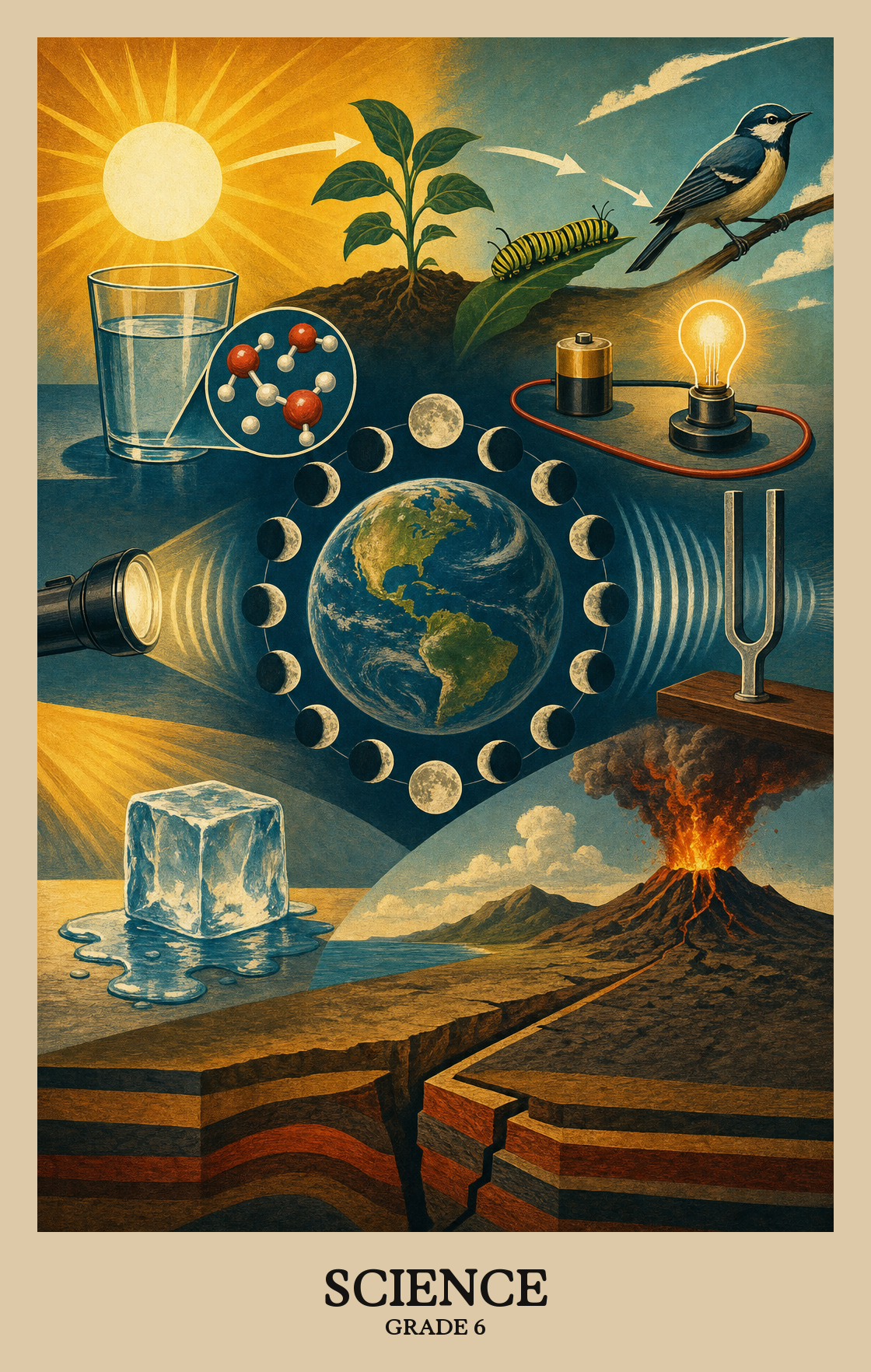
This is the year science zooms in and out at the same time, from the atoms inside a glass of water to the planets circling the sun. Students learn what matter is made of, how heat and electricity move, and how light and sound travel as waves. They study how plants make food, how energy moves from the sun through living things, and how earthquakes and volcanoes reshape the ground. By spring, students can explain why the moon changes shape each month and why ice melts when it warms up.
Students start the year looking at what everything around them is made of. They learn that all matter is built from tiny atoms, and they test properties like density, melting point, and how things dissolve in water.
Students explore how heat moves through objects and why some materials keep drinks hot while others cool them down. They also build simple circuits and figure out why a bulb only lights when the loop is complete.
Students study how waves carry energy, from the ripples that cause earthquakes to the sound and light students use every day. They investigate how the eye sees color and how the ear picks up vibrations.
Students look at how plants make their own food from sunlight and how that energy moves to animals and decomposers. They also compare how living things survive in places like deserts, rainforests, and tundra.
Students track how the sun, Earth, and moon move together to create seasons, tides, and moon phases. They compare the planets and look at how gravity holds the solar system in place.
Students wrap up the year studying what's under their feet. They learn how moving plates build mountains and trigger earthquakes, how rocks become soil, and why choices about farming and forests matter for the land.
Matter is anything that takes up space and has mass. Students learn to describe the physical properties of solids, liquids, and gases, such as color, texture, density, and melting point, and explain how matter is built from atoms and molecules.
Atoms are the tiny building blocks of everything around us. Students use diagrams or models to show that every material is made of atoms, and that different elements are different because of which type of atom they contain.
Students use diagrams or physical models to show how heating or cooling a substance speeds up or slows down its particles, and how those particle movements cause matter to melt, freeze, or boil.
Students test and compare properties like density, melting point, and solubility that stay the same no matter how much of a substance you have, then contrast those with properties like mass and volume that change depending on how much is present.
| Standard | Definition | Code |
|---|---|---|
| Understand the structure, states, and physical properties of matter | Matter is anything that takes up space and has mass. Students learn to describe the physical properties of solids, liquids, and gases, such as color, texture, density, and melting point, and explain how matter is built from atoms and molecules. | PS.6.1 |
| Use models to illustrate that matter is made of atoms and elements | Atoms are the tiny building blocks of everything around us. Students use diagrams or models to show that every material is made of atoms, and that different elements are different because of which type of atom they contain. | PS.6.1.1 |
| Use models to explain the relationship between changes in thermal energy in a… | Students use diagrams or physical models to show how heating or cooling a substance speeds up or slows down its particles, and how those particle movements cause matter to melt, freeze, or boil. | PS.6.1.2 |
| Carry out investigations to compare the physical properties of pure substances… | Students test and compare properties like density, melting point, and solubility that stay the same no matter how much of a substance you have, then contrast those with properties like mass and volume that change depending on how much is present. | PS.6.1.3 |
Heat moves from warm objects to cool ones, and electricity flows through certain materials but not others. Students learn to explain both patterns and connect them to everyday examples like warming a spoon or lighting a bulb.
Students use diagrams or models to show which way heat moves through convection, radiation, and conduction. Each method moves heat differently, and the models make that direction visible.
Students use diagrams or physical models to show what happens when heat moves into or out of a material. They explain why most solids, liquids, and gases expand when heated and shrink when cooled.
Students test which materials slow down heat transfer and which let it pass through quickly, then compare results. A foam cup versus a plain cup is the kind of test this standard has in mind.
Students sort real materials, like metal spoons or plastic cups, into two groups: things that let heat or electricity pass through and things that block it. They back up their sorting with evidence.
Students build simple circuits and test what happens when the loop is broken. The work shows why electricity only flows when the path from one end of a battery back to the other is complete.
| Standard | Definition | Code |
|---|---|---|
| Understand characteristics of thermal and electrical energy transfer… | Heat moves from warm objects to cool ones, and electricity flows through certain materials but not others. Students learn to explain both patterns and connect them to everyday examples like warming a spoon or lighting a bulb. | PS.6.2 |
| Use models to compare the directional transfer of heat energy of matter through… | Students use diagrams or models to show which way heat moves through convection, radiation, and conduction. Each method moves heat differently, and the models make that direction visible. | PS.6.2.1 |
| Use models to explain how the transfer of heat and resulting change… | Students use diagrams or physical models to show what happens when heat moves into or out of a material. They explain why most solids, liquids, and gases expand when heated and shrink when cooled. | PS.6.2.2 |
| Carry out investigations to compare the transfer of thermal energy in insulated… | Students test which materials slow down heat transfer and which let it pass through quickly, then compare results. A foam cup versus a plain cup is the kind of test this standard has in mind. | PS.6.2.3 |
| Engage in argument from evidence to classify materials as conductors… | Students sort real materials, like metal spoons or plastic cups, into two groups: things that let heat or electricity pass through and things that block it. They back up their sorting with evidence. | PS.6.2.4 |
| Carry out investigations to explain the transfer of electrical energy… | Students build simple circuits and test what happens when the loop is broken. The work shows why electricity only flows when the path from one end of a battery back to the other is complete. | PS.6.2.5 |
Students learn how energy travels in waves, from the light they see to the sound they hear to the ground shaking during an earthquake. They study what makes waves different from each other, like how high, long, or fast they are.
Students use diagrams to explain how waves repeat in a pattern. They identify the height of a wave (amplitude), how often it repeats (frequency), and its length, then connect a taller wave to more energy.
Students investigate how visible light fits into the broader electromagnetic spectrum and why the human eye can only detect a small slice of it.
Students investigate how fast something vibrates and what it travels through to explain why we hear different sounds. A slower vibration makes a lower pitch; a denser medium carries sound differently.
Students use diagrams or models to show what happens when a wave hits a material: it bounces back, passes through, or gets absorbed. This applies to light, sound, and the waves that travel through the ground during an earthquake.
| Standard | Definition | Code |
|---|---|---|
| Understand the properties of waves and the wavelike property of energy… | Students learn how energy travels in waves, from the light they see to the sound they hear to the ground shaking during an earthquake. They study what makes waves different from each other, like how high, long, or fast they are. | PS.6.3 |
| Use models of a simple wave to explain wave properties in seismic, light | Students use diagrams to explain how waves repeat in a pattern. They identify the height of a wave (amplitude), how often it repeats (frequency), and its length, then connect a taller wave to more energy. | PS.6.3.1 |
| Carry out investigations to conclude the relationship between… | Students investigate how visible light fits into the broader electromagnetic spectrum and why the human eye can only detect a small slice of it. | PS.6.3.2 |
| Carry out investigations to conclude the relationship between sound waves | Students investigate how fast something vibrates and what it travels through to explain why we hear different sounds. A slower vibration makes a lower pitch; a denser medium carries sound differently. | PS.6.3.3 |
| Use models to explain that various waves | Students use diagrams or models to show what happens when a wave hits a material: it bounces back, passes through, or gets absorbed. This applies to light, sound, and the waves that travel through the ground during an earthquake. | PS.6.3.4 |
Plants have roots, stems, and leaves that each do a specific job to keep the plant alive. Students study how those parts work together so the plant can grow, respond to its environment, and make new plants.
Plants run three processes at once to stay alive: photosynthesis turns sunlight into food, respiration releases that food as energy, and transpiration moves water through the plant. Students use models to show how all three connect.
Students compare two types of plants: those with internal tubes that move water and nutrients through stems and roots, and simpler plants like mosses that absorb what they need directly. Students explain how each type gets what it needs to survive.
Students use diagrams or models to show how flowering plants defend themselves, survive in their environment, and spread their seeds.
| Standard | Definition | Code |
|---|---|---|
| Understand the structures, processes, and behaviors of plants that enable them… | Plants have roots, stems, and leaves that each do a specific job to keep the plant alive. Students study how those parts work together so the plant can grow, respond to its environment, and make new plants. | LS.6.1 |
| Use models to explain how the processes of photosynthesis, respiration | Plants run three processes at once to stay alive: photosynthesis turns sunlight into food, respiration releases that food as energy, and transpiration moves water through the plant. Students use models to show how all three connect. | LS.6.1.1 |
| Construct an explanation to compare how vascular and nonvascular plants obtain… | Students compare two types of plants: those with internal tubes that move water and nutrients through stems and roots, and simpler plants like mosses that absorb what they need directly. Students explain how each type gets what it needs to survive. | LS.6.1.2 |
| Use models to summarize structural adaptations, processes | Students use diagrams or models to show how flowering plants defend themselves, survive in their environment, and spread their seeds. | LS.6.1.3 |
Students trace how energy moves from the sun through plants, animals, and decomposers in an ecosystem. They also explain how living things like predators and nonliving things like temperature or rainfall shape whether a population grows or shrinks.
Plants capture sunlight and use it to make sugar, which passes to animals that eat those plants and then to decomposers that break down dead matter. Students use diagrams or models to trace that energy flow through an ecosystem.
Students look at data about temperature, rainfall, sunlight, and soil to explain why certain plants and animals thrive in some biomes but struggle or die in others.
| Standard | Definition | Code |
|---|---|---|
| Understand the flow of energy through ecosystems and the responses… | Students trace how energy moves from the sun through plants, animals, and decomposers in an ecosystem. They also explain how living things like predators and nonliving things like temperature or rainfall shape whether a population grows or shrinks. | LS.6.2 |
| Use models to summarize how energy derived from the sun is used by plants to… | Plants capture sunlight and use it to make sugar, which passes to animals that eat those plants and then to decomposers that break down dead matter. Students use diagrams or models to trace that energy flow through an ecosystem. | LS.6.2.1 |
| Analyze and interpret data to predict how the abiotic factors | Students look at data about temperature, rainfall, sunlight, and soil to explain why certain plants and animals thrive in some biomes but struggle or die in others. | LS.6.2.2 |
Students learn how the Earth, Moon, and Sun move in relation to each other, and why those patterns are predictable. This includes why we have day and night, phases of the Moon, and how stars and other objects in space are organized.
Students use diagrams or physical models to show why Earth has seasons, why tides rise and fall, why the moon changes shape in the sky each night, and what causes eclipses. It all comes down to how the Sun, Earth, and moon move around each other.
Students compare the eight planets by size, gravity, distance from the sun, and surface conditions, then use that data to explain why Earth is the only planet known to support life.
Models show how gravity from the Sun holds planets in their orbits and shapes the layout of the solar system. Students explain why objects stay in place rather than drifting off into space.
Students compare real mission data to get a feel for how enormous space actually is, from the planets in our solar system out to distant galaxies. The numbers are hard to picture, so the focus is on making sense of the scale.
| Standard | Definition | Code |
|---|---|---|
| Understand the earth/moon/sun system, and the properties, structures… | Students learn how the Earth, Moon, and Sun move in relation to each other, and why those patterns are predictable. This includes why we have day and night, phases of the Moon, and how stars and other objects in space are organized. | ESS.6.1 |
| Use models to explain how the relative motion and relative position of the Sun… | Students use diagrams or physical models to show why Earth has seasons, why tides rise and fall, why the moon changes shape in the sky each night, and what causes eclipses. It all comes down to how the Sun, Earth, and moon move around each other. | ESS.6.1.1 |
| Analyze and interpret data to compare the planets in our solar system in terms… | Students compare the eight planets by size, gravity, distance from the sun, and surface conditions, then use that data to explain why Earth is the only planet known to support life. | ESS.6.1.2 |
| Use models to explain how the gravitational forces of the Sun and… | Models show how gravity from the Sun holds planets in their orbits and shapes the layout of the solar system. Students explain why objects stay in place rather than drifting off into space. | ESS.6.1.3 |
| Analyze and interpret data from historical and ongoing space exploration to… | Students compare real mission data to get a feel for how enormous space actually is, from the planets in our solar system out to distant galaxies. The numbers are hard to picture, so the focus is on making sense of the scale. | ESS.6.1.4 |
Students learn how the outer layer of Earth gets shaped over time. Volcanic eruptions and shifting plates build up the land; erosion and weathering wear it back down.
Students use diagrams or models to show how Earth is built in layers, from the thin rocky crust underfoot down through the mantle to the dense metal core at the center.
Students explain how slow movements deep in the earth build mountains, shift continents, and trigger earthquakes or volcanic eruptions. The same forces that raise land can also crack and reshape it over millions of years.
Students use diagrams or physical models to trace how rocks slowly break down into soil, showing why sandy soil, clay, and other soil types differ depending on the rock they came from.
| Standard | Definition | Code |
|---|---|---|
| Understand the lithosphere and how interactions of constructive and destructive… | Students learn how the outer layer of Earth gets shaped over time. Volcanic eruptions and shifting plates build up the land; erosion and weathering wear it back down. | ESS.6.2 |
| Use models to summarize the structure of the earth, including the layers, the… | Students use diagrams or models to show how Earth is built in layers, from the thin rocky crust underfoot down through the mantle to the dense metal core at the center. | ESS.6.2.1 |
| Construct an explanation to illustrate how the movement of lithospheric plates… | Students explain how slow movements deep in the earth build mountains, shift continents, and trigger earthquakes or volcanic eruptions. The same forces that raise land can also crack and reshape it over millions of years. | ESS.6.2.2 |
| Use models to explain the rock cycle and its relationship to the formation of… | Students use diagrams or physical models to trace how rocks slowly break down into soil, showing why sandy soil, clay, and other soil types differ depending on the rock they came from. | ESS.6.2.3 |
Students learn how humans change the land through mining, building, and farming, and how the land shapes where and how humans live.
Students examine real evidence to argue why keeping soil healthy matters for both people and the environment. This includes why scientists monitor the ground beneath us and what happens when soil quality is ignored.
Farming, logging, and other land uses can either protect or wear out the soil and ecosystems humans depend on. Students compare sustainable practices that preserve land long-term with practices that degrade it, and explain why careful stewardship matters.
| Standard | Definition | Code |
|---|---|---|
| Understand the reciprocal relationship between the lithosphere and humans | Students learn how humans change the land through mining, building, and farming, and how the land shapes where and how humans live. | ESS.6.3 |
| Engage in argument from evidence to explain that the good health of humans and… | Students examine real evidence to argue why keeping soil healthy matters for both people and the environment. This includes why scientists monitor the ground beneath us and what happens when soil quality is ignored. | ESS.6.3.1 |
| Obtain, evaluate, and communicate information to compare the implications of… | Farming, logging, and other land uses can either protect or wear out the soil and ecosystems humans depend on. Students compare sustainable practices that preserve land long-term with practices that degrade it, and explain why careful stewardship matters. | ESS.6.3.2 |
Alternate assessment for eligible students with significant cognitive disabilities, covering state-tested grades and subjects.
Students study four big areas: matter and energy, waves and light and sound, plants and ecosystems, and Earth and space. They run experiments, build models, and use evidence to explain how things work. Expect a lot of hands-on investigation and drawing diagrams to show ideas.
Ask students to explain what they did in class that day, then ask why it happened. Cooking, weather, gardening, and watching the moon all connect to the year's topics. The goal at home is curiosity and questions, not memorizing terms.
Most sixth grade science is about noticing patterns and asking good questions, not getting right answers fast. Try simple kitchen experiments together, like melting ice in different cups or testing what floats. Confidence usually grows once a student sees that scientists also guess, test, and revise.
Some terms matter, like atom, energy, wavelength, and photosynthesis. But the words only stick when students use them to explain something real, such as why a metal spoon feels cold or why the moon looks different each week. Flashcards alone rarely do the job.
A common path is matter first, then energy, then waves, since each builds on the last. Life science fits well in the middle of the year when plants and outdoor work are easier. Earth and space often anchor the spring, with the solar system and plate tectonics as longer units.
Particle motion during phase changes, the difference between heat and temperature, and wave properties tend to trip students up. Moon phases and seasons also need extra time, since students often mix up what causes each one. Plan to revisit these with models more than once.
Students should run real investigations, not just demonstrations. Good examples include testing insulators with hot water, building simple circuits, comparing soils, and modeling moon phases with a lamp and ball. Each lab should end with students explaining what the evidence shows.
By spring, students should be able to use a model to explain a process, such as how heat moves or how plants make food. They should also read a simple data table and draw a reasonable conclusion. Writing a short evidence-based explanation is the clearest sign of readiness.
Students measure, graph, and compare numbers often, but the math stays close to what they already know. Expect units like grams, milliliters, and degrees, plus simple calculations for density and averages. Helping with measuring at home, in recipes or projects, supports this work.