Motion and forces
Students describe how things move by tracking position, direction, and speed. They look at how pushes and pulls like gravity, friction, and magnets change motion, and they read graphs that show distance over time.
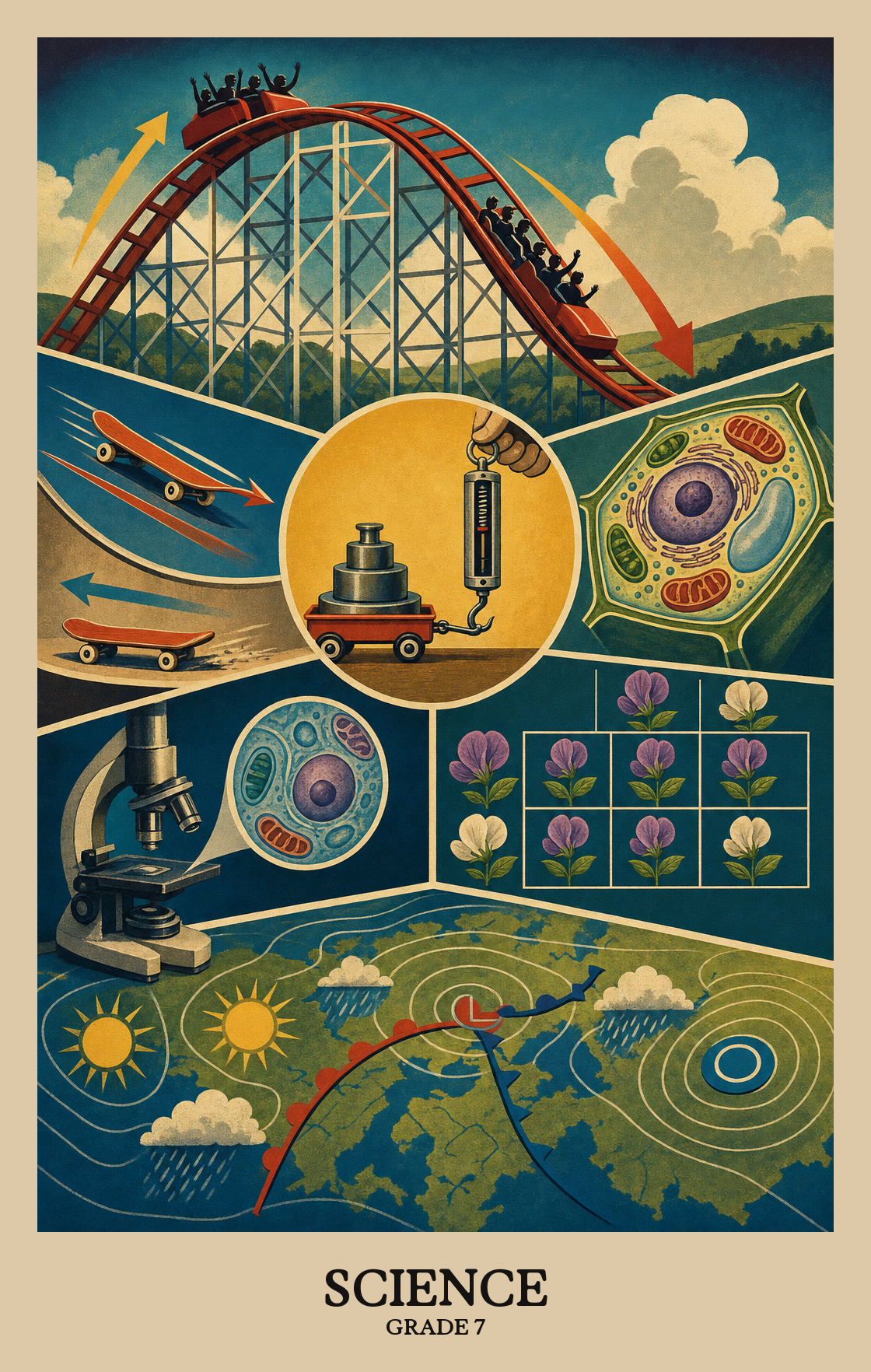
This is the year science moves from describing the world to explaining why it works. Students track how forces speed things up or slow them down, and how energy shifts between motion and stored-up potential on a roller coaster or ramp. They look inside cells to see how living things run, and use Punnett squares to predict which traits a child might inherit. By spring, students can read a weather map and explain what kind of day is coming.
Students describe how things move by tracking position, direction, and speed. They look at how pushes and pulls like gravity, friction, and magnets change motion, and they read graphs that show distance over time.
Students study how energy stored in a still object turns into the energy of a moving one, using examples like roller coasters and pendulums. They also test ramps, pulleys, and levers to see which makes work easier.
Students zoom in on the parts inside a single cell and see how cells build up into tissues, organs, and full body systems. They explain how systems like digestion, breathing, and circulation work together to keep a person alive.
Students learn how genes on chromosomes pass traits from parents to children. They compare offspring made by one parent with offspring made by two, and they use Punnett squares to predict traits like eye color.
Students explore the layers of air around Earth and follow water as it moves between the ground, sky, and clouds. They read weather maps and use fronts, pressure, wind, and humidity to predict what the sky will do next.
Students look at how human activity changes the air and warms the planet through the greenhouse effect. They study hazards like wildfires, hurricanes, and heat waves, and discuss ways people can stay safer and protect the air.
Students learn how forces like pushes, pulls, and gravity change the way objects move. They also read and draw graphs that show how speed and direction shift over time.
Students describe where an object is, which way it is moving, and how fast, all measured against a chosen reference point, like a tree or a building.
Students use diagrams or physical models to show what happens when forces acting on an object cancel each other out versus when one force wins. The examples they work with include friction, gravity, and magnetism.
Students read position-vs-time graphs to describe how an object moved: how far it traveled, how fast, and whether it sped up, slowed down, or stopped.
Reading a distance-over-time graph, students identify whether an object is moving at a steady speed or speeding up and slowing down. A steeper line means faster movement; a flat line means the object has stopped.
| Standard | Definition | Code |
|---|---|---|
| Understand motion, the effects of forces on motion, and the… | Students learn how forces like pushes, pulls, and gravity change the way objects move. They also read and draw graphs that show how speed and direction shift over time. | PS.7.1 |
| Construct an explanation to summarize the motion of an object by its position… | Students describe where an object is, which way it is moving, and how fast, all measured against a chosen reference point, like a tree or a building. | PS.7.1.1 |
| Use models to illustrate the effects of balanced and unbalanced forces acting… | Students use diagrams or physical models to show what happens when forces acting on an object cancel each other out versus when one force wins. The examples they work with include friction, gravity, and magnetism. | PS.7.1.2 |
| Analyze and interpret graphical data to summarize the motion of an object to… | Students read position-vs-time graphs to describe how an object moved: how far it traveled, how fast, and whether it sped up, slowed down, or stopped. | PS.7.1.3 |
| Analyze and interpret graphical data to summarize the motion of an object to… | Reading a distance-over-time graph, students identify whether an object is moving at a steady speed or speeding up and slowing down. A steeper line means faster movement; a flat line means the object has stopped. | PS.7.1.4 |
Students learn how energy moves and changes in mechanical systems, like a swinging pendulum or a rolling ball. They explore why the total amount of energy stays the same even as it shifts between motion and stored forms.
Mechanical energy is the total of two things: how fast an object moves and where it sits (like a ball at the top of a ramp). Students explain how those two parts add up to describe an object's motion and position together.
Students trace how stored energy (a ball at the top of a ramp, a swinging pendulum) turns into moving energy and back again. They back up their explanation with evidence, not just a guess.
Students test what happens when objects push or pull each other, such as a ramp rolling a ball or a stretched rubber band launching an object, to show that energy moves from one thing to another whenever a force acts over a distance.
Students test ramps, pulleys, levers, and wheels to find out which simple machine makes a job easier, then use what they observe to explain which tool fits which task.
| Standard | Definition | Code |
|---|---|---|
| Understand forms of energy, energy transfer and transformation… | Students learn how energy moves and changes in mechanical systems, like a swinging pendulum or a rolling ball. They explore why the total amount of energy stays the same even as it shifts between motion and stored forms. | PS.7.2 |
| Construct an explanation to summarize how kinetic and potential… | Mechanical energy is the total of two things: how fast an object moves and where it sits (like a ball at the top of a ramp). Students explain how those two parts add up to describe an object's motion and position together. | PS.7.2.1 |
| Engage in argument from evidence to explain how energy can be transformed from… | Students trace how stored energy (a ball at the top of a ramp, a swinging pendulum) turns into moving energy and back again. They back up their explanation with evidence, not just a guess. | PS.7.2.2 |
| Carry out investigations to conclude that energy can be transferred from one… | Students test what happens when objects push or pull each other, such as a ramp rolling a ball or a stretched rubber band launching an object, to show that energy moves from one thing to another whenever a force acts over a distance. | PS.7.2.3 |
| Carry out investigations to compare the efficiency of simple machines… | Students test ramps, pulleys, levers, and wheels to find out which simple machine makes a job easier, then use what they observe to explain which tool fits which task. | PS.7.2.4 |
Living things need specific parts and processes to stay alive and have offspring. Students learn how those structures work together, from how a cell gets energy to how a whole organism grows, responds, and reproduces.
Single-celled organisms like Euglena and Amoeba survive without any help from other cells. Students explain how each tiny structure inside these organisms handles eating, moving, and reproducing on its own.
Students use diagrams or models to show what each part of a cell does, such as how the nucleus stores instructions or how the mitochondria produce energy, and explain how those parts keep plant, animal, and bacterial cells alive.
Students trace how a body is built in layers: cells group into tissues, tissues form organs, organs work together as systems, and systems keep the whole organism alive.
Students explain how the body's major systems work together to keep a person alive, covering how we digest food, breathe, circulate blood, and send signals through the nervous system.
| Standard | Definition | Code |
|---|---|---|
| Understand the processes, structures and functions of living organisms that… | Living things need specific parts and processes to stay alive and have offspring. Students learn how those structures work together, from how a cell gets energy to how a whole organism grows, responds, and reproduces. | LS.7.1 |
| Construct an explanation to conclude how the structures of… | Single-celled organisms like Euglena and Amoeba survive without any help from other cells. Students explain how each tiny structure inside these organisms handles eating, moving, and reproducing on its own. | LS.7.1.1 |
| Use models to explain how the relevant structures within cells | Students use diagrams or models to show what each part of a cell does, such as how the nucleus stores instructions or how the mitochondria produce energy, and explain how those parts keep plant, animal, and bacterial cells alive. | LS.7.1.2 |
| Use models to explain how the hierarchical organization of… | Students trace how a body is built in layers: cells group into tissues, tissues form organs, organs work together as systems, and systems keep the whole organism alive. | LS.7.1.3 |
| Construct an explanation to summarize how the major systems of the human body… | Students explain how the body's major systems work together to keep a person alive, covering how we digest food, breathe, circulate blood, and send signals through the nervous system. | LS.7.1.4 |
Genes sit on chromosomes inside every cell and are passed from parents to offspring. Students explain how those inherited genes shape traits like eye color, height, or leaf shape, using evidence to back their reasoning.
Reproduction passes traits from parents to offspring, but the mix of genes can shift with each generation. Students learn why siblings can look different from each other and from their parents.
Students use diagrams or models to show why offspring from asexual reproduction are genetic copies of one parent, while offspring from sexual reproduction carry a mix of traits from two parents.
Students use a Punnett square to predict which traits an offspring might inherit from its parents, such as whether a trait like eye color will show up or stay hidden.
| Standard | Definition | Code |
|---|---|---|
| Construct an explanation supported with scientific evidence to summarize the… | Genes sit on chromosomes inside every cell and are passed from parents to offspring. Students explain how those inherited genes shape traits like eye color, height, or leaf shape, using evidence to back their reasoning. | LS.7.2.1 |
| Understand the relationship of the mechanisms of reproduction, patterns of… | Reproduction passes traits from parents to offspring, but the mix of genes can shift with each generation. Students learn why siblings can look different from each other and from their parents. | LS.7.2 |
| Use models to explain how asexual reproduction results in offspring… | Students use diagrams or models to show why offspring from asexual reproduction are genetic copies of one parent, while offspring from sexual reproduction carry a mix of traits from two parents. | LS.7.2.2 |
| Use models (Punnett squares) to infer and predict patterns of the inheritance… | Students use a Punnett square to predict which traits an offspring might inherit from its parents, such as whether a trait like eye color will show up or stay hidden. | LS.7.2.3 |
Students learn how the atmosphere works and why water moving through it as rain, evaporation, and clouds shapes daily weather and longer climate patterns.
Students compare the layers of air that wrap around Earth, looking at what gases make up each layer and how temperature and pressure change from the ground up into the upper atmosphere.
Students trace water as it moves through the sky, land, and ocean, showing how sunlight powers evaporation and gravity pulls water back down as rain or snow. Those same forces shape the weather patterns we see every day.
Students study weather maps to explain why storms, clear skies, or temperature changes arrive when they do. They connect moving air masses and pressure systems to the actual weather conditions those patterns produce.
Students read weather maps, satellite images, and radar to predict what weather is coming. They use cloud patterns, wind speed, temperature, and air pressure as clues.
Students use diagrams or models to show how rising warm air, global wind patterns, and the jet stream push weather systems around the planet, shaping both day-to-day conditions and longer seasonal patterns.
| Standard | Definition | Code |
|---|---|---|
| Understand the atmosphere and how the cycling of water relates to Earth’s… | Students learn how the atmosphere works and why water moving through it as rain, evaporation, and clouds shapes daily weather and longer climate patterns. | ESS.7.1 |
| Analyze and interpret data to compare the composition, properties and structure… | Students compare the layers of air that wrap around Earth, looking at what gases make up each layer and how temperature and pressure change from the ground up into the upper atmosphere. | ESS.7.1.1 |
| Use models to explain how the energy of the Sun and Earth’s gravity drive the… | Students trace water as it moves through the sky, land, and ocean, showing how sunlight powers evaporation and gravity pulls water back down as rain or snow. Those same forces shape the weather patterns we see every day. | ESS.7.1.2 |
| Analyze and interpret data to explain the relationship between the movement of… | Students study weather maps to explain why storms, clear skies, or temperature changes arrive when they do. They connect moving air masses and pressure systems to the actual weather conditions those patterns produce. | ESS.7.1.3 |
| Use models to predict weather conditions based on observations | Students read weather maps, satellite images, and radar to predict what weather is coming. They use cloud patterns, wind speed, temperature, and air pressure as clues. | ESS.7.1.4 |
| Use models to explain the influence of convection, global winds | Students use diagrams or models to show how rising warm air, global wind patterns, and the jet stream push weather systems around the planet, shaping both day-to-day conditions and longer seasonal patterns. | ESS.7.1.5 |
Students learn how human activity changes the air around us, and how changes in the atmosphere affect human health and daily life in return.
Students look at air quality data and use it to argue why keeping the atmosphere clean matters for human health. They learn that monitoring pollution and making responsible choices about it are connected.
Students look at real climate data to explain how gases like carbon dioxide trap heat in the atmosphere and push global temperatures up or down.
Students study how hazardous weather events and poor air quality harm people, then examine what communities do to reduce that harm. Covered conditions include wildfires, hurricanes, tornadoes, floods, and dangerous heat or UV levels.
| Standard | Definition | Code |
|---|---|---|
| Understand the reciprocal relationship between the atmosphere and humans | Students learn how human activity changes the air around us, and how changes in the atmosphere affect human health and daily life in return. | ESS.7.2 |
| Engage in argument from evidence to explain that the good health of humans and… | Students look at air quality data and use it to argue why keeping the atmosphere clean matters for human health. They learn that monitoring pollution and making responsible choices about it are connected. | ESS.7.2.1 |
| Analyze and interpret data to explain how changes in the structure… | Students look at real climate data to explain how gases like carbon dioxide trap heat in the atmosphere and push global temperatures up or down. | ESS.7.2.2 |
| Obtain, evaluate, and communicate information to explain the impacts on humans… | Students study how hazardous weather events and poor air quality harm people, then examine what communities do to reduce that harm. Covered conditions include wildfires, hurricanes, tornadoes, floods, and dangerous heat or UV levels. | ESS.7.2.3 |
Alternate assessment for eligible students with significant cognitive disabilities, covering state-tested grades and subjects.
Students study four big areas: motion and forces, energy, living things and heredity, and Earth's atmosphere and weather. They explain how things move, how cells and body systems work, how traits pass from parents to offspring, and what drives weather and climate.
Talk through everyday science moments. Watch the weather forecast together and guess what tomorrow will bring. Notice how a bike speeds up going downhill and slows going up. Ask questions like why a roller coaster needs a big first hill or why family members share certain features.
Students look at a graph showing how far something moved over time and describe the trip in words. A steep line means fast, a flat line means stopped. Practice by timing short walks across a room and sketching the result on paper.
Students should name the main parts of plant, animal, and bacterial cells and explain what each part does. They should also explain how single-celled organisms like amoebas handle everything a whole body does in larger creatures.
Many teachers start with motion and forces because the math and graphing skills carry into energy. Energy then leads into simple machines and investigations. Cells and heredity make a strong middle unit, and weather and human impact close the year with data and current events.
Punnett squares and the difference between potential and kinetic energy trip students up most years. Reading motion graphs is another common stumbling block, especially telling the difference between distance over time and speed over time. Plan extra practice and quick checks for these.
Ramp races for speed and energy, pendulum swings, simple machine comparisons, and onion or cheek cell viewing under a microscope all work well. For weather, daily station data and cloud logs give students real numbers to analyze over weeks.
Make a quick family trait chart at the kitchen table. Look at things like attached or free earlobes, eye color, or tongue rolling. Then sketch a two-by-two box and predict what a future child might inherit. Ten minutes of this beats a worksheet.
Ready students can explain a system, not just label it. They can describe how energy changes form on a roller coaster, how body systems work together during exercise, and how a cold front changes the weather, using evidence from data or a model.