Sorting and describing objects
Students look closely at everyday things and put them into groups by size, color, shape, texture, and weight. They start using clear words to describe what they notice.
This is the year students start noticing the world like a scientist. They sort everyday objects by what they feel and look like, watch how things move when pushed or dropped, and figure out what makes something alive. Students also track the weather day by day and notice how it shifts with the seasons. By spring, they can compare two leaves or two puppies and point out what is the same and what is different.
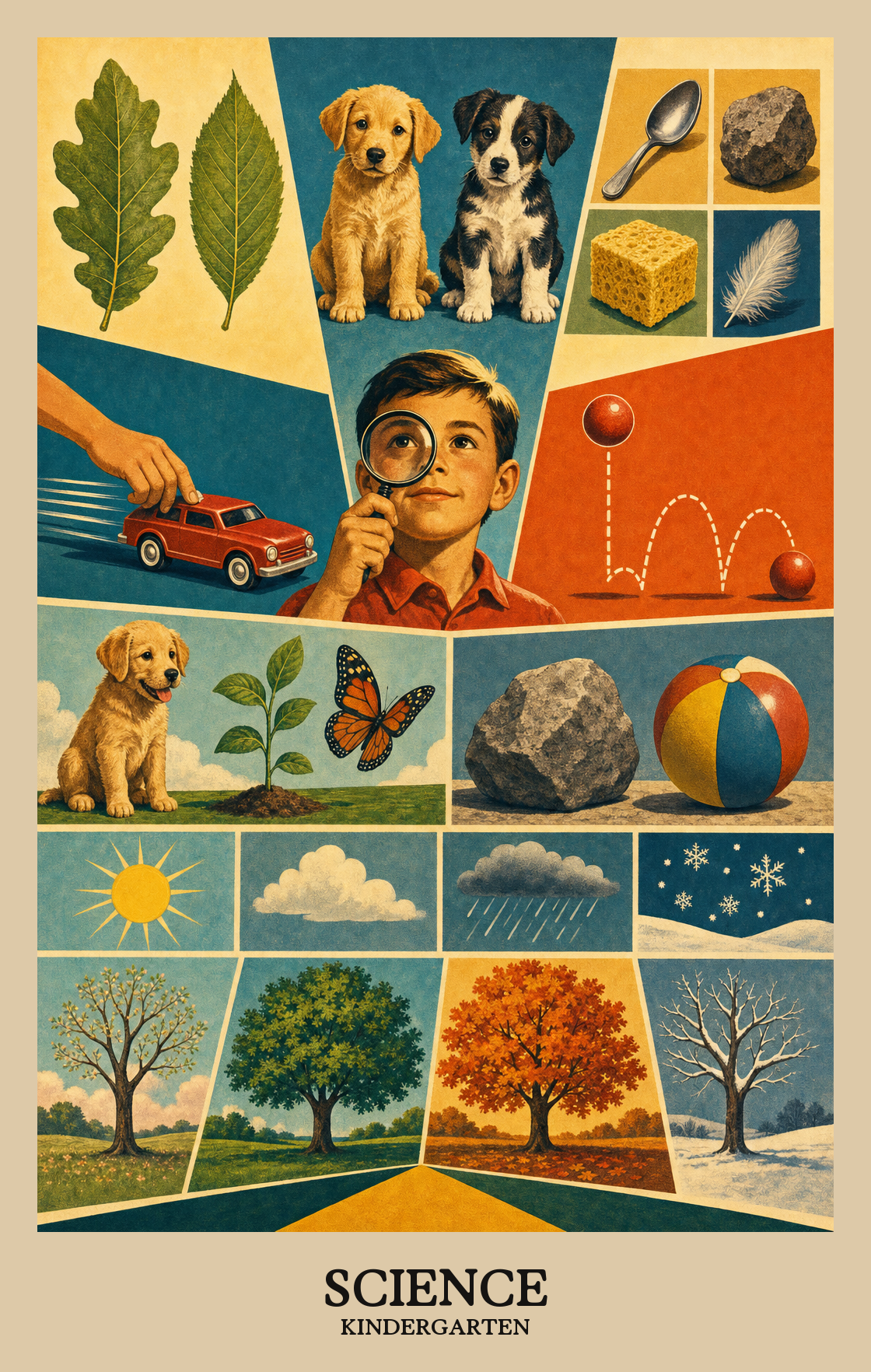
Students look closely at everyday things and put them into groups by size, color, shape, texture, and weight. They start using clear words to describe what they notice.
Students figure out why a raincoat is made of cloth and a block is made of wood. They use what they see and feel to explain why certain materials fit certain jobs.
Students describe where things are using words like above, below, beside, and between. They watch how objects move and notice straight paths, zigzags, fast rolls, and slow drops.
Students compare a rock to a rabbit and a plant to a toy. They notice what living things need to grow and how animals use their bodies to eat, hide, and move.
Students look at dogs next to other dogs and sunflowers next to other sunflowers. They notice what makes plants and animals of the same kind alike and what makes each one its own.
Students track the weather each day and talk about what changes from morning to afternoon and from one season to the next. They notice patterns in rain, sun, wind, and temperature.
Students sort and describe everyday objects by how they look, feel, and move. A rock is hard; a cotton ball is soft. Physical properties like color, shape, size, and texture tell us what something is made of and what it can do.
Students sort everyday objects by what they can see, feel, and lift: how big or small something is, what color and shape it has, whether it feels rough or smooth, and whether it bends or stays stiff.
Students look at everyday materials like clay, wood, and cloth, then explain why each one is useful for certain jobs based on what it feels, looks, or acts like.
| Standard | Definition | Code |
|---|---|---|
| Understand how objects are described based on their physical properties and how… | Students sort and describe everyday objects by how they look, feel, and move. A rock is hard; a cotton ball is soft. Physical properties like color, shape, size, and texture tell us what something is made of and what it can do. | PS.K.1 |
| Analyze and interpret data to classify objects by physical properties | Students sort everyday objects by what they can see, feel, and lift: how big or small something is, what color and shape it has, whether it feels rough or smooth, and whether it bends or stays stiff. | PS.K.1.1 |
| Engage in argument from evidence to summarize how different materials | Students look at everyday materials like clay, wood, and cloth, then explain why each one is useful for certain jobs based on what it feels, looks, or acts like. | PS.K.1.2 |
Students describe where things are (near, far, above, below) and how they move (fast, slow, rolling, spinning). They practice this with everyday objects and living things they can see around them.
Students use toys, drawings, or real objects to practice position words like "above," "below," "beside," and "in front of." They describe where things are in the classroom and outside.
Students watch and test how things move: a ball rolling straight, a toy swinging back and forth, or a leaf spinning as it falls. They try moving objects different ways and notice the difference between fast and slow.
| Standard | Definition | Code |
|---|---|---|
| Understand the positions and motions of objects and organisms observed in the… | Students describe where things are (near, far, above, below) and how they move (fast, slow, rolling, spinning). They practice this with everyday objects and living things they can see around them. | PS.K.2 |
| Use models to compare the relative position of various objects observed in the… | Students use toys, drawings, or real objects to practice position words like "above," "below," "beside," and "in front of." They describe where things are in the classroom and outside. | PS.K.2.1 |
| Carry out investigations to illustrate different ways objects and… | Students watch and test how things move: a ball rolling straight, a toy swinging back and forth, or a leaf spinning as it falls. They try moving objects different ways and notice the difference between fast and slow. | PS.K.2.2 |
Living things grow, eat, and move on their own. Students sort animals, plants, rocks, and water into groups based on what living things do and what they don't.
Students sort living things from nonliving things by looking at how they grow, move, and what they need to survive. A dog grows and needs food; a rock does not.
Animals use their body parts in different ways: sharp claws to catch food, thick shells to stay safe, strong legs to run. Students show how each body part helps the animal survive, using drawings or simple models.
| Standard | Definition | Code |
|---|---|---|
| Understand the characteristics of living organisms and nonliving things | Living things grow, eat, and move on their own. Students sort animals, plants, rocks, and water into groups based on what living things do and what they don't. | LS.K.1 |
| Engage in argument from evidence to summarize the characteristics of living… | Students sort living things from nonliving things by looking at how they grow, move, and what they need to survive. A dog grows and needs food; a rock does not. | LS.K.1.1 |
| Use models to exemplify how animals use their body parts to obtain food and… | Animals use their body parts in different ways: sharp claws to catch food, thick shells to stay safe, strong legs to run. Students show how each body part helps the animal survive, using drawings or simple models. | LS.K.1.2 |
Students sort living things by features they share and features that set them apart, like how a dog and a cat both have fur but one barks and the other meows.
Students look at pictures or real examples of the same kind of animal and notice what is alike and what is different, such as two dogs that share four legs but have different colors or ear shapes.
Students look at pictures or real plants of the same type and notice what is alike and what is different, such as leaf shape or color. Not every plant looks exactly the same, even when they belong to the same family.
| Standard | Definition | Code |
|---|---|---|
| Understand characteristics of organisms that make them alike and different | Students sort living things by features they share and features that set them apart, like how a dog and a cat both have fur but one barks and the other meows. | LS.K.2 |
| Analyze and interpret data to compare the characteristics of different types of… | Students look at pictures or real examples of the same kind of animal and notice what is alike and what is different, such as two dogs that share four legs but have different colors or ear shapes. | LS.K.2.1 |
| Analyze and interpret data to compare the characteristics of different types of… | Students look at pictures or real plants of the same type and notice what is alike and what is different, such as leaf shape or color. Not every plant looks exactly the same, even when they belong to the same family. | LS.K.2.2 |
Students learn to notice how weather changes from day to day and across seasons. They describe what they see outside: sunny or cloudy, warm or cold, rainy or snowy.
Students look at simple weather data, like temperature or rainfall records, and describe how the environment changes from sunny days to rainy ones. They learn to spot patterns in what weather does to the world around them.
Students track the weather each day, noting whether it is sunny, rainy, or cold, and look for patterns in how the weather shifts from one day to the next and across the seasons.
Students look at weather across the four seasons and describe what changes, like why winter feels colder than summer or why spring brings more rain.
| Standard | Definition | Code |
|---|---|---|
| Understand change and observable patterns of weather that occur from day to day… | Students learn to notice how weather changes from day to day and across seasons. They describe what they see outside: sunny or cloudy, warm or cold, rainy or snowy. | ESS.K.1 |
| Analyze and interpret data to compare changes in the environment due to weather | Students look at simple weather data, like temperature or rainfall records, and describe how the environment changes from sunny days to rainy ones. They learn to spot patterns in what weather does to the world around them. | ESS.K.1.1 |
| Use mathematics and computational thinking to summarize daily… | Students track the weather each day, noting whether it is sunny, rainy, or cold, and look for patterns in how the weather shifts from one day to the next and across the seasons. | ESS.K.1.2 |
| Obtain, evaluate and communicate information to compare weather patterns that… | Students look at weather across the four seasons and describe what changes, like why winter feels colder than summer or why spring brings more rain. | ESS.K.1.3 |
Alternate assessment for eligible students with significant cognitive disabilities, covering state-tested grades and subjects.
Students spend the year noticing and sorting things around them. They group objects by how they look and feel, watch how things move, compare plants and animals, and track the weather. Most of the learning happens through hands-on play and short conversations about what students see.
Go on short backyard or sidewalk walks and ask what students notice. Sort laundry by color and texture, point out where the cat is hiding using words like under and behind, or check the sky each morning before school. Five minutes of noticing out loud counts.
Not really. The goal is using words in real moments, not memorizing a list. If a student can say a ball rolled fast and zigzagged, or that a rock is heavy and smooth, that is exactly the right kind of talk.
Students should describe an object by a few properties, show where something is using position words, name basic needs of living things, and talk about how weather changes across the seasons. They should also be able to give a reason for what they think, based on what they saw.
Many teachers start with physical properties and sorting, since those skills carry into every other unit. Motion and position fit well in the fall when students are still building classroom routines. Living things and weather work best stretched across the year so students can watch real changes happen.
Position words like beside, between, and behind trip up a lot of students, and so does the difference between living and nonliving when something moves but is not alive, like water or a toy car. Short daily routines help more than a single big lesson.
Most evidence comes from talking, drawing, sorting, and acting things out. A labeled picture of an animal with its body parts, a sorted pile of leaves, or a daily weather chart with stickers all count as real science work.
No. At this age, careful play is the work. Dropping objects to see how they fall, watching a bug, or sorting rocks is how students build the habits of looking closely and asking questions that science depends on later.
A ready student can describe an object using a couple of properties, compare two plants or two animals, use position and motion words correctly, and talk about today's weather compared to yesterday. Comfort explaining thinking matters as much as the right answer.