Matter and chemical change
Students build models of what stuff is made of and watch what happens when substances mix, heat up, or cool down. They track whether a real change has happened and notice that the amount of matter stays the same.
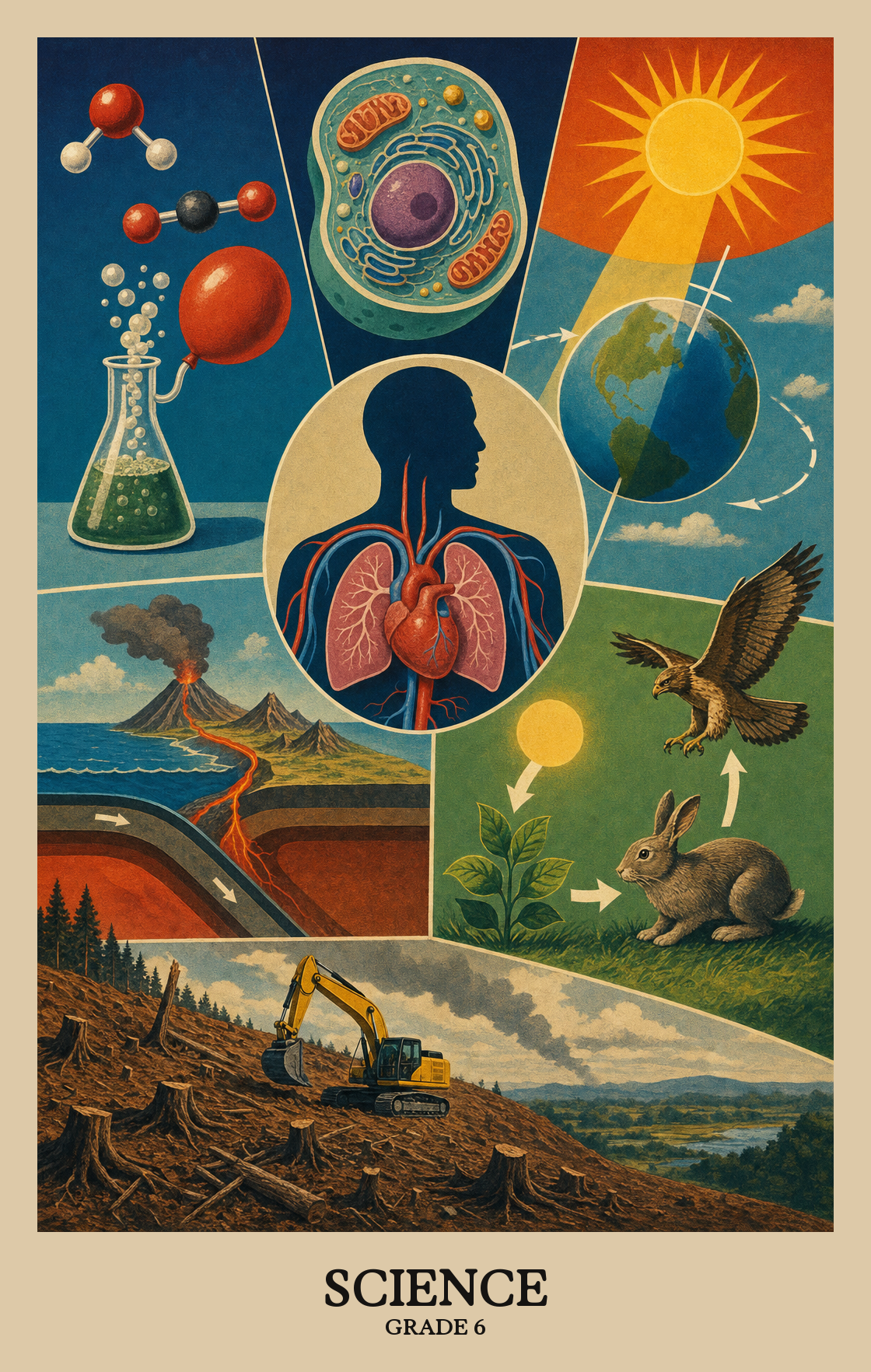
This is the year science starts asking how things actually work under the surface. Students build models of atoms and molecules, track energy as it moves through collisions and chemical reactions, and explain how cells and body systems keep an organism alive. They also look outward, using evidence to explain seasons, plate motion, and how humans change the planet. By spring, students can sketch a model that shows what happens to matter and energy in a real-world system, from a chemical reaction to an ecosystem.
Students build models of what stuff is made of and watch what happens when substances mix, heat up, or cool down. They track whether a real change has happened and notice that the amount of matter stays the same.
Students study what makes objects speed up, slow down, or pull on each other from a distance. They design something to soften a crash and look at how mass and speed change the energy an object carries.
Students explore how waves carry energy, how light and sound bounce or pass through materials, and how heat moves from one thing to another. They build and test a device that traps or releases heat.
Students learn that every living thing is built from cells and that body systems work together to keep an animal alive. They also look at how plants and animals get energy and how living things in an area depend on each other.
Students look at why members of the same species are not identical and how those differences can help some survive. They use fossils and graphs to see how populations and life on Earth have shifted over long stretches of time.
Students model the sun, moon, and planets to explain seasons, phases, and eclipses. They study how the ground, water, and air shape the planet, and look at how a growing human population changes the climate and the land.
Students draw or build models showing how atoms link together to form molecules like water or salt. The model shows which atoms are present and how they connect.
Students compare what a substance looks like, smells like, or weighs before and after mixing it with something else to figure out whether a new substance was formed.
Students research where synthetic materials like plastic or nylon come from, then explain how those materials changed everyday life. The focus is on tracing a manufactured product back to the natural resource it started from.
Students build a diagram or model showing what happens to a substance's particles when heat is added or taken away, tracing how ice melts into water or water freezes back into ice as the particles speed up or slow down.
In a chemical reaction, atoms rearrange into new substances but none are created or destroyed. Students build and use models to show why the total mass before and after a reaction stays the same.
Students build a device that uses a chemical reaction to heat up or cool down, then test it and adjust it based on what they observe. Think hand warmers or instant cold packs.
Students design something that absorbs or redirects impact during a crash, then test how well it worked. The goal is to reduce the force felt when two objects collide.
Students set up an experiment to show that a heavier object needs more force to speed up or slow down, and that two forces pushing in opposite directions partly cancel each other out.
Students study diagrams and collect data to figure out what makes electric and magnetic forces stronger or weaker, such as how distance between objects or the amount of charge affects the pull or push they produce.
Students draw a graph showing how the pull between two objects changes as their masses change, then use that graph to back up the argument that heavier objects exert a stronger gravitational pull.
Students test how magnets and charged objects push or pull each other without touching, then judge whether the experiment was set up well enough to trust the results.
Students read and build graphs showing how a moving object's energy changes when it gets heavier or faster. A heavier car rolling downhill carries more energy than a lighter one; a faster car carries more energy than a slower one.
When two magnets or two charged objects move closer together or farther apart, the stored energy between them changes. Students build a model to show how that stored energy depends on the distance between the objects.
Students design and build a device to control heat transfer, then test whether it works. Think of it as engineering an insulated cooler or a heat sink and proving it does the job.
Students heat different materials and measure how much the temperature changes. The experiment shows how mass and material type affect how much energy something absorbs.
When a moving object speeds up or slows down, energy is either flowing into it or leaving it. Students argue, with evidence, why that change in motion means energy moved somewhere.
Students use math to show how waves work, focusing on amplitude, the height of a wave. A taller wave carries more energy, whether it moves through water, sound, or light.
Waves hit a surface and one of three things happens: they bounce back, pass through, or get soaked up by the material. Students model and explain which outcome occurs depending on what the wave meets.
| Standard | Definition | Code |
|---|---|---|
| Develop models to describe the atomic composition of simple molecules and… | Students draw or build models showing how atoms link together to form molecules like water or salt. The model shows which atoms are present and how they connect. | 6-8.PS1.A-1 |
| Analyze and interpret data on the properties of substances before and after the… | Students compare what a substance looks like, smells like, or weighs before and after mixing it with something else to figure out whether a new substance was formed. | 6-8.PS1.A-2 |
| Gather, analyze, and present information to describe that synthetic materials… | Students research where synthetic materials like plastic or nylon come from, then explain how those materials changed everyday life. The focus is on tracing a manufactured product back to the natural resource it started from. | 6-8.PS1.A-3 |
| Develop a model that describes changes in particle motion, temperature | Students build a diagram or model showing what happens to a substance's particles when heat is added or taken away, tracing how ice melts into water or water freezes back into ice as the particles speed up or slow down. | 6-8.PS1.A-4 |
| Develop and use a model to describe how the total number of atoms remains the… | In a chemical reaction, atoms rearrange into new substances but none are created or destroyed. Students build and use models to show why the total mass before and after a reaction stays the same. | 6-8.PS1.B-5 |
| Construct, test, and modify a device that either releases or absorbs thermal… | Students build a device that uses a chemical reaction to heat up or cool down, then test it and adjust it based on what they observe. Think hand warmers or instant cold packs. | 6-8.PS1.B-6 |
| Apply physics principles to design a solution that minimizes the force of an… | Students design something that absorbs or redirects impact during a crash, then test how well it worked. The goal is to reduce the force felt when two objects collide. | 6-8.PS2.A-1 |
| Plan and conduct an investigation to provide evidence that the change in an… | Students set up an experiment to show that a heavier object needs more force to speed up or slow down, and that two forces pushing in opposite directions partly cancel each other out. | 6-8.PS2.A-2 |
| Analyze diagrams and collect data to determine the factors that affect the… | Students study diagrams and collect data to figure out what makes electric and magnetic forces stronger or weaker, such as how distance between objects or the amount of charge affects the pull or push they produce. | 6-8.PS2.B-3 |
| Create and analyze a graph to use as evidence to support the claim that… | Students draw a graph showing how the pull between two objects changes as their masses change, then use that graph to back up the argument that heavier objects exert a stronger gravitational pull. | 6-8.PS2.B-4 |
| Conduct an investigation and evaluate the experimental design to provide… | Students test how magnets and charged objects push or pull each other without touching, then judge whether the experiment was set up well enough to trust the results. | 6-8.PS2.B-5 |
| Construct and interpret graphical displays of data to describe the… | Students read and build graphs showing how a moving object's energy changes when it gets heavier or faster. A heavier car rolling downhill carries more energy than a lighter one; a faster car carries more energy than a slower one. | 6-8.PS3.A-1 |
| Develop a model to describe that when the arrangement of objects interacting at… | When two magnets or two charged objects move closer together or farther apart, the stored energy between them changes. Students build a model to show how that stored energy depends on the distance between the objects. | 6-8.PS3.A-2 |
| Apply scientific principles to design, construct | Students design and build a device to control heat transfer, then test whether it works. Think of it as engineering an insulated cooler or a heat sink and proving it does the job. | 6-8.PS3.A-3 |
| Plan and conduct an investigation to determine the relationships among the… | Students heat different materials and measure how much the temperature changes. The experiment shows how mass and material type affect how much energy something absorbs. | 6-8.PS3.A-4 |
| Construct, use, and present arguments to support the claim that when the… | When a moving object speeds up or slows down, energy is either flowing into it or leaving it. Students argue, with evidence, why that change in motion means energy moved somewhere. | 6-8.PS3.B-5 |
| Use mathematical representations to describe a simple model for waves that… | Students use math to show how waves work, focusing on amplitude, the height of a wave. A taller wave carries more energy, whether it moves through water, sound, or light. | 6-8.PS4.A-1 |
| Develop and use a model to describe that waves are reflected, absorbed | Waves hit a surface and one of three things happens: they bounce back, pass through, or get soaked up by the material. Students model and explain which outcome occurs depending on what the wave meets. | 6-8.PS4.A-2 |
All living things are made of cells. Students explain how a single-celled organism like an amoeba handles every job needed to stay alive, and how those same jobs get divided among many cells in a larger organism like a plant or an animal.
Cells have parts with specific jobs, the way organs do in a body. Students build or use a model to show what each part does and how the parts work together to keep the cell running.
Living things are built in layers. Cells group into tissues, tissues form organs, and organs work together as systems that keep the body running.
Students gather evidence to show how body systems work together: the lungs bring in oxygen, the digestive system breaks down food, and the blood carries both to cells while hauling waste out.
Animal behaviors like courtship and nest-building, and plant structures like bright flowers or hooks on seeds, all raise the odds that an organism reproduces. Students explain how these traits help living things pass on their characteristics to the next generation.
Growth isn't just genetics. Students explain, using real evidence, how both an organism's genes and its environment (food, light, temperature) shape how it grows and develops.
Plants capture sunlight and turn it into sugar. Animals (and plants) break that sugar down to release energy, cycling the same carbon atoms through living things over and over.
Students look at real data (like food supply records or population counts) to explain why a plant or animal thrives, struggles, or declines when resources like food and water run short.
Students explain how living things and nonliving conditions in an ecosystem affect each other, then predict what happens when one part changes. Think: what shifts when a drought hits a forest, or a predator disappears from a lake.
Students trace how matter (like carbon or water) moves through an ecosystem and how energy flows from the sun through plants to animals. They build a diagram or model showing how living things and their environment exchange both.
When conditions change, like a drought or new species arriving, some ecosystems bounce back and some don't. Students examine what makes an ecosystem stable and what pushes it past the point of recovery.
When something in an ecosystem changes, such as a drought or a new predator arriving, other populations grow, shrink, or disappear. Students use real evidence to build an argument explaining why.
Students look at real plans people have used to protect or restore an ecosystem, then weigh what each plan does well and where it falls short.
Students learn why living things look different from one another and how those differences help some survive while others don't. This builds toward understanding how species change over generations and why some die out.
Fossils, DNA, and body structures show that living things share common ancestors. Students look at this evidence to explain how life on Earth has changed over millions of years and why species that seem different are actually related.
Fossils tell the story of life on Earth. Students study fossil evidence to figure out how environments changed over time, why some species died out, and how others adapted or evolved.
Natural selection is how a species slowly changes over generations. Animals and plants with traits that help them survive in their environment tend to live longer and pass those traits on to offspring.
Some animals in a group are born with traits that help them survive and have offspring in their environment. Students study real examples to explain why those helpful traits get passed down more often over time.
Students research technologies like selective breeding and genetic modification that let humans shape which traits animals or plants pass on to their offspring.
Natural traits that help a species survive, like thick fur in cold climates or long beaks for reaching food, spread through a population over generations because individuals with those traits live longer and reproduce more.
Students read graphs showing how a trait, like body size or coloring, became more or less common in a population over generations. They use that data to explain how natural selection shaped the change.
| Standard | Definition | Code |
|---|---|---|
| Provide evidence that organisms | All living things are made of cells. Students explain how a single-celled organism like an amoeba handles every job needed to stay alive, and how those same jobs get divided among many cells in a larger organism like a plant or an animal. | 6-8.LS1.A-1 |
| Develop and use a model to describe the function of a cell as a whole and ways… | Cells have parts with specific jobs, the way organs do in a body. Students build or use a model to show what each part does and how the parts work together to keep the cell running. | 6-8.LS1.A-2 |
| Develop an argument supported by evidence for how multicellular organisms are… | Living things are built in layers. Cells group into tissues, tissues form organs, and organs work together as systems that keep the body running. | 6-8.LS1.A-3 |
| Present evidence that body systems interact to carry out key body functions… | Students gather evidence to show how body systems work together: the lungs bring in oxygen, the digestive system breaks down food, and the blood carries both to cells while hauling waste out. | 6-8.LS1.A-4 |
| Construct an explanation for how characteristic animal behaviors as well as… | Animal behaviors like courtship and nest-building, and plant structures like bright flowers or hooks on seeds, all raise the odds that an organism reproduces. Students explain how these traits help living things pass on their characteristics to the next generation. | 6-8.LS1.B-5 |
| Construct a scientific explanation based on evidence for how environmental and… | Growth isn't just genetics. Students explain, using real evidence, how both an organism's genes and its environment (food, light, temperature) shape how it grows and develops. | 6-8.LS1.B-6 |
| Construct a scientific explanation based on evidence for the role of… | Plants capture sunlight and turn it into sugar. Animals (and plants) break that sugar down to release energy, cycling the same carbon atoms through living things over and over. | 6-8.LS1.C-7 |
| Analyze and interpret data to provide evidence for the effects of resource… | Students look at real data (like food supply records or population counts) to explain why a plant or animal thrives, struggles, or declines when resources like food and water run short. | 6-8.LS2.A-1 |
| Construct an explanation that predicts the patterns of interactions among and… | Students explain how living things and nonliving conditions in an ecosystem affect each other, then predict what happens when one part changes. Think: what shifts when a drought hits a forest, or a predator disappears from a lake. | 6-8.LS2.A-2 |
| Develop a model to describe the cycling of matter and flow of energy among… | Students trace how matter (like carbon or water) moves through an ecosystem and how energy flows from the sun through plants to animals. They build a diagram or model showing how living things and their environment exchange both. | 6-8.LS2.B-3 |
| Ecosystems Dynamics, Functioning and Resilience | When conditions change, like a drought or new species arriving, some ecosystems bounce back and some don't. Students examine what makes an ecosystem stable and what pushes it past the point of recovery. | LS2.C |
| Construct an argument supported by empirical evidence that explains how changes… | When something in an ecosystem changes, such as a drought or a new predator arriving, other populations grow, shrink, or disappear. Students use real evidence to build an argument explaining why. | 6-8.LS2.C-4 |
| Evaluate benefits and limitations of differing design solutions for maintaining… | Students look at real plans people have used to protect or restore an ecosystem, then weigh what each plan does well and where it falls short. | 6-8.LS2.C-5 |
| Biological Evolution | Students learn why living things look different from one another and how those differences help some survive while others don't. This builds toward understanding how species change over generations and why some die out. | LS4 |
| Evidence of Common Ancestry and Diversity | Fossils, DNA, and body structures show that living things share common ancestors. Students look at this evidence to explain how life on Earth has changed over millions of years and why species that seem different are actually related. | LS4.A |
| Analyze and interpret evidence from the fossil record to infer patterns of… | Fossils tell the story of life on Earth. Students study fossil evidence to figure out how environments changed over time, why some species died out, and how others adapted or evolved. | 6-8.LS4.A-1 |
| Natural Selection | Natural selection is how a species slowly changes over generations. Animals and plants with traits that help them survive in their environment tend to live longer and pass those traits on to offspring. | LS4.B |
| Construct an explanation based on evidence that describes how genetic… | Some animals in a group are born with traits that help them survive and have offspring in their environment. Students study real examples to explain why those helpful traits get passed down more often over time. | 6-8.LS4.B-2 |
| Gather and synthesize information about the technologies that have changed the… | Students research technologies like selective breeding and genetic modification that let humans shape which traits animals or plants pass on to their offspring. | 6-8.LS4.B-3 |
| Adaptation | Natural traits that help a species survive, like thick fur in cold climates or long beaks for reaching food, spread through a population over generations because individuals with those traits live longer and reproduce more. | LS4.C |
| Interpret graphical representations to support explanations of how natural… | Students read graphs showing how a trait, like body size or coloring, became more or less common in a population over generations. They use that data to explain how natural selection shaped the change. | 6-8.LS4.C-4 |
Students build a model of the Earth, sun, and moon to explain why the moon appears to change shape each month and why eclipses happen when the three bodies line up.
Students build or draw a model showing why Earth's tilt causes seasons. As Earth orbits the sun, some parts of the planet receive sunlight at a steeper angle and get more heat, which is why summer and winter happen at different times in different places.
Gravity pulls every planet, moon, and star toward other massive objects. Students build or use a model to show how that pull keeps planets orbiting the sun and holds the shape of a galaxy.
Students study real measurements of planets, moons, and the sun to make sense of how their sizes and distances compare. The numbers are so large that students learn to use scaled-down models to make the comparisons meaningful.
Rock layers act like pages in Earth's history book. Students use evidence from those layers to explain how scientists divide deep time into eras and periods, and why that order matters for understanding how life and landscapes have changed.
Heat rising from deep inside Earth moves huge slabs of rock in slow, grinding loops. That motion builds mountains, pushes up new ocean floor, pulls old ocean floor back down, and sets off volcanoes along the way.
Rocks, landforms, and coastlines don't stay the same forever. Students study how slow processes like erosion and fast ones like earthquakes reshape the land, then use real evidence to explain how those changes happen over years or across millions of years.
Fossils, rock layers, and the shapes of continents give clues about how Earth's plates have shifted over millions of years. Students study maps and data to figure out where those plates used to be.
Students build a model showing how water moves through the water cycle: evaporating into the air, forming clouds, and falling back to Earth. The sun's heat and gravity keep the cycle going.
Students research and analyze weather data to show how moving air masses collide and interact to cause changes in temperature, wind, and precipitation.
Students build a model showing how the sun heats Earth unevenly and how Earth's spin sets the atmosphere and oceans in motion. Those two forces together shape the climate patterns a region gets year after year.
Students explain why coal, oil, drinkable water, and metals aren't spread evenly across the planet. They use evidence to connect those patterns to geological events and to how humans have extracted or redirected resources over time.
Students study real data from past earthquakes, floods, and other natural disasters to spot patterns. Those patterns help scientists predict when and where disasters might strike next, and what tools or structures could reduce the damage.
Students look at real data to see how a growing population, and each person using more resources, puts pressure on land, water, and air over time.
Students design a plan to track and reduce a human impact on the environment, such as pollution or habitat loss, using what they know about how Earth's systems work.
Human activities, like burning fuel for cars and electricity, release gases that trap heat in the atmosphere. Students learn how this changes weather patterns, sea levels, and ecosystems over time.
Students look at real data, like temperature records and carbon levels, to figure out what has driven rising global temperatures over the last hundred years. The evidence points to both natural factors and human activity.
| Standard | Definition | Code |
|---|---|---|
| Develop and use a model of the Earth-sun-moon system to explain the cyclic… | Students build a model of the Earth, sun, and moon to explain why the moon appears to change shape each month and why eclipses happen when the three bodies line up. | 6-8.ESS1.A-1 |
| Develop and use a model of the Earth-sun system to explain the cyclical pattern… | Students build or draw a model showing why Earth's tilt causes seasons. As Earth orbits the sun, some parts of the planet receive sunlight at a steeper angle and get more heat, which is why summer and winter happen at different times in different places. | 6-8.ESS1.A-2 |
| Develop and use a model to describe the role of gravity in the motions within… | Gravity pulls every planet, moon, and star toward other massive objects. Students build or use a model to show how that pull keeps planets orbiting the sun and holds the shape of a galaxy. | 6-8.ESS1.A-3 |
| Analyze and interpret data to determine scale properties of objects in the… | Students study real measurements of planets, moons, and the sun to make sense of how their sizes and distances compare. The numbers are so large that students learn to use scaled-down models to make the comparisons meaningful. | 6-8.ESS1.B-4 |
| Construct a scientific explanation based on evidence from rock strata for how… | Rock layers act like pages in Earth's history book. Students use evidence from those layers to explain how scientists divide deep time into eras and periods, and why that order matters for understanding how life and landscapes have changed. | 6-8.ESS1.C-5 |
| Develop and use a model to illustrate that energy from the Earth's interior… | Heat rising from deep inside Earth moves huge slabs of rock in slow, grinding loops. That motion builds mountains, pushes up new ocean floor, pulls old ocean floor back down, and sets off volcanoes along the way. | 6-8.ESS2.A-1 |
| Construct an explanation based on evidence for how geoscience processes have… | Rocks, landforms, and coastlines don't stay the same forever. Students study how slow processes like erosion and fast ones like earthquakes reshape the land, then use real evidence to explain how those changes happen over years or across millions of years. | 6-8.ESS2.A-2 |
| Analyze and interpret data on the distribution of fossils and rocks… | Fossils, rock layers, and the shapes of continents give clues about how Earth's plates have shifted over millions of years. Students study maps and data to figure out where those plates used to be. | 6-8.ESS2.B-3 |
| Design and develop a model to describe the cycling of water through Earth's… | Students build a model showing how water moves through the water cycle: evaporating into the air, forming clouds, and falling back to Earth. The sun's heat and gravity keep the cycle going. | 6-8.ESS2.C-4 |
| Research, collect, and analyze data to provide evidence for how the motions and… | Students research and analyze weather data to show how moving air masses collide and interact to cause changes in temperature, wind, and precipitation. | 6-8.ESS2.C-5 |
| Develop and use a model to describe how unequal heating and rotation of the… | Students build a model showing how the sun heats Earth unevenly and how Earth's spin sets the atmosphere and oceans in motion. Those two forces together shape the climate patterns a region gets year after year. | 6-8.ESS2.C-6 |
| Construct a scientific explanation based on evidence for how the uneven… | Students explain why coal, oil, drinkable water, and metals aren't spread evenly across the planet. They use evidence to connect those patterns to geological events and to how humans have extracted or redirected resources over time. | 6-8.ESS3.A-1 |
| Analyze and interpret data on natural hazards to forecast future catastrophic… | Students study real data from past earthquakes, floods, and other natural disasters to spot patterns. Those patterns help scientists predict when and where disasters might strike next, and what tools or structures could reduce the damage. | 6-8.ESS3.B-2 |
| Analyze data to define the relationship for how increases in human population… | Students look at real data to see how a growing population, and each person using more resources, puts pressure on land, water, and air over time. | 6-8.ESS3.C-3 |
| Apply scientific principles to design a method for monitoring and minimizing a… | Students design a plan to track and reduce a human impact on the environment, such as pollution or habitat loss, using what they know about how Earth's systems work. | 6-8.ESS3.C-4 |
| Global Climate Change | Human activities, like burning fuel for cars and electricity, release gases that trap heat in the atmosphere. Students learn how this changes weather patterns, sea levels, and ecosystems over time. | ESS3.D |
| Analyze evidence of the factors that have caused the change in global… | Students look at real data, like temperature records and carbon levels, to figure out what has driven rising global temperatures over the last hundred years. The evidence points to both natural factors and human activity. | 6-8.ESS3.D-5 |
Students figure out exactly what a solution must do and what it cannot do before building anything. They factor in science concepts and real-world limits, like cost, safety, or harm to the environment.
Students compare two or more solutions to an engineering problem and use a clear set of criteria to decide which one works best within the given limits, like cost, materials, or size.
Students look at test results from multiple design solutions, find what works best in each, and combine those strengths into one improved design that better solves the original problem.
Students build a model of their design idea, test it, and use what they learn to improve it. The goal is to keep refining until the design works as well as it can.
| Standard | Definition | Code |
|---|---|---|
| Define the criteria and constraints of a design problem with sufficient… | Students figure out exactly what a solution must do and what it cannot do before building anything. They factor in science concepts and real-world limits, like cost, safety, or harm to the environment. | 6-8.ETS.A-1 |
| Evaluate competing design solutions using a systematic process to determine how… | Students compare two or more solutions to an engineering problem and use a clear set of criteria to decide which one works best within the given limits, like cost, materials, or size. | 6-8.ETS.B-2 |
| Analyze data from tests to determine similarities and differences among several… | Students look at test results from multiple design solutions, find what works best in each, and combine those strengths into one improved design that better solves the original problem. | 6-8.ETS.B-3 |
| Develop a model to generate data for iterative testing and modification of a… | Students build a model of their design idea, test it, and use what they learn to improve it. The goal is to keep refining until the design works as well as it can. | 6-8.ETS.B-4 |
Alternate assessment for eligible students with significant cognitive disabilities, covering the state-tested grade-level and end-of-course subjects.
Science this year covers four big areas: matter and energy, living things and ecosystems, Earth and space, and engineering design. Students build models, run investigations, and use data to explain how the world works. Expect a lot of hands-on work and writing about evidence.
Ask students to explain what they learned using their own words and a quick sketch. Cooking, gardening, watching the moon, or fixing something around the house all connect to class topics. Five minutes of curious questions at dinner does more than a worksheet.
Not this year. Students are expected to build models, design tests, and back up their claims with evidence. Memorizing terms helps, but explaining why something happens matters more.
By spring, students should be able to read a graph or diagram, pull out a pattern, and write a short explanation supported by evidence. They should also be able to design a simple test and revise it after it fails. Vocabulary follows from doing the work, not the other way around.
Most teachers anchor each quarter in one big area: matter and chemical reactions, forces and energy, cells and ecosystems, then Earth systems and space. Engineering design fits inside each unit rather than as a separate chapter. Save climate and human impact for the end so students can pull from everything they have learned.
Conservation of mass in chemical reactions, the difference between potential and kinetic energy, and the role of photosynthesis and respiration in matter cycling are the usual sticking points. Plate tectonics and moon phases also need extra model time. Plan to revisit these instead of covering them once.
Have students reread the question out loud and underline what it is actually asking. Then ask them to point to the evidence in the chart, reading, or lab notes. Most science answers at this level come from looking again, not from knowing more facts.
Grades usually reflect the quality of the evidence and reasoning, not just whether the experiment worked. A failed design with a clear explanation of what went wrong often earns more than a working one with no analysis. Encourage students to keep their lab notes neat and honest.
Readiness shows up in three habits: making a claim, supporting it with specific data, and revising thinking when new evidence appears. Students who can do that with a graph, a model, or a lab result are ready. Content gaps are easier to fix later than thinking habits.