Atoms, elements, and reactions
Students start with the building blocks of matter. They learn how the periodic table is organized, why elements behave the way they do, and what happens when substances react and form something new.
This is the year science stops being a tour of topics and starts asking students to explain why things happen. Students dig into atoms, cells, forces, DNA, ecosystems, and Earth's history, building models and running tests to back up their claims. Math and evidence become the backbone of every answer. By spring, students can sketch how a chemical reaction works, trace energy through a food web, or argue from data how a trait spreads in a population.
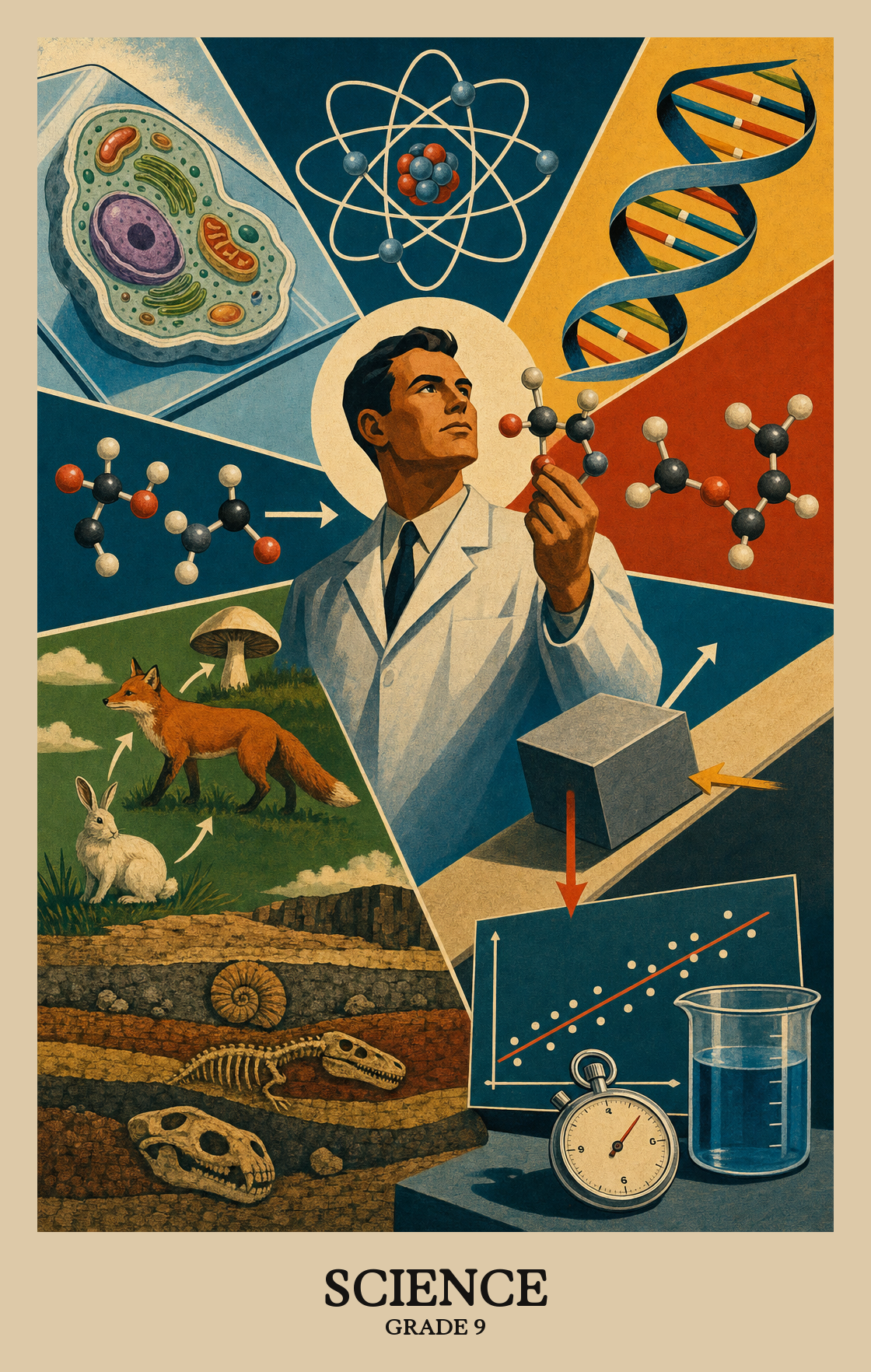
Students start with the building blocks of matter. They learn how the periodic table is organized, why elements behave the way they do, and what happens when substances react and form something new.
Students look at where energy goes during a reaction and why some materials are strong, brittle, or stretchy. They also study what happens inside the nucleus during fission, fusion, and radioactive decay.
Students use math to describe how objects move, collide, and pull on each other through gravity and magnets. They also study waves and how light behaves when it hits different materials.
Students zoom into the cell to see how DNA codes for proteins and how cells divide and specialize. They trace how traits pass from parents to offspring and why siblings can look so different.
Students follow energy and matter through food webs and the carbon cycle. They study how natural selection shapes species over time and how changes in the environment can grow, shrink, or end a population.
Students study how the Sun, stars, and planets formed and how Earth's surface keeps changing. They weigh the trade-offs of using natural resources and look at evidence for climate change and what people can do about it.
The periodic table is arranged so that elements in the same column behave similarly. Students use that pattern to predict how reactive or stable an element is based on how many electrons sit in its outermost shell.
Students figure out what new substances a chemical reaction will produce by looking at how atoms bond using their outer electrons and patterns in the periodic table.
Students design and run an experiment comparing how substances behave when heated, cooled, or mixed, then use those results to figure out how strongly the tiny particles inside each substance are holding onto each other.
Students learn why metals bend, ceramics shatter, and plastics stretch by looking at how atoms bond and arrange themselves inside each material. The internal structure explains the outside behavior.
Chemical reactions break old bonds and form new ones. When the new bonds store less energy than the old ones did, the leftover energy releases as heat or light. Students model how that energy difference explains why some reactions warm up their surroundings and others cool them down.
Changing the temperature or concentration of chemicals changes how fast a reaction happens. Students explain why, using evidence, such as how heating particles makes them collide more often and with more force.
Students adjust conditions like temperature or pressure in a chemical reaction to shift how much product forms. This is the practical side of chemical equilibrium: knowing which lever to pull to get more of what you want.
Students use chemical equations and math to show that the total mass of materials before and after a reaction stays the same. No atoms appear or disappear; they just rearrange into new substances.
Nuclear reactions split or fuse atoms to release energy. Students learn how these reactions differ from ordinary chemical reactions and why they produce so much more energy.
Nuclear equations show what happens inside an atom's nucleus during fission, fusion, and radioactive decay. Students use symbols and numbers to track how the nucleus changes and how much energy each reaction releases.
Students look at motion data (speed, mass, push or pull) to confirm that heavier objects need more force to reach the same acceleration as lighter ones. This is the math behind Newton's second law: force equals mass times acceleration.
Students use math to show that when two objects collide or push off each other, the total momentum before and after stays the same, as long as nothing outside the system is pushing or pulling on them.
Students design and test a device that cushions an object during a crash. Using what they know about motion and momentum, they adjust the design until the impact force is as low as possible.
Students use Newton's formula to calculate how gravity pulls two objects toward each other. The heavier the objects and the closer they are, the stronger the pull.
Students run experiments to show that electricity flowing through a wire creates a magnetic field, and that moving a magnet near a wire can push electricity through it. These two ideas are the foundation of how motors and generators work.
Students build a simple program or spreadsheet that tracks energy moving between parts of a system, like heat leaving one object and entering another, to calculate how much energy each part gained or lost.
Macroscopic energy, like a rolling ball or a stretched spring, breaks down into two parts: the energy of moving particles and the energy stored by their positions. Students build models to show how those two parts add up to the total.
Students design and build a working device that turns one form of energy into another, like converting motion into electricity or heat into light, then adjust the design until it meets a specific set of requirements.
Students plan and run an experiment to show that when a hot object and a cold object are placed together in a sealed container, heat moves from the hotter one to the cooler one until both reach the same temperature.
Students draw or diagram two objects that push or pull each other through electric or magnetic fields, then trace how the energy of each object changes as the force between them grows stronger or weaker.
Students use math to show how a wave's frequency, wavelength, and speed are connected, and how those relationships change when the wave moves through different materials, like air, water, or glass.
Light can act like a wave or like a tiny particle depending on what it's doing. Students learn to weigh the evidence for each idea and decide which picture of light makes more sense for a given situation.
Light, radio waves, X-rays, and microwaves are all forms of electromagnetic radiation. Students learn how these waves carry energy across space and how technologies like cameras, phones, and medical scanners use them.
Students explain how light and other electromagnetic waves behave when they hit different materials, such as being absorbed, reflected, or passed through. This shows up in everyday technology like sunscreen, mirrors, and fiber-optic cables.
Students read science articles or studies and judge whether the evidence actually supports the claim about how radio waves, visible light, X-rays, or other electromagnetic radiation affect the material absorbing them.
| Standard | Definition | Code |
|---|---|---|
| Use the organization of the periodic table to predict the relative properties… | The periodic table is arranged so that elements in the same column behave similarly. Students use that pattern to predict how reactive or stable an element is based on how many electrons sit in its outermost shell. | 9-12.PS1.A-1 |
| Construct and revise an explanation for the products of a simple chemical… | Students figure out what new substances a chemical reaction will produce by looking at how atoms bond using their outer electrons and patterns in the periodic table. | 9-12.PS1.A-2 |
| Plan and conduct an investigation to gather evidence to compare physical and… | Students design and run an experiment comparing how substances behave when heated, cooled, or mixed, then use those results to figure out how strongly the tiny particles inside each substance are holding onto each other. | 9-12.PS1.A-3 |
| Apply the concepts of bonding and crystalline/molecular structure to explain… | Students learn why metals bend, ceramics shatter, and plastics stretch by looking at how atoms bond and arrange themselves inside each material. The internal structure explains the outside behavior. | 9-12.PS1.A-4 |
| Develop a model to illustrate that the release or absorption of energy from a… | Chemical reactions break old bonds and form new ones. When the new bonds store less energy than the old ones did, the leftover energy releases as heat or light. Students model how that energy difference explains why some reactions warm up their surroundings and others cool them down. | 9-12.PS1.A-5 |
| Apply scientific principles and evidence to provide an explanation about the… | Changing the temperature or concentration of chemicals changes how fast a reaction happens. Students explain why, using evidence, such as how heating particles makes them collide more often and with more force. | 9-12.PS1.B-6 |
| Refine the design of a chemical system by specifying a change in conditions… | Students adjust conditions like temperature or pressure in a chemical reaction to shift how much product forms. This is the practical side of chemical equilibrium: knowing which lever to pull to get more of what you want. | 9-12.PS1.B-7 |
| Use symbolic representations and mathematical calculations to support the claim… | Students use chemical equations and math to show that the total mass of materials before and after a reaction stays the same. No atoms appear or disappear; they just rearrange into new substances. | 9-12.PS1.B-8 |
| Nuclear Process | Nuclear reactions split or fuse atoms to release energy. Students learn how these reactions differ from ordinary chemical reactions and why they produce so much more energy. | PS1.C |
| Use symbolic representations to illustrate the changes in the composition of… | Nuclear equations show what happens inside an atom's nucleus during fission, fusion, and radioactive decay. Students use symbols and numbers to track how the nucleus changes and how much energy each reaction releases. | 9-12.PS1.C-9 |
| Analyze data to support and verify the concepts expressed by Newton's 2nd law… | Students look at motion data (speed, mass, push or pull) to confirm that heavier objects need more force to reach the same acceleration as lighter ones. This is the math behind Newton's second law: force equals mass times acceleration. | 9-12.PS2.A-1 |
| Use mathematical representations to support and verify the concepts that the… | Students use math to show that when two objects collide or push off each other, the total momentum before and after stays the same, as long as nothing outside the system is pushing or pulling on them. | 9-12.PS2.A-2 |
| Apply scientific principles of motion and momentum to design, evaluate | Students design and test a device that cushions an object during a crash. Using what they know about motion and momentum, they adjust the design until the impact force is as low as possible. | 9-12.PS2.A-3 |
| Use mathematical representations of Newton's Law of Gravitation to describe and… | Students use Newton's formula to calculate how gravity pulls two objects toward each other. The heavier the objects and the closer they are, the stronger the pull. | 9-12.PS2.B-4 |
| Plan and conduct an investigation to provide evidence that an electric current… | Students run experiments to show that electricity flowing through a wire creates a magnetic field, and that moving a magnet near a wire can push electricity through it. These two ideas are the foundation of how motors and generators work. | 9-12.PS2.B-5 |
| Create a computational model to calculate the change in the energy of one… | Students build a simple program or spreadsheet that tracks energy moving between parts of a system, like heat leaving one object and entering another, to calculate how much energy each part gained or lost. | 9-12.PS3.A-1 |
| Develop and use models to illustrate that energy at the macroscopic scale can… | Macroscopic energy, like a rolling ball or a stretched spring, breaks down into two parts: the energy of moving particles and the energy stored by their positions. Students build models to show how those two parts add up to the total. | 9-12.PS3.A-2 |
| Design, build, and refine a device that works within given constraints to… | Students design and build a working device that turns one form of energy into another, like converting motion into electricity or heat into light, then adjust the design until it meets a specific set of requirements. | 9-12.PS3.A-3 |
| Plan and conduct an investigation to provide evidence that the transfer of… | Students plan and run an experiment to show that when a hot object and a cold object are placed together in a sealed container, heat moves from the hotter one to the cooler one until both reach the same temperature. | 9-12.PS3.B-4 |
| Develop and use a model of two objects interacting through electric or magnetic… | Students draw or diagram two objects that push or pull each other through electric or magnetic fields, then trace how the energy of each object changes as the force between them grows stronger or weaker. | 9-12.PS3.C-5 |
| Use mathematical representations to support a claim regarding relationships… | Students use math to show how a wave's frequency, wavelength, and speed are connected, and how those relationships change when the wave moves through different materials, like air, water, or glass. | 9-12.PS4.A-1 |
| Evaluate the claims, evidence | Light can act like a wave or like a tiny particle depending on what it's doing. Students learn to weigh the evidence for each idea and decide which picture of light makes more sense for a given situation. | 9-12.PS4.A-2 |
| Electromagnetic Radiation | Light, radio waves, X-rays, and microwaves are all forms of electromagnetic radiation. Students learn how these waves carry energy across space and how technologies like cameras, phones, and medical scanners use them. | PS4.B |
| Communicate technical information about how electromagnetic radiation interacts… | Students explain how light and other electromagnetic waves behave when they hit different materials, such as being absorbed, reflected, or passed through. This shows up in everyday technology like sunscreen, mirrors, and fiber-optic cables. | 9-12.PS4.B-3 |
| Evaluate the validity and reliability of claims in published materials of the… | Students read science articles or studies and judge whether the evidence actually supports the claim about how radio waves, visible light, X-rays, or other electromagnetic radiation affect the material absorbing them. | 9-12.PS4.B-4 |
DNA holds the instructions for building proteins, and proteins run nearly every process in the body. Students model how the sequence of bases in DNA gets read and converted into a specific protein.
The body is organized in layers: cells group into tissues, tissues form organs, and organs work together in systems like digestion or circulation. Students model how each layer depends on the others to keep the organism alive.
Students design and run an experiment to show how the body keeps conditions stable, like how heart rate or body temperature returns to normal after exercise.
Mitosis is how the body copies and replaces cells. Students model how cell division produces the trillions of specialized cells that make up skin, muscle, nerves, and every other tissue in the body.
Students build or interpret a model showing how plants capture sunlight and convert it into sugar stored in their cells.
Cellular respiration is how cells break apart food molecules and rebuild them into new compounds, releasing energy the body can use. Students model this chemical process to show where the energy comes from and where it goes.
Living things are built from large molecules made mostly of carbon, hydrogen, and oxygen. Students learn to build and refine an explanation, using evidence, for why nitrogen, sulfur, and phosphorus also show up in the proteins and DNA that make life work.
Students use data and simple math to explain why an ecosystem can only support so many living things. Factors like temperature, rainfall, and food supply set that limit, and shifts in any of them change which species survive.
Plants, algae, and some bacteria convert sunlight or chemicals into usable energy, while all living things release that energy through respiration. These processes keep carbon, oxygen, and other materials cycling through an ecosystem, but only where conditions allow each reaction to happen.
Energy moves through an ecosystem in one direction, from plants to herbivores to predators, while matter like carbon and nitrogen cycles back through the same organisms. Students trace how food chains show both of those patterns at once.
Students trace how carbon moves through living things, air, water, and soil by mapping what happens during photosynthesis, respiration, decomposition, and burning. The goal is explaining why carbon never disappears, it just changes form and location.
When conditions in an ecosystem stay stable, animal and plant populations tend to hold steady. Students look at real evidence to judge whether that claim holds up, and to explain what happens to those populations when conditions shift.
Students look at a real environmental problem and design or improve a solution that protects local species and habitats. The focus is on making a measurable difference, not just identifying the issue.
During sexual reproduction, chromosomes carrying DNA get shuffled and split during meiosis, then combine again at fertilization. Students model how this process moves genetic information from two parents to their offspring.
Asexual reproduction copies one parent's genetic information exactly, so offspring look nearly identical. Sexual reproduction mixes genetic information from two parents, which is why siblings can look so different from each other.
A mutation is a change in the DNA instructions inside a cell. Students model how that change can alter the protein a gene builds, and explain why the result might harm the organism, help it survive better, or make no difference at all.
Students argue, with evidence, that genetic variation comes from two main sources: the reshuffling of genes during reproduction, and mutations that arise during cell copying or from environmental exposure.
Students use probability and simple data analysis to explain why traits like eye color or height vary across a population. They look at patterns across many individuals, not just one family, to see how often certain traits appear.
Students explain why scientists are confident that life on Earth shares common ancestors. They point to evidence from fossils, DNA, body structures, and the geographic spread of species, showing how each line of evidence points to the same conclusion.
Students compare drawings or photos of animal embryos at different stages of development to spot similarities across species. Those shared early features reveal evolutionary relationships that fully grown animals no longer show.
Evolution explains why species change over time. Students use evidence to show how four forces drive it: populations grow fast, individuals inherit different traits, resources run short, and the individuals best suited to their environment survive and have more offspring.
Students use basic probability and data to explain why a helpful inherited trait spreads through a population over generations. If a trait helps an organism survive and reproduce, more of its offspring carry that trait over time.
Natural selection is evolution in action: the individuals best suited to their environment survive and reproduce, so helpful traits gradually spread through a population over generations. Students build an argument using real fossil, genetic, or observational evidence to explain how this process shapes species over time.
When the environment shifts, some species thrive, some slowly change into new ones, and others die out entirely. Students look at real evidence and decide how well it supports each of those outcomes.
Students build or update a model to test whether a proposed fix actually reduces the harm human activity causes to local species and ecosystems.
| Standard | Definition | Code |
|---|---|---|
| Construct a model of how the structure of DNA determines the structure of… | DNA holds the instructions for building proteins, and proteins run nearly every process in the body. Students model how the sequence of bases in DNA gets read and converted into a specific protein. | 9-12.LS1.A-1 |
| Develop and use a model to illustrate the hierarchical organization of… | The body is organized in layers: cells group into tissues, tissues form organs, and organs work together in systems like digestion or circulation. Students model how each layer depends on the others to keep the organism alive. | 9-12.LS1.A-2 |
| Plan and conduct an investigation to provide evidence that feedback mechanisms… | Students design and run an experiment to show how the body keeps conditions stable, like how heart rate or body temperature returns to normal after exercise. | 9-12.LS1.A-3 |
| Develop and use models to communicate the role of mitosis, cellular division | Mitosis is how the body copies and replaces cells. Students model how cell division produces the trillions of specialized cells that make up skin, muscle, nerves, and every other tissue in the body. | 9-12.LS1.B-1 |
| Use a model to demonstrate how photosynthesis transforms light energy into… | Students build or interpret a model showing how plants capture sunlight and convert it into sugar stored in their cells. | 9-12.LS1.C-1 |
| Use a model to demonstrate that cellular respiration is a chemical process… | Cellular respiration is how cells break apart food molecules and rebuild them into new compounds, releasing energy the body can use. Students model this chemical process to show where the energy comes from and where it goes. | 9-12.LS1.C-2 |
| Construct and revise an explanation based on evidence that organic… | Living things are built from large molecules made mostly of carbon, hydrogen, and oxygen. Students learn to build and refine an explanation, using evidence, for why nitrogen, sulfur, and phosphorus also show up in the proteins and DNA that make life work. | 9-12.LS1.C-3 |
| Explain how various biotic and abiotic factors affect the carrying capacity and… | Students use data and simple math to explain why an ecosystem can only support so many living things. Factors like temperature, rainfall, and food supply set that limit, and shifts in any of them change which species survive. | 9-12.LS2.A-1 |
| Construct and revise an explanation based on evidence that the processes of… | Plants, algae, and some bacteria convert sunlight or chemicals into usable energy, while all living things release that energy through respiration. These processes keep carbon, oxygen, and other materials cycling through an ecosystem, but only where conditions allow each reaction to happen. | 9-12.LS2.B-1 |
| Communicate the pattern of the cycling of matter and the flow of energy among… | Energy moves through an ecosystem in one direction, from plants to herbivores to predators, while matter like carbon and nitrogen cycles back through the same organisms. Students trace how food chains show both of those patterns at once. | 9-12.LS2.B-2 |
| Use a model that illustrates the roles of photosynthesis, cellular respiration… | Students trace how carbon moves through living things, air, water, and soil by mapping what happens during photosynthesis, respiration, decomposition, and burning. The goal is explaining why carbon never disappears, it just changes form and location. | 9-12.LS2.B-3 |
| Evaluate the claims, evidence | When conditions in an ecosystem stay stable, animal and plant populations tend to hold steady. Students look at real evidence to judge whether that claim holds up, and to explain what happens to those populations when conditions shift. | 9-12.LS2.C-1 |
| Design, evaluate, and/or refine solutions that positively impact the… | Students look at a real environmental problem and design or improve a solution that protects local species and habitats. The focus is on making a measurable difference, not just identifying the issue. | 9-12.LS2.C-2 |
| Develop and use models to clarify relationships DNA in the form of chromosomes… | During sexual reproduction, chromosomes carrying DNA get shuffled and split during meiosis, then combine again at fertilization. Students model how this process moves genetic information from two parents to their offspring. | 9-12.LS3.A-1 |
| Compare and contrast asexual and sexual reproduction with regard to genetic… | Asexual reproduction copies one parent's genetic information exactly, so offspring look nearly identical. Sexual reproduction mixes genetic information from two parents, which is why siblings can look so different from each other. | 9-12.LS3.B-1 |
| Develop and use a model to describe why structural changes to genes | A mutation is a change in the DNA instructions inside a cell. Students model how that change can alter the protein a gene builds, and explain why the result might harm the organism, help it survive better, or make no difference at all. | 9-12.LS3.B-2 |
| Make and defend a claim that inheritable genetic variations may result from | Students argue, with evidence, that genetic variation comes from two main sources: the reshuffling of genes during reproduction, and mutations that arise during cell copying or from environmental exposure. | 9-12.LS3.B-3 |
| Apply concepts of statistics and probability to explain the variation and… | Students use probability and simple data analysis to explain why traits like eye color or height vary across a population. They look at patterns across many individuals, not just one family, to see how often certain traits appear. | 9-12.LS3.B-4 |
| Communicate scientific information that common and biological evolution are… | Students explain why scientists are confident that life on Earth shares common ancestors. They point to evidence from fossils, DNA, body structures, and the geographic spread of species, showing how each line of evidence points to the same conclusion. | 9-12.LS4.A-1 |
| Analyze displays of pictorial data to compare patterns of similarities in the… | Students compare drawings or photos of animal embryos at different stages of development to spot similarities across species. Those shared early features reveal evolutionary relationships that fully grown animals no longer show. | 9-12.LS4.A-2 |
| Construct an explanation based on evidence that the process of evolution… | Evolution explains why species change over time. Students use evidence to show how four forces drive it: populations grow fast, individuals inherit different traits, resources run short, and the individuals best suited to their environment survive and have more offspring. | 9-12.LS4.B-1 |
| Apply concepts of statistics and probability to support explanations that… | Students use basic probability and data to explain why a helpful inherited trait spreads through a population over generations. If a trait helps an organism survive and reproduce, more of its offspring carry that trait over time. | 9-12.LS4.B-2 |
| Construct an explanation based on evidence for how natural selection leads to… | Natural selection is evolution in action: the individuals best suited to their environment survive and reproduce, so helpful traits gradually spread through a population over generations. Students build an argument using real fossil, genetic, or observational evidence to explain how this process shapes species over time. | 9-12.LS4.C-1 |
| Evaluate the evidence supporting claims that changes in environmental… | When the environment shifts, some species thrive, some slowly change into new ones, and others die out entirely. Students look at real evidence and decide how well it supports each of those outcomes. | 9-12.LS4.C-2 |
| Create or revise a model to test a solution to mitigate adverse impacts of… | Students build or update a model to test whether a proposed fix actually reduces the harm human activity causes to local species and ecosystems. | 9-12.LS4.C-3 |
Students build a model showing how the Sun produces energy by fusing hydrogen atoms together in its core. That process explains how the Sun has burned for billions of years and how its light and heat reach Earth.
Students use light patterns from distant stars and the movement of galaxies to explain how the universe began with the Big Bang. The evidence comes from real telescope observations, not just textbook claims.
Stars act like element factories. Over billions of years, they fuse hydrogen and helium into heavier elements, and when they explode or die, those elements scatter into space and eventually become part of planets, rocks, and living things.
Students use a math rule discovered by Johannes Kepler to predict how fast a planet or moon moves along its orbit and how long its trip around the sun takes.
Students compare the ages of ocean-floor rocks and continental rocks, then use plate tectonics to explain why. Oceanic crust sinks back into the Earth at plate boundaries and gets replaced; continental crust stays on the surface far longer.
Students use rock samples, meteorites, and the surfaces of other planets as evidence to piece together how Earth formed and what its earliest history looked like.
Students build a diagram or model showing how volcanoes, earthquakes, and erosion slowly shape continents and the ocean floor. Some changes take seconds; others take millions of years.
Reading real Earth data, students explain how one change on the surface, like a volcanic eruption or a flood, sets off changes in the atmosphere, ocean, or living things nearby.
Students build a model showing how heat from Earth's core drives slow loops of melted rock through the mantle. Those loops move material from deep inside Earth toward the surface and back down again.
Students use diagrams or simulations to show how changes in the energy entering or leaving Earth, such as more sunlight absorbed or more heat trapped, shift the climate over time.
Students design and run experiments to see how water shapes the ground around us, testing how it moves, soaks into soil, or wears down rock and other Earth materials.
Students build a model using real numbers to track how carbon moves between the ocean, air, rocks, and living things. The goal is to show how much carbon shifts between each part of Earth's system and why that movement matters.
Students build a written argument, using fossil and rock evidence, explaining how Earth's oceans, atmosphere, and land shaped living things over time while living things changed Earth in return.
Students look at real evidence, such as maps, data, and historical records, to explain how resource supplies, natural disasters, and shifting weather patterns have shaped where and how people live and work.
Students compare real proposals for mining or energy production, weighing what each option costs society, the environment, and local economies against what it delivers. The goal is to judge which solution makes the most sense given all three kinds of trade-offs.
Students build a computer simulation that shows how choices about natural resources, like water or land use, affect both human populations and the variety of species that share those resources.
Students look at a real-world design (a wetland filter, a wildlife corridor, a runoff barrier) and judge whether it actually reduces the damage humans caused. They may also suggest improvements to help the ecosystem recover and stay stable.
Students study real temperature records, ice core samples, and climate model outputs to predict how fast the climate is changing and what that means for sea levels, weather patterns, and ecosystems.
Students look at real examples of how farming, building, or burning fuel shifts the balance between land, water, and air, then predict what happens next. The effects can go either way, harmful or helpful.
| Standard | Definition | Code |
|---|---|---|
| Develop a model based on evidence to illustrate the life span of the Sun and… | Students build a model showing how the Sun produces energy by fusing hydrogen atoms together in its core. That process explains how the Sun has burned for billions of years and how its light and heat reach Earth. | 9-12.ESS1.A-1 |
| Construct an explanation of the Big Bang theory based on astronomical evidence… | Students use light patterns from distant stars and the movement of galaxies to explain how the universe began with the Big Bang. The evidence comes from real telescope observations, not just textbook claims. | 9-12.ESS1.A-2 |
| Communicate scientific ideas about the way stars, over their life cycle… | Stars act like element factories. Over billions of years, they fuse hydrogen and helium into heavier elements, and when they explode or die, those elements scatter into space and eventually become part of planets, rocks, and living things. | 9-12.ESS1.A-3 |
| Use Kepler's Law to predict the motion of orbiting objects in the solar system | Students use a math rule discovered by Johannes Kepler to predict how fast a planet or moon moves along its orbit and how long its trip around the sun takes. | 9-12.ESS1.B-4 |
| Evaluate evidence of the past and current movements of continental and oceanic… | Students compare the ages of ocean-floor rocks and continental rocks, then use plate tectonics to explain why. Oceanic crust sinks back into the Earth at plate boundaries and gets replaced; continental crust stays on the surface far longer. | 9-12.ESS1.C-5 |
| Apply scientific reasoning and evidence from ancient Earth materials, meteorites | Students use rock samples, meteorites, and the surfaces of other planets as evidence to piece together how Earth formed and what its earliest history looked like. | 9-12.ESS1.C-6 |
| Develop a model to illustrate how Earth's interior and surface processes | Students build a diagram or model showing how volcanoes, earthquakes, and erosion slowly shape continents and the ocean floor. Some changes take seconds; others take millions of years. | 9-12.ESS2.A-1 |
| Analyze geoscientific data to make the claim that one change to Earth's surface… | Reading real Earth data, students explain how one change on the surface, like a volcanic eruption or a flood, sets off changes in the atmosphere, ocean, or living things nearby. | 9-12.ESS2.A-2 |
| Develop a model based on evidence of Earth's interior to describe the cycling… | Students build a model showing how heat from Earth's core drives slow loops of melted rock through the mantle. Those loops move material from deep inside Earth toward the surface and back down again. | 9-12.ESS2.A-3 |
| Use a model to describe how variations in the flow of energy into and out of… | Students use diagrams or simulations to show how changes in the energy entering or leaving Earth, such as more sunlight absorbed or more heat trapped, shift the climate over time. | 9-12.ESS2.A-4 |
| Plan and conduct an investigation of the properties of water and its effects on… | Students design and run experiments to see how water shapes the ground around us, testing how it moves, soaks into soil, or wears down rock and other Earth materials. | 9-12.ESS2.C-5 |
| Develop a quantitative model to describe the cycling of carbon among the… | Students build a model using real numbers to track how carbon moves between the ocean, air, rocks, and living things. The goal is to show how much carbon shifts between each part of Earth's system and why that movement matters. | 9-12.ESS2.D-6 |
| Construct an argument based on evidence about the simultaneous coevolution of… | Students build a written argument, using fossil and rock evidence, explaining how Earth's oceans, atmosphere, and land shaped living things over time while living things changed Earth in return. | 9-12.ESS2.E-1 |
| Construct an explanation based on evidence for how the availability of natural… | Students look at real evidence, such as maps, data, and historical records, to explain how resource supplies, natural disasters, and shifting weather patterns have shaped where and how people live and work. | 9-12.ESS3.A-1 |
| Evaluate competing design solutions for developing, managing | Students compare real proposals for mining or energy production, weighing what each option costs society, the environment, and local economies against what it delivers. The goal is to judge which solution makes the most sense given all three kinds of trade-offs. | 9-12.ESS3.A-2 |
| Create a computational simulation to illustrate the relationships among… | Students build a computer simulation that shows how choices about natural resources, like water or land use, affect both human populations and the variety of species that share those resources. | 9-12.ESS3.C-1 |
| Evaluate or refine a technological solution that reduces impacts of human… | Students look at a real-world design (a wetland filter, a wildlife corridor, a runoff barrier) and judge whether it actually reduces the damage humans caused. They may also suggest improvements to help the ecosystem recover and stay stable. | 9-12.ESS3.C-4 |
| Analyze geoscientific data and the results from global climate models to make… | Students study real temperature records, ice core samples, and climate model outputs to predict how fast the climate is changing and what that means for sea levels, weather patterns, and ecosystems. | 9-12.ESS3.D-5 |
| Predict how human activity affects the relationships between Earth systems in… | Students look at real examples of how farming, building, or burning fuel shifts the balance between land, water, and air, then predict what happens next. The effects can go either way, harmful or helpful. | 9-12.ESS3.D-2 |
Students pick a real-world problem (like clean water access or food waste) and spell out exactly what a good solution must do and what limits it must work within, using both numbers and plain descriptions.
Students take a messy real-world problem, like reducing food waste or improving water flow, and split it into smaller parts that are each solvable. Then they design solutions for each part.
Students pick the best solution to a real problem by weighing what matters most: cost, safety, how well it holds up, and how it affects people and the environment. Not every solution is perfect, so students explain which trade-offs are worth making.
Students run a computer simulation to test how a proposed solution to a real-world problem holds up when multiple requirements and trade-offs are in play. The simulation shows how changes in one part of a system ripple through the rest.
| Standard | Definition | Code |
|---|---|---|
| Analyze a major global challenge to specify qualitative and quantitative… | Students pick a real-world problem (like clean water access or food waste) and spell out exactly what a good solution must do and what limits it must work within, using both numbers and plain descriptions. | 9-12.ETS.A-1 |
| Design a solution to a complex real-world problem by breaking it down into… | Students take a messy real-world problem, like reducing food waste or improving water flow, and split it into smaller parts that are each solvable. Then they design solutions for each part. | 9-12.ETS.A-2 |
| Evaluate a solution to a complex real-world problem based on prioritized… | Students pick the best solution to a real problem by weighing what matters most: cost, safety, how well it holds up, and how it affects people and the environment. Not every solution is perfect, so students explain which trade-offs are worth making. | 9-12.ETS.B-3 |
| Use a computer simulation to model the impact of proposed solutions to a… | Students run a computer simulation to test how a proposed solution to a real-world problem holds up when multiple requirements and trade-offs are in play. The simulation shows how changes in one part of a system ripple through the rest. | 9-12.ETS.B-4 |
End-of-course assessment taken when students complete Biology. Districts must ensure students complete the Biology EOC prior to graduation.
Alternate assessment for eligible students with significant cognitive disabilities, covering the state-tested grade-level and end-of-course subjects.
Students study chemistry, biology, physics, and earth science in one year, plus some engineering. They build models of atoms, cells, DNA, ecosystems, motion, energy, and Earth systems. Expect lab work, math, and written explanations that use evidence.
Ask students to explain what they did in lab and why it worked. Watch a short science video together and talk about what surprised them. Cooking, gardening, and fixing things at home all show chemistry, biology, and physics in action.
Yes, more than in earlier grades. Students use algebra to work with force, motion, energy, waves, and population data. Keeping math skills sharp at home, even ten minutes a few nights a week, makes science class easier.
Most teachers anchor the year in one strand at a time, often chemistry first to set up bonding and energy, then biology, then physics and earth science. Pull the engineering and modeling work into each unit instead of saving it for the end. Cross-cutting ideas like energy and systems show up in every strand, so name them out loud each time.
Bonding and the periodic table, energy in chemical reactions, DNA to protein, and natural selection tend to need a second pass. Students also struggle to connect photosynthesis and respiration to the carbon cycle. Plan short review labs or models later in the year rather than relying on the first exposure.
Have them teach a topic back at the kitchen table using simple drawings of atoms and electrons. Practice problems from class, even three or four a night, build confidence faster than rereading notes. If they stay stuck, ask the teacher which specific skill to focus on.
Students can build a model or explanation, back it with evidence from a lab or data set, and use the right math. They can move between scales, from atoms to cells to ecosystems to Earth systems. They can also critique a claim, not just repeat one.
Look for students who can plan an investigation, analyze the data, and write a clear claim with evidence and reasoning without heavy scaffolding. They should handle graphs, basic statistics, and unit conversions on their own. Comfort with revising a model after new evidence is the strongest signal.