Adding and subtracting within ten
Students get quick and confident with small sums and differences. By the end of this stretch, answers to problems like 7 plus 2 or 9 minus 4 come without counting on fingers.
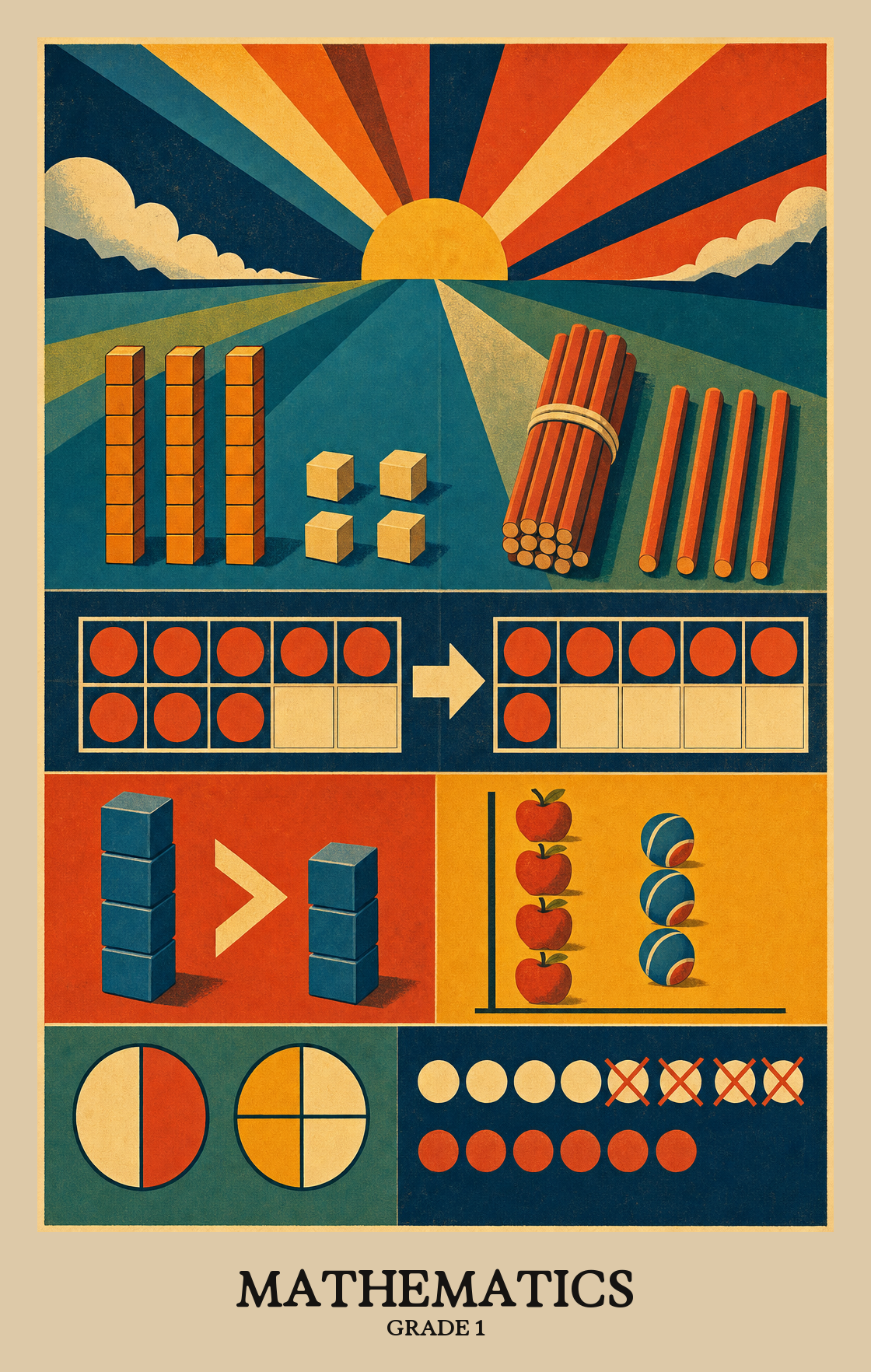
This is the year math grows from counting one by one to thinking in groups of ten. Students add and subtract within 20, and they know their facts up to 10 by heart. They start seeing that a number like 34 is three tens and four ones, and they compare numbers using greater than and less than. By spring, they can solve a story problem like 8 plus 6, read a simple picture graph, and split a circle into halves or fourths.
Students get quick and confident with small sums and differences. By the end of this stretch, answers to problems like 7 plus 2 or 9 minus 4 come without counting on fingers.
Students learn that the equal sign means both sides match, not just where the answer goes. They check whether number sentences like 6 plus 3 equals 4 plus 5 are true or false.
Students see a number like 47 as four tens and seven ones. They compare two numbers using the signs for greater than, less than, and equal to.
Students stretch their adding and subtracting to twenty, then practice adding or subtracting a group of ten from a two-digit number. They explain how they got the answer.
Students build and draw shapes, then put smaller shapes together to make bigger ones. They split circles and rectangles into two or four equal pieces and name the parts.
Students compare the lengths of two objects by using a third object, like a piece of string, as a go-between. They also read picture graphs, tally marks, and simple charts to answer questions.
Students use pictures, objects, and simple equations to figure out addition and subtraction problems. The focus is on understanding what the numbers mean, not just getting the answer.
Students add and subtract numbers up to 20 to solve simple word problems. They figure out how many are left, how many more are needed, or how many there are altogether.
The equal sign means "the same as," not just "the answer." Students look at equations like 4 + 3 = 8 - 1 and decide whether both sides actually match.
Students add and subtract numbers up to 20. This is the building block for every math fact they will practice in first grade.
Adding and subtracting numbers up to 10 from memory, without counting on fingers. Students know facts like 3 + 4 or 7 - 2 quickly and reliably.
| Standard | Definition | Code |
|---|---|---|
| Represent and solve problems involving addition and subtraction | Students use pictures, objects, and simple equations to figure out addition and subtraction problems. The focus is on understanding what the numbers mean, not just getting the answer. | 1.RA.A |
| Use addition and subtraction within 20 to solve problems | Students add and subtract numbers up to 20 to solve simple word problems. They figure out how many are left, how many more are needed, or how many there are altogether. | 1.RA.A.1 |
| Develop the meaning of the equal sign and determine if equations involving… | The equal sign means "the same as," not just "the answer." Students look at equations like 4 + 3 = 8 - 1 and decide whether both sides actually match. | 1.RA.A.3 |
| Add and subtract within 20 | Students add and subtract numbers up to 20. This is the building block for every math fact they will practice in first grade. | 1.RA.C |
| Demonstrate fluency with addition and subtraction within 10 | Adding and subtracting numbers up to 10 from memory, without counting on fingers. Students know facts like 3 + 4 or 7 - 2 quickly and reliably. | 1.RA.C.8 |
Two-digit numbers like 23 or 47 are built from tens and ones. Students learn that the first digit counts groups of ten and the second digit counts the leftovers.
Two-digit numbers are made of tens and ones. The number 34, for example, means 3 tens and 4 ones. Students learn to break apart any two-digit number this way.
Students look at two numbers and decide which is bigger, smaller, or equal, then write the correct symbol between them. For example, they compare 34 and 52 and write 34 < 52.
Adding and subtracting with place value means students use what they know about tens and ones to solve problems. They might add a two-digit number to a multiple of ten, or subtract ten from a number and say what changed.
Students add or subtract a round number like 10, 20, or 30 from any two-digit number and explain why their answer makes sense. The tens digit changes; the ones digit stays the same.
| Standard | Definition | Code |
|---|---|---|
| Understand place value of two-digit numbers | Two-digit numbers like 23 or 47 are built from tens and ones. Students learn that the first digit counts groups of ten and the second digit counts the leftovers. | 1.NBT.A |
| Understand two-digit numbers are composed of ten | Two-digit numbers are made of tens and ones. The number 34, for example, means 3 tens and 4 ones. Students learn to break apart any two-digit number this way. | 1.NBT.A.2 |
| Compare two two-digit numbers using the symbols >, = or < | Students look at two numbers and decide which is bigger, smaller, or equal, then write the correct symbol between them. For example, they compare 34 and 52 and write 34 < 52. | 1.NBT.A.3 |
| Use place value understanding to add and subtract | Adding and subtracting with place value means students use what they know about tens and ones to solve problems. They might add a two-digit number to a multiple of ten, or subtract ten from a number and say what changed. | 1.NBT.B |
| Add or subtract a multiple of 10 from another two-digit number | Students add or subtract a round number like 10, 20, or 30 from any two-digit number and explain why their answer makes sense. The tens digit changes; the ones digit stays the same. | 1.NBT.B.7 |
Students sort and describe flat and solid shapes by their sides, corners, and size. They learn to see how shapes are alike and different.
Shapes have must-have features (a triangle always has three sides) and changeable ones (color or size don't matter). Students sort shapes by their defining features, then build or draw shapes that match those rules.
Students put simple shapes together to make bigger shapes, then take them apart again. This builds their sense of how shapes fit together and what makes each shape look the way it does.
Students cut circles and rectangles into two or four equal pieces, then say what each piece looks like and how the pieces make up the whole shape.
Students pick a small object, like a paper clip or a crayon, and use it as a ruler to measure how long something is. This builds the idea that length is a count of same-size units laid end to end.
Students measure two objects by comparing each one to a third object, like a piece of string or a strip of paper, to figure out which of the two is longer without placing them side by side.
| Standard | Definition | Code |
|---|---|---|
| Reason with shapes and their attributes | Students sort and describe flat and solid shapes by their sides, corners, and size. They learn to see how shapes are alike and different. | 1.GM.A |
| Distinguish between defining attributes versus non-defining attributes | Shapes have must-have features (a triangle always has three sides) and changeable ones (color or size don't matter). Students sort shapes by their defining features, then build or draw shapes that match those rules. | 1.GM.A.1 |
| Compose and decompose two- and three-dimensional shapes to build an… | Students put simple shapes together to make bigger shapes, then take them apart again. This builds their sense of how shapes fit together and what makes each shape look the way it does. | 1.GM.A.2 |
| Partition circles and rectangles into two or four equal shares | Students cut circles and rectangles into two or four equal pieces, then say what each piece looks like and how the pieces make up the whole shape. | 1.GM.A.4 |
| Measure lengths in non-standard units | Students pick a small object, like a paper clip or a crayon, and use it as a ruler to measure how long something is. This builds the idea that length is a count of same-size units laid end to end. | 1.GM.B |
| Compare the lengths of two objects indirectly by using a third object | Students measure two objects by comparing each one to a third object, like a piece of string or a strip of paper, to figure out which of the two is longer without placing them side by side. | 1.GM.B.6 |
Students sort objects or answers into groups, count what's in each group, and read simple picture charts to answer questions like "how many more?" or "which has the most?"
Students look at a simple chart or picture graph and answer questions about it, like which group has more or how many are in each group.
| Standard | Definition | Code |
|---|---|---|
| Represent and interpret data | Students sort objects or answers into groups, count what's in each group, and read simple picture charts to answer questions like "how many more?" or "which has the most?" | 1.DS.A |
| Draw conclusions from object graphs, picture graphs, T-charts and tallies | Students look at a simple chart or picture graph and answer questions about it, like which group has more or how many are in each group. | 1.DS.A.2 |
Missouri Assessment Program grade-level mathematics assessment for grades 3 through 8.
Alternate assessment for eligible students with significant cognitive disabilities, covering the state-tested grade-level and end-of-course subjects.
Students add and subtract numbers up to 20, and they know their facts up to 10 quickly without counting. They read and compare numbers up to about 100, recognize that a number like 47 is 4 tens and 7 ones, and tell which of two numbers is bigger.
Five minutes of fact practice a day goes a long way. Roll two dice and ask for the total, count out coins, or ask quick questions like what is 6 plus 7 while making dinner. Keep it short and playful so it stays a game.
Fluency means students can answer facts up to 10 within a few seconds, without counting on fingers every time. They still use fingers and drawings for harder problems up to 20, and that is fine. Speed on the easy facts frees up thinking for the harder ones.
Not yet. Most students start the year counting every number and slowly learn shortcuts like making ten or using doubles. By spring, facts up to 10 should feel automatic. If finger counting is still the only strategy by then, ask the teacher for a few targeted activities.
Most teachers start with addition and subtraction within 10 and the meaning of the equal sign, then push fluency through the fall. Place value and two-digit comparison come next, followed by adding and subtracting tens. Save shapes, partitioning, and length comparison for shorter units across the year.
The equal sign trips students up because many read it as the answer goes here. Spend time on problems like 8 equals blank plus 3 and true or false equations. Place value also needs revisiting, especially the idea that the 4 in 47 means four tens, not four.
Students can build a number like 36 with three ten-sticks and six ones, and explain that the 3 stands for three tens. They compare two numbers by looking at the tens first, then the ones, and use the symbols for greater than, less than, and equal correctly.
Cut a sandwich or a pancake into two equal pieces, then four, and talk about halves and fourths. Point out shapes around the house and ask what makes a square a square. Building with blocks and folding paper both count as real practice.
At this grade, students compare lengths with objects like paper clips or cubes, lining them up end to end. They also compare two things using a third object, such as a piece of string. Rulers and inches come next year, once the idea of same-size units is solid.
By June, students should know facts up to 10 quickly, solve word problems up to 20, read and compare two-digit numbers, and add or subtract a multiple of ten like 40 plus 30. They should also describe halves and fourths and read a simple picture graph or tally chart.