Sun, moon, and planets
Students study what is out there in space and how it moves. They build scale models of the solar system and explain why the moon changes shape, why eclipses happen, and why seasons shift through the year.
This is the year science zooms out to the whole planet and the sky above it. Students study the solar system, build scale models of the Sun, Earth, and Moon, and use those models to explain seasons, eclipses, and lunar phases. They dig into rock layers, plate motion, the water cycle, and what is driving global temperatures up. By spring, students can use evidence to explain how Earth has changed over billions of years and design a way to reduce a human impact on the environment.
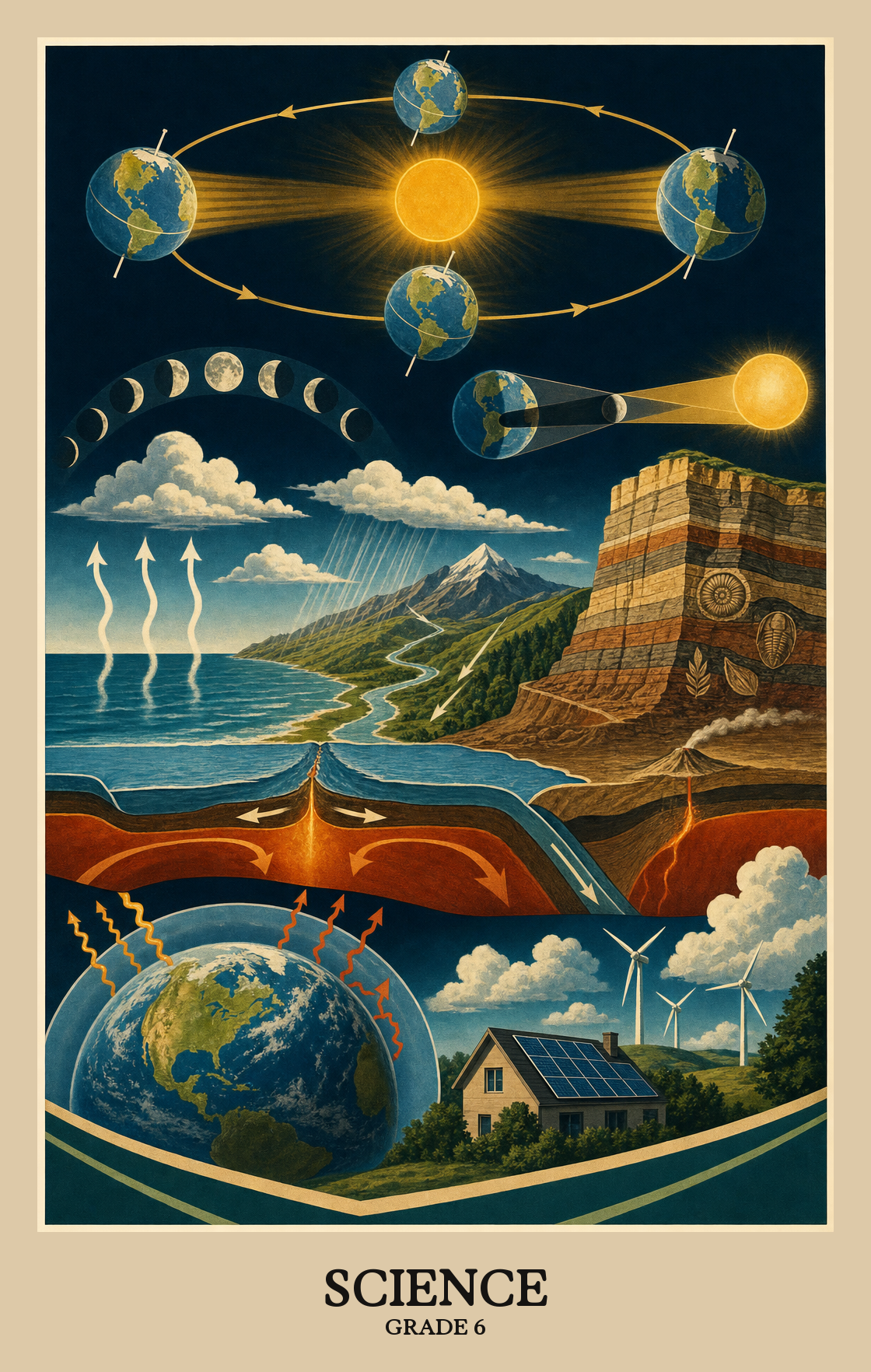
Students study what is out there in space and how it moves. They build scale models of the solar system and explain why the moon changes shape, why eclipses happen, and why seasons shift through the year.
Students learn how scientists figure out the age of the Earth from layers of rock and fossils. They use evidence from rocks, fossils, and the shapes of continents to explain how the surface has shifted over a very long time.
Students follow the cycles that shape Earth day to day. They model how rock changes form, how water moves between the ocean, sky, and land, and how moving air creates the weather outside the window.
Students look at how humans depend on Earth and how human choices change it. They study why resources like minerals and groundwater sit where they do, what drives rising global temperatures, and how to plan for hazards like floods and storms.
Students ask questions about patterns in the sky, like why the sun rises at different times each season, and turn those questions into problems worth investigating.
Students ask questions about what they observe, what experiments show, and what they read. This includes questioning each other's ideas and pushing back on conclusions that need more evidence.
Students watch how the moon, planets, and stars move across the night sky, then ask questions about what a basic solar system model can and can't explain.
Students read charts and graphs about space, weather, or Earth's features to spot patterns and draw conclusions. The data does the talking; students explain what it shows.
Students look at science data, like temperature readings or moon phases recorded over time, and spot patterns. Then they explain what those patterns might mean and whether one thing could be causing another to change.
Students compare data about planets, moons, and other objects in our solar system to find what they have in common and how they differ. They look at things like surface features, size, and what's happening on or around each object.
Students build and use models to show how objects in space move, how forces shape a planet's surface, or how energy flows through a system. The model can be a drawing, a diagram, or a physical object.
Students build and refine diagrams or physical models to show how something in Earth and space science works, then use those models to explain their thinking and share it with others.
Students build scale models of the solar system to show how big planets and the sun are, how far apart they sit, and how they move. The models also explain why gravity and inertia keep each planet on its path instead of flying off or falling in.
Students build explanations for patterns they observe in space, like why seasons change or why the moon looks different each night, and sketch out solutions to problems those patterns create here on Earth.
Students use real evidence, from experiments, data, or research, to explain why something happens in the natural world. They also look for gaps or mistakes in scientific explanations, including their own.
Rock layers act like pages in Earth's history book. Students use evidence from those layers to explain how scientists divide Earth's 4.6-billion-year past into chunks of time, from ancient seas to the first dinosaurs to today.
Students read and compare sources to explain how early observations of the night sky led to modern ideas about Earth's place in space. They evaluate whether sources agree and communicate what the evidence shows.
Students study how different cultures, including Minnesota American Indian tribes, have developed their own ways of explaining natural events and solving problems. They gather and share what they find.
Students explain how the Moon's shape appears to change throughout the month, why eclipses happen, and why seasons shift, drawing on scientific models and the sky knowledge of Minnesota American Indian communities and other cultures.
| Standard | Definition | Code |
|---|---|---|
| Asking questions and defining problems | Students ask questions about patterns in the sky, like why the sun rises at different times each season, and turn those questions into problems worth investigating. | 6EU1.1 |
| Students will be able to ask questions about aspects of the phenomena they… | Students ask questions about what they observe, what experiments show, and what they read. This includes questioning each other's ideas and pushing back on conclusions that need more evidence. | 6EU1.1.1 |
| Ask questions that arise from observations of patterns in the movement of night… | Students watch how the moon, planets, and stars move across the night sky, then ask questions about what a basic solar system model can and can't explain. | 6EU.1.1.1.1 |
| Analyzing and interpreting data | Students read charts and graphs about space, weather, or Earth's features to spot patterns and draw conclusions. The data does the talking; students explain what it shows. | 6EU.2.1 |
| Students will be able to represent observations and data in order to recognize… | Students look at science data, like temperature readings or moon phases recorded over time, and spot patterns. Then they explain what those patterns might mean and whether one thing could be causing another to change. | 6EU.2.1.1 |
| Analyze and interpret data to determine similarities and differences among… | Students compare data about planets, moons, and other objects in our solar system to find what they have in common and how they differ. They look at things like surface features, size, and what's happening on or around each object. | 6EU.2.1.1.1 |
| Developing and using models | Students build and use models to show how objects in space move, how forces shape a planet's surface, or how energy flows through a system. The model can be a drawing, a diagram, or a physical object. | 6EU.3.1 |
| Students will be able to develop, revise | Students build and refine diagrams or physical models to show how something in Earth and space science works, then use those models to explain their thinking and share it with others. | 6EU.3.1.1 |
| Develop and use scale models of solar system objects to describe the sizes of… | Students build scale models of the solar system to show how big planets and the sun are, how far apart they sit, and how they move. The models also explain why gravity and inertia keep each planet on its path instead of flying off or falling in. | 6EU.3.1.1.1 |
| Constructing explanations and designing solutions | Students build explanations for patterns they observe in space, like why seasons change or why the moon looks different each night, and sketch out solutions to problems those patterns create here on Earth. | 6EU.3.2 |
| Students will be able to apply scientific principles and empirical evidence | Students use real evidence, from experiments, data, or research, to explain why something happens in the natural world. They also look for gaps or mistakes in scientific explanations, including their own. | 6EU.3.2.1 |
| Construct a scientific explanation based on evidence from rock strata for how… | Rock layers act like pages in Earth's history book. Students use evidence from those layers to explain how scientists divide Earth's 4.6-billion-year past into chunks of time, from ancient seas to the first dinosaurs to today. | 6EU.3.2.1.1 |
| Obtaining, evaluating and communicating information | Students read and compare sources to explain how early observations of the night sky led to modern ideas about Earth's place in space. They evaluate whether sources agree and communicate what the evidence shows. | 6EU.4.2 |
| Students will be able to gather information about and communicate the methods… | Students study how different cultures, including Minnesota American Indian tribes, have developed their own ways of explaining natural events and solving problems. They gather and share what they find. | 6EU.4.2.2 |
| Communicate how a series of models, including those used by Minnesota American… | Students explain how the Moon's shape appears to change throughout the month, why eclipses happen, and why seasons shift, drawing on scientific models and the sky knowledge of Minnesota American Indian communities and other cultures. | 6EU.4.2.2.1 |
Students form a clear question or problem statement before starting an investigation. This is how scientific work begins.
Students ask questions about what they observe, what experiments show, and what they read. The questions push thinking further, whether they come from a lab result, a classmate's idea, or a passage in a book.
Students look at a stack of rock layers and ask questions about which layers formed first and which formed most recently. They practice reading Earth's history the way you'd read pages in a book, oldest at the bottom, newest at the top.
Students design and run their own science investigations to answer a question about Earth's systems, then record what they observe and explain what the results mean.
Students design their own experiments to test a question, then collect and organize data that backs up their conclusions. This covers both classroom labs and fieldwork.
Students gather weather data and use digital tools to find patterns in how air masses move and collide. Those patterns show why temperature, wind, and precipitation change from day to day.
Students read charts, graphs, and tables about Earth's systems to spot patterns and draw conclusions. The data does the talking; students explain what it means.
Students look at data they've collected about Earth's systems, spot patterns in it, and figure out what those patterns might mean. They practice asking: "Why do these numbers change together?"
Students look at maps of fossils, rock layers, and ocean floor shapes to figure out how Earth's continents have moved over millions of years.
Students build and use diagrams or physical models to show how parts of Earth's systems interact, then revise those models when new evidence changes the picture.
Students build and update diagrams or physical models to show how something in nature works, then use those models to explain their thinking to others.
Students build a diagram or model showing how rocks form, break down, and change over millions of years, and identify the heat and pressure inside Earth that keep the cycle moving.
Students build a diagram or model showing how water moves from oceans and land up into clouds and back down as rain or snow. The model explains what drives that cycle: heat from the Sun and the pull of gravity.
Students back up their ideas about Earth's systems with real evidence. They listen to other explanations, weigh the evidence on each side, and change their thinking when the evidence calls for it.
Students back up their explanations about Earth's systems with evidence, then defend or revise those explanations when new information shows up. They also question other students' scientific arguments and offer their own counterarguments.
Students build a written argument explaining how forces like erosion, earthquakes, or volcanic eruptions have reshaped Earth's surface over time, from a single landslide to millions of years of continental drift. Evidence from data or observations backs each claim.
| Standard | Definition | Code |
|---|---|---|
| Asking questions and defining problems | Students form a clear question or problem statement before starting an investigation. This is how scientific work begins. | 6ES.1.1 |
| Students will be able to ask questions about aspects of the phenomena they… | Students ask questions about what they observe, what experiments show, and what they read. The questions push thinking further, whether they come from a lab result, a classmate's idea, or a passage in a book. | 6ES.1.1.1 |
| Ask questions to examine an interpretation about the relative ages of different… | Students look at a stack of rock layers and ask questions about which layers formed first and which formed most recently. They practice reading Earth's history the way you'd read pages in a book, oldest at the bottom, newest at the top. | 6ES.1.1.1.2 |
| Planning and carrying out investigations | Students design and run their own science investigations to answer a question about Earth's systems, then record what they observe and explain what the results mean. | 6ES.1.2 |
| Students will be able to design and conduct investigations in the classroom… | Students design their own experiments to test a question, then collect and organize data that backs up their conclusions. This covers both classroom labs and fieldwork. | 6ES.1.2.1 |
| Collect data and use digital data analysis tools to identify patterns to… | Students gather weather data and use digital tools to find patterns in how air masses move and collide. Those patterns show why temperature, wind, and precipitation change from day to day. | 6ES.1.2.1.1 |
| Analyzing and interpreting data | Students read charts, graphs, and tables about Earth's systems to spot patterns and draw conclusions. The data does the talking; students explain what it means. | 6ES.2.1 |
| Students will be able to represent observations and data in order to recognize… | Students look at data they've collected about Earth's systems, spot patterns in it, and figure out what those patterns might mean. They practice asking: "Why do these numbers change together?" | 6ES.2.1.1 |
| Analyze and interpret data on the distribution of fossils, rocks, continental… | Students look at maps of fossils, rock layers, and ocean floor shapes to figure out how Earth's continents have moved over millions of years. | 6ES.2.1.1.2 |
| Developing and using models | Students build and use diagrams or physical models to show how parts of Earth's systems interact, then revise those models when new evidence changes the picture. | 6ES.3.1 |
| Students will be able to develop, revise | Students build and update diagrams or physical models to show how something in nature works, then use those models to explain their thinking to others. | 6ES.3.1.1 |
| Develop a model, based on observational evidence, to describe the cycling and… | Students build a diagram or model showing how rocks form, break down, and change over millions of years, and identify the heat and pressure inside Earth that keep the cycle moving. | 6ES.3.1.1.2 |
| Develop a model, based on observational and experimental evidence, to describe… | Students build a diagram or model showing how water moves from oceans and land up into clouds and back down as rain or snow. The model explains what drives that cycle: heat from the Sun and the pull of gravity. | 6ES.3.1.1.3 |
| Engaging in argument from evidence | Students back up their ideas about Earth's systems with real evidence. They listen to other explanations, weigh the evidence on each side, and change their thinking when the evidence calls for it. | 6ES.4.1 |
| Students will be able to engage in argument from evidence for the explanations… | Students back up their explanations about Earth's systems with evidence, then defend or revise those explanations when new information shows up. They also question other students' scientific arguments and offer their own counterarguments. | 6ES.4.1.1 |
| Construct an argument, supported by evidence, for how geoscience processes have… | Students build a written argument explaining how forces like erosion, earthquakes, or volcanic eruptions have reshaped Earth's surface over time, from a single landslide to millions of years of continental drift. Evidence from data or observations backs each claim. | 6ES.4.1.1.1 |
Students learn to ask testable questions and frame problems clearly before jumping to solutions. This is the starting point for any science investigation.
Students form questions about what they observe, what experiments show, and what they read. A good question pushes the investigation further or challenges an idea someone else proposed.
Students look at data on rising temperatures over the last hundred years and ask focused questions about what caused the change. They learn to tell the difference between natural factors and human ones, like burning fossil fuels.
Students read charts and graphs about how human activities affect Earth, then draw conclusions from patterns in the data.
Students collect data about Earth's systems and look for patterns, like whether rising temperatures match changes in sea level or weather. Finding those patterns helps students figure out how one thing might be causing another.
Students study real data from past earthquakes, floods, and storms to predict where disasters are likely to strike next and how to reduce the damage they cause.
Students look at real-world problems caused by Earth's changing systems and use evidence to explain what is happening. Then they sketch out practical solutions that could actually work.
Students use scientific evidence from experiments, studies, or data to explain why something happens in the natural world. They also spot flaws in their own explanations or someone else's when the evidence doesn't hold up.
Students explain why coal, oil, drinkable water, or useful minerals are plentiful in some places and scarce in others. The answer comes from Earth's own history: volcanic activity, ancient seas, and shifting land built these resources unevenly over millions of years.
Students design a real plan to track and reduce a human impact on the environment, like pollution or habitat loss, using science to back up each choice they make.
| Standard | Definition | Code |
|---|---|---|
| Asking questions and defining problems | Students learn to ask testable questions and frame problems clearly before jumping to solutions. This is the starting point for any science investigation. | 6EH.1.1 |
| Students will be able to ask questions about aspects of the phenomena they… | Students form questions about what they observe, what experiments show, and what they read. A good question pushes the investigation further or challenges an idea someone else proposed. | 6EH.1.1.1 |
| Ask questions to clarify evidence of the factors that have caused the rise in… | Students look at data on rising temperatures over the last hundred years and ask focused questions about what caused the change. They learn to tell the difference between natural factors and human ones, like burning fossil fuels. | 6EH.1.1.1.3 |
| Analyzing and interpreting data | Students read charts and graphs about how human activities affect Earth, then draw conclusions from patterns in the data. | 6EH.2.1 |
| Students will be able to represent observations and data in order to recognize… | Students collect data about Earth's systems and look for patterns, like whether rising temperatures match changes in sea level or weather. Finding those patterns helps students figure out how one thing might be causing another. | 6EH.2.1.1 |
| Analyze and interpret data on natural hazards to forecast future catastrophic… | Students study real data from past earthquakes, floods, and storms to predict where disasters are likely to strike next and how to reduce the damage they cause. | 6EH.2.1.1.3 |
| Constructing explanations and designing solutions | Students look at real-world problems caused by Earth's changing systems and use evidence to explain what is happening. Then they sketch out practical solutions that could actually work. | 6EH.3.2 |
| Students will be able to apply scientific principles and empirical evidence | Students use scientific evidence from experiments, studies, or data to explain why something happens in the natural world. They also spot flaws in their own explanations or someone else's when the evidence doesn't hold up. | 6EH.3.2.1 |
| Construct a scientific explanation based on evidence for how the uneven… | Students explain why coal, oil, drinkable water, or useful minerals are plentiful in some places and scarce in others. The answer comes from Earth's own history: volcanic activity, ancient seas, and shifting land built these resources unevenly over millions of years. | 6EH.3.2.1.2 |
| Apply scientific principles to design a method for monitoring and minimizing a… | Students design a real plan to track and reduce a human impact on the environment, like pollution or habitat loss, using science to back up each choice they make. | 6EH.3.2.1.3 |
Alternate standards-based assessment for eligible students with the most significant cognitive disabilities, administered in the same subjects and grades as the MCA program.
The year focuses on Earth and its place in space. Students study the solar system, the moon's phases and seasons, rocks and fossils, weather, the water cycle, and how human activity affects the planet.
Step outside together a few nights a week and notice how the moon looks different. Track the shape on a calendar for a month. Talk about why it gets dark earlier in winter. Ten minutes of looking up goes a long way.
Some basic facts help, but the bigger goal is understanding how things move and why. Students should be able to explain why we have day and night, why the moon changes shape, and why Earth has seasons, using a simple model or drawing.
Many teachers start with space because the patterns are visible and motivating, move into Earth's systems like rocks, weather, and water in the middle of the year, then close with human impact and natural hazards. That order lets earlier evidence support later arguments.
Scale and time give students the most trouble. The size of the solar system, the age of rock layers, and the slow pace of plate motion all sit outside daily experience. Plan to revisit these with models, number lines, and comparisons students can hold in their hands.
Watch the weather and guess what tomorrow will bring. Look at rocks on a walk and notice the layers. Read a news story about a flood or wildfire and talk about what caused it. Curiosity at home matters more than equipment.
Tie it into the sky unit, where students compare different cultural models for explaining moon phases, eclipses, and seasons. Use sources from Tribal Nations themselves rather than secondhand summaries, and treat these explanations as science, not folklore.
By spring, students should be able to ask a good question about something they observe, gather data or evidence, and explain what it shows. If they can defend an idea using evidence and change their mind when shown new evidence, they are ready.
Students can build and revise a model, read a data table or map for patterns, and construct an evidence-based argument about an Earth science question. They should also be able to critique a weak explanation and suggest what evidence would strengthen it.