Noticing and sorting the world
Students start the year as observers. They sort everyday objects by color, size, shape, and texture, and explain why each group belongs together. They also begin asking questions about what they see outside.
This is the year science becomes watching the world on purpose. Students notice the weather each day, track how the sun warms the ground, and see how a push or pull changes where something goes. They compare what plants, animals, and people need to live in different places. By spring, students can sort objects by how they look and feel, describe a weather pattern they watched, and explain why a plant needs sunlight and water.
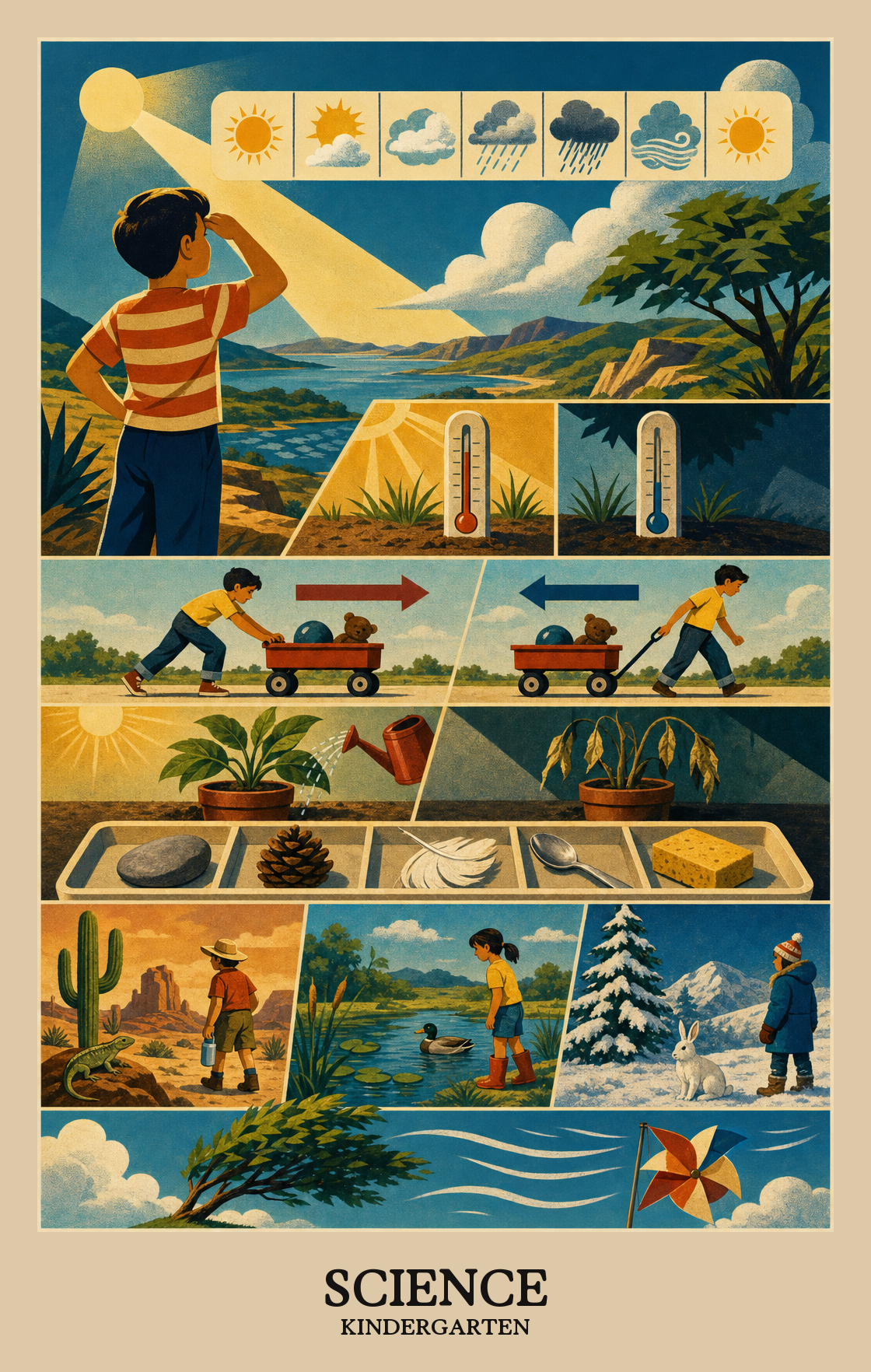
Students start the year as observers. They sort everyday objects by color, size, shape, and texture, and explain why each group belongs together. They also begin asking questions about what they see outside.
Students check the weather each day and track what changes through the seasons. They look at simple forecasts and talk about how to stay safe in storms, snow, and heat.
Students test how the sun warms different surfaces like dirt, sand, and pavement. They then design and build a small structure, such as a shade or cover, to keep a spot cooler.
Students experiment with moving objects by pushing and pulling them harder, softer, and in different directions. They use what they notice to argue whether a ramp, blocker, or other design actually changes how something moves.
Students compare living things in different habitats, like a pond, a forest, and a backyard. They record what plants and animals need to survive and draw a simple picture model showing why each one lives where it does.
Students wrap up the year thinking about water, paper, food, and energy at home and school. They ask questions about how a person can use less and share ideas for small changes they can try.
Students practice noticing things in the world around them and asking "why" or "how" questions about what they see. This is how science starts.
Students ask questions about what they see, what they read, and what other students think. Noticing something curious and wondering why is where science starts.
Students look at weather forecasts and ask questions about storms, floods, or extreme cold so they can figure out what to wear, bring, or do to stay safe.
Students ask questions about small ways people can use less of things found in nature, like water, wood, or soil.
Students sort and compare simple observations, like which day was warmer or which object sank, to find patterns and answer questions about the world around them.
Students collect observations about weather, seasons, or other natural events and look for patterns in what they recorded. Noticing that it rains more in certain months, for example, counts as finding a pattern.
Students go outside (or look out the window) each day and note the weather. Over weeks and seasons, they spot patterns, like which months bring rain or when it gets cold.
| Standard | Definition | Code |
|---|---|---|
| Asking questions and defining problems | Students practice noticing things in the world around them and asking "why" or "how" questions about what they see. This is how science starts. | OE.1.1 |
| Students will be able to ask questions about aspects of the phenomena they… | Students ask questions about what they see, what they read, and what other students think. Noticing something curious and wondering why is where science starts. | OE.1.1.1 |
| Ask questions to obtain information from weather forecasts to prepare for and… | Students look at weather forecasts and ask questions about storms, floods, or extreme cold so they can figure out what to wear, bring, or do to stay safe. | 0E.1.1.1.1 |
| Ask questions about how a person may reduce the amount of natural resources the… | Students ask questions about small ways people can use less of things found in nature, like water, wood, or soil. | 0E.1.1.1.2 |
| Analyzing and interpreting data | Students sort and compare simple observations, like which day was warmer or which object sank, to find patterns and answer questions about the world around them. | OE.2.1 |
| Students will be able to represent observations and data in order to recognize… | Students collect observations about weather, seasons, or other natural events and look for patterns in what they recorded. Noticing that it rains more in certain months, for example, counts as finding a pattern. | OE.2.1.1 |
| Make daily and seasonal observations of local weather conditions to describe… | Students go outside (or look out the window) each day and note the weather. Over weeks and seasons, they spot patterns, like which months bring rain or when it gets cold. | 0E.2.1.1.2 |
Students plan a simple test, gather what they need, and try it out to see what happens. This is how scientists answer questions, and kindergartners practice the same basic steps.
Students design simple tests to answer their own questions, then collect and record what they find. The results become the evidence they use to explain what happened.
Students go outside (or look at pictures) and record what sunlight does to surfaces like soil, sand, and pavement. They sort what they find to see which surfaces get warmer in the sun.
Students sort and compare observations from simple experiments, then explain what the data shows, such as which objects sink or float or which material feels rough or smooth.
Students sort and draw what they notice during a science activity, then look for patterns in what they recorded. For example, they might track which objects sink or float and spot what the results have in common.
Students sort everyday objects by what they look like or feel like (color, shape, size, texture) and explain why they grouped them that way.
Students count, sort, and compare objects to figure out patterns in how the physical world works. Numbers and simple data are the tools, not just the answer.
Students count, measure, and compare everyday objects to describe how the physical world works. They also follow simple step-by-step rules to figure out patterns in nature.
Students push and pull objects to see how hard or which direction makes them move faster, slower, or in a different path. They look for patterns in what they notice.
Students look at a simple problem, like a toy that won't roll or a block tower that keeps falling, and try to figure out why. Then they come up with a fix and explain their thinking.
Students pick a simple problem, think of a way to fix it, and test whether their idea works. They learn that a good solution has to fit the rules given, like using only certain materials or staying under a set size.
Students design and build something that blocks or reflects sunlight to keep a surface cooler. They test whether their structure actually reduces the warming effect.
Students look at simple objects or events and practice saying why they think something is true, using what they saw or touched as the reason.
Students look at simple evidence, like a picture or an object, and explain what they think is happening. When someone shows them new evidence, they change their thinking or explain why they disagree.
Students build a simple argument about whether a push or pull worked the way they planned, using what they actually saw happen to a moving object.
Students find information about the physical world by looking at books, pictures, or simple experiments, then share what they learned with others.
Reading a book, looking at a picture, or watching a video can all teach students something about the world. Students practice finding information from more than one place and deciding what seems true before sharing what they learned.
Students draw or describe a design that would block or reduce the sun's heat on a surface, like a shade structure or roof. The goal is to explain the idea clearly enough that someone else could understand it.
| Standard | Definition | Code |
|---|---|---|
| Planning and carrying out investigations | Students plan a simple test, gather what they need, and try it out to see what happens. This is how scientists answer questions, and kindergartners practice the same basic steps. | OP.1.2 |
| Students will be able to design and conduct investigations in the classroom… | Students design simple tests to answer their own questions, then collect and record what they find. The results become the evidence they use to explain what happened. | OP.1.2.1 |
| Collect and organize observational data to determine the effect of sunlight on… | Students go outside (or look at pictures) and record what sunlight does to surfaces like soil, sand, and pavement. They sort what they find to see which surfaces get warmer in the sun. | 0P.1.2.1.1 |
| Analyzing and interpreting data | Students sort and compare observations from simple experiments, then explain what the data shows, such as which objects sink or float or which material feels rough or smooth. | OP.2.1 |
| Students will be able to represent observations and data in order to recognize… | Students sort and draw what they notice during a science activity, then look for patterns in what they recorded. For example, they might track which objects sink or float and spot what the results have in common. | OP.2.1.1 |
| Sort objects in terms of natural/human-made, color, size, shape | Students sort everyday objects by what they look like or feel like (color, shape, size, texture) and explain why they grouped them that way. | 0P.2.1.1.1 |
| Using mathematics and computational thinking | Students count, sort, and compare objects to figure out patterns in how the physical world works. Numbers and simple data are the tools, not just the answer. | OP.2.2 |
| Students will be able to use mathematics to represent physical variables and… | Students count, measure, and compare everyday objects to describe how the physical world works. They also follow simple step-by-step rules to figure out patterns in nature. | OP.2.2.1 |
| Identify and describe patterns that emerge from the effects of different… | Students push and pull objects to see how hard or which direction makes them move faster, slower, or in a different path. They look for patterns in what they notice. | 0P.2.2.1.1 |
| Constructing explanations and designing solutions | Students look at a simple problem, like a toy that won't roll or a block tower that keeps falling, and try to figure out why. Then they come up with a fix and explain their thinking. | OP.3.2 |
| Students will be able to use their understanding of scientific principles and… | Students pick a simple problem, think of a way to fix it, and test whether their idea works. They learn that a good solution has to fit the rules given, like using only certain materials or staying under a set size. | OP.3.2.2 |
| Design and build a structure to reduce the warming effect of sunlight on… | Students design and build something that blocks or reflects sunlight to keep a surface cooler. They test whether their structure actually reduces the warming effect. | 0P.3.2.2.1 |
| Engaging in argument from evidence | Students look at simple objects or events and practice saying why they think something is true, using what they saw or touched as the reason. | OP.4.1 |
| Students will be able to engage in argument from evidence for the explanations… | Students look at simple evidence, like a picture or an object, and explain what they think is happening. When someone shows them new evidence, they change their thinking or explain why they disagree. | OP.4.1.1 |
| Construct an argument supported by evidence for whether a design solution works… | Students build a simple argument about whether a push or pull worked the way they planned, using what they actually saw happen to a moving object. | 0P.4.1.1.1 |
| Obtaining, evaluating and communicating information | Students find information about the physical world by looking at books, pictures, or simple experiments, then share what they learned with others. | OP.4.2 |
| Students will be able to read and interpret multiple sources to obtain… | Reading a book, looking at a picture, or watching a video can all teach students something about the world. Students practice finding information from more than one place and deciding what seems true before sharing what they learned. | OP.4.2.1 |
| Communicate design ideas for a structure that reduces the warming effect of… | Students draw or describe a design that would block or reduce the sun's heat on a surface, like a shade structure or roof. The goal is to explain the idea clearly enough that someone else could understand it. | 0P.4.2.1.1 |
Students plan a simple question about a plant or animal and then try to find the answer by watching closely or testing it out.
Students plan a simple test to answer a question they have about a plant, animal, or other living thing. They gather information from what they observe and use it to explain what they found.
Students look closely at plants and animals in different places, like a pond and a forest, and describe what makes each place's living things different.
Students sort pictures or objects of living and nonliving things, then look for patterns in what they find. They practice explaining what the data shows.
Students sort and record what they notice about living things, like how plants change or which animals have fur, then look for patterns in what they found.
Students draw or write what they notice about plants, animals, and people, then look for patterns in what all living things need, like food, water, and a safe place to live.
Students draw or build a simple model to show how something in nature works, like a flower, an insect, or the water cycle. The model helps them explain what they notice about the living world around them.
Students draw or build a simple model (like a diagram or clay shape) to show what they think is happening in nature. Then they update the model as they learn more and share their ideas with the class.
Students draw or build a simple model showing why a plant or animal lives where it does. A fish needs water, a cactus needs sun and dry soil. The model connects the living thing to the place that meets its needs.
| Standard | Definition | Code |
|---|---|---|
| Planning and carrying out investigations | Students plan a simple question about a plant or animal and then try to find the answer by watching closely or testing it out. | OL.1.2 |
| Students will be able to design and conduct investigations in the classroom… | Students plan a simple test to answer a question they have about a plant, animal, or other living thing. They gather information from what they observe and use it to explain what they found. | OL.1.2.1 |
| Make observations of plants and animals to compare the diversity of life in… | Students look closely at plants and animals in different places, like a pond and a forest, and describe what makes each place's living things different. | 0L.1.2.1.2 |
| Analyzing and interpreting data | Students sort pictures or objects of living and nonliving things, then look for patterns in what they find. They practice explaining what the data shows. | OL.2.1 |
| Students will be able to represent observations and data in order to recognize… | Students sort and record what they notice about living things, like how plants change or which animals have fur, then look for patterns in what they found. | OL.2.1.1 |
| Record and use observations to describe patterns of what plants and animals | Students draw or write what they notice about plants, animals, and people, then look for patterns in what all living things need, like food, water, and a safe place to live. | 0L.2.1.1.3 |
| Developing and using models | Students draw or build a simple model to show how something in nature works, like a flower, an insect, or the water cycle. The model helps them explain what they notice about the living world around them. | OL.3.1 |
| Students will be able to develop, revise | Students draw or build a simple model (like a diagram or clay shape) to show what they think is happening in nature. Then they update the model as they learn more and share their ideas with the class. | OL.3.1.1 |
| Develop a simple model to represent the relationship between the needs of… | Students draw or build a simple model showing why a plant or animal lives where it does. A fish needs water, a cactus needs sun and dry soil. The model connects the living thing to the place that meets its needs. | 0L.3.1.1.1 |
Alternate standards-based assessment for eligible students with the most significant cognitive disabilities, administered in the same subjects and grades as the MCA program.
Students spend a lot of time watching, sorting, and asking questions about everyday things. They track weather, notice how sunlight warms the ground, push and pull objects to see what happens, and look closely at plants and animals. Most lessons happen through hands-on play and short discussions, not reading.
Go outside and talk about what students notice. Watch the weather together each morning, sort rocks or leaves into groups, or feel which spots in the yard are warm and which are cool. Five minutes of looking closely and asking why is more useful than any worksheet.
No. Most of the work is talking, drawing, sorting, and building. Students share what they notice through pictures and conversation. Reading and writing skills grow in other parts of the day and are not what science depends on at this age.
Weather observation works well as a daily routine from day one and runs all year. Push and pull investigations fit a winter indoor block. Sunlight, shade, and plant or animal habitat work lands best in spring when students can be outside often. Sorting routines weave through every unit.
Students can describe a weather pattern they watched over time, sort objects and explain their reasoning, and predict whether a push or pull will speed something up or slow it down. They can also name what plants and animals need to survive and point to where those needs are met.
Explaining the reasoning behind a sort is harder than the sort itself. Students also confuse what they want to happen with what actually happened in an investigation. Plan extra time for students to put their thinking into words and to revise a claim when new evidence shows up.
Slow down and ask one question at a time. What did you see? What surprised you? What could we try next? Frustration usually means a student has an idea but cannot find the words yet, so a calm conversation helps more than a correct answer.
Watch and listen during the work itself. A student who points to a pattern on the weather chart, groups shells by texture and explains why, or predicts that a bigger push will move a block farther is showing real understanding. Short drawings with labels also work as evidence.
By spring, a student should ask questions about what they see, notice patterns in weather or motion, and explain a simple idea like why a sunny spot feels warmer. Curiosity and steady observation matter more than knowing facts.