Forces and motion
Students push, pull, and roll objects to see how forces change motion. They watch for patterns, like a swing that keeps the same rhythm, and use those patterns to predict what happens next.
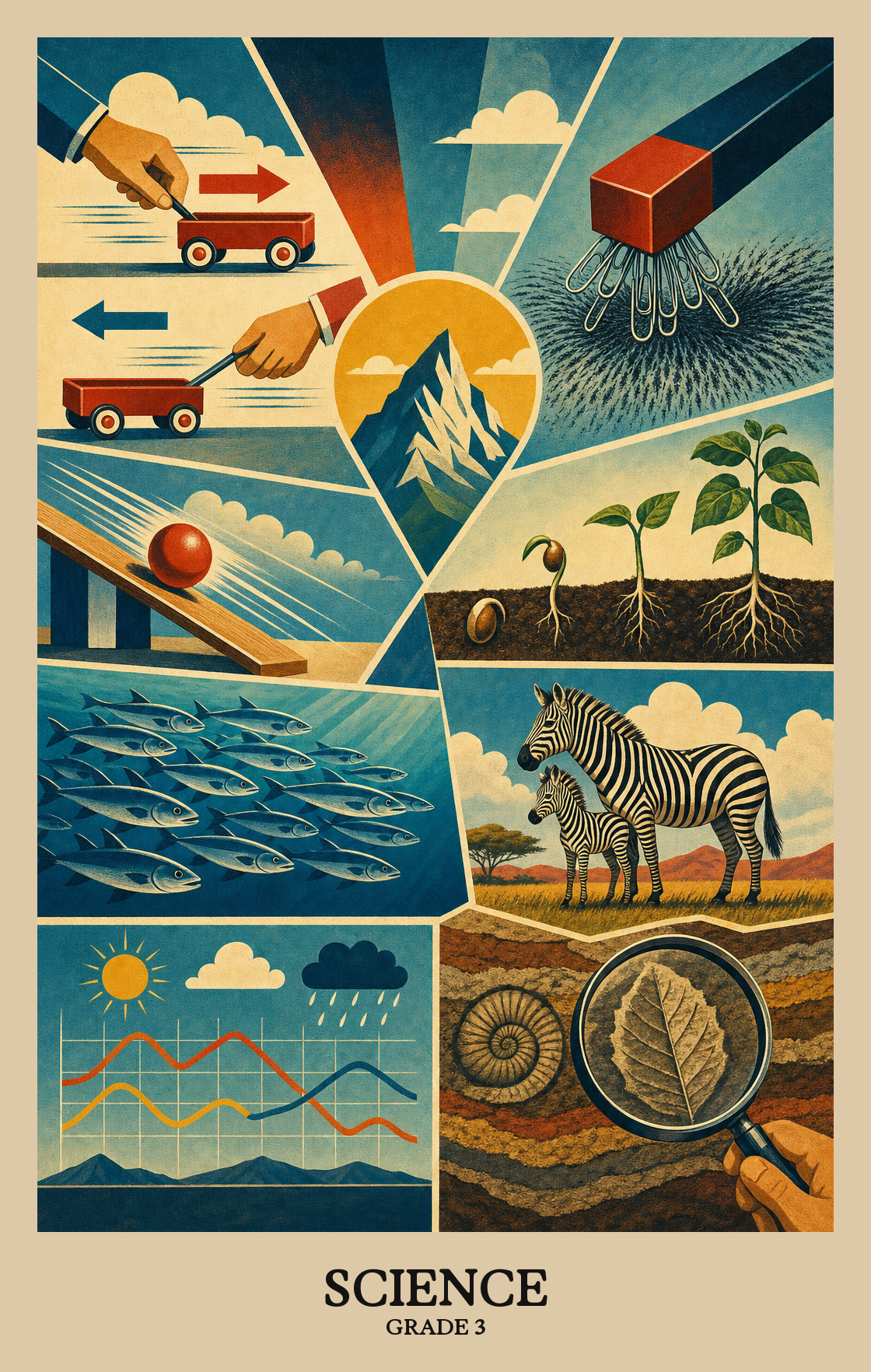
This is the year science becomes about evidence. Students run real tests on pushes and pulls, magnets, and motion, then use what they see to predict what happens next. They study how living things grow, why some animals stick together, and how traits pass from parent to child. By spring, students can look at weather charts or fossils and explain what the data shows.
Students push, pull, and roll objects to see how forces change motion. They watch for patterns, like a swing that keeps the same rhythm, and use those patterns to predict what happens next.
Students explore how magnets and static can move things without touching them. They ask questions about why, then design a small fix to a real problem using magnets.
Students compare how plants and animals are born, grow, and reproduce. They look at how kids resemble parents, why siblings differ, and how sunlight, food, or water can shape a living thing.
Students build arguments for why some animals live in groups. They use evidence to explain how traits like speed, color, or size help certain animals find food, stay safe, and have young.
Students read fossils like clues about old environments and study why some animals thrive in a habitat while others struggle. When a habitat changes, they weigh ideas for helping the plants and animals that live there.
Students chart weather across seasons and compare climates around the world. Then they design and test a solution to reduce harm from a weather hazard like a flood or strong wind, improving it after each try.
Students study why objects move, stop, or change direction. They learn how pushes and pulls affect everyday things like rolling balls, swinging playground equipment, and sliding objects across different surfaces.
Living things share common life processes, like growing, reproducing, and responding to their surroundings. Students learn how the parts of plants and animals are built to help them survive.
Students learn how living things depend on each other and their surroundings to survive. They look at what happens in a habitat when food, water, or shelter runs low.
Students learn why offspring look similar to their parents but not identical. They explore how traits like eye color or leaf shape get passed down, and why no two living things turn out exactly alike.
Students look at fossils and living animals to figure out how creatures have changed over millions of years. They also explore why some animals survive in their environment while others don't.
Students learn how weather patterns, water, and land shape the world around them. They study how rain, wind, and temperature change with the seasons and how those changes affect living things.
Students learn how weather and other natural events affect communities, and how people make choices to reduce the damage from those events.
Students spot a problem, brainstorm solutions, and test a simple design to see if it works. If it doesn't, they figure out what to change and try again.
| Standard | Definition | Code |
|---|---|---|
| Motion and Stability | Students study why objects move, stop, or change direction. They learn how pushes and pulls affect everyday things like rolling balls, swinging playground equipment, and sliding objects across different surfaces. | 3-PS2 |
| From Molecules to Organisms | Living things share common life processes, like growing, reproducing, and responding to their surroundings. Students learn how the parts of plants and animals are built to help them survive. | 3-LS1 |
| Ecosystems: Interactions, Energy | Students learn how living things depend on each other and their surroundings to survive. They look at what happens in a habitat when food, water, or shelter runs low. | 3-LS2 |
| Heredity: Inheritance and Variation of Traits | Students learn why offspring look similar to their parents but not identical. They explore how traits like eye color or leaf shape get passed down, and why no two living things turn out exactly alike. | 3-LS3 |
| Biological Evolution | Students look at fossils and living animals to figure out how creatures have changed over millions of years. They also explore why some animals survive in their environment while others don't. | 3-LS4 |
| Earth's Systems | Students learn how weather patterns, water, and land shape the world around them. They study how rain, wind, and temperature change with the seasons and how those changes affect living things. | 3-ESS2 |
| Earth and Human Activity | Students learn how weather and other natural events affect communities, and how people make choices to reduce the damage from those events. | 3-ESS3 |
| Engineering Design | Students spot a problem, brainstorm solutions, and test a simple design to see if it works. If it doesn't, they figure out what to change and try again. | 3-5-ETS1 |
Students plan and run a test to see what happens when forces on an object are equal (it stays put) or unequal (it moves). Think of pushing a toy car from both sides at once versus pushing harder from one side.
Students watch a moving object, like a rolling ball or a swinging pendulum, and record what they notice. Then they use that pattern to predict where the object will go next.
Students ask questions about what happens when magnets push or pull each other without touching, or when static electricity makes objects move without contact. The goal is figuring out what causes those effects.
Students think up a real problem that a magnet could help solve, like keeping a cabinet shut or sorting metal pieces from a pile, then describe what the solution needs to do.
| Standard | Definition | Code |
|---|---|---|
| Plan and conduct an investigation to provide evidence of the effects of… | Students plan and run a test to see what happens when forces on an object are equal (it stays put) or unequal (it moves). Think of pushing a toy car from both sides at once versus pushing harder from one side. | 3-PS2-1 |
| Make observations and/or measurements of an object's motion to provide evidence… | Students watch a moving object, like a rolling ball or a swinging pendulum, and record what they notice. Then they use that pattern to predict where the object will go next. | 3-PS2-2 |
| Ask questions to determine cause and effect relationships of electric or… | Students ask questions about what happens when magnets push or pull each other without touching, or when static electricity makes objects move without contact. The goal is figuring out what causes those effects. | 3-PS2-3 |
| Define a simple design problem that can be solved by applying scientific ideas… | Students think up a real problem that a magnet could help solve, like keeping a cabinet shut or sorting metal pieces from a pile, then describe what the solution needs to do. | 3-PS2-4 |
Living things follow a life cycle, but no two look exactly alike. Students compare how different animals and plants are born, grow, reproduce, and die, showing that the pattern is shared even when the details differ.
| Standard | Definition | Code |
|---|---|---|
| Develop models to describe that organisms have unique and diverse life cycles… | Living things follow a life cycle, but no two look exactly alike. Students compare how different animals and plants are born, grow, reproduce, and die, showing that the pattern is shared even when the details differ. | 3-LS1-1 |
Animals like wolves, fish, and birds often live in groups rather than alone. Students explain why, using examples that show how grouping helps animals find food, stay safe, or care for young.
| Standard | Definition | Code |
|---|---|---|
| Construct an argument that some animals form groups that help members survive | Animals like wolves, fish, and birds often live in groups rather than alone. Students explain why, using examples that show how grouping helps animals find food, stay safe, or care for young. | 3-LS2-1 |
Students look at real data about plants and animals to show that offspring inherit traits from their parents. They also notice that siblings or members of the same species don't all look exactly alike.
A plant grown in sunlight grows taller than the same plant grown in shade. Students use observations like this to explain how where an animal or plant lives can change how it looks or grows.
| Standard | Definition | Code |
|---|---|---|
| Analyze and interpret data to provide evidence that plants and animals have… | Students look at real data about plants and animals to show that offspring inherit traits from their parents. They also notice that siblings or members of the same species don't all look exactly alike. | 3-LS3-1 |
| Use evidence to support the explanation that traits can be influenced by the… | A plant grown in sunlight grows taller than the same plant grown in shade. Students use observations like this to explain how where an animal or plant lives can change how it looks or grows. | 3-LS3-2 |
Fossils are clues about ancient life. Students look at fossil records to figure out what plants and animals looked like millions of years ago and what kind of place they lived in.
Some animals in a group are faster, better camouflaged, or stronger than others. Students look at real examples to explain how those differences help certain animals survive long enough to have offspring.
Students look at a specific habitat, like a desert or pond, and use evidence to explain why some animals and plants thrive there, some struggle, and some could not live there at all.
Students pick a real-world solution (like planting native trees or building wildlife corridors) and explain why it helps animals and plants survive when their habitat changes. They back up their choice with evidence, not just opinion.
| Standard | Definition | Code |
|---|---|---|
| Analyze and interpret data from fossils to provide evidence of the organisms… | Fossils are clues about ancient life. Students look at fossil records to figure out what plants and animals looked like millions of years ago and what kind of place they lived in. | 3-LS4-1 |
| Use evidence to construct an explanation for how the variations in… | Some animals in a group are faster, better camouflaged, or stronger than others. Students look at real examples to explain how those differences help certain animals survive long enough to have offspring. | 3-LS4-2 |
| Construct an argument with evidence that in a particular habitat some organisms… | Students look at a specific habitat, like a desert or pond, and use evidence to explain why some animals and plants thrive there, some struggle, and some could not live there at all. | 3-LS4-3 |
| Make a claim about the merit of a solution to a problem caused when the… | Students pick a real-world solution (like planting native trees or building wildlife corridors) and explain why it helps animals and plants survive when their habitat changes. They back up their choice with evidence, not just opinion. | 3-LS4-4 |
Students collect weather data across all four seasons and organize it into charts or graphs showing what conditions to typically expect in winter, spring, summer, and fall.
Students gather facts from books, maps, and other sources to describe what the weather is usually like in different parts of the world, such as why a rainforest stays wet and warm while a desert stays hot and dry.
| Standard | Definition | Code |
|---|---|---|
| Represent data in tables and graphical displays to describe typical weather… | Students collect weather data across all four seasons and organize it into charts or graphs showing what conditions to typically expect in winter, spring, summer, and fall. | 3-ESS2-1 |
| Obtain and combine information to describe climates in different regions of the… | Students gather facts from books, maps, and other sources to describe what the weather is usually like in different parts of the world, such as why a rainforest stays wet and warm while a desert stays hot and dry. | 3-ESS2-2 |
Students look at a real design (like a flood barrier or a snow fence) and argue whether it actually helps protect people from dangerous weather. They back up their opinion with evidence.
| Standard | Definition | Code |
|---|---|---|
| Make a claim about the merit of a design solution that reduces the impacts of a… | Students look at a real design (like a flood barrier or a snow fence) and argue whether it actually helps protect people from dangerous weather. They back up their opinion with evidence. | 3-ESS3-1 |
Students identify a real problem worth solving, then set the rules for any solution: what it must do, what materials are allowed, and how much time or money can be spent.
Students come up with more than one way to solve an engineering problem, then compare their ideas to figure out which one best fits the rules and limits they were given.
Students test a prototype, change one thing at a time, and look for what broke or didn't work. Then they use what they found to make the design better.
| Standard | Definition | Code |
|---|---|---|
| Define a simple design problem reflecting a need or a want that includes… | Students identify a real problem worth solving, then set the rules for any solution: what it must do, what materials are allowed, and how much time or money can be spent. | 3-5-ETS1-1 |
| Generate and compare multiple possible solutions to a problem based on how well… | Students come up with more than one way to solve an engineering problem, then compare their ideas to figure out which one best fits the rules and limits they were given. | 3-5-ETS1-2 |
| Plan and carry out fair tests in which variables are controlled and failure… | Students test a prototype, change one thing at a time, and look for what broke or didn't work. Then they use what they found to make the design better. | 3-5-ETS1-3 |
Federally administered sample-based assessment in reading, mathematics, science, writing, and other subjects. NAEP results inform state-by-state comparisons rather than individual student or school accountability.
Students study forces and motion, life cycles and traits, weather and climate, and how living things survive in their habitats. They also work on simple design problems, like building something that uses magnets or protects against bad weather. Expect more investigating and less memorizing.
Ask students to notice patterns and explain why. Roll a ball down a ramp and ask what would make it go farther. Watch the weather for a week and look for patterns. Talk about which traits a pet got from its parents and which came from how it was raised.
Not really. Third grade science is more about asking questions, testing ideas, and using evidence to explain what happened. Knowing a few key words helps, but explaining thinking matters more than reciting definitions.
Plan a fair test, collect data, and use it to back up a claim. Explain how forces change motion, how living things inherit and adapt traits, and how weather patterns differ by season and region. Define a design problem and compare possible solutions.
Many teachers start with forces and motion in the fall because it gives students a clean entry into investigations and fair tests. Life science fits well in winter, and weather and climate land naturally in spring when seasons are shifting. Engineering design threads through every unit.
Balanced versus unbalanced forces trips students up, especially when an object is still moving. Inherited traits versus traits shaped by the environment also takes time, since students often think anything about a living thing comes from its parents. Plan extra examples for both.
Tie it to content already being taught. The magnet unit gives a natural design problem, and the weather unit pairs well with designing something that reduces storm damage. One solid design cycle per semester is more useful than several rushed ones.
Students change one thing at a time, keep the other parts the same, and record what happens. They can explain why a test was fair or unfair and suggest how to fix it. They do not need formal variable language yet, just clear reasoning.
They can ask a testable question, run a simple investigation, and use the results to support an answer. They can read a basic data table or bar graph and describe what it shows. Comfort with these habits matters more than any single topic.