Ancient world and early empires
Students start the year studying the first big societies, from Mesopotamia and Egypt to India, China, Greece, and Rome. They look at how religion, trade, and geography shaped daily life.
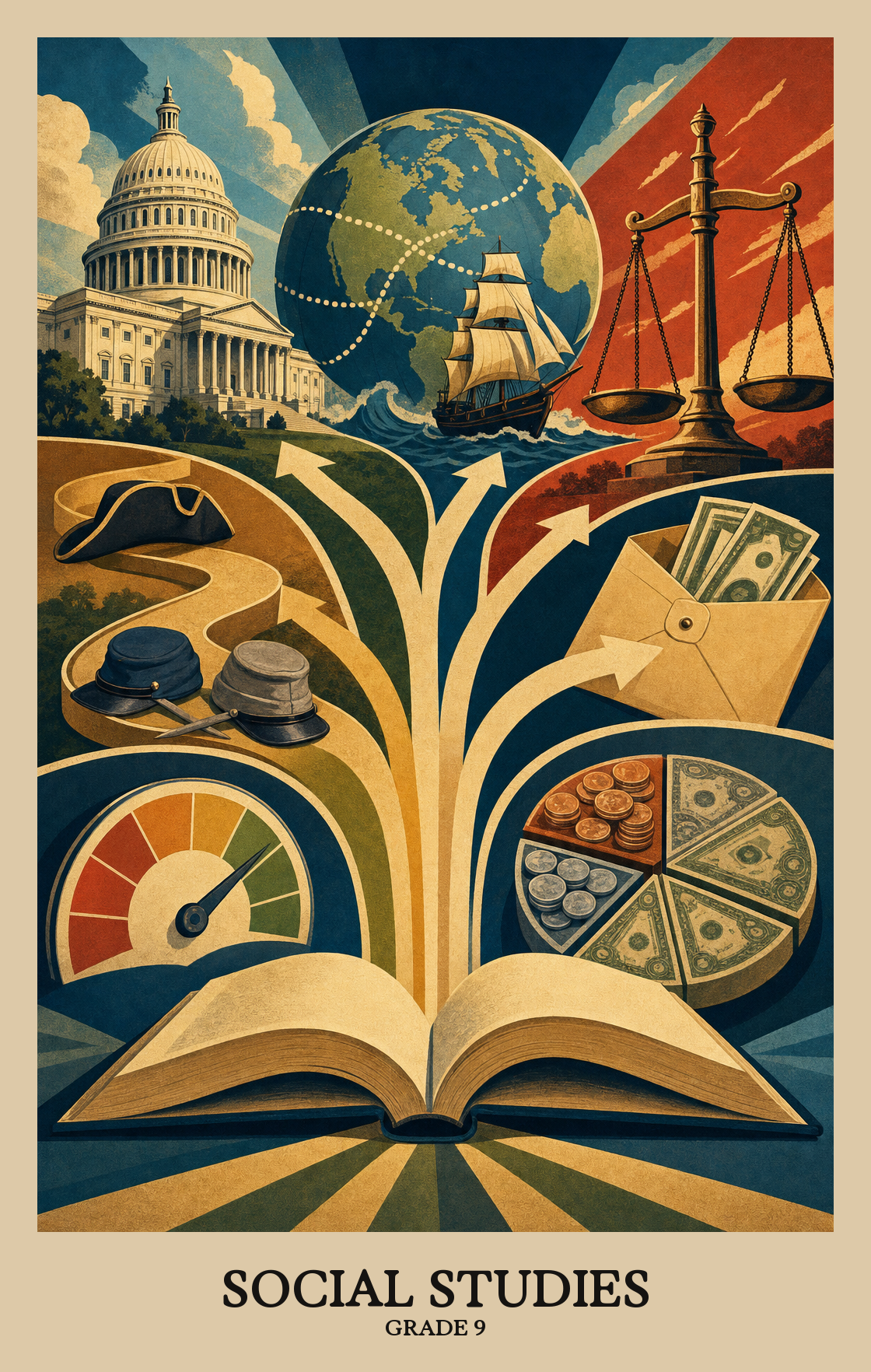
Ninth grade is the year social studies stops being one story and splits into many. Students move between world history, U.S. history, government, geography, and economics, and they start tracing how ideas like democracy, trade, and rights traveled across centuries. They also pick up real-life money skills, from reading a paystub to checking a credit score. By spring, students can explain how an event like the American Revolution or the Civil War reshaped the country, and they can talk through a basic budget.
Students start the year studying the first big societies, from Mesopotamia and Egypt to India, China, Greece, and Rome. They look at how religion, trade, and geography shaped daily life.
Students move into the Middle Ages and follow Byzantium, the Islamic world, African kingdoms, and feudal Europe. They finish this stretch with the Renaissance, Reformation, and the printing press.
Students study global exploration, the Columbian Exchange, and the slave trade, then turn to the Enlightenment and the revolutions that followed in America, France, Haiti, and Latin America.
Students focus on the English colonies, the road to independence, and the writing of the Constitution and Bill of Rights. They look at how the early presidents set lasting precedents.
Students work through slavery, the Civil War, and Reconstruction, then study industry, immigration, and the Progressive reformers who pushed for safer factories, voting rights, and cleaner government.
Students close the year with the two world wars, the Great Depression and New Deal, the Cold War, and the civil rights movement. They end in the present, looking at globalization and recent presidencies.
Students trace how U.S. intelligence agencies, from early wartime spy networks to the modern CIA and NSA, grew into the system that collects and analyzes information to protect national security.
Students compare how early English colonies took shape differently across North America, looking at why settlers came, how they governed themselves, and what their daily lives looked like by the late 1600s.
Students compare sources of income like wages, tips, and investments, then look at what drives the differences, such as education, skills, and job type.
Early human societies built the first cities, governments, and trade networks. Students study how civilizations like ancient Egypt, Mesopotamia, and the Indus Valley got started, how they were organized, and how they dealt with each other.
Students study how different governments are set up and who holds power in each one. They look at what makes a democracy different from a monarchy or dictatorship.
Students learn what intelligence agencies actually do: collecting and analyzing information to help government leaders make decisions about national security.
Students learn how governments and agencies gather information, the different forms that intelligence takes, and how that information gets shared across organizations.
Students break down how raw information gets turned into finished intelligence reports, tracing each step from collecting data to delivering analysis to decision-makers.
Intelligence analysts study information gathered from many sources and look for patterns that help government leaders make decisions about national security threats.
Students examine whether collecting and using intelligence data is legal, fair, and morally defensible. They weigh competing values like national security and personal privacy to form a reasoned position.
Students compare the jobs of federal agencies like the CIA, FBI, and NSA, looking at what each one is responsible for and how their missions overlap or differ.
Students read the ideas of Enlightenment thinkers and trace how those ideas pushed the founders to write a constitution built on limited government, individual rights, and consent of the governed.
Early English colonies built their own rules long before the United States existed. Students examine how settlers organized local governments, who held power, and how those choices shaped colonial life.
Students examine early Chinese and Indian civilizations and name their key contributions, from writing systems and philosophy to mathematics and medicine, in the centuries before 500 CE.
Budgeting means deciding in advance where each dollar of income goes. Students learn how tracking spending and adjusting a plan helps stretch limited money across real needs like rent, food, and savings.
Students read the original Constitution and explain how its parts fit together: why the Founders divided power between branches, and what the rules were meant to prevent.
Students examine why colonists broke from Britain, tracing the tension from taxes and trade laws to the ideas that made independence feel necessary.
Students study how ancient Greeks, Romans, and their neighbors shaped each other's governments, ideas, and daily life across roughly a thousand years of Mediterranean history.
Students compare ways to pay for something, such as cash, credit, and debit, and think through the costs and trade-offs of each choice.
Students examine why colonists broke from Britain and how they won the war: the ideas behind independence, key battles, the role of ordinary people, and the alliances that made victory possible.
Students learn how the federal government is structured and where its power comes from. They study which branch handles which job and what limits exist on each.
Students learn how power is split between the national government and the states under the U.S. Constitution. They study which decisions belong to Washington and which belong to state capitals.
Students trace how the Byzantine Empire kept Roman law and Christian traditions alive for centuries, and how the Mongol Empire reshaped trade routes and political power across Asia and Europe.
Students weigh real options for life after high school, from college and trade school to military service, work, or taking a gap year, and practice thinking through what each path actually involves.
Students trace the debates, compromises, and key figures that pushed the country from the Articles of Confederation to a working Constitution, including ratification and the Bill of Rights.
Students read each of the first ten amendments and explain what right it protects, why that right matters, and what laws or courts do to keep it in place.
Civil liberties are the freedoms the government cannot take away, like free speech. Civil rights are the protections that guarantee equal treatment under the law. Students learn what each term means and how both show up in real legal and political situations.
Credit is a lender's way of deciding whether to trust you with a loan. Students learn why building a good credit score matters and how it affects their ability to borrow money, rent an apartment, or sometimes even get a job.
From 600 to 1300 CE, the lands around the Mediterranean Sea saw Islamic empires, Christian kingdoms, and Byzantine rulers trade goods, fight wars, and swap ideas. Students trace how those contacts shaped laws, money, and daily life across three continents.
Students examine the decisions George Washington, Adams, Jefferson, Madison, and Monroe made when the country faced its first real tests: paying off war debt, staying out of European conflicts, and holding a fragile new government together.
Students learn how Congress works: who serves in the Senate and the House, how a bill becomes a law, and what powers the legislative branch holds under the Constitution.
Early African societies before 1500 CE were not one people or one culture. Students examine the range of political structures, trade networks, religious practices, and ways of life that developed across the continent.
Students learn what banks, credit unions, and other financial institutions actually do: hold deposits, make loans, and move money. The focus is on why these institutions exist and how they affect everyday financial decisions.
Students examine how Andrew Jackson reshaped the presidency, from the expansion of voting rights for white men to the forced removal of Native Americans and the battles over the national bank.
Students examine life in medieval Europe, looking at how the church shaped daily life, how kings and nobles divided power, and how peasants, merchants, and lords fit into the social and economic order.
Impeachment is how Congress can remove a president, judge, or other federal official from office. Students learn the constitutional steps: a House vote to charge the official, then a Senate trial to decide whether to remove them.
Students learn how the President and executive branch carry out the nation's laws. This includes how the cabinet works, what federal agencies do, and how executive power is limited.
Interest rates change how much borrowing costs. Students learn how a higher rate makes a loan more expensive and a lower rate can make buying a car or home more affordable.
Students trace how slavery spread debates between the North and South as the country pushed westward, and how those conflicts eventually pulled the nation into the Civil War.
Students examine the cultures, governments, and ways of life that developed across Central and South America, from Indigenous communities to colonial settlements. The goal is to understand why these societies look so different from one another.
Students examine what shifted and what stayed the same as Europe moved from medieval life into the Renaissance and Reformation, looking at art, religion, and how people understood their place in the world.
Key people, battles, and decisions that shaped the Civil War. Students examine what caused the war, how it unfolded, and why the outcome changed the country.
Students look at why people invest money and compare ways to do it, such as buying stocks, bonds, or real estate. The goal is to weigh the risks and potential gains of each option.
Students learn what the major federal departments and agencies actually do: how the Pentagon oversees the military, how the FDA reviews food and drugs, and how dozens of other offices carry out the day-to-day work of running the country.
Students learn how the U.S. government works with other countries, from signing treaties and sending aid to imposing sanctions or using military force. Each tool serves a different purpose depending on what the situation calls for.
Students learn how courts in the United States work, from how a case moves through the system to how judges interpret the law. The focus is on the federal court structure and the Supreme Court's role in deciding what the Constitution means.
Reconstruction was the period after the Civil War when the country debated how to reunite, who would hold political power, and what rights formerly enslaved people would have. Students examine the laws, elections, and conflicts that shaped that struggle.
Students learn how insurance works as a safety net when something goes wrong, like a car accident or a medical bill. They also look at other ways people protect their money from unexpected losses.
Students examine why European nations sent ships to the Americas, Africa, and Asia in the 1400s and 1500s, and what changed for the people already living there once those ships arrived.
Students trace what happens when someone is arrested, charged, tried, and sentenced. This covers how courts and law enforcement work together from the moment of arrest through verdict and punishment.
Students study how Japan and China changed politically and socially from the 1300s through the mid-1800s, covering the rise and fall of rulers, shifts in power, and how ordinary people's lives changed over those centuries.
Students trace how factories, railroads, and new machines made a handful of companies very powerful, how workers responded by organizing into unions, and why those two forces shaped everyday life in the late 1800s.
Government collects taxes and spends that money on public services. Students learn how those choices raise or lower prices, change what people can afford, and shape everyday financial decisions.
Students trace how three major Islamic empires, the Ottoman, Safavid, and Mughal, rose to power and what they built, governed, and left behind in art, religion, and law.
Elections decide who holds office and what policies get passed. Students learn how local, state, and national elections work, including who runs, how voting works, and why turnout shapes the result.
Students look at how European ideas about science, government, trade, and society shifted between the 1500s and the late 1700s. This covers the Renaissance, Reformation, Scientific Revolution, and Enlightenment as connected turning points, not isolated events.
Students examine how the U.S. push to settle land from coast to coast displaced Native tribes on the Great Plains. They look at what Americans believed justified that expansion and what it cost the people already living there.
Students study the rules and agencies that protect buyers from unsafe products, false advertising, and unfair charges. They weigh how well those protections actually work in real situations.
Starting around the late 1700s, people across the Atlantic world overthrew monarchies and colonial rulers to demand new rights and governments. Students study the American, French, and Haitian Revolutions to understand what caused them and what changed.
Students examine the early 1900s, when reformers pushed to break up corporate monopolies, clean up corrupt city governments, and give more Americans a voice in politics through new voting rules.
Students sort civic actions into two buckets: things people are required to do, like jury duty and paying taxes, and things people choose to do, like voting or joining a community group.
Students learn where identity theft comes from and what steps protect against it. That includes spotting risky habits, like sharing personal information online, and knowing what to do if someone steals a name, password, or financial account.
Industrialization moved work from farms and hand tools into factories, which pulled millions of people into fast-growing cities. Students examine how that shift changed jobs, living conditions, and daily life across the world.
Students learn how Georgia's state and local governments are set up and what each level is allowed to do, based on the rules written in the Georgia Constitution.
Students examine how the United States shifted from staying out of foreign affairs to actively trading, competing, and claiming territory overseas in the late 1800s and early 1900s.
Students examine how countries in the 1800s and early 1900s built strong national identities and used that pride to justify taking control of other lands and peoples around the world.
Students trace how the U.S. moved from staying out of World War I to joining the fight, and what changed at home and abroad as a result.
Students trace the tensions that built up in Europe before 1914 and explain how a single assassination pulled the world into war. The focus is on why the conflict spread so far and changed so much.
After World War I, Americans built a stronger sense of shared identity. Students examine how politics, the economy, and popular culture in the 1920s pulled a diverse country toward common values, pastimes, and beliefs.
Students study what caused the political and economic instability between the two World Wars. That includes the rise of dictators, the Great Depression, and how those pressures pushed nations toward another global conflict.
Students examine what caused the economy to collapse in the 1920s and 1930s and what happened to families, workers, and the country as a result.
World War II reshaped nearly every country on earth. Students examine how the war shifted borders, economies, and daily life across continents, and why its aftermath still shapes the world today.
Students examine how Franklin Roosevelt responded to the Great Depression by creating government jobs, financial relief, and banking reforms. They compare specific programs to see which ones helped unemployed workers, struggling farmers, and families who had lost their savings.
Students trace how the rivalry between the United States and the Soviet Union reshaped governments, economies, and daily life around the world, while colonies in Africa and Asia broke free from European rule.
Students trace how the U.S. entered World War II, how the war changed daily life at home, and why the federal government grew so much larger during those years.
From the 1960s to today, students trace what changed in the world and what stayed the same, looking at shifts in politics, society, and global power alongside patterns that persisted across decades.
Students examine how decisions made by Presidents Truman and Eisenhower shaped everyday American life, from the space race and highway construction to civil rights tensions and Cold War fears at home.
Globalization is how goods, ideas, money, and people now cross borders faster than ever. Students look at how that worldwide connectedness shapes economies, cultures, and political decisions in the modern world.
Students examine how Kennedy and Johnson shaped the country at home and abroad, from civil rights legislation to the space race, and how those decisions changed everyday American life.
Students examine how Nixon, Ford, and Carter handled foreign policy, domestic programs, and major events like Watergate, the energy crisis, and detente with China and the Soviet Union, and what those decisions changed at home and abroad.
Students study how American life shifted from the 1980s through the Obama years, looking at major policy decisions, economic swings, and new technology that changed everyday life and the country's role in the world.
| Standard | Definition | Code |
|---|---|---|
| Examine the development of the field of U.S | Students trace how U.S. intelligence agencies, from early wartime spy networks to the modern CIA and NSA, grew into the system that collects and analyzes information to protect national security. | SSINSS1 |
| Compare and contrast the development of English settlement and colonization… | Students compare how early English colonies took shape differently across North America, looking at why settlers came, how they governed themselves, and what their daily lives looked like by the late 1600s. | SSUSH1 |
| Evaluate various sources of income and analyze variables that affect a person's… | Students compare sources of income like wages, tips, and investments, then look at what drives the differences, such as education, skills, and job type. | SSPFL1 |
| Analyze the origins, structures | Early human societies built the first cities, governments, and trade networks. Students study how civilizations like ancient Egypt, Mesopotamia, and the Indus Valley got started, how they were organized, and how they dealt with each other. | SSWH1 |
| Compare and contrast various systems of government | Students study how different governments are set up and who holds power in each one. They look at what makes a democracy different from a monarchy or dictatorship. | SSCG1 |
| Describe the basic roles and functions of the Intelligence field | Students learn what intelligence agencies actually do: collecting and analyzing information to help government leaders make decisions about national security. | SSINSS2 |
| Explore the different types of Intelligence, collection methods | Students learn how governments and agencies gather information, the different forms that intelligence takes, and how that information gets shared across organizations. | SSINSS3 |
| Analyze the Intelligence Cycle | Students break down how raw information gets turned into finished intelligence reports, tracing each step from collecting data to delivering analysis to decision-makers. | SSINSS4 |
| Evaluate role of an Intelligence Analyst | Intelligence analysts study information gathered from many sources and look for patterns that help government leaders make decisions about national security threats. | SSINSS5 |
| Analyze the ethical, moral | Students examine whether collecting and using intelligence data is legal, fair, and morally defensible. They weigh competing values like national security and personal privacy to form a reasoned position. | SSINSS6 |
| Compare and contrast the roles and missions of the U.S | Students compare the jobs of federal agencies like the CIA, FBI, and NSA, looking at what each one is responsible for and how their missions overlap or differ. | SSINSS7 |
| Demonstrate knowledge of the political philosophies that shaped the development… | Students read the ideas of Enlightenment thinkers and trace how those ideas pushed the founders to write a constitution built on limited government, individual rights, and consent of the governed. | SSCG2 |
| Describe the early English colonial society and investigate the development of… | Early English colonies built their own rules long before the United States existed. Students examine how settlers organized local governments, who held power, and how those choices shaped colonial life. | SSUSH2 |
| Identify the major achievements of Chinese and Indian societies to 500 CE/AD | Students examine early Chinese and Indian civilizations and name their key contributions, from writing systems and philosophy to mathematics and medicine, in the centuries before 500 CE. | SSWH2 |
| Describe how budgeting and actively reviewing finances can be used to allocate… | Budgeting means deciding in advance where each dollar of income goes. Students learn how tracking spending and adjusting a plan helps stretch limited money across real needs like rent, food, and savings. | SSPFL2 |
| Demonstrate knowledge of the framing and structure of the United States… | Students read the original Constitution and explain how its parts fit together: why the Founders divided power between branches, and what the rules were meant to prevent. | SSCG3 |
| Analyze the causes of the American Revolution | Students examine why colonists broke from Britain, tracing the tension from taxes and trade laws to the ideas that made independence feel necessary. | SSUSH3 |
| Examine the political, philosophical | Students study how ancient Greeks, Romans, and their neighbors shaped each other's governments, ideas, and daily life across roughly a thousand years of Mediterranean history. | SSWH3 |
| Evaluate different methods for paying for goods and services | Students compare ways to pay for something, such as cash, credit, and debit, and think through the costs and trade-offs of each choice. | SSPFL3 |
| Analyze the ideological, military, social | Students examine why colonists broke from Britain and how they won the war: the ideas behind independence, key battles, the role of ordinary people, and the alliances that made victory possible. | SSUSH4 |
| Demonstrate knowledge of the organization and powers of the national government | Students learn how the federal government is structured and where its power comes from. They study which branch handles which job and what limits exist on each. | SSCG4 |
| Demonstrate knowledge of the federal system of government described in the… | Students learn how power is split between the national government and the states under the U.S. Constitution. They study which decisions belong to Washington and which belong to state capitals. | SSCG5 |
| Analyze impact of the Byzantine and Mongol empires | Students trace how the Byzantine Empire kept Roman law and Christian traditions alive for centuries, and how the Mongol Empire reshaped trade routes and political power across Asia and Europe. | SSWH4 |
| Evaluate alternatives for life after high school including college, technical… | Students weigh real options for life after high school, from college and trade school to military service, work, or taking a gap year, and practice thinking through what each path actually involves. | SSPFL4 |
| Investigate specific events and key ideas that brought about the adoption and… | Students trace the debates, compromises, and key figures that pushed the country from the Articles of Confederation to a working Constitution, including ratification and the Bill of Rights. | SSUSH5 |
| Analyze the meaning and importance of each of the rights guaranteed under the… | Students read each of the first ten amendments and explain what right it protects, why that right matters, and what laws or courts do to keep it in place. | SSCG6 |
| Demonstrate knowledge of civil liberties and civil rights | Civil liberties are the freedoms the government cannot take away, like free speech. Civil rights are the protections that guarantee equal treatment under the law. Students learn what each term means and how both show up in real legal and political situations. | SSCG7 |
| Describe the importance of credit and having a favorable credit score | Credit is a lender's way of deciding whether to trust you with a loan. Students learn why building a good credit score matters and how it affects their ability to borrow money, rent an apartment, or sometimes even get a job. | SSPFL5 |
| Examine the political, economic | From 600 to 1300 CE, the lands around the Mediterranean Sea saw Islamic empires, Christian kingdoms, and Byzantine rulers trade goods, fight wars, and swap ideas. Students trace how those contacts shaped laws, money, and daily life across three continents. | SSWH5 |
| Analyze the challenges faced by the first five presidents and how they… | Students examine the decisions George Washington, Adams, Jefferson, Madison, and Monroe made when the country faced its first real tests: paying off war debt, staying out of European conflicts, and holding a fragile new government together. | SSUSH6 |
| Demonstrate knowledge of the legislative branch of government | Students learn how Congress works: who serves in the Senate and the House, how a bill becomes a law, and what powers the legislative branch holds under the Constitution. | SSCG8 |
| Describe the diverse characteristics of early African societies before 1500… | Early African societies before 1500 CE were not one people or one culture. Students examine the range of political structures, trade networks, religious practices, and ways of life that developed across the continent. | SSWH6 |
| Analyze the purpose and functions of various financial institutions | Students learn what banks, credit unions, and other financial institutions actually do: hold deposits, make loans, and move money. The focus is on why these institutions exist and how they affect everyday financial decisions. | SSPFL6 |
| Investigate political, economic | Students examine how Andrew Jackson reshaped the presidency, from the expansion of voting rights for white men to the forced removal of Native Americans and the battles over the national bank. | SSUSH7 |
| Analyze European medieval society with regard to culture, politics, society | Students examine life in medieval Europe, looking at how the church shaped daily life, how kings and nobles divided power, and how peasants, merchants, and lords fit into the social and economic order. | SSWH7 |
| Explain the impeachment and removal process and its use for federal officials… | Impeachment is how Congress can remove a president, judge, or other federal official from office. Students learn the constitutional steps: a House vote to charge the official, then a Senate trial to decide whether to remove them. | SSCG9 |
| Demonstrate knowledge of the executive branch of government | Students learn how the President and executive branch carry out the nation's laws. This includes how the cabinet works, what federal agencies do, and how executive power is limited. | SSCG10 |
| Explain how interest rates affect various consumer decisions | Interest rates change how much borrowing costs. Students learn how a higher rate makes a loan more expensive and a lower rate can make buying a car or home more affordable. | SSPFL7 |
| Explore the relationship between slavery, growing north-south divisions | Students trace how slavery spread debates between the North and South as the country pushed westward, and how those conflicts eventually pulled the nation into the Civil War. | SSUSH8 |
| Describe the diverse characteristics of societies in Central and South America | Students examine the cultures, governments, and ways of life that developed across Central and South America, from Indigenous communities to colonial settlements. The goal is to understand why these societies look so different from one another. | SSWH8 |
| Analyze change and continuity in the Renaissance and Reformation | Students examine what shifted and what stayed the same as Europe moved from medieval life into the Renaissance and Reformation, looking at art, religion, and how people understood their place in the world. | SSWH9 |
| Evaluate key events, issues | Key people, battles, and decisions that shaped the Civil War. Students examine what caused the war, how it unfolded, and why the outcome changed the country. | SSUSH9 |
| Evaluate reasons for and various methods of investment | Students look at why people invest money and compare ways to do it, such as buying stocks, bonds, or real estate. The goal is to weigh the risks and potential gains of each option. | SSPFL8 |
| Explain the functions of the departments and agencies of the federal… | Students learn what the major federal departments and agencies actually do: how the Pentagon oversees the military, how the FDA reviews food and drugs, and how dozens of other offices carry out the day-to-day work of running the country. | SSCG11 |
| Describe the tools used to carry out United States foreign policy, including… | Students learn how the U.S. government works with other countries, from signing treaties and sending aid to imposing sanctions or using military force. Each tool serves a different purpose depending on what the situation calls for. | SSCG12 |
| Demonstrate knowledge of the operation of the judicial branch of government | Students learn how courts in the United States work, from how a case moves through the system to how judges interpret the law. The focus is on the federal court structure and the Supreme Court's role in deciding what the Constitution means. | SSCG13 |
| Identify legal, political | Reconstruction was the period after the Civil War when the country debated how to reunite, who would hold political power, and what rights formerly enslaved people would have. Students examine the laws, elections, and conflicts that shaped that struggle. | SSUSH10 |
| Describe how insurance and other risk-management strategies protect against… | Students learn how insurance works as a safety net when something goes wrong, like a car accident or a medical bill. They also look at other ways people protect their money from unexpected losses. | SSPFL9 |
| Analyze the causes and effects of exploration and expansion into the Americas… | Students examine why European nations sent ships to the Americas, Africa, and Asia in the 1400s and 1500s, and what changed for the people already living there once those ships arrived. | SSWH10 |
| Demonstrate knowledge of the criminal justice process | Students trace what happens when someone is arrested, charged, tried, and sentenced. This covers how courts and law enforcement work together from the moment of arrest through verdict and punishment. | SSCG14 |
| Examine political and social changes in Japan and in China from the fourteenth… | Students study how Japan and China changed politically and socially from the 1300s through the mid-1800s, covering the rise and fall of rulers, shifts in power, and how ordinary people's lives changed over those centuries. | SSWH11 |
| Examine connections between the rise of big business, the growth of labor unions | Students trace how factories, railroads, and new machines made a handful of companies very powerful, how workers responded by organizing into unions, and why those two forces shaped everyday life in the late 1800s. | SSUSH11 |
| Describe how government taxing and spending decisions affect consumers | Government collects taxes and spends that money on public services. Students learn how those choices raise or lower prices, change what people can afford, and shape everyday financial decisions. | SSPFL10 |
| Describe the development and contributions of the Ottoman, Safavid | Students trace how three major Islamic empires, the Ottoman, Safavid, and Mughal, rose to power and what they built, governed, and left behind in art, religion, and law. | SSWH12 |
| Demonstrate knowledge of local, state | Elections decide who holds office and what policies get passed. Students learn how local, state, and national elections work, including who runs, how voting works, and why turnout shapes the result. | SSCG15 |
| Examine the intellectual, political, social | Students look at how European ideas about science, government, trade, and society shifted between the 1500s and the late 1700s. This covers the Renaissance, Reformation, Scientific Revolution, and Enlightenment as connected turning points, not isolated events. | SSWH13 |
| Evaluate how westward expansion impacted the Plains Indians and fulfilled… | Students examine how the U.S. push to settle land from coast to coast displaced Native tribes on the Great Plains. They look at what Americans believed justified that expansion and what it cost the people already living there. | SSUSH12 |
| Explain and evaluate various forms of consumer protection | Students study the rules and agencies that protect buyers from unsafe products, false advertising, and unfair charges. They weigh how well those protections actually work in real situations. | SSPFL11 |
| Analyze the Age of Revolutions | Starting around the late 1700s, people across the Atlantic world overthrew monarchies and colonial rulers to demand new rights and governments. Students study the American, French, and Haitian Revolutions to understand what caused them and what changed. | SSWH14 |
| Evaluate efforts to reform American society and politics in the Progressive Era | Students examine the early 1900s, when reformers pushed to break up corporate monopolies, clean up corrupt city governments, and give more Americans a voice in politics through new voting rules. | SSUSH13 |
| Analyze the difference between involuntary and voluntary participation in civic… | Students sort civic actions into two buckets: things people are required to do, like jury duty and paying taxes, and things people choose to do, like voting or joining a community group. | SSCG16 |
| Explain sources of and protection against identity theft | Students learn where identity theft comes from and what steps protect against it. That includes spotting risky habits, like sharing personal information online, and knowing what to do if someone steals a name, password, or financial account. | SSPFL12 |
| Describe the impact of industrialization and urbanization | Industrialization moved work from farms and hand tools into factories, which pulled millions of people into fast-growing cities. Students examine how that shift changed jobs, living conditions, and daily life across the world. | SSWH15 |
| Demonstrate knowledge of the organization and powers of state and local… | Students learn how Georgia's state and local governments are set up and what each level is allowed to do, based on the rules written in the Georgia Constitution. | SSCG17 |
| Explain America's evolving relationship with the world at the turn of the… | Students examine how the United States shifted from staying out of foreign affairs to actively trading, competing, and claiming territory overseas in the late 1800s and early 1900s. | SSUSH14 |
| Analyze the rise of nationalism and worldwide imperialism | Students examine how countries in the 1800s and early 1900s built strong national identities and used that pride to justify taking control of other lands and peoples around the world. | SSWH16 |
| Analyze the origins and impact of U.S | Students trace how the U.S. moved from staying out of World War I to joining the fight, and what changed at home and abroad as a result. | SSUSH15 |
| Demonstrate an understanding of long-term causes of World War I and its global… | Students trace the tensions that built up in Europe before 1914 and explain how a single assassination pulled the world into war. The focus is on why the conflict spread so far and changed so much. | SSWH17 |
| Investigate how political, economic | After World War I, Americans built a stronger sense of shared identity. Students examine how politics, the economy, and popular culture in the 1920s pulled a diverse country toward common values, pastimes, and beliefs. | SSUSH16 |
| Examine the major political and economic factors that shaped world societies… | Students study what caused the political and economic instability between the two World Wars. That includes the rise of dictators, the Great Depression, and how those pressures pushed nations toward another global conflict. | SSWH18 |
| Analyze the causes and consequences of the Great Depression | Students examine what caused the economy to collapse in the 1920s and 1930s and what happened to families, workers, and the country as a result. | SSUSH17 |
| Demonstrate an understanding of the global political, economic | World War II reshaped nearly every country on earth. Students examine how the war shifted borders, economies, and daily life across continents, and why its aftermath still shapes the world today. | SSWH19 |
| Evaluate Franklin D. Roosevelt's New Deal as a response to the Great Depression… | Students examine how Franklin Roosevelt responded to the Great Depression by creating government jobs, financial relief, and banking reforms. They compare specific programs to see which ones helped unemployed workers, struggling farmers, and families who had lost their savings. | SSUSH18 |
| Demonstrate an understanding of the global social, economic | Students trace how the rivalry between the United States and the Soviet Union reshaped governments, economies, and daily life around the world, while colonies in Africa and Asia broke free from European rule. | SSWH20 |
| Examine the origins, major developments | Students trace how the U.S. entered World War II, how the war changed daily life at home, and why the federal government grew so much larger during those years. | SSUSH19 |
| Examine change and continuity in the world since the 1960s | From the 1960s to today, students trace what changed in the world and what stayed the same, looking at shifts in politics, society, and global power alongside patterns that persisted across decades. | SSWH21 |
| Analyze U.S. international and domestic policies including their influences on… | Students examine how decisions made by Presidents Truman and Eisenhower shaped everyday American life, from the space race and highway construction to civil rights tensions and Cold War fears at home. | SSUSH20 |
| Analyze globalization in the contemporary world | Globalization is how goods, ideas, money, and people now cross borders faster than ever. Students look at how that worldwide connectedness shapes economies, cultures, and political decisions in the modern world. | SSWH22 |
| Analyze U.S. international and domestic policies including their influences on… | Students examine how Kennedy and Johnson shaped the country at home and abroad, from civil rights legislation to the space race, and how those decisions changed everyday American life. | SSUSH21 |
| Analyze U.S. international and domestic policies including their influences on… | Students examine how Nixon, Ford, and Carter handled foreign policy, domestic programs, and major events like Watergate, the energy crisis, and detente with China and the Soviet Union, and what those decisions changed at home and abroad. | SSUSH22 |
| Assess the political, economic | Students study how American life shifted from the 1980s through the Obama years, looking at major policy decisions, economic swings, and new technology that changed everyday life and the country's role in the world. | SSUSH23 |
Students trace how the United States gathered secret information during wartime, from George Washington's spy networks during the Revolution to the intelligence operations that shaped the Civil War.
Students trace how U.S. spy and intelligence work changed between World War I and World War II, looking at what the government learned, how it gathered information, and how those lessons shaped the way America prepared for the next conflict.
The Cold War arms race and its aftermath pushed U.S. spy agencies to expand, reorganize, and shift their focus. Students explain how events like the Soviet collapse changed what intelligence agencies tracked and how they operated.
Students look at how social media, disinformation campaigns, and other modern threats make it harder for U.S. intelligence agencies to protect national security. They explain what those challenges are and why they matter.
| Standard | Definition | Code |
|---|---|---|
| Explore the history of U.S | Students trace how the United States gathered secret information during wartime, from George Washington's spy networks during the Revolution to the intelligence operations that shaped the Civil War. | SSINSS1.a |
| Explain the application of U.S | Students trace how U.S. spy and intelligence work changed between World War I and World War II, looking at what the government learned, how it gathered information, and how those lessons shaped the way America prepared for the next conflict. | SSINSS1.b |
| Explain how the late and post-Cold War era shaped U.S | The Cold War arms race and its aftermath pushed U.S. spy agencies to expand, reorganize, and shift their focus. Students explain how events like the Soviet collapse changed what intelligence agencies tracked and how they operated. | SSINSS1.c |
| Analyze the current challenges to the U.S | Students look at how social media, disinformation campaigns, and other modern threats make it harder for U.S. intelligence agencies to protect national security. They explain what those challenges are and why they matter. | SSINSS1.d |
Intelligence, in this context, means gathering and analyzing information about threats to the U.S., its people, or its interests, whether those threats come from inside the country or abroad. Students learn what the intelligence field does and why it exists.
Students learn what intelligence agencies actually do: collecting and analyzing information to help U.S. leaders make decisions about national security, military action, and foreign policy.
Students learn about the different jobs available in the Intelligence field, such as analysts who study information, officers who run operations, and technical specialists who build systems.
Students learn how the government decides who can access classified information. The security clearance process involves background checks, interviews, and personal history reviews, and certain factors like debt or criminal records can block or delay approval.
Students identify what makes intelligence information vulnerable to theft, leaks, or misuse, and explain how different levels of sensitivity affect how that information is protected.
| Standard | Definition | Code |
|---|---|---|
| Define Intelligence as the process of collection and analysis of information… | Intelligence, in this context, means gathering and analyzing information about threats to the U.S., its people, or its interests, whether those threats come from inside the country or abroad. Students learn what the intelligence field does and why it exists. | SSINSS2.a |
| Explain the purpose and uses of Intelligence for the U.S | Students learn what intelligence agencies actually do: collecting and analyzing information to help U.S. leaders make decisions about national security, military action, and foreign policy. | SSINSS2.b |
| Describe the various career paths for a person entering the Intelligence field | Students learn about the different jobs available in the Intelligence field, such as analysts who study information, officers who run operations, and technical specialists who build systems. | SSINSS2.c |
| Explain the security clearance process | Students learn how the government decides who can access classified information. The security clearance process involves background checks, interviews, and personal history reviews, and certain factors like debt or criminal records can block or delay approval. | SSINSS2.d |
| Describe levels of vulnerability for Intelligence Security | Students identify what makes intelligence information vulnerable to theft, leaks, or misuse, and explain how different levels of sensitivity affect how that information is protected. | SSINSS2.e |
Students learn the six main ways governments and agencies gather information, from intercepting communications and analyzing satellite images to interviewing people on the ground and researching publicly available sources.
Students identify types of intelligence beyond spy tradecraft, such as medical, financial, cyber, and cultural intelligence, and explain what kind of information each type collects and why governments or agencies use it.
Students weigh what different intelligence sources get right and where they fall short, then compare them against each other to understand why analysts rarely rely on just one source.
Students look at how modern intelligence gathering, like satellite imagery or cyber monitoring, is changing what spy agencies and governments can collect and how they share that information securely.
Recent world events change what governments share with allies and what they keep secret. Students study how crises, conflicts, and shifting politics shape the flow of intelligence between countries.
| Standard | Definition | Code |
|---|---|---|
| Identify the six basic intelligence sources and methods of collection and… | Students learn the six main ways governments and agencies gather information, from intercepting communications and analyzing satellite images to interviewing people on the ground and researching publicly available sources. | SSINSS3.a |
| Describe other sources and types of Intelligence such as | Students identify types of intelligence beyond spy tradecraft, such as medical, financial, cyber, and cultural intelligence, and explain what kind of information each type collects and why governments or agencies use it. | SSINSS3.b |
| Compare and contrast the strengths and weaknesses inherent in the various… | Students weigh what different intelligence sources get right and where they fall short, then compare them against each other to understand why analysts rarely rely on just one source. | SSINSS3.c |
| Explore current trends in different types of Intelligence that challenge… | Students look at how modern intelligence gathering, like satellite imagery or cyber monitoring, is changing what spy agencies and governments can collect and how they share that information securely. | SSINSS3.d |
| Explain how recent events affect how information is shared with partner nations | Recent world events change what governments share with allies and what they keep secret. Students study how crises, conflicts, and shifting politics shape the flow of intelligence between countries. | SSINSS3.e |
Students learn the steps intelligence agencies follow to gather and use information, from deciding what to find out, to collecting and analyzing it, to sharing conclusions with decision-makers.
Raw intelligence is unverified information collected from sources. Finished intelligence is that same information analyzed, checked, and turned into a report decision-makers can actually use.
Students walk through each stage of how governments collect and use information to make decisions, then weigh what works and what falls short in the current process.
| Standard | Definition | Code |
|---|---|---|
| Describe the stages of the Intelligence Cycle | Students learn the steps intelligence agencies follow to gather and use information, from deciding what to find out, to collecting and analyzing it, to sharing conclusions with decision-makers. | SSINSS4.a |
| Distinguish between raw and finished Intelligence | Raw intelligence is unverified information collected from sources. Finished intelligence is that same information analyzed, checked, and turned into a report decision-makers can actually use. | SSINSS4.b |
| Explain how to be successful at each stage of the Intelligence Cycle and… | Students walk through each stage of how governments collect and use information to make decisions, then weigh what works and what falls short in the current process. | SSINSS4.c |
An intelligence analyst sorts through raw information and judges what's actually useful. Students learn how analysts decide which facts matter, which sources to trust, and what to set aside before any decision gets made.
Analysts rarely trust their first instinct. Students learn how intelligence professionals test competing explanations against the same evidence and check the assumptions baked into any conclusion before acting on it.
Students identify what each federal intelligence agency is actually allowed to do, such as whether it operates inside the U.S. or abroad, and whether it serves the military or civilian government.
Intelligence agencies collect and share information with each other to build a clearer picture of national security threats. Students explain why that sharing matters and how the process works across agencies like the CIA, FBI, and NSA.
Fusion Centers are places where federal and state agencies share information about security threats. Students learn what these centers do, how they connect different levels of government, and why that coordination matters for national security.
| Standard | Definition | Code |
|---|---|---|
| Describe the role of an analyst in assessing the value of information | An intelligence analyst sorts through raw information and judges what's actually useful. Students learn how analysts decide which facts matter, which sources to trust, and what to set aside before any decision gets made. | SSINSS5.a |
| Explain how analysts use structured analytic techniques such as analysis of… | Analysts rarely trust their first instinct. Students learn how intelligence professionals test competing explanations against the same evidence and check the assumptions baked into any conclusion before acting on it. | SSINSS5.b |
| Describe the authorized activities | Students identify what each federal intelligence agency is actually allowed to do, such as whether it operates inside the U.S. or abroad, and whether it serves the military or civilian government. | SSINSS5.c |
| Explain the purposes and processes for sharing of information between U.S | Intelligence agencies collect and share information with each other to build a clearer picture of national security threats. Students explain why that sharing matters and how the process works across agencies like the CIA, FBI, and NSA. | SSINSS5.d |
| Describe the role of Fusion Centers in coordinating federal and state… | Fusion Centers are places where federal and state agencies share information about security threats. Students learn what these centers do, how they connect different levels of government, and why that coordination matters for national security. | SSINSS5.e |
Intelligence analysts face real moral conflicts: deciding how much to hide, when force is justified, and whether the goal excuses the method. Students examine the ethical pressures that shape those decisions.
Intelligence officers follow rules shaped by what society considers right and wrong. As those values shift at home and abroad, the laws and guidelines officers must work within change too.
Students learn how intelligence agencies weigh right and wrong when deciding whether to spy on someone or run a secret operation. The job requires balancing what is legal, what is effective, and what a democratic society will accept.
Gathering information about threats, at home or overseas, runs into legal limits. Students examine the laws and court rulings that set boundaries on what intelligence agencies can collect and why those boundaries are hard to enforce.
| Standard | Definition | Code |
|---|---|---|
| Describe how ethical standards and moral dilemmas challenge intelligence… | Intelligence analysts face real moral conflicts: deciding how much to hide, when force is justified, and whether the goal excuses the method. Students examine the ethical pressures that shape those decisions. | SSINSS6.a |
| Explain how changes over time in societal ethics and morality, both domestic… | Intelligence officers follow rules shaped by what society considers right and wrong. As those values shift at home and abroad, the laws and guidelines officers must work within change too. | SSINSS6.b |
| Explain how Intelligence professionals relate ethical and moral issues to… | Students learn how intelligence agencies weigh right and wrong when deciding whether to spy on someone or run a secret operation. The job requires balancing what is legal, what is effective, and what a democratic society will accept. | SSINSS6.c |
| Describe the legal constraints and challenges to the collection of… | Gathering information about threats, at home or overseas, runs into legal limits. Students examine the laws and court rulings that set boundaries on what intelligence agencies can collect and why those boundaries are hard to enforce. | SSINSS6.d |
Students name the federal agencies that make up the U.S. Intelligence Community, such as the CIA, NSA, and FBI, and explain what each one does and what it focuses on.
Students learn what the Director of National Intelligence does: oversee the 18 agencies that gather and share intelligence, and make sure those agencies are talking to each other instead of working in silos.
Congress has the power to review, question, and limit what U.S. spy agencies do. Students learn how lawmakers use hearings, budgets, and investigations to keep intelligence agencies accountable.
| Standard | Definition | Code |
|---|---|---|
| Identify all U.S. federal agencies which make up the U.S | Students name the federal agencies that make up the U.S. Intelligence Community, such as the CIA, NSA, and FBI, and explain what each one does and what it focuses on. | SSINSS7.a |
| Describe the role of the Director of National Intelligence in coordinating… | Students learn what the Director of National Intelligence does: oversee the 18 agencies that gather and share intelligence, and make sure those agencies are talking to each other instead of working in silos. | SSINSS7.b |
| Explain the role of Congress as an oversight body to the U.S | Congress has the power to review, question, and limit what U.S. spy agencies do. Students learn how lawmakers use hearings, budgets, and investigations to keep intelligence agencies accountable. | SSINSS7.c |
Landforms, rivers, climate, and natural resources shape where people choose to live. Students explain why some places draw large populations while others stay nearly empty.
Rivers, mountains, and rocky terrain shaped where people settled across North America. Students explain why communities formed near waterways like the Mississippi and avoided rugged regions like the Rockies or the Canadian Shield.
Students look at how the Andes Mountains, Amazon rainforest, Atacama Desert, and Pampas grasslands shaped where people settled in Central and South America, and why some regions drew large populations while others stayed nearly empty.
Students study Europe's mountains, rivers, and climate zones to explain why people settled where they did. A river valley or mild coast drew more settlers than a steep mountain range.
Africa's landforms and climate shaped where people settled. Students examine how the Nile River, the Sahara, and other major features made some areas crowded with people and left others nearly empty.
Students study how mountains, rivers, and seas in Central and Southwest Asia shaped where people chose to live. Rivers like the Tigris and Euphrates made farming possible, while rugged mountain ranges pushed settlements toward lower ground.
Students study how mountains, deserts, and rivers across South, Southeast, and East Asia shaped where people chose to live. The Himalayas, Gobi Desert, and major river valleys like the Ganges and Yangtze each made certain areas easier or harder to settle.
Students learn where the major landforms, deserts, and coastlines of Australia, New Zealand, and Antarctica sit, and why features like a mountain range or a vast desert push people toward certain areas and leave others nearly empty.
Natural resources like oil, farmland, and minerals are not spread evenly across the earth. Students explain where key resources are found and why people have built cities and settlements close to them.
| Standard | Definition | Code |
|---|---|---|
| Explain why physical characteristics of place such as landforms, bodies of… | Landforms, rivers, climate, and natural resources shape where people choose to live. Students explain why some places draw large populations while others stay nearly empty. | SSWG1 |
| Identify and describe climates and locations of major physical features of… | Rivers, mountains, and rocky terrain shaped where people settled across North America. Students explain why communities formed near waterways like the Mississippi and avoided rugged regions like the Rockies or the Canadian Shield. | SSWG1.a |
| Identify and describe climates and locations of major physical features of… | Students look at how the Andes Mountains, Amazon rainforest, Atacama Desert, and Pampas grasslands shaped where people settled in Central and South America, and why some regions drew large populations while others stayed nearly empty. | SSWG1.b |
| Identify and describe climates and locations of major physical features of… | Students study Europe's mountains, rivers, and climate zones to explain why people settled where they did. A river valley or mild coast drew more settlers than a steep mountain range. | SSWG1.c |
| Identify and describe climates and locations of major physical features of… | Africa's landforms and climate shaped where people settled. Students examine how the Nile River, the Sahara, and other major features made some areas crowded with people and left others nearly empty. | SSWG1.d |
| Identify and describe climates and locations of major physical features of… | Students study how mountains, rivers, and seas in Central and Southwest Asia shaped where people chose to live. Rivers like the Tigris and Euphrates made farming possible, while rugged mountain ranges pushed settlements toward lower ground. | SSWG1.e |
| Identify and describe climates and locations of major physical features of… | Students study how mountains, deserts, and rivers across South, Southeast, and East Asia shaped where people chose to live. The Himalayas, Gobi Desert, and major river valleys like the Ganges and Yangtze each made certain areas easier or harder to settle. | SSWG1.f |
| Identify and describe climates and locations of major physical features of… | Students learn where the major landforms, deserts, and coastlines of Australia, New Zealand, and Antarctica sit, and why features like a mountain range or a vast desert push people toward certain areas and leave others nearly empty. | SSWG1.g |
| Describe the spatial distribution of natural resources, including | Natural resources like oil, farmland, and minerals are not spread evenly across the earth. Students explain where key resources are found and why people have built cities and settlements close to them. | SSWG1.h |
Income is limited, so spending choices always involve tradeoffs. Students examine how people decide what to pay for, save, and give up when money runs out.
Students compare the different ways people earn money, from hourly pay and salaries to tips, investment dividends, and profits from selling assets. Each type shows up differently on a paycheck or tax form.
Career choice, education, and the overall job market all shape how much a person earns and whether work is easy to find. Students examine why two people with different training or skills can end up with very different paychecks.
Income taxes are the portion of earnings the government takes before a person can spend. Students learn how that deduction shrinks what someone actually has left to pay rent, buy food, or save.
Students practice filling out a simplified federal tax form, entering income, deductions, and basic personal information the way an adult would when filing taxes each spring.
Reading a pay stub means knowing why the number on your check is smaller than what you earned. Students learn what gross pay, net pay, and deductions like Social Security, Medicare, and income tax actually mean.
| Standard | Definition | Code |
|---|---|---|
| Analyze income as a scarce resource that must be allocated | Income is limited, so spending choices always involve tradeoffs. Students examine how people decide what to pay for, save, and give up when money runs out. | SSPFL1.a |
| Compare different types of income including hourly wages, salary, tips… | Students compare the different ways people earn money, from hourly pay and salaries to tips, investment dividends, and profits from selling assets. Each type shows up differently on a paycheck or tax form. | SSPFL1.b |
| Analyze how career choice, education, skills | Career choice, education, and the overall job market all shape how much a person earns and whether work is easy to find. Students examine why two people with different training or skills can end up with very different paychecks. | SSPFL1.c |
| Describe how income taxes affect disposable income | Income taxes are the portion of earnings the government takes before a person can spend. Students learn how that deduction shrinks what someone actually has left to pay rent, buy food, or save. | SSPFL1.d |
| Review and complete a sample federal individual income tax form 1040EZ or 1040A | Students practice filling out a simplified federal tax form, entering income, deductions, and basic personal information the way an adult would when filing taxes each spring. | SSPFL1.e |
| Describe the basic components of a pay-stub including gross pay, net pay | Reading a pay stub means knowing why the number on your check is smaller than what you earned. Students learn what gross pay, net pay, and deductions like Social Security, Medicare, and income tax actually mean. | SSPFL1.f |
Students learn how ideas about human behavior have changed over time, from early theories about the mind to today's research methods. They compare what different psychologists believed and how those beliefs shaped the way psychology is practiced now.
Psychology is the scientific study of how people think, feel, and behave. Students learn what psychologists actually do, from studying memory and emotion to understanding why people act the way they do.
Students learn who built the field of psychology and what each thinker believed, covering figures like Freud, Skinner, and Pavlov, among others.
Students name the jobs psychologists actually hold, such as counselor, researcher, or school psychologist, and explain what each one does day to day.
Students learn how psychologists design studies, collect data, and use basic statistics to make sense of what they find. This covers surveys, experiments, and the numbers researchers use to describe and compare results.
Psychologists use controlled studies and observation to figure out why people behave the way they do. Students learn how researchers design those studies to spot patterns, make predictions, and test whether a change in one thing causes a change in another.
Psychologists use several methods to study behavior and mental processes. Students learn how experiments test cause and effect, surveys gather opinions from large groups, case studies examine one person in depth, and observations record how people act in real situations.
Experiments test one change at a time to see how it affects an outcome. Students learn to spot what researchers control, what they measure, and how tricks like placebos or blind procedures keep results honest.
Students learn why "two things happen together" is not the same as "one thing causes the other." Correlation spots a pattern between two variables; an experiment tests whether one actually drives the change in the other.
Descriptive statistics are numbers that summarize a set of data in one place. Students learn to read and use tools like averages and ranges to describe what a group of research results actually shows.
Students read charts, graphs, and tables that display research findings and explain what the data shows, including trends or patterns worth noting.
Students learn why psychologists follow strict rules when running studies on people, including getting consent, protecting privacy, and avoiding harm. These guidelines exist so research helps people rather than hurts them.
| Standard | Definition | Code |
|---|---|---|
| Explain selected historical and contemporary perspectives and practices of… | Students learn how ideas about human behavior have changed over time, from early theories about the mind to today's research methods. They compare what different psychologists believed and how those beliefs shaped the way psychology is practiced now. | SSPFR1 |
| Define the field of psychology | Psychology is the scientific study of how people think, feel, and behave. Students learn what psychologists actually do, from studying memory and emotion to understanding why people act the way they do. | SSPFR1.a |
| Identify key figures and their perspectives in the history of the field of… | Students learn who built the field of psychology and what each thinker believed, covering figures like Freud, Skinner, and Pavlov, among others. | SSPFR1.b |
| List and describe the major occupations and subfields of psychology | Students name the jobs psychologists actually hold, such as counselor, researcher, or school psychologist, and explain what each one does day to day. | SSPFR1.c |
| Explain the research methods and the types of statistics used in the field of… | Students learn how psychologists design studies, collect data, and use basic statistics to make sense of what they find. This covers surveys, experiments, and the numbers researchers use to describe and compare results. | SSPFR2 |
| Explain how psychologists conduct research to describe, explain, predict | Psychologists use controlled studies and observation to figure out why people behave the way they do. Students learn how researchers design those studies to spot patterns, make predictions, and test whether a change in one thing causes a change in another. | SSPFR2.a |
| Describe the types of research methods used by psychologists, include | Psychologists use several methods to study behavior and mental processes. Students learn how experiments test cause and effect, surveys gather opinions from large groups, case studies examine one person in depth, and observations record how people act in real situations. | SSPFR2.b |
| Identify the basic elements of an experiment, include | Experiments test one change at a time to see how it affects an outcome. Students learn to spot what researchers control, what they measure, and how tricks like placebos or blind procedures keep results honest. | SSPFR2.c |
| Explain the differences between a correlation and an experiment | Students learn why "two things happen together" is not the same as "one thing causes the other." Correlation spots a pattern between two variables; an experiment tests whether one actually drives the change in the other. | SSPFR2.d |
| Classify the types and uses of statistics in psychological research, include | Descriptive statistics are numbers that summarize a set of data in one place. Students learn to read and use tools like averages and ranges to describe what a group of research results actually shows. | SSPFR2.e |
| Interpret graphic data representations | Students read charts, graphs, and tables that display research findings and explain what the data shows, including trends or patterns worth noting. | SSPFR2.f |
| Explain ethical issues in psychological research | Students learn why psychologists follow strict rules when running studies on people, including getting consent, protecting privacy, and avoiding harm. These guidelines exist so research helps people rather than hurts them. | SSPFR2.g |
Students compare how ancient Mesopotamia and Egypt each organized their governments, practiced religion, traded goods, and developed new tools. The goal is to spot where the two civilizations lined up and where they went their own ways.
Students examine how ancient India and China organized their governments, practiced religion, traded goods, and developed new tools. The goal is to see how each society held together and what made it distinct.
Ancient Hebrew religion gave rise to one of the world's earliest monotheistic traditions, the belief in a single, all-powerful God. Students examine how that idea took shape through sacred texts, laws, and a covenant between God and the Hebrew people.
Students trace where Bantu-speaking peoples moved across Africa over centuries and explain how that movement spread farming practices to new regions.
Students study the Olmecs, one of the earliest civilizations in the Americas, and explain how they developed complex society along the Gulf Coast of Mexico, including their cities, artwork, and influence on later cultures.
| Standard | Definition | Code |
|---|---|---|
| Compare and contrast Mesopotamian and Egyptian societies, include | Students compare how ancient Mesopotamia and Egypt each organized their governments, practiced religion, traded goods, and developed new tools. The goal is to spot where the two civilizations lined up and where they went their own ways. | SSWH1.a |
| Describe the societies of India and China, include | Students examine how ancient India and China organized their governments, practiced religion, traded goods, and developed new tools. The goal is to see how each society held together and what made it distinct. | SSWH1.b |
| Explain the development of monotheism, include | Ancient Hebrew religion gave rise to one of the world's earliest monotheistic traditions, the belief in a single, all-powerful God. Students examine how that idea took shape through sacred texts, laws, and a covenant between God and the Hebrew people. | SSWH1.c |
| Identify the Bantu migration patterns and contribution to settled agriculture | Students trace where Bantu-speaking peoples moved across Africa over centuries and explain how that movement spread farming practices to new regions. | SSWH1.d |
| Explain the rise of the Olmecs | Students study the Olmecs, one of the earliest civilizations in the Americas, and explain how they developed complex society along the Gulf Coast of Mexico, including their cities, artwork, and influence on later cultures. | SSWH1.e |
Mercantilism was the idea that colonies existed to make the mother country richer. Students learn how that economic pressure, combined with Atlantic trade routes, pushed England to establish permanent settlements in North America.
Students learn why the Southern Colonies took root where they did, how settlers built a tobacco-based economy, and what happened when English colonists came into conflict with the American Indians already living on that land.
Students explain why Puritans and Pilgrims settled in New England, how the region's cold climate and rocky soil shaped daily life, what trade and conflict with Native peoples looked like, and how towns built their early economies around fishing, timber, and trade.
Students examine how colonies like New York and Pennsylvania took shape, looking at why settlers came, how the land and waterways shaped daily life, what trade and farming looked like, and how colonists interacted with the Native peoples already living there.
| Standard | Definition | Code |
|---|---|---|
| Investigate how mercantilism and trans-Atlantic trade led to the development of… | Mercantilism was the idea that colonies existed to make the mother country richer. Students learn how that economic pressure, combined with Atlantic trade routes, pushed England to establish permanent settlements in North America. | SSUSH1.a |
| Explain the development of the Southern Colonies, including but not limited to… | Students learn why the Southern Colonies took root where they did, how settlers built a tobacco-based economy, and what happened when English colonists came into conflict with the American Indians already living on that land. | SSUSH1.b |
| Explain the development of the New England Colonies, including but not limited… | Students explain why Puritans and Pilgrims settled in New England, how the region's cold climate and rocky soil shaped daily life, what trade and conflict with Native peoples looked like, and how towns built their early economies around fishing, timber, and trade. | SSUSH1.c |
| Explain the development of the Mid-Atlantic Colonies, including but not limited… | Students examine how colonies like New York and Pennsylvania took shape, looking at why settlers came, how the land and waterways shaped daily life, what trade and farming looked like, and how colonists interacted with the Native peoples already living there. | SSUSH1.d |
Sociology is the study of how groups, societies, and social forces shape human behavior. Students learn where this field came from, how sociologists think about the world, and how sociology connects to fields like psychology, economics, and history.
Sociology is the study of how groups, societies, and shared patterns shape the way people think and act. Students learn to look past individual choices and ask what larger forces, like culture, class, or history, push people in certain directions.
Sociology grew out of 18th- and 19th-century thinkers trying to make sense of rapid changes in society. Students learn who those early thinkers were, why the field emerged when it did, and why that history still shapes how sociologists study people today.
Sociology shares questions with history, economics, psychology, and political science. Students learn how each field approaches human behavior differently, and why sociologists focus on groups and social patterns rather than individuals alone.
Students list jobs where understanding people, groups, and social patterns is part of the work. Think counselors, social workers, teachers, researchers, and policy analysts.
Sociology uses specific methods to study how people behave in groups. Students learn how sociologists collect data through surveys, observations, and interviews, then use that evidence to explain patterns in society.
Sociology researchers use several tools to study people: surveys, interviews, experiments, and observation. Students learn what each method is and when sociologists choose one over another.
Sociologists gather information about people and groups using tools like surveys, interviews, and direct observation. Students learn why researchers choose different methods depending on what question they are trying to answer.
Students look at how sociologists gather data, then weigh what each method gets right and where it falls short. A survey reaches many people quickly but misses the details a close interview would catch.
Sociologists follow ethical rules that protect the people they study. Students learn why those rules matter and how they shape what researchers are allowed to ask, observe, and report.
Students learn the main lenses sociologists use to explain how society works, such as how institutions hold communities together, how groups compete for power, and how people make sense of everyday life.
Students learn three frameworks sociologists use to explain how society works: one focuses on how parts of society fit together, one on how people assign meaning to everyday interactions, and one on how power and inequality drive social conflict.
Students compare three lenses sociologists use to study society: one looks at how parts work together, one examines the meaning behind everyday interactions, and one focuses on power and inequality. Students weigh the strengths and limits of each.
| Standard | Definition | Code |
|---|---|---|
| Explain the origins of sociology, the sociological perspective | Sociology is the study of how groups, societies, and social forces shape human behavior. Students learn where this field came from, how sociologists think about the world, and how sociology connects to fields like psychology, economics, and history. | SSSocFR1 |
| Explain sociology, sociological perspective | Sociology is the study of how groups, societies, and shared patterns shape the way people think and act. Students learn to look past individual choices and ask what larger forces, like culture, class, or history, push people in certain directions. | SSSocFR1.a |
| Describe the origins of sociology as a social science and the significance of… | Sociology grew out of 18th- and 19th-century thinkers trying to make sense of rapid changes in society. Students learn who those early thinkers were, why the field emerged when it did, and why that history still shapes how sociologists study people today. | SSSocFR1.b |
| Explain the relationship of sociology to the other social sciences | Sociology shares questions with history, economics, psychology, and political science. Students learn how each field approaches human behavior differently, and why sociologists focus on groups and social patterns rather than individuals alone. | SSSocFR1.c |
| Identify careers where sociological knowledge is applicable | Students list jobs where understanding people, groups, and social patterns is part of the work. Think counselors, social workers, teachers, researchers, and policy analysts. | SSSocFR1.d |
| Explain the research methodologies used in sociology | Sociology uses specific methods to study how people behave in groups. Students learn how sociologists collect data through surveys, observations, and interviews, then use that evidence to explain patterns in society. | SSSocFR2 |
| Identify the major research methods used in sociology | Sociology researchers use several tools to study people: surveys, interviews, experiments, and observation. Students learn what each method is and when sociologists choose one over another. | SSSocFR2.a |
| Explain how various methods are used to conduct research in sociology | Sociologists gather information about people and groups using tools like surveys, interviews, and direct observation. Students learn why researchers choose different methods depending on what question they are trying to answer. | SSSocFR2.b |
| Evaluate the strengths and weaknesses of the methods of sociological research | Students look at how sociologists gather data, then weigh what each method gets right and where it falls short. A survey reaches many people quickly but misses the details a close interview would catch. | SSSocFR2.c |
| Explain the importance and influence of ethics in guiding research and data… | Sociologists follow ethical rules that protect the people they study. Students learn why those rules matter and how they shape what researchers are allowed to ask, observe, and report. | SSSocFR2.d |
| Explain the major theoretical perspectives in sociology | Students learn the main lenses sociologists use to explain how society works, such as how institutions hold communities together, how groups compete for power, and how people make sense of everyday life. | SSSocFR3 |
| Explain and apply the theoretical perspectives of Structural Functionalism… | Students learn three frameworks sociologists use to explain how society works: one focuses on how parts of society fit together, one on how people assign meaning to everyday interactions, and one on how power and inequality drive social conflict. | SSSocFR3.a |
| Compare and evaluate the theoretical perspectives of Structural Functionalism… | Students compare three lenses sociologists use to study society: one looks at how parts work together, one examines the meaning behind everyday interactions, and one focuses on power and inequality. Students weigh the strengths and limits of each. | SSSocFR3.b |
Scarcity means there's never enough of everything, so people, businesses, and governments have to choose what to spend money and time on. Students learn why those trade-offs happen and what gets left out when a choice is made.
Scarcity means there is never enough time, money, or materials to satisfy every want. Students learn why every person, business, and government has to make choices about what to do with limited resources.
When resources are limited, they have to be distributed somehow. Students compare different methods for deciding who gets what, from price and voting to lotteries and first-come-first-served rules.
Productive resources are the building blocks of anything an economy makes. Students learn to sort those resources into four types: land, labor, physical tools and equipment, and the entrepreneurs who bring them together.
Opportunity cost is what you give up when you pick one option over another. Students learn to name the real trade-off behind decisions, whether a person skips a job to go to college, a business spends money on equipment, or a government funds one program instead of another.
Rational decision-making means asking whether the next step is worth it. Students learn to weigh the extra benefit of a choice against its extra cost, like deciding if one more hour of work pays off more than it costs.
Rational decisions happen when the extra benefit of a choice is worth at least as much as the extra cost. Students learn to compare what a decision gains against what it gives up before deciding whether it makes sense.
People change their behavior when the payoff shifts. When a reward goes up or a penalty gets steeper, individuals, businesses, and governments adjust what they do in ways that follow a recognizable pattern.
Economic systems (like capitalism or command economies) shape who decides what gets made, bought, and sold. Students learn how those rules change the choices available to individuals, businesses, and governments.
Command, market, and mixed economies each have a different way of deciding what gets made, how it gets made, and who gets it. Students compare those three systems and explain how each one shapes goals like jobs, prices, and fairness.
Governments play different roles depending on the economic system. Students compare how much governments do in each system, from providing roads and schools, to setting rules for businesses, to moving money toward people who need it.
Standard of living measures how comfortable life is for a person or a country. Students look at what shapes that comfort, including income, prices, health, and access to goods and services.
Spending on education, job training, or healthcare tends to raise people's incomes and quality of life over time. Students examine why countries and individuals that invest in these areas tend to end up better off financially.
Buying better tools and technology helps businesses make more goods with less effort. Over time, that output raises incomes and living standards across the economy.
Specialization means doing the one thing you do best and trading for everything else. Students learn why individuals, businesses, and governments are all better off when they stick to their strengths and trade freely and honestly with others.
Students use a simple two-axis graph to show how an economy chooses between producing two things, like cars and food, and what it looks like when total output grows over time.
| Standard | Definition | Code |
|---|---|---|
| Analyze how scarcity affects the choices of individuals, businesses | Scarcity means there's never enough of everything, so people, businesses, and governments have to choose what to spend money and time on. Students learn why those trade-offs happen and what gets left out when a choice is made. | SSEF1 |
| Explain that scarcity is a basic, permanent condition that exists because… | Scarcity means there is never enough time, money, or materials to satisfy every want. Students learn why every person, business, and government has to make choices about what to do with limited resources. | SSEF1.a |
| Compare and contrast strategies for allocating scarce resources such as by… | When resources are limited, they have to be distributed somehow. Students compare different methods for deciding who gets what, from price and voting to lotteries and first-come-first-served rules. | SSEF1.b |
| Define and give examples of productive resources | Productive resources are the building blocks of anything an economy makes. Students learn to sort those resources into four types: land, labor, physical tools and equipment, and the entrepreneurs who bring them together. | SSEF1.c |
| Apply the concept of opportunity cost | Opportunity cost is what you give up when you pick one option over another. Students learn to name the real trade-off behind decisions, whether a person skips a job to go to college, a business spends money on equipment, or a government funds one program instead of another. | SSEF1.d |
| Give examples of how rational decision-making entails comparing the marginal… | Rational decision-making means asking whether the next step is worth it. Students learn to weigh the extra benefit of a choice against its extra cost, like deciding if one more hour of work pays off more than it costs. | SSEF2 |
| Explain that rational decisions occur when the marginal benefits of an action… | Rational decisions happen when the extra benefit of a choice is worth at least as much as the extra cost. Students learn to compare what a decision gains against what it gives up before deciding whether it makes sense. | SSEF2.a |
| Explain that individuals, businesses | People change their behavior when the payoff shifts. When a reward goes up or a penalty gets steeper, individuals, businesses, and governments adjust what they do in ways that follow a recognizable pattern. | SSEF2.b |
| Analyze how economic systems influence the choices of individuals, businesses | Economic systems (like capitalism or command economies) shape who decides what gets made, bought, and sold. Students learn how those rules change the choices available to individuals, businesses, and governments. | SSEF3 |
| Analyze how command, market and mixed economic systems answer the three basic… | Command, market, and mixed economies each have a different way of deciding what gets made, how it gets made, and who gets it. Students compare those three systems and explain how each one shapes goals like jobs, prices, and fairness. | SSEF3.a |
| Compare the roles of government in different economic systems with regards to… | Governments play different roles depending on the economic system. Students compare how much governments do in each system, from providing roads and schools, to setting rules for businesses, to moving money toward people who need it. | SSEF3.b |
| Analyze factors that influence the standard of living of individuals and… | Standard of living measures how comfortable life is for a person or a country. Students look at what shapes that comfort, including income, prices, health, and access to goods and services. | SSEF4 |
| Explain how investments in human capital | Spending on education, job training, or healthcare tends to raise people's incomes and quality of life over time. Students examine why countries and individuals that invest in these areas tend to end up better off financially. | SSEF4.a |
| Explain how investment in equipment and technology can lead to economic growth | Buying better tools and technology helps businesses make more goods with less effort. Over time, that output raises incomes and living standards across the economy. | SSEF4.b |
| Explain how individuals, businesses | Specialization means doing the one thing you do best and trading for everything else. Students learn why individuals, businesses, and governments are all better off when they stick to their strengths and trade freely and honestly with others. | SSEF4.c |
| Illustrate economic growth using a production possibilities curve | Students use a simple two-axis graph to show how an economy chooses between producing two things, like cars and food, and what it looks like when total output grows over time. | SSEF4.d |
Governments divide power differently. Students compare three models: unitary systems where one central government holds most power, federal systems where power is shared between national and local governments, and confederal systems where local governments keep most control.
Governments range from ones where citizens vote and shape policy to ones where a single ruler or small group holds all the power. Students compare how much say ordinary people have under different systems, from full democracies to authoritarian regimes.
In a presidential system, the executive (like a U.S. president) is elected separately from the legislature and holds independent power. In a parliamentary system, the executive (like a prime minister) is chosen by the legislature and can be removed by it.
Students learn the difference between citizens voting directly on every law, electing representatives to vote for them, or living under a republic where elected officials govern within a written framework.
| Standard | Definition | Code |
|---|---|---|
| Determine how governments differ in geographic distribution of power… | Governments divide power differently. Students compare three models: unitary systems where one central government holds most power, federal systems where power is shared between national and local governments, and confederal systems where local governments keep most control. | SSCG1.a |
| Determine how some forms of government differ in their level of citizen… | Governments range from ones where citizens vote and shape policy to ones where a single ruler or small group holds all the power. Students compare how much say ordinary people have under different systems, from full democracies to authoritarian regimes. | SSCG1.b |
| Determine how the role of the executive differs in presidential and… | In a presidential system, the executive (like a U.S. president) is elected separately from the legislature and holds independent power. In a parliamentary system, the executive (like a prime minister) is chosen by the legislature and can be removed by it. | SSCG1.c |
| Differentiate between a direct democracy, representative democracy, and/or a… | Students learn the difference between citizens voting directly on every law, electing representatives to vote for them, or living under a republic where elected officials govern within a written framework. | SSCG1.d |
Students examine the mix of European peoples who settled early America, looking at how different ethnic backgrounds and religious beliefs shaped the way colonists lived, worked, and organized their communities.
Students learn what the Middle Passage was: the forced voyage that brought enslaved Africans to the colonies. They also study how enslaved Africans shaped colonial life through farming methods, building traditions, and food culture that still influence American society today.
Early American colonies largely ran their own affairs through local assemblies and charters while Britain looked the other way. Students learn what those governing bodies did and why Britain's hands-off approach let colonial self-rule take root.
The Great Awakening was a religious revival movement in the 1700s that spread across all the colonies. Students explain how it gave colonists a shared identity and taught them to question inherited authority, laying groundwork for later political independence.
| Standard | Definition | Code |
|---|---|---|
| Describe European cultural diversity including the contributions of different… | Students examine the mix of European peoples who settled early America, looking at how different ethnic backgrounds and religious beliefs shaped the way colonists lived, worked, and organized their communities. | SSUSH2.a |
| Describe the Middle Passage, the growth of the African population and their… | Students learn what the Middle Passage was: the forced voyage that brought enslaved Africans to the colonies. They also study how enslaved Africans shaped colonial life through farming methods, building traditions, and food culture that still influence American society today. | SSUSH2.b |
| Describe different methods of colonial self-governance in the period of… | Early American colonies largely ran their own affairs through local assemblies and charters while Britain looked the other way. Students learn what those governing bodies did and why Britain's hands-off approach let colonial self-rule take root. | SSUSH2.c |
| Explain the role of the Great Awakening in creating unity in the colonies and… | The Great Awakening was a religious revival movement in the 1700s that spread across all the colonies. Students explain how it gave colonists a shared identity and taught them to question inherited authority, laying groundwork for later political independence. | SSUSH2.d |
Three documents from English history helped plant the idea that even kings must follow the law. Students trace how the Magna Carta, the Petition of Right, and the English Bill of Rights pushed that idea forward into what became American constitutional government.
Students read foundational thinkers who argued about why governments exist and who should hold power. Their ideas about rights, consent, and separated powers shaped the U.S. Constitution directly.
Students read the Declaration of Independence and trace specific ideas back to earlier thinkers, showing how Enlightenment philosophy shaped the arguments the founders used to justify breaking from Britain.
| Standard | Definition | Code |
|---|---|---|
| Analyze key ideas of limited government and the rule of law as seen in the… | Three documents from English history helped plant the idea that even kings must follow the law. Students trace how the Magna Carta, the Petition of Right, and the English Bill of Rights pushed that idea forward into what became American constitutional government. | SSCG2.a |
| Analyze the impact of the writings of Hobbes | Students read foundational thinkers who argued about why governments exist and who should hold power. Their ideas about rights, consent, and separated powers shaped the U.S. Constitution directly. | SSCG2.b |
| Analyze the ways in which the philosophies listed in element 2b influenced the… | Students read the Declaration of Independence and trace specific ideas back to earlier thinkers, showing how Enlightenment philosophy shaped the arguments the founders used to justify breaking from Britain. | SSCG2.c |
Students trace how India's first major empires rose, expanded, and collapsed. That includes what made the Maurya and Gupta empires powerful and what brought each one down.
Students learn how China's first major dynasties shaped the country: Zhou rulers spread feudal power across regions, Qin unified China under strict central rule, and Han leaders built a government and trade network that lasted for centuries.
Students trace how Hinduism, Buddhism, and Confucianism took shape in ancient India and China, and explain how each belief system changed the way people lived, governed, and treated one another.
Students learn how mountains, deserts, and coastlines pushed traders onto specific routes, and how those routes carried not just goods but religions, languages, and inventions across Asia and into the wider world.
| Standard | Definition | Code |
|---|---|---|
| Describe the development of Indian civilization, include | Students trace how India's first major empires rose, expanded, and collapsed. That includes what made the Maurya and Gupta empires powerful and what brought each one down. | SSWH2.a |
| Describe the development of Chinese civilization under Zhou, Qin | Students learn how China's first major dynasties shaped the country: Zhou rulers spread feudal power across regions, Qin unified China under strict central rule, and Han leaders built a government and trade network that lasted for centuries. | SSWH2.b |
| Explain the development and impact of Hinduism and Buddhism on India | Students trace how Hinduism, Buddhism, and Confucianism took shape in ancient India and China, and explain how each belief system changed the way people lived, governed, and treated one another. | SSWH2.c |
| Explain how geography contributed to the movement of people and ideas, include | Students learn how mountains, deserts, and coastlines pushed traders onto specific routes, and how those routes carried not just goods but religions, languages, and inventions across Asia and into the wider world. | SSWH2.d |
Students learn why saving money works better with a plan. Short-term goals cover needs coming up soon, like school supplies, while longer-term goals build toward bigger purchases or emergencies down the road.
Students sort expenses into two groups: things they must have (food, shelter, medicine) and things they'd like but could live without (streaming subscriptions, new shoes). Recognizing the difference is the first step in building a budget that works.
A personal budget tracks money coming in, money going out, and what gets saved. Students learn to read and build a simple budget so they can see where money goes each month.
Reconciling a checking account means matching your own record of deposits and spending against the bank's record. Students learn to spot transactions the bank hasn't posted yet, like a check still in the mail or a weekend debit purchase, so the two records agree.
Overdraft fees are bank charges that hit when students spend more money than their account holds. Knowing how to track their balance and set up alerts helps them avoid fees that can quickly add up.
Net worth is what you own minus what you owe. Students learn to calculate this number and use it to see where someone stands financially at any given point in time.
| Standard | Definition | Code |
|---|---|---|
| Explain the importance of setting short-term, medium-term | Students learn why saving money works better with a plan. Short-term goals cover needs coming up soon, like school supplies, while longer-term goals build toward bigger purchases or emergencies down the road. | SSPFL2.a |
| Differentiate between needs and wants | Students sort expenses into two groups: things they must have (food, shelter, medicine) and things they'd like but could live without (streaming subscriptions, new shoes). Recognizing the difference is the first step in building a budget that works. | SSPFL2.b |
| Analyze the basic components of a personal budget including income, expenses | A personal budget tracks money coming in, money going out, and what gets saved. Students learn to read and build a simple budget so they can see where money goes each month. | SSPFL2.c |
| Explain how to reconcile a checking account, either online or on paper… | Reconciling a checking account means matching your own record of deposits and spending against the bank's record. Students learn to spot transactions the bank hasn't posted yet, like a check still in the mail or a weekend debit purchase, so the two records agree. | SSPFL2.d |
| Describe overdraft fees including why they are assessed and how to avoid them | Overdraft fees are bank charges that hit when students spend more money than their account holds. Knowing how to track their balance and set up alerts helps them avoid fees that can quickly add up. | SSPFL2.e |
| Explain the concept of net worth | Net worth is what you own minus what you owe. Students learn to calculate this number and use it to see where someone stands financially at any given point in time. | SSPFL2.f |
People change their behavior when rewards or penalties change. A tax on cigarettes reduces smoking; a bonus at work increases effort. Students learn to predict those shifts by asking what someone gains or loses from a choice.
Students learn what the government actually does in the economy: why it collects taxes, funds public goods like roads and schools, sets rules for businesses, and steps in when markets fall short.
Government does things the market won't do on its own: build roads, protect what people own, and help those with less. Students learn why those roles exist and what happens when markets fail to solve a problem on their own.
Government rules can raise or lower prices, limit choices, or change what businesses are allowed to sell. Students learn how those rules affect what people pay and what companies produce.
Investing in better equipment and a better-trained workforce raises what an economy can produce over time. Students learn why spending on schools, hospitals, and new technology today leads to higher output and living standards later.
Productivity measures how much you get out compared to what you put in. A factory that makes 100 cars with 10 workers is more productive than one that makes 50 cars with the same 10 workers. Students learn to use this ratio to explain economic growth.
Buying better machines and newer technology helps businesses make more goods with the same effort. That increase in output is one of the main ways an economy grows over time.
Spending money on schooling, job training, and healthcare is a form of investment. When people are better educated and healthier, they tend to earn more and produce more, which raises living standards over time.
A production possibilities curve is a graph showing the trade-offs a country faces when deciding how to split its resources between two goods. Students read the curve to find opportunity costs, spot inefficiency, and see how growth shifts what's possible.
| Standard | Definition | Code |
|---|---|---|
| Explain that people, businesses | People change their behavior when rewards or penalties change. A tax on cigarettes reduces smoking; a bonus at work increases effort. Students learn to predict those shifts by asking what someone gains or loses from a choice. | SSEF2.c |
| Describe the roles of government in the United States economy | Students learn what the government actually does in the economy: why it collects taxes, funds public goods like roads and schools, sets rules for businesses, and steps in when markets fall short. | SSEF5 |
| Explain why government provides public goods and services, redistributes… | Government does things the market won't do on its own: build roads, protect what people own, and help those with less. Students learn why those roles exist and what happens when markets fail to solve a problem on their own. | SSEF5.a |
| Explain the effects on consumers and producers caused by government regulation… | Government rules can raise or lower prices, limit choices, or change what businesses are allowed to sell. Students learn how those rules affect what people pay and what companies produce. | SSEF5.b |
| Explain how productivity, economic growth | Investing in better equipment and a better-trained workforce raises what an economy can produce over time. Students learn why spending on schools, hospitals, and new technology today leads to higher output and living standards later. | SSEF6 |
| Define productivity as the relationship of inputs to outputs | Productivity measures how much you get out compared to what you put in. A factory that makes 100 cars with 10 workers is more productive than one that makes 50 cars with the same 10 workers. Students learn to use this ratio to explain economic growth. | SSEF6.a |
| Explain how investment in equipment and technology can lead to economic growth | Buying better machines and newer technology helps businesses make more goods with the same effort. That increase in output is one of the main ways an economy grows over time. | SSEF6.b |
| Explain how investments in human capital | Spending money on schooling, job training, and healthcare is a form of investment. When people are better educated and healthier, they tend to earn more and produce more, which raises living standards over time. | SSEF6.c |
| Analyze, by means of a production possibilities curve | A production possibilities curve is a graph showing the trade-offs a country faces when deciding how to split its resources between two goods. Students read the curve to find opportunity costs, spot inefficiency, and see how growth shifts what's possible. | SSEF6.d |
Students examine the arguments the Founders made while writing the Constitution, focusing on key deals like how states counted enslaved people, how small and large states split power in Congress, and who got to regulate trade.
Students learn why the Articles of Confederation left the new government too weak, then explain how the Constitution fixed those problems by creating a stronger federal government with the power to tax, regulate trade, and enforce laws.
Students explain the core rules built into the Constitution: that government power is limited, split between federal and state levels, and divided across three branches that keep each other in check. Laws apply to everyone, and government authority comes from the people.
Students learn what Federalists and Anti-Federalists argued during the fight over approving the Constitution. The two sides disagreed mainly on how much power the new national government should hold and whether a Bill of Rights was needed.
| Standard | Definition | Code |
|---|---|---|
| Analyze debates during the drafting of the Constitution, including the… | Students examine the arguments the Founders made while writing the Constitution, focusing on key deals like how states counted enslaved people, how small and large states split power in Congress, and who got to regulate trade. | SSCG3.a |
| Analyze how the Constitution addresses the weaknesses of the Articles of… | Students learn why the Articles of Confederation left the new government too weak, then explain how the Constitution fixed those problems by creating a stronger federal government with the power to tax, regulate trade, and enforce laws. | SSCG3.b |
| Explain the fundamental principles of the United States Constitution, including… | Students explain the core rules built into the Constitution: that government power is limited, split between federal and state levels, and divided across three branches that keep each other in check. Laws apply to everyone, and government authority comes from the people. | SSCG3.c |
| Explain the key ideas in the debate over ratification made by the Federalists… | Students learn what Federalists and Anti-Federalists argued during the fight over approving the Constitution. The two sides disagreed mainly on how much power the new national government should hold and whether a Bill of Rights was needed. | SSCG3.d |
Places shape people. Students examine how geography, like climate, landforms, and city layout, influences the traditions, beliefs, and identities that define a culture.
Different ethnic groups shape the places they settle. Students look at how those groups leave visible marks on a region through the buildings, foods, art, and traditions that make one neighborhood or city look and feel distinct from another.
Language can hold a group together or split it apart. Students look at real communities where a shared language shapes who people are and whether they feel included or excluded from the larger society around them.
Students look at how major world religions shape daily life, laws, and traditions in the places they spread. They compare religions that seek global followers, like Christianity and Islam, with those tied to a specific culture or ancestry, like Judaism and Hinduism.
Students examine how cultural beliefs shape gender roles and attitudes toward race across different regions. Examples include caste systems, apartheid, and laws governing women's rights.
Students examine how ideas, brands, and habits spread across countries when goods, media, and travel connect people. A song, a clothing style, or a fast-food chain that starts in one place can show up nearly everywhere within a generation.
| Standard | Definition | Code |
|---|---|---|
| Evaluate how the physical and human characteristics of places and regions are… | Places shape people. Students examine how geography, like climate, landforms, and city layout, influences the traditions, beliefs, and identities that define a culture. | SSWG2 |
| Examine how ethnic compositions of various groups has led to diversified… | Different ethnic groups shape the places they settle. Students look at how those groups leave visible marks on a region through the buildings, foods, art, and traditions that make one neighborhood or city look and feel distinct from another. | SSWG2.a |
| Examine how language can be central to identity and a unifying or a divisive… | Language can hold a group together or split it apart. Students look at real communities where a shared language shapes who people are and whether they feel included or excluded from the larger society around them. | SSWG2.b |
| Examine the effects of universalizing and ethnic religions on local… | Students look at how major world religions shape daily life, laws, and traditions in the places they spread. They compare religions that seek global followers, like Christianity and Islam, with those tied to a specific culture or ancestry, like Judaism and Hinduism. | SSWG2.c |
| Examine the impact of cultural beliefs on gender roles and perceptions of race… | Students examine how cultural beliefs shape gender roles and attitudes toward race across different regions. Examples include caste systems, apartheid, and laws governing women's rights. | SSWG2.d |
| Explain the processes of culture diffusion and convergence through the effects… | Students examine how ideas, brands, and habits spread across countries when goods, media, and travel connect people. A song, a clothing style, or a fast-food chain that starts in one place can show up nearly everywhere within a generation. | SSWG2.e |
The French and Indian War left Britain deep in debt, so Britain taxed the colonies to pay for it. Those taxes, and the 1763 Treaty of Paris that reshaped North America, pushed colonists toward rebellion.
Colonists pushed back against British taxes and land restrictions through protests, boycotts, and secret networks. Students trace how those early acts of resistance, from the Sons of Liberty to the Committees of Correspondence, built the organized opposition that led to revolution.
Thomas Paine wrote a short pamphlet in 1776 arguing that breaking from Britain was the only sensible choice. Students explain why that pamphlet shifted ordinary colonists from frustration with the king to support for full independence.
| Standard | Definition | Code |
|---|---|---|
| Explain how the French and Indian War and the 1763 Treaty of Paris laid the… | The French and Indian War left Britain deep in debt, so Britain taxed the colonies to pay for it. Those taxes, and the 1763 Treaty of Paris that reshaped North America, pushed colonists toward rebellion. | SSUSH3.a |
| Explain colonial response to the Proclamation of 1763, the Stamp Act | Colonists pushed back against British taxes and land restrictions through protests, boycotts, and secret networks. Students trace how those early acts of resistance, from the Sons of Liberty to the Committees of Correspondence, built the organized opposition that led to revolution. | SSUSH3.b |
| Explain the importance of Thomas Paine's Common Sense to the movement for… | Thomas Paine wrote a short pamphlet in 1776 arguing that breaking from Britain was the only sensible choice. Students explain why that pamphlet shifted ordinary colonists from frustration with the king to support for full independence. | SSUSH3.c |
Students compare how ancient Greece and Rome organized their governments, from the city-states of Greece to the elected Senate of the Roman Republic to the later rule of Roman emperors. The focus is on how each system started and how power was structured.
Students learn what Socrates, Plato, Aristotle, Alexander the Great, Julius Caesar, and Augustus Caesar believed and did, and how their ideas or conquests shaped the ancient world long after they died.
Students trace how Greek and Roman ideas about government, architecture, and engineering shaped the modern world. Think democracy, courts, roads, and aqueducts.
Students learn what it meant for ancient Greeks and Romans to worship many gods, each tied to specific forces like war, love, or the sea. They study how those beliefs shaped daily life, temples, and public rituals across the classical world.
Students trace how Christianity began in the Roman province of Judea, spread through trade routes and Roman roads, and became the dominant religion of the empire within four centuries.
Students study why the Western Roman Empire fell apart, looking at causes like military pressure, economic strain, and political instability. The goal is to explain how a combination of forces, not a single event, ended Roman rule in the West.
| Standard | Definition | Code |
|---|---|---|
| Compare the origins and structure of the Greek polis, the Roman Republic | Students compare how ancient Greece and Rome organized their governments, from the city-states of Greece to the elected Senate of the Roman Republic to the later rule of Roman emperors. The focus is on how each system started and how power was structured. | SSWH3.a |
| Identify the ideas and impact of important individuals, include | Students learn what Socrates, Plato, Aristotle, Alexander the Great, Julius Caesar, and Augustus Caesar believed and did, and how their ideas or conquests shaped the ancient world long after they died. | SSWH3.b |
| Analyze the impact of Greek and Roman culture, politics | Students trace how Greek and Roman ideas about government, architecture, and engineering shaped the modern world. Think democracy, courts, roads, and aqueducts. | SSWH3.c |
| Describe polytheism in the Greek and Roman world | Students learn what it meant for ancient Greeks and Romans to worship many gods, each tied to specific forces like war, love, or the sea. They study how those beliefs shaped daily life, temples, and public rituals across the classical world. | SSWH3.d |
| Explain the origins and diffusion of Christianity in the Roman world | Students trace how Christianity began in the Roman province of Judea, spread through trade routes and Roman roads, and became the dominant religion of the empire within four centuries. | SSWH3.e |
| Analyze the factors that led to the collapse of the Western Roman Empire | Students study why the Western Roman Empire fell apart, looking at causes like military pressure, economic strain, and political instability. The goal is to explain how a combination of forces, not a single event, ended Roman rule in the West. | SSWH3.f |
Students learn how the brain and nervous system are built, how they develop, and how they drive the way people think, feel, and act.
Students learn how the brain, spinal cord, and branching nerve networks work together to control movement, automatic body functions, and behavior. Each division has a specific job, from voluntary motion to the body's fight-or-flight response.
Students learn the parts of a single nerve cell and what each part does, from the branching tips that receive signals to the long fiber that carries those signals toward the next cell.
Students learn how a signal travels through a nerve cell and jumps the gap to the next one. That process, from electrical pulse to chemical messenger, is how the brain sends every thought, feeling, and instruction to the body.
Students learn the names of the brain's main regions and what each one does, such as how the cortex handles thinking and the cerebellum controls balance and movement.
Brain scans like MRIs and EEGs let scientists watch the brain in action without surgery. Students learn what each tool measures and how researchers use the results to study memory, emotion, and behavior.
Students look at how inherited genes can shape the way people act, feel, and respond to the world around them.
Students compare mental states like sleep, dreaming, and waking alertness, looking at how awareness and attention shift between them.
Sleeping, dreaming, hypnosis, and meditation are all altered states of consciousness. Students identify what each one is and how substances or practices like biofeedback can shift how the mind works.
Students learn how the body cycles through stages of sleep each night and how an internal 24-hour clock shapes when people feel awake or tired.
Students learn why humans sleep and what the leading theories say about why we dream. This covers ideas like memory consolidation, emotional processing, and what the brain is actually doing during different sleep stages.
Students examine whether hypnosis is real and how it works, looking at what research and psychologists actually say about it. The goal is to separate what's proven from what's myth.
Students learn what happens in the brain and body when someone becomes addicted to a substance, and why stopping is hard both physically and emotionally.
Students learn how stimulants, depressants, and hallucinogens change the way brain cells send signals to each other, and how those chemical shifts affect mood, thinking, and behavior.
Students identify what causes stress and explain how it affects the body and mind, including how different situations can trigger physical or emotional responses.
Students sort the body's reactions to stress (racing heart, tense muscles) from the mental ones (worry, trouble concentrating) and explain what causes each. The goal is to see how stress shows up physically and mentally at the same time.
Students identify ways to manage stress that actually help. That includes changing how you think about a problem (coping strategies) and changing habits or behaviors that make stress worse.
Students learn how the brain turns raw input from the eyes, ears, and skin into what a person actually sees, hears, and feels. The gap between what's out there and what the mind perceives is the focus.
Students learn how the eye and ear turn light and sound into signals the brain can read. That includes the basic parts of each organ and the nerve pathways that carry those signals to the brain.
Students learn what can damage hearing or sight over time, including loud noise, illness, injury, and genetics. The focus is on why these senses weaken, not just that they do.
Students learn how the eyes and ears turn light and sound into what the brain actually sees and hears. The main theories covered explain why humans can detect faint sounds, see color, and tell pitches apart.
Students learn that the body has more senses than just sight and hearing. Smell, taste, and touch each send signals to the brain that shape how people experience the world around them.
Students look at visual illusions, like images that trick the eye into seeing the wrong size or shape, and explain what those tricks reveal about how the brain builds what we think we see.
Students learn two ways the brain makes sense of what we see and hear: starting with raw sensory details and building up, or starting with what we already expect and filtering down.
Students learn what drives human behavior, from basic needs like hunger and safety to emotions like fear and joy. They look at key theories that explain why people act the way they do.
Students compare three explanations for why people do what they do: biology (hunger, hormones, instinct), learned habits and thinking patterns, and the drive to grow or meet personal needs like belonging and purpose.
Three competing theories try to explain why emotions feel the way they do. Students compare each one, looking at whether the body reacts first, the brain reacts first, or whether thoughts and physical feelings work together to create an emotion.
| Standard | Definition | Code |
|---|---|---|
| Explain the development, structure | Students learn how the brain and nervous system are built, how they develop, and how they drive the way people think, feel, and act. | SSPBF1 |
| Discuss the major divisions and sub-divisions of the nervous system and their… | Students learn how the brain, spinal cord, and branching nerve networks work together to control movement, automatic body functions, and behavior. Each division has a specific job, from voluntary motion to the body's fight-or-flight response. | SSPBF1.a |
| Identify the components and function of a neuron | Students learn the parts of a single nerve cell and what each part does, from the branching tips that receive signals to the long fiber that carries those signals toward the next cell. | SSPBF1.b |
| Explain the process of neurotransmission, include | Students learn how a signal travels through a nerve cell and jumps the gap to the next one. That process, from electrical pulse to chemical messenger, is how the brain sends every thought, feeling, and instruction to the body. | SSPBF1.c |
| Identify the major structures and functions of the brain | Students learn the names of the brain's main regions and what each one does, such as how the cortex handles thinking and the cerebellum controls balance and movement. | SSPBF1.d |
| Describe the methods used to analyze neural form and function | Brain scans like MRIs and EEGs let scientists watch the brain in action without surgery. Students learn what each tool measures and how researchers use the results to study memory, emotion, and behavior. | SSPBF1.e |
| Examine the role of genetics in the development of behaviors | Students look at how inherited genes can shape the way people act, feel, and respond to the world around them. | SSPBF1.f |
| Compare different states of consciousness | Students compare mental states like sleep, dreaming, and waking alertness, looking at how awareness and attention shift between them. | SSPBF2 |
| Identify altered states of consciousness, include | Sleeping, dreaming, hypnosis, and meditation are all altered states of consciousness. Students identify what each one is and how substances or practices like biofeedback can shift how the mind works. | SSPBF2.a |
| Describe the sleep cycle and circadian rhythm | Students learn how the body cycles through stages of sleep each night and how an internal 24-hour clock shapes when people feel awake or tired. | SSPBF2.b |
| Explain theories of sleeping and dreaming | Students learn why humans sleep and what the leading theories say about why we dream. This covers ideas like memory consolidation, emotional processing, and what the brain is actually doing during different sleep stages. | SSPBF2.c |
| Investigate the validity of hypnosis | Students examine whether hypnosis is real and how it works, looking at what research and psychologists actually say about it. The goal is to separate what's proven from what's myth. | SSPBF2.d |
| Analyze the physical and psychological issues associated with addiction | Students learn what happens in the brain and body when someone becomes addicted to a substance, and why stopping is hard both physically and emotionally. | SSPBF2.e |
| Explain how the major drug classes | Students learn how stimulants, depressants, and hallucinogens change the way brain cells send signals to each other, and how those chemical shifts affect mood, thinking, and behavior. | SSPBF2.f |
| Discuss the components of stress | Students identify what causes stress and explain how it affects the body and mind, including how different situations can trigger physical or emotional responses. | SSPBF3 |
| Categorize and explain the different physiological and psychological reactions… | Students sort the body's reactions to stress (racing heart, tense muscles) from the mental ones (worry, trouble concentrating) and explain what causes each. The goal is to see how stress shows up physically and mentally at the same time. | SSPBF3.a |
| Identify strategies to deal with stress that promote health, include | Students identify ways to manage stress that actually help. That includes changing how you think about a problem (coping strategies) and changing habits or behaviors that make stress worse. | SSPBF3.b |
| Describe how the physical world is translated into a psychological experience | Students learn how the brain turns raw input from the eyes, ears, and skin into what a person actually sees, hears, and feels. The gap between what's out there and what the mind perceives is the focus. | SSPBF4 |
| Describe the basic structures of the eye and ear, the associated neural pathways | Students learn how the eye and ear turn light and sound into signals the brain can read. That includes the basic parts of each organ and the nerve pathways that carry those signals to the brain. | SSPBF4.a |
| Recognize causes which can lead to hearing and vision deficits | Students learn what can damage hearing or sight over time, including loud noise, illness, injury, and genetics. The focus is on why these senses weaken, not just that they do. | SSPBF4.b |
| Describe the major theories associated with visual and auditory sensation and… | Students learn how the eyes and ears turn light and sound into what the brain actually sees and hears. The main theories covered explain why humans can detect faint sounds, see color, and tell pitches apart. | SSPBF4.c |
| Identify additional senses, include | Students learn that the body has more senses than just sight and hearing. Smell, taste, and touch each send signals to the brain that shape how people experience the world around them. | SSPBF4.d |
| Analyze different perceptual illusions and describe why illusions are important… | Students look at visual illusions, like images that trick the eye into seeing the wrong size or shape, and explain what those tricks reveal about how the brain builds what we think we see. | SSPBF4.e |
| Compare top-down and bottom-up processing | Students learn two ways the brain makes sense of what we see and hear: starting with raw sensory details and building up, or starting with what we already expect and filtering down. | SSPBF4.f |
| Identify major theories and concepts related to motivation and emotion | Students learn what drives human behavior, from basic needs like hunger and safety to emotions like fear and joy. They look at key theories that explain why people act the way they do. | SSPBF5 |
| Compare and contrast the biological, cognitive/learning | Students compare three explanations for why people do what they do: biology (hunger, hormones, instinct), learned habits and thinking patterns, and the drive to grow or meet personal needs like belonging and purpose. | SSPBF5.a |
| Compare and contrast theories of emotion, include | Three competing theories try to explain why emotions feel the way they do. Students compare each one, looking at whether the body reacts first, the brain reacts first, or whether thoughts and physical feelings work together to create an emotion. | SSPBF5.b |
Students read the Declaration of Independence and trace where its ideas came from, how Jefferson and a small committee shaped the final argument, and why the document made the case for breaking from Britain.
Students learn why France decided to help the American colonists fight Britain, and what that alliance meant for the war's outcome. The diplomacy of Benjamin Franklin and John Adams played a central role in securing that support.
Students examine how George Washington shaped the Continental Army into a fighting force, looking at how foreign allies like von Steuben and Lafayette helped train and equip his troops, and why the brutal winter at Valley Forge became a turning point in the war.
Students examine how rivers, terrain, and weather shaped the outcomes of three turning-point battles. They explain why location and landscape gave one side an advantage, and how those geographic factors helped determine the war's direction.
Students examine how women, Native Americans, and Black Americans (both enslaved and free) contributed to the Revolution. Groups that rarely appear in textbook summaries turn out to have shaped the outcome in real ways.
Students learn what the 1783 peace agreement actually settled: Britain officially recognized the United States as an independent nation and handed over all land east of the Mississippi River. That boundary shaped the young country's first serious arguments over land, trade, and western expansion.
| Standard | Definition | Code |
|---|---|---|
| Investigate the intellectual sources, organization | Students read the Declaration of Independence and trace where its ideas came from, how Jefferson and a small committee shaped the final argument, and why the document made the case for breaking from Britain. | SSUSH4.a |
| Explain the reason for and significance of the French alliance and other… | Students learn why France decided to help the American colonists fight Britain, and what that alliance meant for the war's outcome. The diplomacy of Benjamin Franklin and John Adams played a central role in securing that support. | SSUSH4.b |
| Analyze George Washington as a military leader, including but not limited to… | Students examine how George Washington shaped the Continental Army into a fighting force, looking at how foreign allies like von Steuben and Lafayette helped train and equip his troops, and why the brutal winter at Valley Forge became a turning point in the war. | SSUSH4.c |
| Investigate the role of geography at the Battles of Trenton, Saratoga | Students examine how rivers, terrain, and weather shaped the outcomes of three turning-point battles. They explain why location and landscape gave one side an advantage, and how those geographic factors helped determine the war's direction. | SSUSH4.d |
| Examine the roles of women, American Indians | Students examine how women, Native Americans, and Black Americans (both enslaved and free) contributed to the Revolution. Groups that rarely appear in textbook summaries turn out to have shaped the outcome in real ways. | SSUSH4.e |
| Explain the significance of the Treaty of Paris, 1783 | Students learn what the 1783 peace agreement actually settled: Britain officially recognized the United States as an independent nation and handed over all land east of the Mississippi River. That boundary shaped the young country's first serious arguments over land, trade, and western expansion. | SSUSH4.f |
Culture is the shared set of beliefs, customs, and practices a group of people builds over time. Students examine how culture shapes daily life and why it differs from place to place.
Culture is not handed down by nature. Students examine how groups of people create shared rules, traditions, and beliefs over time through choices, habits, and history.
Culture includes the shared language, beliefs, customs, and arts a group of people pass down over time. Students identify these building blocks and explain how they shape daily life within a society.
Culture is the shared set of values, customs, and beliefs a group uses to organize daily life together. Students explain why those shared patterns matter for how communities make decisions, settle disagreements, and pass on ways of living.
Culture is the shared set of rules, beliefs, objects, and symbols a group lives by. Students learn to tell apart the physical things a group makes or uses from the ideas, values, and unwritten rules that shape how people treat one another.
Cultures change as people borrow ideas, mix with new groups, and respond to events. Students look at how a society's beliefs, traditions, and daily life shifted from one era to the next, and what drove those shifts.
Students learn why cultures shift and split over time. They study how groups judge other cultures by their own standards, how local traditions differ from mass pop culture, and how smaller groups push back against or step outside the mainstream.
Globalization connects countries through trade, media, and migration, and those connections change what people eat, wear, speak, and believe. Students look at how those changes have shaped American culture and cultures elsewhere in the world.
Social structure is how people in a society sort themselves into groups, roles, and relationships. Students examine why those patterns form, how they shape everyday life, and what happens when different groups interact.
Students learn what holds society together: the positions people hold (like parent or teacher), the behaviors expected in those positions, and the larger systems (like schools, courts, and families) that organize everyday life.
Students look at how different societies organize themselves, from hunter-gatherer groups to industrial nations, and compare what those differences mean for how people live and relate to each other.
Students sort the groups people belong to into categories: close personal circles like family, wider groups like coworkers, and the outside groups people measure themselves against. They compare how each type shapes the way people think and behave.
Students study how groups behave differently depending on their size and who leads them. They look at why people sometimes go along with a crowd instead of acting on their own judgment.
Students look at how large organizations like schools, governments, or businesses actually work, weighing what makes them effective and where rules and red tape slow things down.
| Standard | Definition | Code |
|---|---|---|
| Explain the development and importance of culture | Culture is the shared set of beliefs, customs, and practices a group of people builds over time. Students examine how culture shapes daily life and why it differs from place to place. | SSSocC1 |
| Describe how culture is a social construction | Culture is not handed down by nature. Students examine how groups of people create shared rules, traditions, and beliefs over time through choices, habits, and history. | SSSocC1.a |
| Identify the basic elements of culture | Culture includes the shared language, beliefs, customs, and arts a group of people pass down over time. Students identify these building blocks and explain how they shape daily life within a society. | SSSocC1.b |
| Explain the importance of culture as an organizing tool in society | Culture is the shared set of values, customs, and beliefs a group uses to organize daily life together. Students explain why those shared patterns matter for how communities make decisions, settle disagreements, and pass on ways of living. | SSSocC1.c |
| Describe the components of culture to include language, symbols, norms | Culture is the shared set of rules, beliefs, objects, and symbols a group lives by. Students learn to tell apart the physical things a group makes or uses from the ideas, values, and unwritten rules that shape how people treat one another. | SSSocC1.d |
| Evaluate how cultures evolve over time | Cultures change as people borrow ideas, mix with new groups, and respond to events. Students look at how a society's beliefs, traditions, and daily life shifted from one era to the next, and what drove those shifts. | SSSocC2 |
| Explain cultural change and diversity include ethnocentrism, cultural… | Students learn why cultures shift and split over time. They study how groups judge other cultures by their own standards, how local traditions differ from mass pop culture, and how smaller groups push back against or step outside the mainstream. | SSSocC2.a |
| Analyze the impact of globalization on U.S | Globalization connects countries through trade, media, and migration, and those connections change what people eat, wear, speak, and believe. Students look at how those changes have shaped American culture and cultures elsewhere in the world. | SSSocC2.b |
| Analyze social structure and interaction within society | Social structure is how people in a society sort themselves into groups, roles, and relationships. Students examine why those patterns form, how they shape everyday life, and what happens when different groups interact. | SSSocC3 |
| Explain the components of social structure, include | Students learn what holds society together: the positions people hold (like parent or teacher), the behaviors expected in those positions, and the larger systems (like schools, courts, and families) that organize everyday life. | SSSocC3.a |
| Describe and compare various types of societies | Students look at how different societies organize themselves, from hunter-gatherer groups to industrial nations, and compare what those differences mean for how people live and relate to each other. | SSSocC3.b |
| Categorize groups within a society by comparing primary and secondary groups… | Students sort the groups people belong to into categories: close personal circles like family, wider groups like coworkers, and the outside groups people measure themselves against. They compare how each type shapes the way people think and behave. | SSSocC3.c |
| Analyze the components, varieties | Students study how groups behave differently depending on their size and who leads them. They look at why people sometimes go along with a crowd instead of acting on their own judgment. | SSSocC3.d |
| Analyze the strengths and weaknesses of formal organizations and bureaucracies | Students look at how large organizations like schools, governments, or businesses actually work, weighing what makes them effective and where rules and red tape slow things down. | SSSocC3.e |
Students compare ways to pay for things, like cash, checks, debit cards, and credit cards, weighing what each one costs, who accepts it, and what happens if something goes wrong.
Debit, credit, and prepaid cards all let students pay without cash, but they work differently. Students learn where the money comes from with each card, where it's accepted, and what fees or interest charges can add up over time.
Students learn to spot and sidestep the fees that come with debit, credit, and prepaid cards, like ATM charges, overdraft penalties, and late payment costs, so small purchases don't end up costing more than expected.
Students learn what to do if a debit card, credit card, or prepaid card is lost or stolen, including what legal protections limit how much money they can lose.
| Standard | Definition | Code |
|---|---|---|
| Describe advantages and disadvantages of paying for goods and services with… | Students compare ways to pay for things, like cash, checks, debit cards, and credit cards, weighing what each one costs, who accepts it, and what happens if something goes wrong. | SSPFL3.a |
| Compare and contrast debit, credit | Debit, credit, and prepaid cards all let students pay without cash, but they work differently. Students learn where the money comes from with each card, where it's accepted, and what fees or interest charges can add up over time. | SSPFL3.b |
| Explain how to avoid fees when using debit, credit | Students learn to spot and sidestep the fees that come with debit, credit, and prepaid cards, like ATM charges, overdraft penalties, and late payment costs, so small purchases don't end up costing more than expected. | SSPFL3.c |
| Explain the major consumer protections related to debit, credit | Students learn what to do if a debit card, credit card, or prepaid card is lost or stolen, including what legal protections limit how much money they can lose. | SSPFL3.d |
Students learn how Congress, the President, and the Supreme Court each get their authority from the Constitution and where that authority stops. Each branch has real power over the others, and the Constitution spells out exactly what each one can and cannot do.
Students learn how Congress, the President, and the courts each hold power over the others so no single branch can act alone. The goal is understanding why the system was built that way, not just naming the parts.
| Standard | Definition | Code |
|---|---|---|
| Describe the structure, powers | Students learn how Congress, the President, and the Supreme Court each get their authority from the Constitution and where that authority stops. Each branch has real power over the others, and the Constitution spells out exactly what each one can and cannot do. | SSCG4.a |
| Analyze the relationship between the three branches in a system of checks and… | Students learn how Congress, the President, and the courts each hold power over the others so no single branch can act alone. The goal is understanding why the system was built that way, not just naming the parts. | SSCG4.b |
Students explain how state governments and the federal government share power, including which decisions belong to each level and where those responsibilities overlap.
Students learn the five types of constitutional powers: what only the federal government can do, what only states can do, what both can do, and what neither is allowed to do. They match each type to real examples from law and government.
Students look at real current issues, like education or immigration policy, and explain how states and the federal government compete or cooperate over who holds the authority to act.
The Supremacy Clause says federal law beats state law when the two conflict. Students learn why the U.S. Constitution sits above all other laws in the country and what that means when a state law and a federal law disagree.
Amending the Constitution requires approval from two-thirds of Congress and three-fourths of the states. Students learn how that process works and why it makes large-scale changes to the Constitution rare and deliberate.
| Standard | Definition | Code |
|---|---|---|
| Explain and analyze the relationship of state governments to the national… | Students explain how state governments and the federal government share power, including which decisions belong to each level and where those responsibilities overlap. | SSCG5.a |
| Define and provide examples of enumerated, implied, concurrent, reserved | Students learn the five types of constitutional powers: what only the federal government can do, what only states can do, what both can do, and what neither is allowed to do. They match each type to real examples from law and government. | SSCG5.b |
| Analyze the ongoing debate that focuses on the balance of power between state… | Students look at real current issues, like education or immigration policy, and explain how states and the federal government compete or cooperate over who holds the authority to act. | SSCG5.c |
| Analyze the Supremacy Clause found in Article VI and the role of the U.S | The Supremacy Clause says federal law beats state law when the two conflict. Students learn why the U.S. Constitution sits above all other laws in the country and what that means when a state law and a federal law disagree. | SSCG5.d |
| Describe the roles of Congress and the states in the formal process of amending… | Amending the Constitution requires approval from two-thirds of Congress and three-fourths of the states. Students learn how that process works and why it makes large-scale changes to the Constitution rare and deliberate. | SSCG5.e |
Students look at why borders, territories, and regions are drawn the way they are, examining how agreements between groups and conflicts over land shape who controls what parts of the world.
Political boundaries mark where one country or region's authority ends and another begins. Students learn why those lines get drawn, moved, or disputed, including cases where a group of people and a government's borders don't match up.
A country's size, shape, and location affect how easily it trades, travels, and forms alliances with other nations. Students examine real countries to see how geography opens some doors and closes others.
Border disputes and separatist movements show how cultural, ethnic, and religious differences can push groups to fight over land or demand their own country. Students study real cases like the partition of India and independence movements in Scotland, Kurdistan, and the Basque region.
Students examine how international organizations like the United Nations or European Union shape borders, trade, and daily life in countries around the world. The focus is on why nations join these groups and what changes when they do.
| Standard | Definition | Code |
|---|---|---|
| Evaluate how cooperation and conflict among people influence the division and… | Students look at why borders, territories, and regions are drawn the way they are, examining how agreements between groups and conflicts over land shape who controls what parts of the world. | SSWG3 |
| Explain why political boundaries are created and why they change | Political boundaries mark where one country or region's authority ends and another begins. Students learn why those lines get drawn, moved, or disputed, including cases where a group of people and a government's borders don't match up. | SSWG3.a |
| Explain how geography | A country's size, shape, and location affect how easily it trades, travels, and forms alliances with other nations. Students examine real countries to see how geography opens some doors and closes others. | SSWG3.b |
| Explain the causes of external and internal conflicts among cultural groups… | Border disputes and separatist movements show how cultural, ethnic, and religious differences can push groups to fight over land or demand their own country. Students study real cases like the partition of India and independence movements in Scotland, Kurdistan, and the Basque region. | SSWG3.c |
| Explain how political, economic | Students examine how international organizations like the United Nations or European Union shape borders, trade, and daily life in countries around the world. The focus is on why nations join these groups and what changes when they do. | SSWG3.d |
Students apply basic economic thinking to real-life choices like paying for college, buying a car, or starting a job. They weigh costs, trade-offs, and long-term consequences before deciding.
Students weigh the real costs and likely payoffs of choices after high school, such as attending college, learning a trade, joining the military, or going straight to work, to figure out which path makes the most sense for them.
Students weigh the real costs and benefits of ways to pay for life after high school, from scholarships and grants to loans and savings, so they can make a smarter choice about how to cover college or work.
Students learn which documents, like tax returns and school records, are needed to fill out college financial aid and scholarship applications.
Students weigh the real costs and trade-offs of big financial choices like taking a job, renting or buying a home, and financing a car. They use a step-by-step process to compare options before deciding.
Saving, investing, and owning assets can build wealth that passes from parents to children over time. Students examine how early financial choices, like buying property or contributing to a retirement account, can change a family's financial future.
Income is limited, so spending choices matter. Students learn how a budget helps people decide where money goes each month, balancing needs like rent and food against other expenses.
Paychecks, tips, dividends, and investment gains are all forms of income, but each works differently. Students compare how people earn money across different jobs and financial situations, from hourly workers to freelancers to investors.
Students practice filling out a real federal 1040 tax form, working through the sections that show income earned, deductions taken, and the final amount owed or refunded.
A paycheck stub shows more than the amount deposited. Students learn what gross pay, net pay, and deductions like taxes, Social Security, and retirement contributions mean on a real paycheck.
A personal budget tracks what money comes in and where it goes out. Students learn to separate fixed costs (like rent) from costs that change month to month, and to plan for both near-term needs and longer goals like college or retirement.
Reconciling a checking account means comparing your own spending records against the bank's records to catch anything the bank hasn't processed yet, like a mailed check or an automatic payment. Keeping those records in sync helps students avoid spending money that's already gone and getting hit with overdraft fees.
Net worth is what someone owns minus what they owe. Students learn to add up a person's assets (savings, a car, a home) and subtract their debts to get a single number that shows their financial position.
Savings deposited in banks don't sit still. Banks and other financial institutions lend that money to businesses and individuals who need it, connecting people who save with people who invest or borrow.
Money does three jobs: it lets people trade goods and services without bartering, holds value so it can be spent later, and gives everyone a common way to measure what things are worth.
Students compare what banks, credit unions, payday lenders, and title pawn lenders actually offer, looking at costs, terms, and risks to understand why choosing the right institution matters.
Students compare everyday ways to pay, such as cash, debit cards, credit cards, and phone apps, looking at where each is accepted, what it costs to use, and what protection or risk comes with it.
Savings accounts are safe but grow slowly. Stocks can grow faster but might lose value. Students learn to compare these tradeoffs across common options and why spreading money across different investments protects against losing it all.
Speculative investments are high-risk bets where buyers hope an asset's price will rise fast. Students learn how this behavior, from 1920s stock margin buying to cryptocurrency, can fuel economic instability when the bets go wrong.
Interest rates change how much borrowing actually costs. Students learn how a higher rate on a car loan or credit card changes the real price of a purchase, and how rates on savings accounts affect how much money grows over time.
Students compare the interest rates on loans and credit cards from banks, credit unions, payday lenders, and title-pawn companies to see which option costs more or less to borrow money.
Annual percentage rate (APR) is the yearly cost of borrowing money, shown as a percentage. Students learn how a higher APR raises monthly loan payments and a lower APR reduces them.
Students practice with an online calculator to see how each mortgage payment splits between interest (the cost of borrowing) and principal (the actual loan balance). Early payments go mostly to interest; later payments chip away at what's owed.
Simple interest grows at a flat rate on the original amount borrowed or saved. Compound interest grows on the original amount plus any interest already earned, so the balance grows faster over time. Fixed rates stay the same; variable rates can rise or fall.
Nominal return is what a savings account says it earns. Real return is what that money actually buys after inflation. Students learn why a 5% interest rate can still leave savers behind when prices rise faster than their balance does.
A tax increase means less take-home pay, so students trace how that change pushes someone to spend less or save differently. A tax cut works the other direction.
This standard covers the main types of taxes Americans pay: income tax on wages, sales tax on purchases, property tax on a home, capital gains tax on investments sold for a profit, and estate tax on inherited wealth.
Progressive taxes take a bigger percentage from higher earners; regressive taxes take a bigger percentage from lower earners; proportional taxes take the same percentage from everyone. Students learn how the type of tax shapes who pays more and who keeps more.
Students weigh the real tradeoffs of borrowing money: credit lets you buy now, but interest and debt can cost more in the long run.
Students learn the difference between a credit report and a credit score, and how to get a copy of each. A credit report lists your borrowing history; a credit score is the number lenders use to decide whether to loan you money.
A credit score is a number lenders use to decide whether to loan someone money. Students learn what goes into that number: whether bills get paid on time, how much debt someone carries compared to their income, and how long they have had credit accounts open.
Students look at a real loan application and decide whether the borrower is likely to get approved and why. They practice reading credit history, income, and debt to judge whether a lender would offer a low interest rate or a high one.
Revolving credit lets students borrow up to a set limit repeatedly, like a credit card. Installment credit means borrowing a fixed amount and paying it back in regular payments, like a car loan.
Personal bankruptcy happens when someone owes more than they can repay. Students learn what leads people to that point and what follows, including damaged credit, court oversight, and limits on future borrowing.
Insurance pays out when something goes wrong, like a car accident or a hospital visit, so one bad event doesn't wipe out a family's savings. Students learn how to weigh the cost of coverage against the risk of going without it.
People buy insurance to avoid a huge bill when something goes wrong. A monthly payment to an insurance company means a car crash, illness, or house fire won't wipe out savings built over years.
Insurance is a monthly payment that protects against a big unexpected bill. Students learn what different types cover, from car crashes and hospital visits to house fires and lost income.
Students learn what they're actually paying for when they buy insurance: the monthly premium, the amount they owe before coverage kicks in, and the maximum a policy will pay out. They weigh those costs against what they'd lose without coverage.
Insurability is whether an insurance company will cover someone based on how risky they are to insure. Students learn why a teenager pays more for car insurance than an experienced adult driver.
Students learn why some jobs pay more than others. Pay is shaped by the skills a job requires, how many workers can do it, and what employers are willing to offer.
Skills like showing up on time, working well with others, and communicating clearly make workers more valuable. Employers look for these habits when hiring and promoting, which shapes what workers earn over time.
Social media posts, photos, and comments can follow students into job applications and salary negotiations. Employers search online profiles, and a damaging digital history can cost someone a job offer or a promotion.
Choosing a career means weighing how much schooling or training each path requires against what it pays over time. Students examine why jobs that demand more education or specialized skills tend to earn higher wages.
Students learn how laws and government agencies protect people when they buy goods, take out loans, or sign contracts. This includes knowing where to turn when a company treats a customer unfairly.
Government agencies like the FDIC, SEC, and Consumer Financial Protection Bureau set rules that protect people when they open a bank account, invest money, take out a loan, or buy something. Students learn what those agencies do and when to turn to them.
Students learn how to actually complain when a product or service lets them down. They compare options like contacting a business directly, filing a report with the Better Business Bureau, or posting a review online to see which approach gets results.
Laws like the Truth in Lending Act and Fair Credit Reporting Act exist to stop lenders and collectors from misleading or mistreating people. Students learn what each law does and why it was passed.
Students learn where identity theft comes from and what steps can stop it. That means recognizing how personal information gets stolen and knowing what to do to protect a Social Security number, bank account, or credit history.
Students learn how criminals steal personal information, from digging through trash and copying card data at payment terminals to fake emails and large-scale company data leaks.
Students learn specific habits that stop thieves from stealing their personal information, like shredding old bills, avoiding suspicious emails, and checking their credit report regularly.
Identity theft victims need to act fast. Students learn the steps to take after someone steals your personal information: canceling cards, freezing your credit file, reporting the theft to the right agencies, and updating passwords.
Students learn to spot common investment scams, including fake returns promised by Ponzi schemes and "advance fee" tricks that demand money upfront. Recognizing these patterns helps students protect their money and avoid fraud.
| Standard | Definition | Code |
|---|---|---|
| Analyze major life decisions using economics-based decision-making skills | Students apply basic economic thinking to real-life choices like paying for college, buying a car, or starting a job. They weigh costs, trade-offs, and long-term consequences before deciding. | SSEPF1 |
| Apply a rational decision-making model to evaluate the costs and benefits of… | Students weigh the real costs and likely payoffs of choices after high school, such as attending college, learning a trade, joining the military, or going straight to work, to figure out which path makes the most sense for them. | SSEPF1.a |
| Evaluate costs and benefits of various ways to pay for post-high school life… | Students weigh the real costs and benefits of ways to pay for life after high school, from scholarships and grants to loans and savings, so they can make a smarter choice about how to cover college or work. | SSEPF1.b |
| Identify necessary documents needed to complete forms like the FAFSA or… | Students learn which documents, like tax returns and school records, are needed to fill out college financial aid and scholarship applications. | SSEPF1.c |
| Apply a rational decision-making model to evaluate other major life choices… | Students weigh the real costs and trade-offs of big financial choices like taking a job, renting or buying a home, and financing a car. They use a step-by-step process to compare options before deciding. | SSEPF1.d |
| Describe how individual financial decisions can help create generational wealth | Saving, investing, and owning assets can build wealth that passes from parents to children over time. Students examine how early financial choices, like buying property or contributing to a retirement account, can change a family's financial future. | SSEPF1.e |
| Analyze income as a scarce resource that can be allocated effectively through… | Income is limited, so spending choices matter. Students learn how a budget helps people decide where money goes each month, balancing needs like rent and food against other expenses. | SSEPF2 |
| Compare different types of income including hourly wages, salary, tips… | Paychecks, tips, dividends, and investment gains are all forms of income, but each works differently. Students compare how people earn money across different jobs and financial situations, from hourly workers to freelancers to investors. | SSEPF2.a |
| Review and complete a sample federal individual income tax form 1040 | Students practice filling out a real federal 1040 tax form, working through the sections that show income earned, deductions taken, and the final amount owed or refunded. | SSEPF2.b |
| Describe the basic components of a paystub including gross pay, net pay | A paycheck stub shows more than the amount deposited. Students learn what gross pay, net pay, and deductions like taxes, Social Security, and retirement contributions mean on a real paycheck. | SSEPF2.c |
| Analyze the basic components of a personal budget including income, expenses | A personal budget tracks what money comes in and where it goes out. Students learn to separate fixed costs (like rent) from costs that change month to month, and to plan for both near-term needs and longer goals like college or retirement. | SSEPF2.d |
| Explain how to reconcile a checking account, either online or on paper… | Reconciling a checking account means comparing your own spending records against the bank's records to catch anything the bank hasn't processed yet, like a mailed check or an automatic payment. Keeping those records in sync helps students avoid spending money that's already gone and getting hit with overdraft fees. | SSEPF2.e |
| Describe how to determine a person's net worth | Net worth is what someone owns minus what they owe. Students learn to add up a person's assets (savings, a car, a home) and subtract their debts to get a single number that shows their financial position. | SSEPF2.f |
| Explain how the financial system channels funds from savers to investors | Savings deposited in banks don't sit still. Banks and other financial institutions lend that money to businesses and individuals who need it, connecting people who save with people who invest or borrow. | SSEPF3 |
| Explain the roles/functions of money as a medium of exchange, store of value | Money does three jobs: it lets people trade goods and services without bartering, holds value so it can be spent later, and gives everyone a common way to measure what things are worth. | SSEPF3.a |
| Compare services offered by different financial institutions, including banks… | Students compare what banks, credit unions, payday lenders, and title pawn lenders actually offer, looking at costs, terms, and risks to understand why choosing the right institution matters. | SSEPF3.b |
| Compare and contrast cash, debit cards, credit cards, prepaid cards and mobile… | Students compare everyday ways to pay, such as cash, debit cards, credit cards, and phone apps, looking at where each is accepted, what it costs to use, and what protection or risk comes with it. | SSEPF3.c |
| Evaluate the risk and return of a variety of savings and investment options… | Savings accounts are safe but grow slowly. Stocks can grow faster but might lose value. Students learn to compare these tradeoffs across common options and why spreading money across different investments protects against losing it all. | SSEPF3.d |
| Describe the role of speculative investments | Speculative investments are high-risk bets where buyers hope an asset's price will rise fast. Students learn how this behavior, from 1920s stock margin buying to cryptocurrency, can fuel economic instability when the bets go wrong. | SSEPF3.e |
| Explain how interest rates affect various consumer decisions | Interest rates change how much borrowing actually costs. Students learn how a higher rate on a car loan or credit card changes the real price of a purchase, and how rates on savings accounts affect how much money grows over time. | SSEPF4 |
| Compare interest rates on loans and credit cards from different institutions… | Students compare the interest rates on loans and credit cards from banks, credit unions, payday lenders, and title-pawn companies to see which option costs more or less to borrow money. | SSEPF4.a |
| Define annual percentage rate and describe how different interest rates can… | Annual percentage rate (APR) is the yearly cost of borrowing money, shown as a percentage. Students learn how a higher APR raises monthly loan payments and a lower APR reduces them. | SSEPF4.b |
| Use an online amortization tool to show how payments on a fixed loan like a… | Students practice with an online calculator to see how each mortgage payment splits between interest (the cost of borrowing) and principal (the actual loan balance). Early payments go mostly to interest; later payments chip away at what's owed. | SSEPF4.c |
| Explain the difference between simple and compound interest and the difference… | Simple interest grows at a flat rate on the original amount borrowed or saved. Compound interest grows on the original amount plus any interest already earned, so the balance grows faster over time. Fixed rates stay the same; variable rates can rise or fall. | SSEPF4.d |
| Define nominal and real returns and explain how inflation affects… | Nominal return is what a savings account says it earns. Real return is what that money actually buys after inflation. Students learn why a 5% interest rate can still leave savers behind when prices rise faster than their balance does. | SSEPF4.e |
| Explain how changes in taxation can have an impact on an individual's spending… | A tax increase means less take-home pay, so students trace how that change pushes someone to spend less or save differently. A tax cut works the other direction. | SSEPF5 |
| Describe income, sales, property, capital gains | This standard covers the main types of taxes Americans pay: income tax on wages, sales tax on purchases, property tax on a home, capital gains tax on investments sold for a profit, and estate tax on inherited wealth. | SSEPF5.a |
| Describe the difference between progressive, regressive | Progressive taxes take a bigger percentage from higher earners; regressive taxes take a bigger percentage from lower earners; proportional taxes take the same percentage from everyone. Students learn how the type of tax shapes who pays more and who keeps more. | SSEPF5.b |
| Evaluate the costs and benefits of using credit | Students weigh the real tradeoffs of borrowing money: credit lets you buy now, but interest and debt can cost more in the long run. | SSEPF6 |
| Differentiate between and explain how to access one's credit report and credit… | Students learn the difference between a credit report and a credit score, and how to get a copy of each. A credit report lists your borrowing history; a credit score is the number lenders use to decide whether to loan you money. | SSEPF6.a |
| Describe the basic components of a credit score including payment history, debt… | A credit score is a number lenders use to decide whether to loan someone money. Students learn what goes into that number: whether bills get paid on time, how much debt someone carries compared to their income, and how long they have had credit accounts open. | SSEPF6.b |
| Analyze and evaluate a sample loan application for credit worthiness and the… | Students look at a real loan application and decide whether the borrower is likely to get approved and why. They practice reading credit history, income, and debt to judge whether a lender would offer a low interest rate or a high one. | SSEPF6.c |
| Explain the difference between revolving credit and installment credit | Revolving credit lets students borrow up to a set limit repeatedly, like a credit card. Installment credit means borrowing a fixed amount and paying it back in regular payments, like a car loan. | SSEPF6.d |
| Explain causes of personal bankruptcy and describe consequences of declaring… | Personal bankruptcy happens when someone owes more than they can repay. Students learn what leads people to that point and what follows, including damaged credit, court oversight, and limits on future borrowing. | SSEPF6.e |
| Analyze how insurance and other risk-management strategies protect against… | Insurance pays out when something goes wrong, like a car accident or a hospital visit, so one bad event doesn't wipe out a family's savings. Students learn how to weigh the cost of coverage against the risk of going without it. | SSEPF7 |
| Explain why people buy insurance | People buy insurance to avoid a huge bill when something goes wrong. A monthly payment to an insurance company means a car crash, illness, or house fire won't wipe out savings built over years. | SSEPF7.a |
| Describe various types of insurance such as automobile, health, life | Insurance is a monthly payment that protects against a big unexpected bill. Students learn what different types cover, from car crashes and hospital visits to house fires and lost income. | SSEPF7.b |
| Explain the costs and benefits associated with different types of insurance… | Students learn what they're actually paying for when they buy insurance: the monthly premium, the amount they owe before coverage kicks in, and the maximum a policy will pay out. They weigh those costs against what they'd lose without coverage. | SSEPF7.c |
| Define insurability and explain why insurance rates can vary | Insurability is whether an insurance company will cover someone based on how risky they are to insure. Students learn why a teenager pays more for car insurance than an experienced adult driver. | SSEPF7.d |
| Describe how the earnings of workers are determined in the marketplace | Students learn why some jobs pay more than others. Pay is shaped by the skills a job requires, how many workers can do it, and what employers are willing to offer. | SSEPF8 |
| Identify skills that are required to be successful in the workplace, including… | Skills like showing up on time, working well with others, and communicating clearly make workers more valuable. Employers look for these habits when hiring and promoting, which shapes what workers earn over time. | SSEPF8.a |
| Describe the impact a person's social media footprint can have on their career… | Social media posts, photos, and comments can follow students into job applications and salary negotiations. Employers search online profiles, and a damaging digital history can cost someone a job offer or a promotion. | SSEPF8.b |
| Evaluate job and career options and explain the significance of investment in… | Choosing a career means weighing how much schooling or training each path requires against what it pays over time. Students examine why jobs that demand more education or specialized skills tend to earn higher wages. | SSEPF8.c |
| Explain ways consumers are protected by rules and regulations | Students learn how laws and government agencies protect people when they buy goods, take out loans, or sign contracts. This includes knowing where to turn when a company treats a customer unfairly. | SSEPF9 |
| Describe how government agencies offer protection in banking, investments… | Government agencies like the FDIC, SEC, and Consumer Financial Protection Bureau set rules that protect people when they open a bank account, invest money, take out a loan, or buy something. Students learn what those agencies do and when to turn to them. | SSEPF9.a |
| Compare different methods for lodging consumer complaints | Students learn how to actually complain when a product or service lets them down. They compare options like contacting a business directly, filing a report with the Better Business Bureau, or posting a review online to see which approach gets results. | SSEPF9.b |
| Explain the primary purpose of important consumer legislation | Laws like the Truth in Lending Act and Fair Credit Reporting Act exist to stop lenders and collectors from misleading or mistreating people. Students learn what each law does and why it was passed. | SSEPF9.c |
| Explain sources of and protection against identity theft | Students learn where identity theft comes from and what steps can stop it. That means recognizing how personal information gets stolen and knowing what to do to protect a Social Security number, bank account, or credit history. | SSEPF10 |
| Describe common ways identity theft happens including dumpster diving… | Students learn how criminals steal personal information, from digging through trash and copying card data at payment terminals to fake emails and large-scale company data leaks. | SSEPF10.a |
| Describe ways to protect yourself from identity theft including shredding… | Students learn specific habits that stop thieves from stealing their personal information, like shredding old bills, avoiding suspicious emails, and checking their credit report regularly. | SSEPF10.b |
| Describe steps that should be taken if a person is the victim of identity theft… | Identity theft victims need to act fast. Students learn the steps to take after someone steals your personal information: canceling cards, freezing your credit file, reporting the theft to the right agencies, and updating passwords. | SSEPF10.c |
| Describe the basic characteristics of investment scams such as Ponzi schemes… | Students learn to spot common investment scams, including fake returns promised by Ponzi schemes and "advance fee" tricks that demand money upfront. Recognizing these patterns helps students protect their money and avoid fraud. | SSEPF10.d |
Students trace how the Roman Empire split and how the eastern half, called the Byzantine Empire, lived on for nearly a thousand years. They look closely at Emperor Justinian and Empress Theodora, whose laws, building projects, and political decisions shaped that empire's peak.
Students trace how the Byzantine Empire shaped early Russian cities like Kiev and Moscow, passing on its religion, writing system, and ideas about leadership that stayed with Russia for centuries.
Students learn why the Christian church permanently split into two branches in 1054. The break came down to disagreements over religious authority and practice between leaders in Rome and Constantinople.
Students study why the Byzantine Empire collapsed and what changed across Europe, Asia, and the Middle East when Constantinople fell to the Ottoman Turks in 1453. The fall reshaped trade routes, pushed scholars westward, and helped spark the Renaissance.
Students study how Genghis Khan built the Mongol Empire and what happened when Mongol armies swept into Russia, China, and the Middle East, changing trade routes, governments, and populations across a huge stretch of the world.
| Standard | Definition | Code |
|---|---|---|
| Describe the relationship between the Roman and Byzantine Empires, include | Students trace how the Roman Empire split and how the eastern half, called the Byzantine Empire, lived on for nearly a thousand years. They look closely at Emperor Justinian and Empress Theodora, whose laws, building projects, and political decisions shaped that empire's peak. | SSWH4.a |
| Analyze the impact Byzantium had on Kiev, Moscow | Students trace how the Byzantine Empire shaped early Russian cities like Kiev and Moscow, passing on its religion, writing system, and ideas about leadership that stayed with Russia for centuries. | SSWH4.b |
| Explain the Great Schism | Students learn why the Christian church permanently split into two branches in 1054. The break came down to disagreements over religious authority and practice between leaders in Rome and Constantinople. | SSWH4.c |
| Explain the decline of Byzantium and the impact of the fall of Constantinople… | Students study why the Byzantine Empire collapsed and what changed across Europe, Asia, and the Middle East when Constantinople fell to the Ottoman Turks in 1453. The fall reshaped trade routes, pushed scholars westward, and helped spark the Renaissance. | SSWH4.d |
| Describe the impact of the Mongols on Russia, China | Students study how Genghis Khan built the Mongol Empire and what happened when Mongol armies swept into Russia, China, and the Middle East, changing trade routes, governments, and populations across a huge stretch of the world. | SSWH4.e |
Students practice a step-by-step decision-making process to compare post-high school options, like college, trade school, the military, or a gap year, and choose the path that fits their goals and circumstances.
Every choice after high school comes with a trade-off. Opportunity cost is what students give up when they pick one path over another, like choosing a job over college and losing the degree that job might have required.
Students weigh the real costs of paying for life after high school, comparing options like scholarships, grants, loans, and work-study programs to figure out which mix of funding makes sense for their situation.
Students practice filling out the FAFSA, the federal form used to apply for college financial aid. Completing a sample form helps students understand what information is required and what kinds of aid they may qualify for.
| Standard | Definition | Code |
|---|---|---|
| Use a rational decision making model to identify the most appropriate… | Students practice a step-by-step decision-making process to compare post-high school options, like college, trade school, the military, or a gap year, and choose the path that fits their goals and circumstances. | SSPFL4.a |
| Describe opportunity cost as it relates to the options in SSPFL4 | Every choice after high school comes with a trade-off. Opportunity cost is what students give up when they pick one path over another, like choosing a job over college and losing the degree that job might have required. | SSPFL4.b |
| Evaluate costs and benefits of various ways to pay for post-high school life… | Students weigh the real costs of paying for life after high school, comparing options like scholarships, grants, loans, and work-study programs to figure out which mix of funding makes sense for their situation. | SSPFL4.c |
| Review and complete a sample Free Application for Federal Student Aid | Students practice filling out the FAFSA, the federal form used to apply for college financial aid. Completing a sample form helps students understand what information is required and what kinds of aid they may qualify for. | SSPFL4.d |
Students study what the Articles of Confederation actually got right. Two early land laws set rules for settling the Northwest Territory, shaped how new states joined the union, and drew the first government lines around slavery and public schools.
Students examine why the Articles of Confederation left the new government too weak to handle debt, taxes, or unrest, and how an armed uprising in Massachusetts convinced leaders that the country needed a stronger national government.
Students learn why the Constitution looks the way it does. They study how delegates settled disputes over representation in Congress, agreed to restrict government power, and reached a deeply flawed deal that counted enslaved people as three-fifths of a person for political purposes.
Federalists like Hamilton and Madison argued the new Constitution would create a strong, stable government. Anti-Federalists pushed back, warning it gave too much power to the center. Students study both sides of that debate and the essays written to win the public over.
Some Americans refused to support the new Constitution unless it protected individual freedoms. The Bill of Rights was added to answer those objections, spelling out specific rights like free speech and a fair trial.
| Standard | Definition | Code |
|---|---|---|
| Examine the strengths of the Articles of Confederation, including but not… | Students study what the Articles of Confederation actually got right. Two early land laws set rules for settling the Northwest Territory, shaped how new states joined the union, and drew the first government lines around slavery and public schools. | SSUSH5.a |
| Evaluate how weaknesses in the Articles of Confederation and Daniel Shays'… | Students examine why the Articles of Confederation left the new government too weak to handle debt, taxes, or unrest, and how an armed uprising in Massachusetts convinced leaders that the country needed a stronger national government. | SSUSH5.b |
| Explain the key features of the Constitution, including the Great Compromise… | Students learn why the Constitution looks the way it does. They study how delegates settled disputes over representation in Congress, agreed to restrict government power, and reached a deeply flawed deal that counted enslaved people as three-fifths of a person for political purposes. | SSUSH5.c |
| Evaluate the major arguments of the Anti-Federalists and Federalists during the… | Federalists like Hamilton and Madison argued the new Constitution would create a strong, stable government. Anti-Federalists pushed back, warning it gave too much power to the center. Students study both sides of that debate and the essays written to win the public over. | SSUSH5.d |
| Explain how objections to the ratification of the Constitution were addressed… | Some Americans refused to support the new Constitution unless it protected individual freedoms. The Bill of Rights was added to answer those objections, spelling out specific rights like free speech and a fair trial. | SSUSH5.e |
Students study where people live, why populations are clustered in some places and sparse in others, and what drives people to move from one region to another.
Reading a population graph or map, students figure out where people live in high or low numbers, how populations are growing or shrinking, and where people are moving around the world.
Students look at why some countries encourage larger families through paid leave and child payments, while others limit family size, then explain how those policies change a country's age makeup, growth rate, and future workforce.
Push factors drive people away from a place (war, drought, poverty) and pull factors draw them toward another (jobs, safety, land). Students explain why populations move and what happens to schools, hospitals, and resources when they do.
Different countries and communities respond to migration in different ways. Students compare policies like entry limits, amnesty programs, and official language laws to understand why some governments welcome newcomers while others restrict them.
| Standard | Definition | Code |
|---|---|---|
| Assess the characteristics, spatial distribution | Students study where people live, why populations are clustered in some places and sparse in others, and what drives people to move from one region to another. | SSWG4 |
| Assess demographic patterns of population using graphs, maps | Reading a population graph or map, students figure out where people live in high or low numbers, how populations are growing or shrinking, and where people are moving around the world. | SSWG4.a |
| Analyze population issues in reference to pro and anti-natal policies of… | Students look at why some countries encourage larger families through paid leave and child payments, while others limit family size, then explain how those policies change a country's age makeup, growth rate, and future workforce. | SSWG4.b |
| Explain how push and pull factors contribute to human migration patterns and… | Push factors drive people away from a place (war, drought, poverty) and pull factors draw them toward another (jobs, safety, land). Students explain why populations move and what happens to schools, hospitals, and resources when they do. | SSWG4.c |
| Compare the response of different groups and governments to migration… | Different countries and communities respond to migration in different ways. Students compare policies like entry limits, amnesty programs, and official language laws to understand why some governments welcome newcomers while others restrict them. | SSWG4.d |
Civil liberties are legal protections that limit what the government can do to individuals. The First Amendment is a key example: it stops the government from restricting free speech or religion.
Civil rights are legal protections that guarantee everyone is treated equally under the law. Students learn what those protections mean and study landmark examples like the Civil Rights Act and the Supreme Court case that ended school segregation.
Due process means the government must follow fair procedures before punishing someone or taking their property. Students learn how the 5th and 14th Amendments set those rules and how courts extended those protections to apply at the state level, not just federal.
Students learn how constitutional amendments expanded voting rights over time, covering changes like granting suffrage to Black Americans, women, and 18-year-olds. The focus is on which amendments made those changes and why.
| Standard | Definition | Code |
|---|---|---|
| Define civil liberties as protections against government actions | Civil liberties are legal protections that limit what the government can do to individuals. The First Amendment is a key example: it stops the government from restricting free speech or religion. | SSCG7.a |
| Define civil rights as equal protections for all people | Civil rights are legal protections that guarantee everyone is treated equally under the law. Students learn what those protections mean and study landmark examples like the Civil Rights Act and the Supreme Court case that ended school segregation. | SSCG7.b |
| Analyze due process of law as expressed in the 5th and 14th amendments, as… | Due process means the government must follow fair procedures before punishing someone or taking their property. Students learn how the 5th and 14th Amendments set those rules and how courts extended those protections to apply at the state level, not just federal. | SSCG7.c |
| Identify how amendments extend the right to vote | Students learn how constitutional amendments expanded voting rights over time, covering changes like granting suffrage to Black Americans, women, and 18-year-olds. The focus is on which amendments made those changes and why. | SSCG7.d |
Students trace how Islam began in 7th-century Arabia and spread into one of the largest empires of the medieval world, covering land from Spain to Central Asia within a century of the religion's founding.
Students learn why Islam split into two branches shortly after the Prophet Muhammad's death. The dispute was over who should lead the faith, and that disagreement shaped the politics and religious life of the Muslim world for centuries.
Students trace how Muslim merchants connected distant markets, moving goods between Asia, Europe, and Africa. They weigh how those trade networks shaped prices, city growth, and the spread of new products across the medieval world.
Islamic scholars during this period preserved and expanded knowledge in medicine, astronomy, and mathematics. Students examine specific discoveries and texts that shaped how later civilizations understood the natural world.
Students study how Judaism, Christianity, and Islam shaped each other over centuries. They look at shared roots, key differences in belief, and how conflict and trade between the three religions changed politics and culture across the medieval world.
| Standard | Definition | Code |
|---|---|---|
| Analyze the origins of Islam and the growth of the Islamic Empire | Students trace how Islam began in 7th-century Arabia and spread into one of the largest empires of the medieval world, covering land from Spain to Central Asia within a century of the religion's founding. | SSWH5.a |
| Understand the reasons for the split between Sunni and Shi'a Muslims | Students learn why Islam split into two branches shortly after the Prophet Muhammad's death. The dispute was over who should lead the faith, and that disagreement shaped the politics and religious life of the Muslim world for centuries. | SSWH5.b |
| Assess the economic impact of Muslim trade routes to India, China, Europe and… | Students trace how Muslim merchants connected distant markets, moving goods between Asia, Europe, and Africa. They weigh how those trade networks shaped prices, city growth, and the spread of new products across the medieval world. | SSWH5.c |
| Identify the contributions of Islamic scholars in science, math | Islamic scholars during this period preserved and expanded knowledge in medicine, astronomy, and mathematics. Students examine specific discoveries and texts that shaped how later civilizations understood the natural world. | SSWH5.d |
| Analyze the relationship between Judaism, Christianity | Students study how Judaism, Christianity, and Islam shaped each other over centuries. They look at shared roots, key differences in belief, and how conflict and trade between the three religions changed politics and culture across the medieval world. | SSWH5.e |
Credit is borrowed money students agree to pay back, usually with extra charges called interest. A higher interest rate means paying back more over time.
Credit scores, collateral, and income all affect whether a lender approves a loan and what interest rate students pay. A stronger credit history and reliable income usually mean lower rates and better borrowing terms.
A credit score is a number lenders use to decide whether to loan someone money. Students learn what shapes that number: whether bills get paid on time, how much debt someone carries compared to their income, and how long they have been borrowing.
Credit reports and scores follow students beyond the bank. Lenders decide whether to approve a loan, landlords decide whether to rent an apartment, and some employers check credit before hiring.
Students learn how to pull their own credit report and check their credit score, the number lenders use to decide whether to approve a loan or set an interest rate.
Students read a real-style credit report and explain what the numbers and payment history mean. They identify what makes a score strong or weak and what a lender would likely decide based on what they see.
Starting credit history early, like using a student credit card responsibly or paying bills on time, makes it easier to borrow money for a car, apartment, or college later. Small habits now shape what lenders see in the future.
Bankruptcy happens when someone owes more money than they can repay. Students learn what leads people to that point and what follows, including damaged credit, lost assets, and limits on borrowing for years afterward.
| Standard | Definition | Code |
|---|---|---|
| Define credit and interest rates | Credit is borrowed money students agree to pay back, usually with extra charges called interest. A higher interest rate means paying back more over time. | SSPFL5.a |
| Describe factors that affect credit worthiness and the ability to receive… | Credit scores, collateral, and income all affect whether a lender approves a loan and what interest rate students pay. A stronger credit history and reliable income usually mean lower rates and better borrowing terms. | SSPFL5.b |
| Describe the basic components of a credit score including payment history, debt… | A credit score is a number lenders use to decide whether to loan someone money. Students learn what shapes that number: whether bills get paid on time, how much debt someone carries compared to their income, and how long they have been borrowing. | SSPFL5.c |
| Describe different ways financial institutions, employers | Credit reports and scores follow students beyond the bank. Lenders decide whether to approve a loan, landlords decide whether to rent an apartment, and some employers check credit before hiring. | SSPFL5.d |
| Describe how to access one's credit report and credit score | Students learn how to pull their own credit report and check their credit score, the number lenders use to decide whether to approve a loan or set an interest rate. | SSPFL5.e |
| Analyze and evaluate a sample credit report | Students read a real-style credit report and explain what the numbers and payment history mean. They identify what makes a score strong or weak and what a lender would likely decide based on what they see. | SSPFL5.f |
| Explain how to begin building a good credit history at an early age | Starting credit history early, like using a student credit card responsibly or paying bills on time, makes it easier to borrow money for a car, apartment, or college later. Small habits now shape what lenders see in the future. | SSPFL5.g |
| Explain causes of personal bankruptcy and describe consequences of declaring… | Bankruptcy happens when someone owes more money than they can repay. Students learn what leads people to that point and what follows, including damaged credit, lost assets, and limits on borrowing for years afterward. | SSPFL5.h |
Households give businesses labor and money; businesses give households jobs, goods, and services. This back-and-forth flow keeps the economy running.
Reading a supply-and-demand graph, students find the point where the two curves cross. That crossing point shows the price a market settles on and how much of a product gets bought and sold.
When the cost to make something changes, or new technology arrives, or more sellers enter a market, the supply curve shifts. Students learn to spot those triggers and show what happens to price and quantity on a supply and demand graph.
When prices are not the cause, something else shifts how much people want to buy. Students learn what those causes are, such as a change in income or a new trend, and show the effect by moving the demand curve on a graph.
When a price is forced too high, more goods are produced than people will buy, creating a surplus. When a price is forced too low, demand outstrips supply, creating a shortage. Students read and draw graphs that show both outcomes.
Households buy goods and services from businesses, and businesses use workers and resources from households to produce them. Students trace how money and resources move back and forth between the two in a continuous loop.
A circular flow diagram maps how households and businesses trade with each other: businesses sell goods and services to households, while households supply labor and other resources back to businesses. Money moves in the opposite direction at each step.
Supply and demand set prices, and prices tell producers how much to make and who ends up with the goods. Students learn how those three forces work together in a market economy.
Supply and demand describe how price affects what sellers make and what buyers buy. When prices rise, sellers produce more and buyers buy less. When prices fall, the opposite happens.
Students learn what causes supply and demand curves to shift, such as a change in input costs or consumer income, and how those shifts push the market price and quantity bought and sold to a new level.
When a price is set too high by law, more goods get produced than people buy, leaving a surplus. When a price is set too low, more people want the good than sellers can provide, creating a shortage. Students show both situations on a supply-and-demand graph.
Students learn how businesses are set up and how competition works across different markets. They look at what happens to prices and choices when one company dominates versus when many companies compete.
Starting a business means choosing a structure. Students compare three options, sole proprietorship, partnership, and corporation, looking at who owns the business, who is on the hook for debts, how long it lasts, and how it gets taxed.
Students learn the four main market shapes in the U.S. economy: one seller with total price control, a handful of dominant companies, many sellers with similar but distinct products, and many sellers with identical products and no price control.
| Standard | Definition | Code |
|---|---|---|
| Explain the real flow of goods, services, resources | Households give businesses labor and money; businesses give households jobs, goods, and services. This back-and-forth flow keeps the economy running. | SSEMI1.b |
| Illustrate on a graph how supply and demand determine equilibrium price and… | Reading a supply-and-demand graph, students find the point where the two curves cross. That crossing point shows the price a market settles on and how much of a product gets bought and sold. | SSEMI2.d |
| Identify the determinants | When the cost to make something changes, or new technology arrives, or more sellers enter a market, the supply curve shifts. Students learn to spot those triggers and show what happens to price and quantity on a supply and demand graph. | SSEMI2.e |
| Identify the determinants | When prices are not the cause, something else shifts how much people want to buy. Students learn what those causes are, such as a change in income or a new trend, and show the effect by moving the demand curve on a graph. | SSEMI2.f |
| Explain and illustrate on a graph how prices set too high | When a price is forced too high, more goods are produced than people will buy, creating a surplus. When a price is forced too low, demand outstrips supply, creating a shortage. Students read and draw graphs that show both outcomes. | SSEMI2.g |
| Describe how households and businesses are interdependent and interact through… | Households buy goods and services from businesses, and businesses use workers and resources from households to produce them. Students trace how money and resources move back and forth between the two in a continuous loop. | SSEMI1 |
| Explain, using a circular flow diagram, the real flow of goods and services… | A circular flow diagram maps how households and businesses trade with each other: businesses sell goods and services to households, while households supply labor and other resources back to businesses. Money moves in the opposite direction at each step. | SSEMI1.a |
| Explain how the law of demand, the law of supply | Supply and demand set prices, and prices tell producers how much to make and who ends up with the goods. Students learn how those three forces work together in a market economy. | SSEMI2 |
| Define the law of supply and the law of demand | Supply and demand describe how price affects what sellers make and what buyers buy. When prices rise, sellers produce more and buyers buy less. When prices fall, the opposite happens. | SSEMI2.a |
| Describe various determinants | Students learn what causes supply and demand curves to shift, such as a change in input costs or consumer income, and how those shifts push the market price and quantity bought and sold to a new level. | SSEMI2.b |
| Explain and illustrate on a graph how prices set too high | When a price is set too high by law, more goods get produced than people buy, leaving a surplus. When a price is set too low, more people want the good than sellers can provide, creating a shortage. Students show both situations on a supply-and-demand graph. | SSEMI2.c |
| Explain the organization and role of business and analyze the four types of… | Students learn how businesses are set up and how competition works across different markets. They look at what happens to prices and choices when one company dominates versus when many companies compete. | SSEMI3 |
| Compare and contrast three forms of business organization—sole proprietorship… | Starting a business means choosing a structure. Students compare three options, sole proprietorship, partnership, and corporation, looking at who owns the business, who is on the hook for debts, how long it lasts, and how it gets taxed. | SSEMI3.a |
| Identify the basic characteristics of monopoly, oligopoly, monopolistic… | Students learn the four main market shapes in the U.S. economy: one seller with total price control, a handful of dominant companies, many sellers with similar but distinct products, and many sellers with identical products and no price control. | SSEMI3.b |
Washington was the first president, so every decision he made set a pattern for those who followed. Students study what he did, from forming a cabinet to stepping down after two terms, and why those choices still shape the presidency today.
John Adams signed the Sedition Act, which made it a crime to criticize the government. The backlash was severe enough to help Thomas Jefferson defeat Adams in the 1800 election.
Students examine how Thomas Jefferson stretched the boundaries of presidential authority by buying the Louisiana Territory from France and sending Lewis and Clark to map it. The purchase roughly doubled the size of the United States.
Students learn why the United States fought Britain again in 1812 and how that war, fought under President James Madison, pushed Americans to think of themselves as one nation rather than a loose collection of states.
James Monroe declared in 1823 that European powers should stay out of the Western Hemisphere. Students learn what pushed him to that decision and how it shaped the way the United States dealt with other nations for generations.
| Standard | Definition | Code |
|---|---|---|
| Examine the presidency of Washington, including the precedents he set | Washington was the first president, so every decision he made set a pattern for those who followed. Students study what he did, from forming a cabinet to stepping down after two terms, and why those choices still shape the presidency today. | SSUSH6.a |
| Explain the presidency of John Adams including the Sedition Act and its… | John Adams signed the Sedition Act, which made it a crime to criticize the government. The backlash was severe enough to help Thomas Jefferson defeat Adams in the 1800 election. | SSUSH6.b |
| Explore Jefferson's expansion of presidential power including the purchase and… | Students examine how Thomas Jefferson stretched the boundaries of presidential authority by buying the Louisiana Territory from France and sending Lewis and Clark to map it. The purchase roughly doubled the size of the United States. | SSUSH6.c |
| Explain James Madison's presidency in relation to the War of 1812 and the war's… | Students learn why the United States fought Britain again in 1812 and how that war, fought under President James Madison, pushed Americans to think of themselves as one nation rather than a loose collection of states. | SSUSH6.d |
| Explain James Monroe's presidency in relation to the Monroe Doctrine | James Monroe declared in 1823 that European powers should stay out of the Western Hemisphere. Students learn what pushed him to that decision and how it shaped the way the United States dealt with other nations for generations. | SSUSH6.e |
Socialization is how people learn the rules, values, and behaviors of the groups they belong to. Students study how family, school, and culture shape the way a person thinks and acts from childhood into adulthood.
Socialization shapes who people become. Students identify the roles a person plays in society, such as family member, worker, or citizen, and explain what responsibilities come with each role.
Students compare two theories about how people develop a sense of self. Cooley argued we see ourselves through how others react to us. Mead focused on how children learn to take on social roles through play and interaction with others.
Students identify and compare life's main stages of socialization, from childhood and adolescence through adulthood to death, looking at how people learn social roles and expectations differently at each point in life.
Students examine the main forces that shape who people become: family, friends, school, media, and religion. They weigh how each one influences beliefs, behavior, and identity as people grow up.
Students examine how growing up as a particular gender, race, or economic class shapes what people learn to value, how they behave, and what opportunities they expect. The focus is on why two people raised in the same country can have very different experiences of everyday life.
Deviance means breaking the unwritten or written rules a society lives by. Students look at why some behaviors get labeled wrong or criminal, who sets those rules, and what happens to people who step outside them.
Deviance isn't a fixed quality in a behavior. Students examine how societies label certain actions as "normal" or "wrong" based on shared rules that shift over time and across cultures.
Social control is how groups and institutions push people to follow rules. Students examine who holds the power to set those rules, enforce them, and decide what counts as acceptable behavior.
Students study why people break social rules, looking at factors like family, community, economic pressure, and how society defines what counts as "normal" behavior in the first place.
Deviance means breaking a society's norms or rules. Students examine how that behavior shapes communities, from pushing society to change unfair rules to straining trust and prompting laws, courts, and other institutions to respond.
Social control is how a society pushes people toward accepted behavior through rules, laws, and peer pressure. Students study what happens when those forces break down or are applied unevenly, and why some behaviors get labeled as deviant while others don't.
Students learn two explanations for why people follow rules or break them. Control theory asks what keeps most people in line. Labeling theory looks at how being called a criminal can push someone further toward crime.
Conformity means following a group's rules and expectations. Students examine why most people go along with social norms, and what happens when someone steps outside those boundaries.
Students learn how people respond to society's rules in different ways: going along, working together, adjusting, or pushing back. These responses shape how order and conflict play out in communities.
Social institutions like schools, governments, and religious groups shape how people behave. Students examine how these institutions have enforced rules and norms differently across cultures and history.
Social institutions are the big, organized parts of society (family, schools, religion, government, and others) that shape how people behave and keep communities running. Students examine what each one does and how its role has changed across different cultures and time periods.
Students look at real institutions like schools, governments, or religious groups and weigh what they do well against where they fall short. The goal is an honest, evidence-based judgment, not just a list of facts.
Sports leagues, fan cultures, and athletic traditions are social institutions too. Students examine how organized sports shape behavior, reinforce values, and maintain order in a community.
Students look at how courts, police, and prisons decide who gets punished and why, then ask whether those decisions fall equally across different groups or favor some people over others.
Total institutions are places like prisons or psychiatric hospitals that control nearly every part of a person's daily life. Students examine how these settings shape behavior and identity by removing personal choice.
Re-socialization is when a person unlearns old habits and beliefs and takes on new ones. Students look at what causes that shift, such as moving to a new country, joining the military, or leaving a cult.
| Standard | Definition | Code |
|---|---|---|
| Explain the process of socialization | Socialization is how people learn the rules, values, and behaviors of the groups they belong to. Students study how family, school, and culture shape the way a person thinks and acts from childhood into adulthood. | SSSocSC1 |
| Identify and describe the roles and responsibilities of an individual in… | Socialization shapes who people become. Students identify the roles a person plays in society, such as family member, worker, or citizen, and explain what responsibilities come with each role. | SSSocSC1.a |
| Analyze the individual development theories of Cooley and Mead | Students compare two theories about how people develop a sense of self. Cooley argued we see ourselves through how others react to us. Mead focused on how children learn to take on social roles through play and interaction with others. | SSSocSC1.b |
| Identify and compare the stages of socialization, include | Students identify and compare life's main stages of socialization, from childhood and adolescence through adulthood to death, looking at how people learn social roles and expectations differently at each point in life. | SSSocSC1.c |
| Evaluate the agents of socialization including family, peers, education, media | Students examine the main forces that shape who people become: family, friends, school, media, and religion. They weigh how each one influences beliefs, behavior, and identity as people grow up. | SSSocSC1.d |
| Analyze gender, race/ethnicity | Students examine how growing up as a particular gender, race, or economic class shapes what people learn to value, how they behave, and what opportunities they expect. The focus is on why two people raised in the same country can have very different experiences of everyday life. | SSSocSC1.e |
| Analyze deviance in society | Deviance means breaking the unwritten or written rules a society lives by. Students look at why some behaviors get labeled wrong or criminal, who sets those rules, and what happens to people who step outside them. | SSSocSC2 |
| Explain the socially constructed nature of deviance | Deviance isn't a fixed quality in a behavior. Students examine how societies label certain actions as "normal" or "wrong" based on shared rules that shift over time and across cultures. | SSSocSC2.a |
| Explain the relationship of social control and power in society | Social control is how groups and institutions push people to follow rules. Students examine who holds the power to set those rules, enforce them, and decide what counts as acceptable behavior. | SSSocSC2.b |
| Analyze the causes of deviant behavior | Students study why people break social rules, looking at factors like family, community, economic pressure, and how society defines what counts as "normal" behavior in the first place. | SSSocSC2.c |
| Explain the impact of deviance on society | Deviance means breaking a society's norms or rules. Students examine how that behavior shapes communities, from pushing society to change unfair rules to straining trust and prompting laws, courts, and other institutions to respond. | SSSocSC2.d |
| Analyze the impact of social control on deviance in society | Social control is how a society pushes people toward accepted behavior through rules, laws, and peer pressure. Students study what happens when those forces break down or are applied unevenly, and why some behaviors get labeled as deviant while others don't. | SSSocSC3 |
| Explain theories of social control, include | Students learn two explanations for why people follow rules or break them. Control theory asks what keeps most people in line. Labeling theory looks at how being called a criminal can push someone further toward crime. | SSSocSC3.a |
| Explain conformity in relationship to deviance and social control | Conformity means following a group's rules and expectations. Students examine why most people go along with social norms, and what happens when someone steps outside those boundaries. | SSSocSC3.b |
| Describe adaptation, cooperation, accommodation | Students learn how people respond to society's rules in different ways: going along, working together, adjusting, or pushing back. These responses shape how order and conflict play out in communities. | SSSocSC3.c |
| Analyze the function of social institutions as agents of social control across… | Social institutions like schools, governments, and religious groups shape how people behave. Students examine how these institutions have enforced rules and norms differently across cultures and history. | SSSocSC4 |
| Analyze the function of social institutions in society, include | Social institutions are the big, organized parts of society (family, schools, religion, government, and others) that shape how people behave and keep communities running. Students examine what each one does and how its role has changed across different cultures and time periods. | SSSocSC4.a |
| Evaluate the strengths and weaknesses of various social institutions | Students look at real institutions like schools, governments, or religious groups and weigh what they do well against where they fall short. The goal is an honest, evidence-based judgment, not just a list of facts. | SSSocSC4.b |
| Evaluate other possible social institutions such as sports | Sports leagues, fan cultures, and athletic traditions are social institutions too. Students examine how organized sports shape behavior, reinforce values, and maintain order in a community. | SSSocSC4.c |
| Analyze the functions and inequalities of the criminal justice system in… | Students look at how courts, police, and prisons decide who gets punished and why, then ask whether those decisions fall equally across different groups or favor some people over others. | SSSocSC4.d |
| Explain the role of total institutions | Total institutions are places like prisons or psychiatric hospitals that control nearly every part of a person's daily life. Students examine how these settings shape behavior and identity by removing personal choice. | SSSocSC4.e |
| Analyze the re-socialization process | Re-socialization is when a person unlearns old habits and beliefs and takes on new ones. Students look at what causes that shift, such as moving to a new country, joining the military, or leaving a cult. | SSSocSC4.f |
Students study how people change the environment around them and how those changes come back around to affect daily life, from building cities on floodplains to clearing forests for farmland.
Students trace how farming methods have changed over centuries, from simple irrigation ditches to modern gene-modified crops, and explain why each shift happened.
Students examine what happens when regions run out of or lose access to clean water. They look at real cases like droughts, shrinking lakes, and fights over who controls water supplies.
Students look at how countries extract and manage resources like oil, timber, and water, then weigh the trade-offs: what industries gain, what governments decide, and what happens to the land and people nearby.
When a hurricane, earthquake, or tsunami strikes, governments at every level have to decide how to respond. Students study how those decisions play out differently across countries and compare what works.
Global trade shapes the environment on both ends of a deal. Students look at how buying and selling goods across borders, like timber, fish, or farmed crops, can strain land, water, and wildlife in the countries that produce them.
| Standard | Definition | Code |
|---|---|---|
| Analyze human interactions with the world's environments | Students study how people change the environment around them and how those changes come back around to affect daily life, from building cities on floodplains to clearing forests for farmland. | SSWG5 |
| Describe how and why agricultural techniques and technology have changed over… | Students trace how farming methods have changed over centuries, from simple irrigation ditches to modern gene-modified crops, and explain why each shift happened. | SSWG5.a |
| Analyze the impact of water insecurity around the world | Students examine what happens when regions run out of or lose access to clean water. They look at real cases like droughts, shrinking lakes, and fights over who controls water supplies. | SSWG5.b |
| Analyze the economic, political and environmental impacts associated with… | Students look at how countries extract and manage resources like oil, timber, and water, then weigh the trade-offs: what industries gain, what governments decide, and what happens to the land and people nearby. | SSWG5.c |
| Analyze international and varied local governmental responses to natural… | When a hurricane, earthquake, or tsunami strikes, governments at every level have to decide how to respond. Students study how those decisions play out differently across countries and compare what works. | SSWG5.d |
| Evaluate how global trade systems impact environmental sustainability in both… | Global trade shapes the environment on both ends of a deal. Students look at how buying and selling goods across borders, like timber, fish, or farmed crops, can strain land, water, and wildlife in the countries that produce them. | SSWG5.e |
Students name the age, citizenship, and residency requirements the Constitution sets for running for the House or Senate.
Students learn how citizens vote to elect members of Congress and what changed when the 17th Amendment shifted the choice of U.S. senators from state legislatures to a direct public vote.
Students compare how long senators and representatives serve (six years versus two years) and explain why the Founders set different terms for each chamber.
The Senate and House of Representatives share some powers but not all. Students learn which chamber controls the budget, which approves treaties, and how the 16th Amendment shifted taxing authority between them.
Students trace how a bill becomes a law, from introduction in Congress through committee review, floor debate, and the president's signature or veto.
Students learn what committee chairs, majority leaders, and other legislative roles actually do, and how those positions shape which bills get debated, changed, or buried before a full vote.
Lobbyists try to persuade lawmakers to support or block specific laws, representing businesses, unions, and other groups. Students examine when that influence helps give citizens a voice and when it gives wealthy interests outsized power over policy.
| Standard | Definition | Code |
|---|---|---|
| Cite the formal qualifications for representatives and senators listed in the… | Students name the age, citizenship, and residency requirements the Constitution sets for running for the House or Senate. | SSCG8.a |
| Describe the election process for representatives and senators and how the 17th… | Students learn how citizens vote to elect members of Congress and what changed when the 17th Amendment shifted the choice of U.S. senators from state legislatures to a direct public vote. | SSCG8.b |
| Compare the terms of office for each chamber of Congress and explain the… | Students compare how long senators and representatives serve (six years versus two years) and explain why the Founders set different terms for each chamber. | SSCG8.c |
| Compare and contrast the powers of each chamber of Congress | The Senate and House of Representatives share some powers but not all. Students learn which chamber controls the budget, which approves treaties, and how the 16th Amendment shifted taxing authority between them. | SSCG8.d |
| Explain the steps in the legislative process | Students trace how a bill becomes a law, from introduction in Congress through committee review, floor debate, and the president's signature or veto. | SSCG8.e |
| Explain the functions of various leadership positions and committees within the… | Students learn what committee chairs, majority leaders, and other legislative roles actually do, and how those positions shape which bills get debated, changed, or buried before a full vote. | SSCG8.f |
| Analyze the positive and negative role lobbyists play in the legislative… | Lobbyists try to persuade lawmakers to support or block specific laws, representing businesses, unions, and other groups. Students examine when that influence helps give citizens a voice and when it gives wealthy interests outsized power over policy. | SSCG8.g |
Ghana, Mali, and Songhai were powerful kingdoms that rose and fell in West Africa over several centuries. Students trace how leaders like Sundiata built those kingdoms and how Mansa Musa's famous journey to Mecca showed the world just how wealthy Mali had become.
Students learn how West African kingdoms grew wealthy by trading gold and salt across the Sahara Desert, and how East African port cities like those along the Swahili Coast connected Africa to Arab and Asian merchants by sea.
Students examine how Islam and Christianity mixed with existing African religious traditions, and what changed in daily life, government, and culture when those belief systems met.
| Standard | Definition | Code |
|---|---|---|
| Describe the development and decline of the Sudanic kingdoms | Ghana, Mali, and Songhai were powerful kingdoms that rose and fell in West Africa over several centuries. Students trace how leaders like Sundiata built those kingdoms and how Mansa Musa's famous journey to Mecca showed the world just how wealthy Mali had become. | SSWH6.a |
| Describe the trading networks and distribution of resources by examining… | Students learn how West African kingdoms grew wealthy by trading gold and salt across the Sahara Desert, and how East African port cities like those along the Swahili Coast connected Africa to Arab and Asian merchants by sea. | SSWH6.b |
| Understand the blending of traditional African beliefs with new ideas from… | Students examine how Islam and Christianity mixed with existing African religious traditions, and what changed in daily life, government, and culture when those belief systems met. | SSWH6.c |
Jacksonian Democracy reshaped American politics in the 1820s and 1830s. Students examine how voting rights expanded for white men, why Southern states clashed with the federal government over taxes, and how the Indian Removal Act forced Native Americans from their homelands.
Students learn how roads, canals, and tariffs connected the country's three regions in the early 1800s. Henry Clay's American System tied northern factories, southern farms, and western settlements into one national economy.
The Second Great Awakening was a wave of religious revival in the early 1800s that pushed Americans to fix social problems. Students explain how that energy drove reform movements like reducing alcohol use, building public schools, and organizing the first campaigns for women's right to vote.
Students study how slavery became a central political fight in the early 1800s, looking at slave rebellions and the growing movement to end slavery entirely.
| Standard | Definition | Code |
|---|---|---|
| Explain Jacksonian Democracy, including expanding suffrage, the Nullification… | Jacksonian Democracy reshaped American politics in the 1820s and 1830s. Students examine how voting rights expanded for white men, why Southern states clashed with the federal government over taxes, and how the Indian Removal Act forced Native Americans from their homelands. | SSUSH7.a |
| Explain how the North, South | Students learn how roads, canals, and tariffs connected the country's three regions in the early 1800s. Henry Clay's American System tied northern factories, southern farms, and western settlements into one national economy. | SSUSH7.b |
| Explain the influence of the Second Great Awakening on social reform movements… | The Second Great Awakening was a wave of religious revival in the early 1800s that pushed Americans to fix social problems. Students explain how that energy drove reform movements like reducing alcohol use, building public schools, and organizing the first campaigns for women's right to vote. | SSUSH7.c |
| Explain how the significance of slavery grew in American politics including… | Students study how slavery became a central political fight in the early 1800s, looking at slave rebellions and the growing movement to end slavery entirely. | SSUSH7.d |
Students compare what banks, credit unions, payday lenders, and title pawn lenders actually offer, and weigh the costs and trade-offs of each. The goal is knowing which institution to trust with your money and why.
Some banks and lenders operate to earn a profit; credit unions and similar nonprofits return earnings to members instead. That difference shapes the interest rates and loan terms each type of institution offers borrowers.
Students weigh the pros and cons of where people can borrow or save money, from banks and credit unions to payday lenders and title pawn shops, to understand which options cost more and which offer better protections.
People without bank accounts can't easily save money safely, get a loan, or cash a check without paying steep fees. This standard covers why being "unbanked" costs more and creates real financial obstacles.
| Standard | Definition | Code |
|---|---|---|
| Analyze services offered by different financial institutions including banks… | Students compare what banks, credit unions, payday lenders, and title pawn lenders actually offer, and weigh the costs and trade-offs of each. The goal is knowing which institution to trust with your money and why. | SSPFL6.a |
| Explain that some financial institutions are for profit and others are… | Some banks and lenders operate to earn a profit; credit unions and similar nonprofits return earnings to members instead. That difference shapes the interest rates and loan terms each type of institution offers borrowers. | SSPFL6.b |
| Compare the benefits and drawbacks of different financial institutions… | Students weigh the pros and cons of where people can borrow or save money, from banks and credit unions to payday lenders and title pawn shops, to understand which options cost more and which offer better protections. | SSPFL6.c |
| Describe difficulties "unbanked" people face | People without bank accounts can't easily save money safely, get a loan, or cash a check without paying steep fees. This standard covers why being "unbanked" costs more and creates real financial obstacles. | SSPFL6.d |
Students learn how medieval Europe was organized, from peasants who farmed land they didn't own, to lords and kings who traded land for loyalty. Charlemagne's rule shows how that system took shape across a continent.
Students study how the Catholic Church shaped governments and daily life in medieval Europe, including why popes and kings often clashed over who held real power.
Students trace how growing trade routes turned small settlements into bustling medieval towns, then examine how the Bubonic Plague disrupted that growth by wiping out large portions of the population and reshaping European economic and social life.
Students examine why Christian and Muslim kingdoms fought over the Holy Land and what those wars changed. They trace how the Crusades reshaped trade, religious tensions, and political power across Europe and the Middle East.
| Standard | Definition | Code |
|---|---|---|
| Explain the manorial system and feudal relationships, include | Students learn how medieval Europe was organized, from peasants who farmed land they didn't own, to lords and kings who traded land for loyalty. Charlemagne's rule shows how that system took shape across a continent. | SSWH7.a |
| Explain the political impact of Christianity and the role of the church in… | Students study how the Catholic Church shaped governments and daily life in medieval Europe, including why popes and kings often clashed over who held real power. | SSWH7.b |
| Describe how increasing trade led to the growth of towns and cities, include | Students trace how growing trade routes turned small settlements into bustling medieval towns, then examine how the Bubonic Plague disrupted that growth by wiping out large portions of the population and reshaping European economic and social life. | SSWH7.c |
| Describe the causes and impact of the Crusades on the Islamic World and Europe | Students examine why Christian and Muslim kingdoms fought over the Holy Land and what those wars changed. They trace how the Crusades reshaped trade, religious tensions, and political power across Europe and the Middle East. | SSWH7.d |
Students look at maps to see where different economies exist around the world, then explain how a region's land, resources, and location shape what it produces and how wealthy it becomes.
Students compare countries by looking at income per person alongside measures like literacy rates, life expectancy, and access to healthcare to understand why some places are wealthier and healthier than others.
Countries at different stages of development depend on different kinds of work. Poorer regions often rely on farming or mining, wealthier ones shift toward factories, and the wealthiest lean heavily on service jobs like banking or healthcare.
Where businesses and industries set up depends on geography. Students study why factories, ports, and trade centers cluster in certain spots, looking at local features like rivers and deep harbors alongside broader connections like roads, rail lines, and nearby cities.
More people move to cities every year. Students study why that happens and what follows, including how job markets shift, neighborhoods get rebuilt for wealthier residents, and informal housing settlements grow on city edges.
Trade between countries shapes how governments treat each other. Students look at how agreements like NAFTA or the EU connect nations through legal trade, and how illegal trade in drugs or counterfeit goods strains those same relationships.
| Standard | Definition | Code |
|---|---|---|
| Examine the spatial distribution of major economic systems and analyze the role… | Students look at maps to see where different economies exist around the world, then explain how a region's land, resources, and location shape what it produces and how wealthy it becomes. | SSWG6 |
| Compare the levels of economic development of countries in terms of Gross… | Students compare countries by looking at income per person alongside measures like literacy rates, life expectancy, and access to healthcare to understand why some places are wealthier and healthier than others. | SSWG6.a |
| Explain the relationship between levels of development and economic activity in… | Countries at different stages of development depend on different kinds of work. Poorer regions often rely on farming or mining, wealthier ones shift toward factories, and the wealthiest lean heavily on service jobs like banking or healthcare. | SSWG6.b |
| Describe the factors that influence the location and spatial distribution of… | Where businesses and industries set up depends on geography. Students study why factories, ports, and trade centers cluster in certain spots, looking at local features like rivers and deep harbors alongside broader connections like roads, rail lines, and nearby cities. | SSWG6.c |
| Describe and explain causes and consequences of the worldwide trend towards… | More people move to cities every year. Students study why that happens and what follows, including how job markets shift, neighborhoods get rebuilt for wealthier residents, and informal housing settlements grow on city edges. | SSWG6.d |
| Analyze the impact of trade across international borders and its impact on… | Trade between countries shapes how governments treat each other. Students look at how agreements like NAFTA or the EU connect nations through legal trade, and how illegal trade in drugs or counterfeit goods strains those same relationships. | SSWG6.e |
The Missouri Compromise was an 1820 deal that tried to keep a balance between slave and free states as new land from the Louisiana Purchase was carved into states. Students learn how that line on the map shaped which new states allowed slavery and which did not.
Polk pushed hard to expand U.S. territory in the 1840s. Students examine how annexing Texas and settling the Oregon boundary added vast land to the country, and how that expansion deepened the conflict between North and South over whether slavery would spread into new states.
The Mexican-American War added vast new territory to the United States and forced a bitter national argument over whether slavery would spread into those lands. That fight deepened the divide between North and South and pushed the country closer to Civil War.
The Compromise of 1850 was a set of laws Congress passed to settle disputes over whether new western territories would allow slavery. Students learn how rapid population growth and land gained after the Mexican-American War forced lawmakers to strike an uneasy deal.
Five events pushed the country toward Civil War: a law that reopened the slavery debate in new territories, a Supreme Court ruling that denied citizenship to Black Americans, a violent raid meant to spark a slave rebellion, and an election that convinced Southern states the Union no longer represented them.
| Standard | Definition | Code |
|---|---|---|
| Explain the impact of the Missouri Compromise on the admission of states from… | The Missouri Compromise was an 1820 deal that tried to keep a balance between slave and free states as new land from the Louisiana Purchase was carved into states. Students learn how that line on the map shaped which new states allowed slavery and which did not. | SSUSH8.a |
| Examine James K. Polk's presidency in the fulfillment of Manifest Destiny… | Polk pushed hard to expand U.S. territory in the 1840s. Students examine how annexing Texas and settling the Oregon boundary added vast land to the country, and how that expansion deepened the conflict between North and South over whether slavery would spread into new states. | SSUSH8.b |
| Analyze the impact of the Mexican War on growing sectionalism | The Mexican-American War added vast new territory to the United States and forced a bitter national argument over whether slavery would spread into those lands. That fight deepened the divide between North and South and pushed the country closer to Civil War. | SSUSH8.c |
| Explain how the Compromise of 1850 arose out of territorial expansion and… | The Compromise of 1850 was a set of laws Congress passed to settle disputes over whether new western territories would allow slavery. Students learn how rapid population growth and land gained after the Mexican-American War forced lawmakers to strike an uneasy deal. | SSUSH8.d |
| Evaluate the Kansas-Nebraska Act, the failure of popular sovereignty, Scott v | Five events pushed the country toward Civil War: a law that reopened the slavery debate in new territories, a Supreme Court ruling that denied citizenship to Black Americans, a violent raid meant to spark a slave rebellion, and an election that convinced Southern states the Union no longer represented them. | SSUSH8.e |
The Federal Reserve can raise or lower interest rates, which changes how much it costs to borrow money. When rates go up, loans and credit cards get more expensive. When rates drop, borrowing gets cheaper.
Students compare the interest rates on loans and credit cards from banks, credit unions, and payday lenders to see how the cost of borrowing varies by source. The difference between a low rate and a high one can mean hundreds of extra dollars paid over time.
Students learn what annual percentage rate (APR) means and compare how a higher or lower rate changes the monthly payment on a car loan, student loan, or credit card balance.
Simple interest grows at a flat rate; compound interest stacks on top of itself and grows faster over time. Fixed rates stay the same for the life of a loan, while variable rates can rise or fall.
Nominal return is the interest rate on paper; real return is what that money actually buys after inflation. Students learn why rising prices can quietly shrink the value of savings sitting in a bank account.
| Standard | Definition | Code |
|---|---|---|
| Explain how actions taken by the Federal Reserve System affect interest rates | The Federal Reserve can raise or lower interest rates, which changes how much it costs to borrow money. When rates go up, loans and credit cards get more expensive. When rates drop, borrowing gets cheaper. | SSPFL7.a |
| Compare interest rates on loans and credit cards from different institutions… | Students compare the interest rates on loans and credit cards from banks, credit unions, and payday lenders to see how the cost of borrowing varies by source. The difference between a low rate and a high one can mean hundreds of extra dollars paid over time. | SSPFL7.b |
| Define annual percentage rate and analyze how different interest rates can… | Students learn what annual percentage rate (APR) means and compare how a higher or lower rate changes the monthly payment on a car loan, student loan, or credit card balance. | SSPFL7.c |
| Explain the difference between simple and compound interest and the difference… | Simple interest grows at a flat rate; compound interest stacks on top of itself and grows faster over time. Fixed rates stay the same for the life of a loan, while variable rates can rise or fall. | SSPFL7.d |
| Define nominal and real returns and explain how inflation affects savings and… | Nominal return is the interest rate on paper; real return is what that money actually buys after inflation. Students learn why rising prices can quietly shrink the value of savings sitting in a bank account. | SSPFL7.e |
Students name the requirements the Constitution sets for becoming President: age, citizenship, and how long a person must have lived in the country.
Students study the unwritten expectations that nearly every U.S. president has met, like prior political experience, military service, or a background in law, even though none of those traits appear in the Constitution.
Students learn how long a president can serve and who takes over if the president can no longer do the job. The rules come from specific constitutional amendments that set term limits and establish the order of succession.
Students learn how presidents are actually elected through the Electoral College system, not by a direct popular vote, and what the 12th Amendment changed about how electoral votes for president and vice president are counted and certified.
Students learn the President wears several hats at once: running the military, setting the national agenda, representing the country abroad, and leading a political party. Each role carries different responsibilities and limits.
| Standard | Definition | Code |
|---|---|---|
| Cite the formal qualifications listed in the Constitution for President of the… | Students name the requirements the Constitution sets for becoming President: age, citizenship, and how long a person must have lived in the country. | SSCG10.a |
| Describe informal qualifications common to past presidents | Students study the unwritten expectations that nearly every U.S. president has met, like prior political experience, military service, or a background in law, even though none of those traits appear in the Constitution. | SSCG10.b |
| Identify term of office and describe the line of succession | Students learn how long a president can serve and who takes over if the president can no longer do the job. The rules come from specific constitutional amendments that set term limits and establish the order of succession. | SSCG10.c |
| Analyze the role of the Electoral College in electing the President and the… | Students learn how presidents are actually elected through the Electoral College system, not by a direct popular vote, and what the 12th Amendment changed about how electoral votes for president and vice president are counted and certified. | SSCG10.d |
| Distinguish between the roles of the President, including Commander in Chief of… | Students learn the President wears several hats at once: running the military, setting the national agenda, representing the country abroad, and leading a political party. Each role carries different responsibilities and limits. | SSCG10.e |
Students trace how the Maya, Aztec, and Inca built powerful empires in Central and South America, then examine what caused each one to collapse.
Students examine what daily life, worship, trade, and government looked like in three major civilizations, then explain where the Maya, Aztec, and Inca overlapped and where they differed.
| Standard | Definition | Code |
|---|---|---|
| Explain the rise and fall of the Mayan, Aztec | Students trace how the Maya, Aztec, and Inca built powerful empires in Central and South America, then examine what caused each one to collapse. | SSWH8.a |
| Compare and contrast the Mayan, Aztec | Students examine what daily life, worship, trade, and government looked like in three major civilizations, then explain where the Maya, Aztec, and Inca overlapped and where they differed. | SSWH8.b |
Students identify what learning is and how it happens, covering approaches like conditioning, observation, and memory. This standard focuses on the science of how people pick up new skills and change their behavior over time.
Learning is not just memorizing a fact for a test. Students study how experience actually changes the way people think and act over time, in ways that tend to stick.
The behavioral approach says that learning happens through practice and feedback. Students study how rewards and consequences shape what people do repeatedly over time.
Classical conditioning teaches a response to a cue (like a dog salivating at a bell). Operant conditioning shapes behavior through rewards and consequences. Students compare how each method works and why both still show up in everyday life.
Social learning theory says people learn by watching others. Students explain how seeing someone rewarded or punished for a behavior can change what we do, without any direct experience of our own.
Students study how the brain takes in, stores, and retrieves information. They look at why some things stick in memory and others fade.
Students learn how the brain takes in and stores information, from the first flash of a sight or sound, to holding an idea in mind long enough to use it, to filing it away for later recall.
Students compare memory strategies like rhymes or acronyms, simple repetition, and connecting new facts to things they already know, then judge which approach works best for different kinds of information.
Students study why memories fade or disappear entirely, looking at causes like weak encoding, interference from other memories, and different forms of amnesia where people lose access to past or new information.
Students learn why people take mental shortcuts when solving problems and how those shortcuts can lead to quick decisions or consistent mistakes. They study the patterns, rules, and built-in biases that shape how we think through choices.
Students trace how thinking, emotions, and social behavior shift from before birth through old age, connecting each stage of life to real changes in how people learn, relate, and make decisions.
Students chart how the human body changes from before birth through old age, tracking growth in size, strength, and physical ability at each stage of life.
Students learn what four famous psychologists believed about how people grow and change mentally and emotionally. Each thinker proposed a model showing the stages humans move through, from childhood into adulthood.
Students compare competing theories of how humans learn language, looking at ideas like whether language is hardwired into the brain, shaped by rewards and repetition, or influenced by the words a culture has available.
Critical periods are windows of time when the brain is especially ready to learn certain skills, like language or emotional attachment. If the right experiences don't happen during that window, development in that area becomes harder to catch up on later.
| Standard | Definition | Code |
|---|---|---|
| Identify the characteristics of and major approaches to learning | Students identify what learning is and how it happens, covering approaches like conditioning, observation, and memory. This standard focuses on the science of how people pick up new skills and change their behavior over time. | SSPBC1 |
| Identify learning as a relatively permanent change in behavior based on… | Learning is not just memorizing a fact for a test. Students study how experience actually changes the way people think and act over time, in ways that tend to stick. | SSPBC1.a |
| Explain the behavioral approach to learning | The behavioral approach says that learning happens through practice and feedback. Students study how rewards and consequences shape what people do repeatedly over time. | SSPBC1.b |
| Compare and contrast the paradigms of classical and operant conditioning | Classical conditioning teaches a response to a cue (like a dog salivating at a bell). Operant conditioning shapes behavior through rewards and consequences. Students compare how each method works and why both still show up in everyday life. | SSPBC1.c |
| Describe changes in behavior using the social learning theory | Social learning theory says people learn by watching others. Students explain how seeing someone rewarded or punished for a behavior can change what we do, without any direct experience of our own. | SSPBC1.d |
| Analyze key concepts associated with information processing and memory | Students study how the brain takes in, stores, and retrieves information. They look at why some things stick in memory and others fade. | SSPBC2 |
| Describe the components of the human information processing system, include | Students learn how the brain takes in and stores information, from the first flash of a sight or sound, to holding an idea in mind long enough to use it, to filing it away for later recall. | SSPBC2.a |
| Evaluate strategies that enhance memory, include | Students compare memory strategies like rhymes or acronyms, simple repetition, and connecting new facts to things they already know, then judge which approach works best for different kinds of information. | SSPBC2.b |
| Analyze theories of forgetting, include, encoding failure, decay… | Students study why memories fade or disappear entirely, looking at causes like weak encoding, interference from other memories, and different forms of amnesia where people lose access to past or new information. | SSPBC2.c |
| Explain the phenomena involved in problem solving and decision-making, include | Students learn why people take mental shortcuts when solving problems and how those shortcuts can lead to quick decisions or consistent mistakes. They study the patterns, rules, and built-in biases that shape how we think through choices. | SSPBC2.d |
| Describe behavioral, social | Students trace how thinking, emotions, and social behavior shift from before birth through old age, connecting each stage of life to real changes in how people learn, relate, and make decisions. | SSPBC3 |
| Chart physical changes of a human being from conception through late adulthood | Students chart how the human body changes from before birth through old age, tracking growth in size, strength, and physical ability at each stage of life. | SSPBC3.a |
| Explain the developmental models of Freud, Piaget, Kohlberg | Students learn what four famous psychologists believed about how people grow and change mentally and emotionally. Each thinker proposed a model showing the stages humans move through, from childhood into adulthood. | SSPBC3.b |
| Compare and contrast the theories of language and language acquisition, include | Students compare competing theories of how humans learn language, looking at ideas like whether language is hardwired into the brain, shaped by rewards and repetition, or influenced by the words a culture has available. | SSPBC3.c |
| Describe the role of critical periods in development | Critical periods are windows of time when the brain is especially ready to learn certain skills, like language or emotional attachment. If the right experiences don't happen during that window, development in that area becomes harder to catch up on later. | SSPBC3.d |
Students explain why Florence became a powerful city in Renaissance Italy, looking at how its banking families, trade wealth, and shifting political rivalries created the conditions for an explosion of art and new ideas.
Students learn to recognize key works and ideas from the Renaissance, a period of intense creativity in Europe roughly 1300 to 1600. This includes paintings, sculptures, and discoveries in astronomy and anatomy that changed how people understood the world.
Humanism was a Renaissance idea that put human achievement, reason, and individual potential at the center of art, education, and public life. Students learn what made this shift away from purely religious thinking a turning point in European history.
Students learn why Gutenberg's printing press mattered: for the first time, books could be copied quickly and cheaply, so new ideas spread across Europe far faster than handwritten manuscripts ever allowed.
Students examine why Martin Luther and John Calvin broke from the Catholic Church and how their ideas about faith, salvation, and church authority reshaped religion and politics across Europe.
Students learn how England broke from the Catholic Church, starting with Henry VIII's political motives and continuing through Elizabeth I's decisions that shaped a lasting national church.
The Catholic Church's formal response to the Protestant movement: students explain how Church leaders met at the Council of Trent to reform Church practices and how the Jesuits spread Catholic teachings through education and missionary work.
| Standard | Definition | Code |
|---|---|---|
| Explain the social, economic | Students explain why Florence became a powerful city in Renaissance Italy, looking at how its banking families, trade wealth, and shifting political rivalries created the conditions for an explosion of art and new ideas. | SSWH9.a |
| Identify artistic and scientific achievements of the Renaissance | Students learn to recognize key works and ideas from the Renaissance, a period of intense creativity in Europe roughly 1300 to 1600. This includes paintings, sculptures, and discoveries in astronomy and anatomy that changed how people understood the world. | SSWH9.b |
| Explain the main characteristics of humanism | Humanism was a Renaissance idea that put human achievement, reason, and individual potential at the center of art, education, and public life. Students learn what made this shift away from purely religious thinking a turning point in European history. | SSWH9.c |
| Explain the importance of Gutenberg and the invention of the printing press | Students learn why Gutenberg's printing press mattered: for the first time, books could be copied quickly and cheaply, so new ideas spread across Europe far faster than handwritten manuscripts ever allowed. | SSWH9.d |
| Analyze the impact of the Protestant Reformation, include | Students examine why Martin Luther and John Calvin broke from the Catholic Church and how their ideas about faith, salvation, and church authority reshaped religion and politics across Europe. | SSWH9.e |
| Describe the English Reformation, include | Students learn how England broke from the Catholic Church, starting with Henry VIII's political motives and continuing through Elizabeth I's decisions that shaped a lasting national church. | SSWH9.f |
| Describe the Counter Reformation at the Council of Trent and the role of the… | The Catholic Church's formal response to the Protestant movement: students explain how Church leaders met at the Council of Trent to reform Church practices and how the Jesuits spread Catholic teachings through education and missionary work. | SSWH9.g |
Unanticipated inflation catches people off guard. Students identify who comes out ahead (borrowers who repay loans with cheaper dollars) and who gets hurt (savers and people on fixed incomes) when prices rise faster than anyone expected.
Students learn the four main reasons people are out of work: job market shifts from season to season, industries changing over time, recessions slowing hiring, and workers moving between jobs.
The business cycle describes how the economy rises and falls over time. Students learn the six stages: peak (the high point), contraction (slowing down), trough (the low point), recovery (picking back up), recession (a notable decline), and depression (a severe, prolonged slump).
The Federal Reserve uses four main tools to control how much money flows through the economy. Students learn what each one does: how much cash banks must keep on hand, the rate the Fed charges banks to borrow, how the Fed buys and sells government bonds, and what banks earn for holding extra reserves.
The Federal Reserve uses interest rates and other financial levers to keep prices steady and help more people find jobs. Students learn how those decisions ripple through the broader economy, slowing it down or speeding it up.
When the government spends more than it collects in taxes, it runs a deficit and borrows money to cover the gap. Those borrowed amounts stack up over time and add to the national debt.
Students learn how economists track the health of an economy, including how to read measures like GDP, unemployment rates, and inflation to understand whether an economy is growing or struggling.
GDP tracks the total value of everything a country produces. The Consumer Price Index tracks how prices change over time. The unemployment rate tracks how many people are out of work. Together, these three numbers show how the overall economy is doing.
Four types of unemployment get covered here. Seasonal work dries up at certain times of year, structural happens when jobs disappear and workers lack new skills, cyclical follows economic downturns, and frictional is the normal gap between leaving one job and starting another.
The business cycle describes how a country's economy rises and falls over time. Students learn the four stages, from a peak of high activity down through a contraction and trough, then back up through recovery, and what it means when a contraction lasts long enough to become a recession.
The Federal Reserve is the central bank of the United States. Students learn what it does: setting interest rates, keeping banks stable, and managing how much money flows through the economy.
The Federal Reserve is the central bank of the United States, split into 12 regional districts. Students learn how its three main parts, the Board of Governors, the districts, and the FOMC, divide up decisions about the country's money supply and interest rates.
The Federal Reserve is the U.S. central bank. Students learn how it keeps prices from rising too fast, helps keep Americans employed, oversees other banks, and moves money through the payment system that handles everyday transactions.
The Federal Reserve sets a key borrowing rate between banks, then uses tools like buying or selling government bonds to keep that rate on target. When the rate moves up or down, interest rates on car loans, mortgages, and credit cards tend to follow.
Fiscal policy is how the government decides to tax and spend. Students examine how those choices affect how much money the country owes over time.
Fiscal policy is how the government decides to tax people and spend public money. Those choices ripple through the whole economy, affecting whether prices stay steady, whether people can find jobs, and how fast the economy grows.
When the government spends more than it collects in taxes, it runs a deficit and borrows money to cover the gap, adding to the national debt. Students learn how surpluses work the opposite way, reducing what the government owes.
| Standard | Definition | Code |
|---|---|---|
| Give examples of who benefits and who loses from unanticipated inflation | Unanticipated inflation catches people off guard. Students identify who comes out ahead (borrowers who repay loans with cheaper dollars) and who gets hurt (savers and people on fixed incomes) when prices rise faster than anyone expected. | SSEMA1.d |
| Identify seasonal, structural, cyclical | Students learn the four main reasons people are out of work: job market shifts from season to season, industries changing over time, recessions slowing hiring, and workers moving between jobs. | SSEMA1.e |
| Define the stages of the business cycle, including | The business cycle describes how the economy rises and falls over time. Students learn the six stages: peak (the high point), contraction (slowing down), trough (the low point), recovery (picking back up), recession (a notable decline), and depression (a severe, prolonged slump). | SSEMA1.f |
| Define the tools of monetary policy including reserve requirement, discount… | The Federal Reserve uses four main tools to control how much money flows through the economy. Students learn what each one does: how much cash banks must keep on hand, the rate the Fed charges banks to borrow, how the Fed buys and sells government bonds, and what banks earn for holding extra reserves. | SSEMA2.d |
| Describe how the Federal Reserve uses the tools of monetary policy to promote… | The Federal Reserve uses interest rates and other financial levers to keep prices steady and help more people find jobs. Students learn how those decisions ripple through the broader economy, slowing it down or speeding it up. | SSEMA2.e |
| Explain how government budget deficits or surpluses impact national debt | When the government spends more than it collects in taxes, it runs a deficit and borrows money to cover the gap. Those borrowed amounts stack up over time and add to the national debt. | SSEMA3.c |
| Explain the methods by which economic activity is measured | Students learn how economists track the health of an economy, including how to read measures like GDP, unemployment rates, and inflation to understand whether an economy is growing or struggling. | SSEMA1 |
| Describe key economic outcomes and how they are measured including economic… | GDP tracks the total value of everything a country produces. The Consumer Price Index tracks how prices change over time. The unemployment rate tracks how many people are out of work. Together, these three numbers show how the overall economy is doing. | SSEMA1.a |
| Explain the differences between seasonal, structural, cyclical | Four types of unemployment get covered here. Seasonal work dries up at certain times of year, structural happens when jobs disappear and workers lack new skills, cyclical follows economic downturns, and frictional is the normal gap between leaving one job and starting another. | SSEMA1.b |
| Describe the stages of the business cycle and its relation to economic… | The business cycle describes how a country's economy rises and falls over time. Students learn the four stages, from a peak of high activity down through a contraction and trough, then back up through recovery, and what it means when a contraction lasts long enough to become a recession. | SSEMA1.c |
| Explain the role and functions of the Federal Reserve System | The Federal Reserve is the central bank of the United States. Students learn what it does: setting interest rates, keeping banks stable, and managing how much money flows through the economy. | SSEMA2 |
| Describe the organization of the Federal Reserve System | The Federal Reserve is the central bank of the United States, split into 12 regional districts. Students learn how its three main parts, the Board of Governors, the districts, and the FOMC, divide up decisions about the country's money supply and interest rates. | SSEMA2.a |
| Describe the Federal Reserve Bank's roles in payment processing, bank… | The Federal Reserve is the U.S. central bank. Students learn how it keeps prices from rising too fast, helps keep Americans employed, oversees other banks, and moves money through the payment system that handles everyday transactions. | SSEMA2.b |
| Describe how the Federal Reserve uses various tools of monetary policy to… | The Federal Reserve sets a key borrowing rate between banks, then uses tools like buying or selling government bonds to keep that rate on target. When the rate moves up or down, interest rates on car loans, mortgages, and credit cards tend to follow. | SSEMA2.c |
| Analyze how the government uses fiscal policy and its effects on national debt | Fiscal policy is how the government decides to tax and spend. Students examine how those choices affect how much money the country owes over time. | SSEMA3 |
| Explain the effect on the economy of the government's taxing and spending… | Fiscal policy is how the government decides to tax people and spend public money. Those choices ripple through the whole economy, affecting whether prices stay steady, whether people can find jobs, and how fast the economy grows. | SSEMA3.a |
| Explain how government budget deficits or surpluses impact national debt | When the government spends more than it collects in taxes, it runs a deficit and borrows money to cover the gap, adding to the national debt. Students learn how surpluses work the opposite way, reducing what the government owes. | SSEMA3.b |
Students compare the North and South before the Civil War, looking at how many people lived in each region, how much railroad track each had, and how much each region produced in factories. Those gaps help explain why the two sides fought so differently.
Lincoln used presidential powers in ways no president had before: jailing suspected traitors without trial, freeing enslaved people in Confederate states, and giving two speeches that redefined what the war was actually for.
Students examine what five key figures actually did during the Civil War and how their decisions shaped the war's outcome. That includes Union generals Grant and Sherman, Confederate generals Lee and Jackson, and Confederate president Jefferson Davis.
Each of these battles shifted the course of the Civil War in a different way. Students explain what happened at each location and how the terrain, rivers, or roads shaped who fought where and who gained the upper hand.
| Standard | Definition | Code |
|---|---|---|
| Explain the importance of the growing economic disparity between the North and… | Students compare the North and South before the Civil War, looking at how many people lived in each region, how much railroad track each had, and how much each region produced in factories. Those gaps help explain why the two sides fought so differently. | SSUSH9.a |
| Discuss Lincoln's purpose in using emergency powers to suspend habeas corpus… | Lincoln used presidential powers in ways no president had before: jailing suspected traitors without trial, freeing enslaved people in Confederate states, and giving two speeches that redefined what the war was actually for. | SSUSH9.b |
| Examine the influences of Ulysses S | Students examine what five key figures actually did during the Civil War and how their decisions shaped the war's outcome. That includes Union generals Grant and Sherman, Confederate generals Lee and Jackson, and Confederate president Jefferson Davis. | SSUSH9.c |
| Explain the importance of Fort Sumter, Antietam, Vicksburg, Gettysburg | Each of these battles shifted the course of the Civil War in a different way. Students explain what happened at each location and how the terrain, rivers, or roads shaped who fought where and who gained the upper hand. | SSUSH9.d |
Students learn how three types of federal organizations differ: independent regulatory agencies set rules for industries, government corporations run services like the post office, and executive agencies carry out the president's policies.
The President's Cabinet is made up of the heads of major government departments, like Defense, Education, and Treasury. These officials advise the President and run the day-to-day work of the federal government.
| Standard | Definition | Code |
|---|---|---|
| Compare and contrast the organization and responsibilities of independent… | Students learn how three types of federal organizations differ: independent regulatory agencies set rules for industries, government corporations run services like the post office, and executive agencies carry out the president's policies. | SSCG11.a |
| Explain the functions of the President's Cabinet | The President's Cabinet is made up of the heads of major government departments, like Defense, Education, and Treasury. These officials advise the President and run the day-to-day work of the federal government. | SSCG11.b |
Students compare savings accounts, CDs, stocks, bonds, and mutual funds to see how much risk each carries and what return they might earn. Higher potential earnings usually come with a greater chance of losing money.
Students learn the difference between retirement savings accounts like IRAs and 401(k)s, and why some accounts let money grow without being taxed each year. Choosing the right account early can mean significantly more money saved by retirement.
Students learn why spreading money across different types of investments, like stocks, bonds, and real estate, reduces risk. If one investment loses value, others can help offset the loss.
Long-term investing means holding onto stocks or funds for years, letting them grow over time. Short-term investing means buying and selling quickly to catch smaller gains, which usually carries more risk.
| Standard | Definition | Code |
|---|---|---|
| Evaluate the risk and return of a variety of savings and investment options… | Students compare savings accounts, CDs, stocks, bonds, and mutual funds to see how much risk each carries and what return they might earn. Higher potential earnings usually come with a greater chance of losing money. | SSPFL8.a |
| Explain the advantages of using tax-advantaged retirement planning including a… | Students learn the difference between retirement savings accounts like IRAs and 401(k)s, and why some accounts let money grow without being taxed each year. Choosing the right account early can mean significantly more money saved by retirement. | SSPFL8.b |
| Describe the importance of diversification investing | Students learn why spreading money across different types of investments, like stocks, bonds, and real estate, reduces risk. If one investment loses value, others can help offset the loss. | SSPFL8.c |
| Describe the differences in strategies used for long-term investing vs | Long-term investing means holding onto stocks or funds for years, letting them grow over time. Short-term investing means buying and selling quickly to catch smaller gains, which usually carries more risk. | SSPFL8.d |
Students learn how federal judges get their jobs: the President nominates a candidate, and the Senate holds hearings and votes to approve or reject the nomination.
Students learn which cases each court has the authority to hear. That means knowing when a dispute goes to a state court, a federal court, or all the way to the Supreme Court.
In 1803, Chief Justice John Marshall ruled that courts could strike down laws that conflict with the Constitution. That decision, called Marbury v. Madison, gave the Supreme Court the power of judicial review, which it still uses today.
Students learn how the Supreme Court chooses which cases to hear and how the justices review arguments, study written briefs, and vote to reach a decision.
Students compare two approaches judges take when deciding cases: activism (judges shape policy when laws fall short) and restraint (judges defer to elected lawmakers). Cases about marriage rights, gun laws, and the death penalty show both approaches in action.
| Standard | Definition | Code |
|---|---|---|
| Describe the selection and approval process for federal judges | Students learn how federal judges get their jobs: the President nominates a candidate, and the Senate holds hearings and votes to approve or reject the nomination. | SSCG13.a |
| Explain the jurisdiction of the Supreme Court, federal courts and the state… | Students learn which cases each court has the authority to hear. That means knowing when a dispute goes to a state court, a federal court, or all the way to the Supreme Court. | SSCG13.b |
| Examine how John Marshall established judicial review through his opinion in… | In 1803, Chief Justice John Marshall ruled that courts could strike down laws that conflict with the Constitution. That decision, called Marbury v. Madison, gave the Supreme Court the power of judicial review, which it still uses today. | SSCG13.c |
| Describe how the Supreme Court selects and decides cases | Students learn how the Supreme Court chooses which cases to hear and how the justices review arguments, study written briefs, and vote to reach a decision. | SSCG13.d |
| Compare the philosophies of judicial activism and judicial restraint and… | Students compare two approaches judges take when deciding cases: activism (judges shape policy when laws fall short) and restraint (judges defer to elected lawmakers). Cases about marriage rights, gun laws, and the death penalty show both approaches in action. | SSCG13.e |
Presidential Reconstruction offered lenient terms for readmitting Southern states; Congressional Reconstruction pushed harder for civil rights and Black citizenship. Students learn how Lincoln's assassination and Johnson's impeachment shifted control of that process from the White House to Congress.
The Freedmen's Bureau was a federal agency set up after the Civil War to help formerly enslaved people, poor white Southerners, and American Indians get food, schools, and legal support. Students examine what the Bureau actually did and how far its help reached.
The 13th, 14th, and 15th Amendments ended slavery, made formerly enslaved people citizens with equal legal protection, and gave Black men the right to vote. Students explain why each change mattered and what it meant for life in the post-Civil War United States.
Black Codes were laws passed after the Civil War to limit the rights and freedoms of formerly enslaved people. Students learn how those laws, along with groups like the Ku Klux Klan, were used to block racial equality during Reconstruction.
Students examine how the 1876 presidential election led to a deal that pulled federal troops out of the South, ending the government's effort to protect the rights of formerly enslaved people.
| Standard | Definition | Code |
|---|---|---|
| Compare and contrast Presidential Reconstruction with Congressional… | Presidential Reconstruction offered lenient terms for readmitting Southern states; Congressional Reconstruction pushed harder for civil rights and Black citizenship. Students learn how Lincoln's assassination and Johnson's impeachment shifted control of that process from the White House to Congress. | SSUSH10.a |
| Investigate the efforts of the Bureau of Refugees, Freedmen | The Freedmen's Bureau was a federal agency set up after the Civil War to help formerly enslaved people, poor white Southerners, and American Indians get food, schools, and legal support. Students examine what the Bureau actually did and how far its help reached. | SSUSH10.b |
| Describe the significance of the Thirteenth, Fourteenth | The 13th, 14th, and 15th Amendments ended slavery, made formerly enslaved people citizens with equal legal protection, and gave Black men the right to vote. Students explain why each change mattered and what it meant for life in the post-Civil War United States. | SSUSH10.c |
| Explain the Black Codes, the Ku Klux Klan | Black Codes were laws passed after the Civil War to limit the rights and freedoms of formerly enslaved people. Students learn how those laws, along with groups like the Ku Klux Klan, were used to block racial equality during Reconstruction. | SSUSH10.d |
| Analyze how the Presidential Election of 1876 marked the end of Reconstruction | Students examine how the 1876 presidential election led to a deal that pulled federal troops out of the South, ending the government's effort to protect the rights of formerly enslaved people. | SSUSH10.e |
Insurance is a deal where someone pays a regular fee so a company will cover the cost if something goes wrong, like a car crash, a medical bill, or a house fire. Students learn why people use it to avoid large unexpected expenses.
Risk means the chance that something valuable could be lost or damaged. Students learn to apply that idea to real things like a car, a house, a job, or a savings account.
Students learn the main types of insurance (car, health, life, disability, and home) and what each one covers if something goes wrong. Knowing the difference helps people choose coverage before they need it.
Students read sample insurance policies and identify what each one covers, what it costs, and what happens when a claim is filed. The focus is on auto, health, and property policies.
Health insurance can come from a job, bought privately, or through a government marketplace. Students learn what each option costs, who qualifies, and how to compare them when choosing coverage.
Students compare the real costs of insurance plans, such as monthly payments, out-of-pocket fees at the doctor, and what the plan actually covers if something goes wrong.
Insurability is whether a person or thing can be covered by an insurance policy. Students learn why rates differ based on factors like age, health, or driving history.
| Standard | Definition | Code |
|---|---|---|
| Define insurance as an agreement where one party agrees to pay for another's… | Insurance is a deal where someone pays a regular fee so a company will cover the cost if something goes wrong, like a car crash, a medical bill, or a house fire. Students learn why people use it to avoid large unexpected expenses. | SSPFL9.a |
| Define risk as it relates to various assets | Risk means the chance that something valuable could be lost or damaged. Students learn to apply that idea to real things like a car, a house, a job, or a savings account. | SSPFL9.b |
| Describe various types of insurance including automobile, health, life | Students learn the main types of insurance (car, health, life, disability, and home) and what each one covers if something goes wrong. Knowing the difference helps people choose coverage before they need it. | SSPFL9.c |
| Review and describe the basic components of a sample automobile, health | Students read sample insurance policies and identify what each one covers, what it costs, and what happens when a claim is filed. The focus is on auto, health, and property policies. | SSPFL9.d |
| Analyze different methods for obtaining health insurance including through an… | Health insurance can come from a job, bought privately, or through a government marketplace. Students learn what each option costs, who qualifies, and how to compare them when choosing coverage. | SSPFL9.e |
| Analyze the costs and benefits associated with different types of insurance… | Students compare the real costs of insurance plans, such as monthly payments, out-of-pocket fees at the doctor, and what the plan actually covers if something goes wrong. | SSPFL9.f |
| Define insurability and explain why insurance rates can vary | Insurability is whether a person or thing can be covered by an insurance policy. Students learn why rates differ based on factors like age, health, or driving history. | SSPFL9.g |
Explorers mapped new coastlines and trade routes; conquistadors followed to claim land and resources by force. Students examine why these groups traveled, who sent them, and what happened to the people already living in the places they reached.
Students examine how the movement of crops, animals, and diseases between Europe, the Americas, and Africa after 1492 reshaped what people ate, how populations grew or collapsed, and how economies changed across continents.
Better ships, maps, and navigation tools let sailors travel farther and return home safely. Students explain how those advances made it possible for European countries to reach the Americas, Africa, and Asia.
Students trace how the Transatlantic Slave Trade forcibly moved millions of Africans to the Americas, then examine what that did to African societies, economies, and families, and how it shaped the labor systems and cultures of the colonial Americas.
| Standard | Definition | Code |
|---|---|---|
| Explain the roles of explorers and conquistadors | Explorers mapped new coastlines and trade routes; conquistadors followed to claim land and resources by force. Students examine why these groups traveled, who sent them, and what happened to the people already living in the places they reached. | SSWH10.a |
| Analyze the global, economic | Students examine how the movement of crops, animals, and diseases between Europe, the Americas, and Africa after 1492 reshaped what people ate, how populations grew or collapsed, and how economies changed across continents. | SSWH10.b |
| Explain the role of improved technology in exploration | Better ships, maps, and navigation tools let sailors travel farther and return home safely. Students explain how those advances made it possible for European countries to reach the Americas, Africa, and Asia. | SSWH10.c |
| Examine the effects of the Transatlantic Slave Trade on Africa and on the… | Students trace how the Transatlantic Slave Trade forcibly moved millions of Africans to the Americas, then examine what that did to African societies, economies, and families, and how it shaped the labor systems and cultures of the colonial Americas. | SSWH10.d |
Social inequality means some groups have more power, money, or opportunities than others. Students study how those gaps form, who benefits, and who doesn't.
When wealth and power are spread unevenly, some people have far fewer options in life than others. Students examine how those gaps in resources shape what individuals can realistically achieve, from education to employment to health.
Students look at why some groups in society have more power, money, or opportunity than others, and what happens to real people because of those gaps. They examine how race, gender, age, class, and disability shape what someone can access or achieve.
Students examine why some countries and groups have far more wealth and opportunity than others, looking at historical, economic, and political causes behind those gaps.
Global stratification means some countries hold far more wealth and power than others. Students examine how those gaps shape trade, aid, conflict, and diplomacy between nations.
Students examine how societies shift over time, looking at what sparks change, who drives it, and what gets left behind. They trace real movements, laws, and conflicts to understand why some groups gain power while others lose it.
Collective behavior, like protests, social movements, and viral trends, can push societies to change their laws, norms, or institutions. Students learn to recognize these group actions and explain how they shift the way a society operates.
Globalization connects countries through trade, travel, and technology. Students explain how those connections shift how people live, work, and see each other across societies.
Students examine how new tools and technologies, from printing presses to social media, have shifted power, spread ideas, and changed the way people live together in society.
Students look at how shifts in population size, age, or where people choose to live reshape a society's economy, culture, and daily life.
| Standard | Definition | Code |
|---|---|---|
| Analyze forms of social inequality | Social inequality means some groups have more power, money, or opportunities than others. Students study how those gaps form, who benefits, and who doesn't. | SSSocIC1 |
| Explain how unequal distribution of power and resources affects the life… | When wealth and power are spread unevenly, some people have far fewer options in life than others. Students examine how those gaps in resources shape what individuals can realistically achieve, from education to employment to health. | SSSocIC1.a |
| Analyze the sources and effects of stratification on the basis of social class… | Students look at why some groups in society have more power, money, or opportunity than others, and what happens to real people because of those gaps. They examine how race, gender, age, class, and disability shape what someone can access or achieve. | SSSocIC1.b |
| Analyze the sources of global stratification and inequality | Students examine why some countries and groups have far more wealth and opportunity than others, looking at historical, economic, and political causes behind those gaps. | SSSocIC1.c |
| Evaluate the impact of global stratification and inequality on global relations | Global stratification means some countries hold far more wealth and power than others. Students examine how those gaps shape trade, aid, conflict, and diplomacy between nations. | SSSocIC1.d |
| Analyze social change processes in a society | Students examine how societies shift over time, looking at what sparks change, who drives it, and what gets left behind. They trace real movements, laws, and conflicts to understand why some groups gain power while others lose it. | SSSocIC2 |
| Describe the various forms of collective behavior as factors of social change | Collective behavior, like protests, social movements, and viral trends, can push societies to change their laws, norms, or institutions. Students learn to recognize these group actions and explain how they shift the way a society operates. | SSSocIC2.a |
| Explain the impact of globalization on social change | Globalization connects countries through trade, travel, and technology. Students explain how those connections shift how people live, work, and see each other across societies. | SSSocIC2.b |
| Evaluate the impact of technology on social change | Students examine how new tools and technologies, from printing presses to social media, have shifted power, spread ideas, and changed the way people live together in society. | SSSocIC2.c |
| Analyze the impact of demographic changes and changes in settlement patterns on… | Students look at how shifts in population size, age, or where people choose to live reshape a society's economy, culture, and daily life. | SSSocIC2.d |
The Constitution limits how the government can investigate, arrest, and prosecute people. Students learn which rights protect individuals at each step, from searches and questioning through trial and sentencing.
Students sort crimes into categories like violent, property, and white-collar offenses, learning how the law distinguishes between different harmful acts and why those distinctions affect how cases are handled.
Students trace how a criminal case moves from arrest through trial and sentencing. They look at what happens at each step and why the rules at each stage matter.
Students study the range of punishments a judge can hand down after a guilty verdict, from fines and probation to prison time. The goal is understanding why sentences differ based on the crime and the person's record.
Students compare how a civil lawsuit (one person suing another) differs from a criminal case (the government prosecuting someone for breaking the law), including who brings the case, what the outcome can be, and what standard of proof applies.
| Standard | Definition | Code |
|---|---|---|
| Explain an individual's due process rights | The Constitution limits how the government can investigate, arrest, and prosecute people. Students learn which rights protect individuals at each step, from searches and questioning through trial and sentencing. | SSCG14.a |
| Categorize different types of crimes | Students sort crimes into categories like violent, property, and white-collar offenses, learning how the law distinguishes between different harmful acts and why those distinctions affect how cases are handled. | SSCG14.b |
| Analyze the procedures in the criminal justice process | Students trace how a criminal case moves from arrest through trial and sentencing. They look at what happens at each step and why the rules at each stage matter. | SSCG14.c |
| Examine the different types of sentences a convicted person can receive | Students study the range of punishments a judge can hand down after a guilty verdict, from fines and probation to prison time. The goal is understanding why sentences differ based on the crime and the person's record. | SSCG14.d |
| Contrast the procedures related to civil suits with criminal proceedings | Students compare how a civil lawsuit (one person suing another) differs from a criminal case (the government prosecuting someone for breaking the law), including who brings the case, what the outcome can be, and what standard of proof applies. | SSCG14.e |
The Tokugawa Shogunate locked Japanese society into a rigid class order: warriors at the top, then farmers, artisans, and merchants. Students learn how those rules shaped daily life and kept outside ideas out of Japan for more than two centuries.
Ming and Qing rulers shaped who held power in Chinese society through strict class rules, civil service exams, and policies that kept merchants below scholars and landowners. Students explain how those choices affected ordinary people's daily lives and chances for advancement.
| Standard | Definition | Code |
|---|---|---|
| Describe the impact of the Tokugawa Shogunate policies on the social structure… | The Tokugawa Shogunate locked Japanese society into a rigid class order: warriors at the top, then farmers, artisans, and merchants. Students learn how those rules shaped daily life and kept outside ideas out of Japan for more than two centuries. | SSWH11.a |
| Describe the impact of the Qing and Ming Dynasty policies on the social… | Ming and Qing rulers shaped who held power in Chinese society through strict class rules, civil service exams, and policies that kept merchants below scholars and landowners. Students explain how those choices affected ordinary people's daily lives and chances for advancement. | SSWH11.b |
Railroads needed massive amounts of steel for tracks and oil to run engines, so demand from the railroad industry pushed both industries to grow fast. Students learn how one booming business can pull entire sectors of the economy behind it.
Students study how Rockefeller and Carnegie built massive oil and steel empires by buying out competitors until one company controlled an entire industry. The goal was profit; the side effect was that smaller businesses could not compete.
Key inventions in the late 1800s reshaped how Americans communicated and powered their cities. Students examine how the telegraph, telephone, and electric light bulb changed daily life, business, and the way the country was connected.
Students learn where immigrants entered the U.S. in the late 1800s and early 1900s, where those immigrants came from, and how their work, votes, and traditions shaped American cities, industries, and daily life.
Labor unions formed when workers joined together to demand better pay and safer conditions. Students examine how groups like the American Federation of Labor organized strikes and negotiations to push back against powerful industrial employers.
| Standard | Definition | Code |
|---|---|---|
| Explain the effects of railroads on other industries, including steel and oil | Railroads needed massive amounts of steel for tracks and oil to run engines, so demand from the railroad industry pushed both industries to grow fast. Students learn how one booming business can pull entire sectors of the economy behind it. | SSUSH11.a |
| Examine the significance of John D | Students study how Rockefeller and Carnegie built massive oil and steel empires by buying out competitors until one company controlled an entire industry. The goal was profit; the side effect was that smaller businesses could not compete. | SSUSH11.b |
| Examine the influence of key inventions on U.S | Key inventions in the late 1800s reshaped how Americans communicated and powered their cities. Students examine how the telegraph, telephone, and electric light bulb changed daily life, business, and the way the country was connected. | SSUSH11.c |
| Describe Ellis and Angel Islands, the change in immigrants' origins and their… | Students learn where immigrants entered the U.S. in the late 1800s and early 1900s, where those immigrants came from, and how their work, votes, and traditions shaped American cities, industries, and daily life. | SSUSH11.d |
| Discuss the origins, growth, influence | Labor unions formed when workers joined together to demand better pay and safer conditions. Students examine how groups like the American Federation of Labor organized strikes and negotiations to push back against powerful industrial employers. | SSUSH11.e |
Students learn the difference between three types of taxes: ones where higher earners pay a bigger share, ones where lower earners pay a bigger share, and ones where everyone pays the same percentage.
Different taxes pull money from different places: income taxes come out of a paycheck, property taxes are tied to owning a home, and sales taxes appear at the register. Students learn why each type exists and what the government funds with the money collected.
A sales tax takes the same percentage from everyone, but that bite is bigger for lower-income households because it uses up a larger share of what they earn. Students explain why the same tax rate can hit families differently depending on how much money they make.
Students learn what government assistance programs like food stamps, Medicaid, and public housing actually do and who they're designed to help.
Unemployment insurance is money the government sends to workers who lose their jobs through no fault of their own. Students learn how federal and state governments fund and run these programs together.
| Standard | Definition | Code |
|---|---|---|
| Define progressive, regressive | Students learn the difference between three types of taxes: ones where higher earners pay a bigger share, ones where lower earners pay a bigger share, and ones where everyone pays the same percentage. | SSPFL10.a |
| Analyze the purpose of different types of taxes including income, property… | Different taxes pull money from different places: income taxes come out of a paycheck, property taxes are tied to owning a home, and sales taxes appear at the register. Students learn why each type exists and what the government funds with the money collected. | SSPFL10.b |
| Explain how an increase in sales tax affects different income groups | A sales tax takes the same percentage from everyone, but that bite is bigger for lower-income households because it uses up a larger share of what they earn. Students explain why the same tax rate can hit families differently depending on how much money they make. | SSPFL10.c |
| Describe government programs designed to provide assistance to low income… | Students learn what government assistance programs like food stamps, Medicaid, and public housing actually do and who they're designed to help. | SSPFL10.d |
| Explain how unemployment insurance is provided by federal and state governments | Unemployment insurance is money the government sends to workers who lose their jobs through no fault of their own. Students learn how federal and state governments fund and run these programs together. | SSPFL10.e |
Students study what intelligence means, how psychologists try to measure it, and why experts disagree about whether a single test score can capture how smart a person really is.
Students learn that intelligence isn't one single score. They compare the idea of overall mental ability with Howard Gardner's theory that people can be smart in distinct ways, like music, movement, or math.
Students examine how intelligence is shaped by both genes and life experiences, such as what someone is taught, where they grow up, and what opportunities they have access to.
Students look at how well-known intelligence tests actually measure what they claim to measure, whether results hold up over time, and how tests were designed to compare fairly across different groups of people.
Students look at what IQ scores and intelligence tests actually measure, and ask what it means when those scores are used to make decisions about people's education, careers, or opportunities.
Students learn that intelligence is measured on a wide spectrum. They study what it means to be identified as gifted or to have an intellectual disability, including how those labels are defined and what they look like in real life.
Students examine how psychologists explain why people think and act differently, then look at the tests and methods used to measure those traits.
Students study Freud's idea that hidden drives and past experiences shape personality, then weigh how much that thinking still influences modern psychology and therapy.
Students examine what humanists like Maslow and Rogers believed about personality: that people are naturally motivated to grow, meet their needs, and become their best selves. The focus is on free will and personal experience, not biology or unconscious drives.
Trait theory says personality can be broken into stable, measurable characteristics, like being curious, anxious, or agreeable. Students examine how psychologists use those traits to describe and predict how a person tends to think and act.
Students examine how personality is shaped by the interaction between a person's thoughts, their behavior, and the world around them. They look at how expectations and past experiences influence why people act differently in similar situations.
Students learn about the tools psychologists use to measure personality, such as surveys, interviews, and standardized tests. The goal is to recognize what each tool is designed to find out about a person.
Students learn to recognize common mental health conditions, such as anxiety or depression, and understand the types of treatment used to help people manage them.
Students learn how psychologists decide when behavior crosses from typical to disordered. The key markers are whether the behavior causes personal distress, falls far outside social norms, or interferes with daily life.
Students learn how psychologists identify mental health conditions, covering tools like the DSM diagnostic handbook, the MMPI personality questionnaire, and projective tests such as inkblot assessments.
Students learn to recognize major mental health conditions, from anxiety and depression to schizophrenia, and match each one to the treatments most likely to help.
Students examine why putting a name to a mental health condition is complicated. A diagnosis can open doors to treatment, but it can also shape how others see a person and how that person sees themselves.
Students compare four ways therapists treat mental health conditions: changing brain chemistry with medication, exploring unconscious thoughts, reshaping how a person thinks, and focusing on behavior or personal growth.
| Standard | Definition | Code |
|---|---|---|
| Analyze concepts related to the measurement | Students study what intelligence means, how psychologists try to measure it, and why experts disagree about whether a single test score can capture how smart a person really is. | SSPVB1 |
| Differentiate between general and multiple intelligences | Students learn that intelligence isn't one single score. They compare the idea of overall mental ability with Howard Gardner's theory that people can be smart in distinct ways, like music, movement, or math. | SSPVB1.a |
| Explain how intelligence may be influenced by heredity and environment | Students examine how intelligence is shaped by both genes and life experiences, such as what someone is taught, where they grow up, and what opportunities they have access to. | SSPVB1.b |
| Evaluate the reliability, validity | Students look at how well-known intelligence tests actually measure what they claim to measure, whether results hold up over time, and how tests were designed to compare fairly across different groups of people. | SSPVB1.c |
| Evaluate the implications of measurement of intelligence on the individual and… | Students look at what IQ scores and intelligence tests actually measure, and ask what it means when those scores are used to make decisions about people's education, careers, or opportunities. | SSPVB1.d |
| Differentiate the levels of intelligence | Students learn that intelligence is measured on a wide spectrum. They study what it means to be identified as gifted or to have an intellectual disability, including how those labels are defined and what they look like in real life. | SSPVB1.e |
| Evaluate theories of personality and assessment tools | Students examine how psychologists explain why people think and act differently, then look at the tests and methods used to measure those traits. | SSPVB2 |
| Evaluate Psychodynamic Theory and its impact on contemporary psychology | Students study Freud's idea that hidden drives and past experiences shape personality, then weigh how much that thinking still influences modern psychology and therapy. | SSPVB2.a |
| Evaluate the Humanistic Perspective of personality | Students examine what humanists like Maslow and Rogers believed about personality: that people are naturally motivated to grow, meet their needs, and become their best selves. The focus is on free will and personal experience, not biology or unconscious drives. | SSPVB2.b |
| Analyze the purpose and theories of the Trait Perspective of personality | Trait theory says personality can be broken into stable, measurable characteristics, like being curious, anxious, or agreeable. Students examine how psychologists use those traits to describe and predict how a person tends to think and act. | SSPVB2.c |
| Analyze the Social-Cognitive Perspective of personality | Students examine how personality is shaped by the interaction between a person's thoughts, their behavior, and the world around them. They look at how expectations and past experiences influence why people act differently in similar situations. | SSPVB2.d |
| Identify various personality assessment tools | Students learn about the tools psychologists use to measure personality, such as surveys, interviews, and standardized tests. The goal is to recognize what each tool is designed to find out about a person. | SSPVB2.e |
| Identify psychological disorders and treatment | Students learn to recognize common mental health conditions, such as anxiety or depression, and understand the types of treatment used to help people manage them. | SSPVB3 |
| Identify criteria that distinguish normal from disordered behavior, include | Students learn how psychologists decide when behavior crosses from typical to disordered. The key markers are whether the behavior causes personal distress, falls far outside social norms, or interferes with daily life. | SSPVB3.a |
| Describe methods used to diagnose and assess psychological disorders, include | Students learn how psychologists identify mental health conditions, covering tools like the DSM diagnostic handbook, the MMPI personality questionnaire, and projective tests such as inkblot assessments. | SSPVB3.b |
| Analyze various psychological disorders and identify appropriate treatments… | Students learn to recognize major mental health conditions, from anxiety and depression to schizophrenia, and match each one to the treatments most likely to help. | SSPVB3.c |
| Analyze the challenges associated with labeling psychological disorders and the… | Students examine why putting a name to a mental health condition is complicated. A diagnosis can open doors to treatment, but it can also shape how others see a person and how that person sees themselves. | SSPVB3.d |
| Compare the biomedical, psychoanalytical, cognitive | Students compare four ways therapists treat mental health conditions: changing brain chemistry with medication, exploring unconscious thoughts, reshaping how a person thinks, and focusing on behavior or personal growth. | SSPVB3.e |
Students trace how three major Islamic empires grew across the Middle East, Persia, and South Asia, and map the territories each one controlled at its height.
Students study how three major Islamic empires shaped art, architecture, literature, and law across the Middle East, Persia, and South Asia. Think the Taj Mahal, Ottoman mosques, and Persian poetry as evidence of each empire's lasting mark.
| Standard | Definition | Code |
|---|---|---|
| Describe the development and geographical extent of the Ottoman, Safavid | Students trace how three major Islamic empires grew across the Middle East, Persia, and South Asia, and map the territories each one controlled at its height. | SSWH12.a |
| Describe the cultural contributions of the Ottoman, Safavid | Students study how three major Islamic empires shaped art, architecture, literature, and law across the Middle East, Persia, and South Asia. Think the Taj Mahal, Ottoman mosques, and Persian poetry as evidence of each empire's lasting mark. | SSWH12.b |
Students trace how political parties formed over time, explain how they are organized, and identify the groups of voters each party tries to represent.
Students learn how a candidate gets from announcing a run for office to appearing on a ballot, then how votes are cast and counted to decide a winner.
Students look at where campaign money comes from and where it goes, then consider how outside groups with specific goals can shape what voters hear and how elections turn out.
Students trace how court decisions and new laws have changed who can donate money to political campaigns, how much they can give, and where that money comes from.
Students study how TV coverage, campaign ads, and polls shape what voters think and how candidates run their campaigns.
| Standard | Definition | Code |
|---|---|---|
| Describe the historical development, organization, role | Students trace how political parties formed over time, explain how they are organized, and identify the groups of voters each party tries to represent. | SSCG15.a |
| Describe the nomination and election process | Students learn how a candidate gets from announcing a run for office to appearing on a ballot, then how votes are cast and counted to decide a winner. | SSCG15.b |
| Examine campaign funding and spending and the influence of special interest… | Students look at where campaign money comes from and where it goes, then consider how outside groups with specific goals can shape what voters hear and how elections turn out. | SSCG15.c |
| Explain how recent policy changes and Supreme Court rulings have impacted the… | Students trace how court decisions and new laws have changed who can donate money to political campaigns, how much they can give, and where that money comes from. | SSCG15.d |
| Analyze the influence of media coverage, campaign advertising | Students study how TV coverage, campaign ads, and polls shape what voters think and how candidates run their campaigns. | SSCG15.e |
Students learn how four scientists, Copernicus, Galileo, Kepler, and Newton, upended what Europeans believed about the universe, motion, and the natural world, shifting the basis of knowledge from church authority to observation and evidence.
Students read the arguments of thinkers like Locke, Voltaire, and Rousseau and explain how their ideas about individual rights and government power reshaped laws and societies across Europe and beyond.
| Standard | Definition | Code |
|---|---|---|
| Explain the scientific contributions of Copernicus, Galileo, Kepler | Students learn how four scientists, Copernicus, Galileo, Kepler, and Newton, upended what Europeans believed about the universe, motion, and the natural world, shifting the basis of knowledge from church authority to observation and evidence. | SSWH13.a |
| Identify the major ideas of the Enlightenment from the writings of Locke… | Students read the arguments of thinkers like Locke, Voltaire, and Rousseau and explain how their ideas about individual rights and government power reshaped laws and societies across Europe and beyond. | SSWH13.b |
Students learn how the transcontinental railroad was built in the 1860s, including the role of Chinese and Irish immigrant workers who did most of the physical labor laying track across the country.
Westward expansion brought settlers, new farming tools, and cattle ranches onto the Great Plains. Students examine how that growth pushed Plains Indians off their land and reshaped how they lived.
Plains Indians fought back against settlers and the U.S. government as expansion pushed onto their lands. Students study those acts of resistance and what followed: loss of land, forced relocation, and the near-destruction of a way of life.
| Standard | Definition | Code |
|---|---|---|
| Examine the construction of the transcontinental railroad including the use of… | Students learn how the transcontinental railroad was built in the 1860s, including the role of Chinese and Irish immigrant workers who did most of the physical labor laying track across the country. | SSUSH12.a |
| Evaluate how the growth of the western population and innovations in farming… | Westward expansion brought settlers, new farming tools, and cattle ranches onto the Great Plains. Students examine how that growth pushed Plains Indians off their land and reshaped how they lived. | SSUSH12.b |
| Explain the Plains Indians' resistance to western expansion of the United… | Plains Indians fought back against settlers and the U.S. government as expansion pushed onto their lands. Students study those acts of resistance and what followed: loss of land, forced relocation, and the near-destruction of a way of life. | SSUSH12.c |
Students learn what five federal agencies actually do to protect people's money. Each agency has a specific job, from policing dishonest ads to insuring bank accounts if a bank fails.
Students learn the steps for complaining when a product or service goes wrong. They compare options like contacting a business directly, filing a report with the Better Business Bureau, or using a government complaint site.
Laws like the Truth in Lending Act and Fair Credit Reporting Act are designed to keep banks and lenders honest with borrowers. Students learn what each law requires companies to disclose and how those rules protect people who borrow money or check their credit.
| Standard | Definition | Code |
|---|---|---|
| Describe the roles of the Securities and Exchange Commission | Students learn what five federal agencies actually do to protect people's money. Each agency has a specific job, from policing dishonest ads to insuring bank accounts if a bank fails. | SSPFL11.a |
| Compare different methods for lodging consumer complaints | Students learn the steps for complaining when a product or service goes wrong. They compare options like contacting a business directly, filing a report with the Better Business Bureau, or using a government complaint site. | SSPFL11.b |
| Explain the primary purpose of important consumer legislation including the… | Laws like the Truth in Lending Act and Fair Credit Reporting Act are designed to keep banks and lenders honest with borrowers. Students learn what each law requires companies to disclose and how those rules protect people who borrow money or check their credit. | SSPFL11.c |
Students compare two powerful rulers, Louis XIV of France and Peter the Great of Russia, to understand how absolute monarchs held total control over their countries with little check on their power.
Students trace what sparked each major revolution and what changed afterward, from England's 1689 shift in royal power to the independence movements that swept Latin America by 1825.
Students trace how Napoleon went from military general to ruler of France, then examine how distance and harsh winters doomed his campaigns. The standard covers what his final defeat meant for European borders and political power.
| Standard | Definition | Code |
|---|---|---|
| Examine absolutism through a comparison of the reigns of Louis XIV and Tsar… | Students compare two powerful rulers, Louis XIV of France and Peter the Great of Russia, to understand how absolute monarchs held total control over their countries with little check on their power. | SSWH14.a |
| Identify the causes and results of the revolutions in England | Students trace what sparked each major revolution and what changed afterward, from England's 1689 shift in royal power to the independence movements that swept Latin America by 1825. | SSWH14.b |
| Explain Napoleon's rise to power, the role of geography in his defeat | Students trace how Napoleon went from military general to ruler of France, then examine how distance and harsh winters doomed his campaigns. The standard covers what his final defeat meant for European borders and political power. | SSWH14.c |
Muckrakers were journalists and writers who exposed corruption, unsafe factories, and poverty in the early 1900s. Students learn how their reporting pressured lawmakers to pass new rules protecting workers, consumers, and the public.
Women played a central role in Progressive Era reforms. Students examine how women organized, lobbied, and led campaigns for changes like safer workplaces, child labor laws, and voting rights.
Plessy v. Ferguson was the 1896 Supreme Court ruling that made "separate but equal" legal. Students trace how that decision spread Jim Crow segregation laws across the South and pushed Black leaders to found the NAACP in response.
Progressive Era laws changed who had power and how daily life was regulated. Students examine how reforms like direct voting, limits on work hours, and early environmental protections shifted the balance between ordinary people, workers, and the government.
| Standard | Definition | Code |
|---|---|---|
| Describe the influence of muckrakers on affecting change by bringing attention… | Muckrakers were journalists and writers who exposed corruption, unsafe factories, and poverty in the early 1900s. Students learn how their reporting pressured lawmakers to pass new rules protecting workers, consumers, and the public. | SSUSH13.a |
| Examine and explain the roles of women in reform movements | Women played a central role in Progressive Era reforms. Students examine how women organized, lobbied, and led campaigns for changes like safer workplaces, child labor laws, and voting rights. | SSUSH13.b |
| Connect the decision of Plessy v | Plessy v. Ferguson was the 1896 Supreme Court ruling that made "separate but equal" legal. Students trace how that decision spread Jim Crow segregation laws across the South and pushed Black leaders to found the NAACP in response. | SSUSH13.c |
| Describe Progressive legislative actions including empowerment of the voter… | Progressive Era laws changed who had power and how daily life was regulated. Students examine how reforms like direct voting, limits on work hours, and early environmental protections shifted the balance between ordinary people, workers, and the government. | SSUSH13.d |
Trading blocs are groups of countries that agree to trade with each other on easier terms. Students explain why nations form these alliances and what members gain from lowering barriers between them.
Students weigh the real cases for and against letting goods cross borders without tariffs or limits. They look at who benefits from open trade and who gets hurt, then decide which arguments hold up.
When one country's currency gains or loses value against another's, people on both sides can suddenly afford more or less of what they need. Students study how a rising or falling dollar affects the prices Americans and foreigners pay for everyday goods.
An exchange rate is the price you pay to swap one country's money for another. For example, one U.S. dollar might buy 0.90 euros or 130 Japanese yen on a given day.
When one country's currency gains or loses value against another's, prices for imported goods shift. Students read currency data to explain who can buy more and who pays more as exchange rates move.
When a country's currency gains or loses value against another, some people pay less for imported goods while others pay more. Students explain who comes out ahead and who takes a loss when exchange rates shift.
International trade lets countries buy and sell goods they couldn't easily make at home. Students learn why that exchange benefits economies and what tariffs or quotas do when governments want to slow it down.
Countries focus on making what they're best at producing, then trade with others for the rest. That's comparative advantage, and it's why the U.S. exports software while importing coffee instead of trying to grow both.
Trade barriers like tariffs raise prices for shoppers but can protect local businesses from foreign competition. Students explain who gains and who pays when a government limits imports, and how those effects shift over time.
Georgia's ports, inland shipping hubs, and foreign-owned companies connect the state to buyers and sellers around the world. Students examine how that global trade shapes jobs, prices, and economic growth in Georgia.
When a country's currency gets stronger or weaker against another, prices for imported goods, jobs in export industries, and the cost of travel all shift. Students trace who benefits and who loses when exchange rates move.
Exchange rates shift when things like inflation, interest rates, or political instability make one country's currency more or less attractive to traders. Students learn what pushes those rates up or down between countries.
When a country's currency gains or loses value against others, its exports and imports shift. A stronger dollar makes American goods pricier abroad and foreign goods cheaper at home, which helps importers and hurts exporters.
| Standard | Definition | Code |
|---|---|---|
| Describe the purpose of trading blocs such as the EU, NAFTA | Trading blocs are groups of countries that agree to trade with each other on easier terms. Students explain why nations form these alliances and what members gain from lowering barriers between them. | SSEIN2.c |
| Evaluate arguments for and against free trade | Students weigh the real cases for and against letting goods cross borders without tariffs or limits. They look at who benefits from open trade and who gets hurt, then decide which arguments hold up. | SSEIN2.d |
| Explain how changes in exchange rates can have an impact on the purchasing… | When one country's currency gains or loses value against another's, people on both sides can suddenly afford more or less of what they need. Students study how a rising or falling dollar affects the prices Americans and foreigners pay for everyday goods. | SSEIN3 |
| Define exchange rate as the price of one nation's currency in terms of another… | An exchange rate is the price you pay to swap one country's money for another. For example, one U.S. dollar might buy 0.90 euros or 130 Japanese yen on a given day. | SSEIN3.a |
| Interpret changes in exchange rates, in regards to appreciation and… | When one country's currency gains or loses value against another's, prices for imported goods shift. Students read currency data to explain who can buy more and who pays more as exchange rates move. | SSEIN3.b |
| Explain why some groups benefit and others lose when exchange rates change | When a country's currency gains or loses value against another, some people pay less for imported goods while others pay more. Students explain who comes out ahead and who takes a loss when exchange rates shift. | SSEIN3.c |
| Explain the benefits of international trade and the role of trade barriers | International trade lets countries buy and sell goods they couldn't easily make at home. Students learn why that exchange benefits economies and what tariffs or quotas do when governments want to slow it down. | SSEIN1 |
| Explain how nations benefit when they specialize in producing goods and… | Countries focus on making what they're best at producing, then trade with others for the rest. That's comparative advantage, and it's why the U.S. exports software while importing coffee instead of trying to grow both. | SSEIN1.a |
| Explain how trade barriers create costs and benefits to consumers and producers… | Trade barriers like tariffs raise prices for shoppers but can protect local businesses from foreign competition. Students explain who gains and who pays when a government limits imports, and how those effects shift over time. | SSEIN1.b |
| Analyze Georgia's role in the international economy | Georgia's ports, inland shipping hubs, and foreign-owned companies connect the state to buyers and sellers around the world. Students examine how that global trade shapes jobs, prices, and economic growth in Georgia. | SSEIN1.c |
| Analyze how changes in exchange rates can have an impact on groups in the… | When a country's currency gets stronger or weaker against another, prices for imported goods, jobs in export industries, and the cost of travel all shift. Students trace who benefits and who loses when exchange rates move. | SSEIN2 |
| Describe factors that cause changes in exchange rates | Exchange rates shift when things like inflation, interest rates, or political instability make one country's currency more or less attractive to traders. Students learn what pushes those rates up or down between countries. | SSEIN2.a |
| Explain how appreciation and depreciation of currency affects net exports and… | When a country's currency gains or loses value against others, its exports and imports shift. A stronger dollar makes American goods pricier abroad and foreign goods cheaper at home, which helps importers and hurts exporters. | SSEIN2.b |
Civic life includes some things that are required, not optional. Students learn why the law requires adults to pay taxes, show up for jury duty, and register for military service when eligible.
Voting, serving in the community, staying informed, and respecting others' views are all ways citizens take part in democracy by choice. Students examine what responsible political participation looks like when people engage willingly rather than because they have to.
Students learn what the Pledge of Allegiance says, why each phrase was written, and how the words changed over time. It's a short lesson in how a familiar ritual carries real historical weight.
| Standard | Definition | Code |
|---|---|---|
| Describe how and why citizens are required by law to pay taxes, serve on a jury | Civic life includes some things that are required, not optional. Students learn why the law requires adults to pay taxes, show up for jury duty, and register for military service when eligible. | SSCG16.a |
| Describe how citizens voluntarily and responsibly participate in the political… | Voting, serving in the community, staying informed, and respecting others' views are all ways citizens take part in democracy by choice. Students examine what responsible political participation looks like when people engage willingly rather than because they have to. | SSCG16.b |
| Explain the meaning and history of the Pledge of Allegiance | Students learn what the Pledge of Allegiance says, why each phrase was written, and how the words changed over time. It's a short lesson in how a familiar ritual carries real historical weight. | SSCG16.c |
Students learn how personal information gets stolen, whether someone digs through trash for old bills, copies a card at checkout, or tricks people into sharing passwords through fake emails or websites.
Identity theft happens when someone steals personal information to open accounts or spend money in your name. Students learn concrete habits to prevent it: shredding sensitive documents, avoiding suspicious emails, keeping passwords updated, and checking their credit report regularly.
Students learn what to do after someone steals their personal information: cancel and replace credit cards, freeze their credit report, notify the right authorities, and update passwords to limit further damage.
Investment scams promise easy money but use tricks to steal it. Students learn how schemes like Ponzi plans and fake "advance fee" offers work, and what warning signs to watch for before handing over money.
| Standard | Definition | Code |
|---|---|---|
| Describe common ways identity theft happens including dumpster diving… | Students learn how personal information gets stolen, whether someone digs through trash for old bills, copies a card at checkout, or tricks people into sharing passwords through fake emails or websites. | SSPFL12.a |
| Analyze ways to protect yourself from identity theft including shredding… | Identity theft happens when someone steals personal information to open accounts or spend money in your name. Students learn concrete habits to prevent it: shredding sensitive documents, avoiding suspicious emails, keeping passwords updated, and checking their credit report regularly. | SSPFL12.b |
| Describe steps that should be taken if a person is the victim of identity theft… | Students learn what to do after someone steals their personal information: cancel and replace credit cards, freeze their credit report, notify the right authorities, and update passwords to limit further damage. | SSPFL12.c |
| Describe the basic characteristics of investment scams such as Ponzi schemes… | Investment scams promise easy money but use tricks to steal it. Students learn how schemes like Ponzi plans and fake "advance fee" offers work, and what warning signs to watch for before handing over money. | SSPFL12.d |
Students examine how factories, railroads, and new industries changed daily life and national power in Great Britain, Germany, and Japan. They look at why each country industrialized when it did and what shifted for workers, cities, and governments as a result.
Students read and compare two famous economic thinkers: Adam Smith, who argued free markets work best with little government interference, and Karl Marx, who argued workers were exploited by the wealthy and needed to take control of the economy.
Students study how rapid city growth in the 1800s changed daily life for women and children, including where they worked, how they lived, and what rights they lacked.
| Standard | Definition | Code |
|---|---|---|
| Analyze the process and impact of industrialization in Great Britain, Germany | Students examine how factories, railroads, and new industries changed daily life and national power in Great Britain, Germany, and Japan. They look at why each country industrialized when it did and what shifted for workers, cities, and governments as a result. | SSWH15.a |
| Examine the political and economic ideas of Adam Smith and Karl Marx | Students read and compare two famous economic thinkers: Adam Smith, who argued free markets work best with little government interference, and Karl Marx, who argued workers were exploited by the wealthy and needed to take control of the economy. | SSWH15.b |
| Examine the social impact of urbanization, include | Students study how rapid city growth in the 1800s changed daily life for women and children, including where they worked, how they lived, and what rights they lacked. | SSWH15.c |
The Spanish-American War and the fighting in the Philippines pushed the U.S. to take control of overseas territories. Students study how those events sparked a real argument about whether a democracy should rule other countries by force.
Students learn why the U.S. started policing Latin America and building the Panama Canal around 1900. The Roosevelt Corollary gave the U.S. the right to intervene in neighboring countries, and the Canal cut shipping time between the Atlantic and Pacific.
| Standard | Definition | Code |
|---|---|---|
| Describe how the Spanish-American War, war in the Philippines | The Spanish-American War and the fighting in the Philippines pushed the U.S. to take control of overseas territories. Students study how those events sparked a real argument about whether a democracy should rule other countries by force. | SSUSH14.a |
| Examine U.S. involvement in Latin America, as reflected by the Roosevelt… | Students learn why the U.S. started policing Latin America and building the Panama Canal around 1900. The Roosevelt Corollary gave the U.S. the right to intervene in neighboring countries, and the Canal cut shipping time between the Atlantic and Pacific. | SSUSH14.b |
Students learn how county and city governments are set up, who holds power in each, and how local decisions get made close to home.
Students study how city and county governments get their authority from the state, and what decisions each level can make on its own versus what requires state approval.
Students examine where local governments get their money, including property taxes, sales taxes, and fees. The focus is on understanding which revenue sources fund schools, roads, and public services in a community.
Students examine what state and local governments actually do for residents: paving roads, running public schools, staffing police and fire departments, and managing parks. The goal is understanding which level of government handles which services.
Citizens can vote to propose new laws, reject laws the legislature passed, or remove elected officials from office before their term ends. These tools let the public check the power of state and local government between elections.
| Standard | Definition | Code |
|---|---|---|
| Examine the structure of local governments with emphasis on counties and cities | Students learn how county and city governments are set up, who holds power in each, and how local decisions get made close to home. | SSCG17.a |
| Analyze the relationship among state and local governments | Students study how city and county governments get their authority from the state, and what decisions each level can make on its own versus what requires state approval. | SSCG17.b |
| Examine sources of revenue received by local governments | Students examine where local governments get their money, including property taxes, sales taxes, and fees. The focus is on understanding which revenue sources fund schools, roads, and public services in a community. | SSCG17.c |
| Analyze the services provided by state and local governments | Students examine what state and local governments actually do for residents: paving roads, running public schools, staffing police and fire departments, and managing parks. The goal is understanding which level of government handles which services. | SSCG17.d |
| Analyze limitations on state and local government that may be exercised by the… | Citizens can vote to propose new laws, reject laws the legislature passed, or remove elected officials from office before their term ends. These tools let the public check the power of state and local government between elections. | SSCG17.e |
Students compare how Germany and Japan each built strong central governments in the 1800s. In Germany, Bismarck united separate states through war and politics. In Japan, the Meiji Restoration replaced a feudal system with a modern state modeled on Western powers.
Students examine how geography and natural resources drew European powers into Africa and Asia, looking at how coastlines, rivers, and raw materials like rubber and minerals shaped which regions were colonized and why.
Students learn how people in China and India pushed back against European control in the 1800s. They look at specific uprisings and conflicts to understand why those revolts happened and what they were fighting against.
| Standard | Definition | Code |
|---|---|---|
| Compare and contrast the rise of the nation state in Germany under Otto von… | Students compare how Germany and Japan each built strong central governments in the 1800s. In Germany, Bismarck united separate states through war and politics. In Japan, the Meiji Restoration replaced a feudal system with a modern state modeled on Western powers. | SSWH16.a |
| Assess imperialism in Africa and Asia, include | Students examine how geography and natural resources drew European powers into Africa and Asia, looking at how coastlines, rivers, and raw materials like rubber and minerals shaped which regions were colonized and why. | SSWH16.b |
| Examine anti-imperial resistance, include | Students learn how people in China and India pushed back against European control in the 1800s. They look at specific uprisings and conflicts to understand why those revolts happened and what they were fighting against. | SSWH16.c |
Students learn why the U.S. entered World War I after staying out for years. The focus is on two turning points: German submarines attacking ships without warning, and a secret telegram asking Mexico to join Germany against the U.S.
The war years pushed millions of Black Americans to move north for work and safety. At the same time, the government jailed people, including labor leader Eugene Debs, for speaking out against the war.
After World War I, President Wilson proposed a peace plan called the Fourteen Points, including a new international group to prevent future wars. Students study why the U.S. Senate refused to join that group and what that refusal meant for the world.
| Standard | Definition | Code |
|---|---|---|
| Describe the movement from U.S | Students learn why the U.S. entered World War I after staying out for years. The focus is on two turning points: German submarines attacking ships without warning, and a secret telegram asking Mexico to join Germany against the U.S. | SSUSH15.a |
| Explain the domestic impact of World War I, including the origins of the Great… | The war years pushed millions of Black Americans to move north for work and safety. At the same time, the government jailed people, including labor leader Eugene Debs, for speaking out against the war. | SSUSH15.b |
| Explain Wilson's Fourteen Points and the debate over U.S | After World War I, President Wilson proposed a peace plan called the Fourteen Points, including a new international group to prevent future wars. Students study why the U.S. Senate refused to join that group and what that refusal meant for the world. | SSUSH15.c |
Students learn why World War I started by studying four key pressures: countries competing for power and empire, governments building up armies, fierce national pride, and a web of treaties that pulled nations into war when one conflict began.
Students learn what fighting in World War I actually looked like: trenches, poison gas, machine guns, and artillery that made older battlefield tactics useless. New weapons changed how wars were fought and what soldiers survived.
Students study the peace deal that ended World War I, focusing on two things: the massive fines placed on Germany for war damages, and how the winning powers divided up former Ottoman territories by putting them under European control.
When the Ottoman, Austro-Hungarian, and Russian empires collapsed around World War I, the borders and governments they left behind were unstable. Students examine how that instability reshaped Europe and set the stage for future conflicts.
| Standard | Definition | Code |
|---|---|---|
| Identify causes of the war, include | Students learn why World War I started by studying four key pressures: countries competing for power and empire, governments building up armies, fierce national pride, and a web of treaties that pulled nations into war when one conflict began. | SSWH17.a |
| Describe conditions on the war front for soldiers, include | Students learn what fighting in World War I actually looked like: trenches, poison gas, machine guns, and artillery that made older battlefield tactics useless. New weapons changed how wars were fought and what soldiers survived. | SSWH17.b |
| Explain the major decisions made in the Versailles Treaty, include | Students study the peace deal that ended World War I, focusing on two things: the massive fines placed on Germany for war damages, and how the winning powers divided up former Ottoman territories by putting them under European control. | SSWH17.c |
| Analyze the destabilization of Europe in the collapse of the great empires | When the Ottoman, Austro-Hungarian, and Russian empires collapsed around World War I, the borders and governments they left behind were unstable. Students examine how that instability reshaped Europe and set the stage for future conflicts. | SSWH17.d |
Students examine how the people and groups around them shape the way individuals think and act. A crowd, a classroom, or a close friendship can push behavior in directions that surprise even the person involved.
Students learn why people act differently in groups than alone, covering patterns like following orders, going along with the crowd, and doing less work when others are around.
Students learn why people explain others' actions differently than their own, and how people mentally resolve holding two conflicting beliefs at once.
Students learn why people tend to become friends with those who live or work nearby, who they see often, and who share similar interests or backgrounds.
Students examine real experiments, like Stanley Milgram's obedience study and Philip Zimbardo's prison simulation, to decide whether the methods were ethical. They weigh what researchers learned against the harm caused to participants.
| Standard | Definition | Code |
|---|---|---|
| Analyze the impact of the social environment on behaviors | Students examine how the people and groups around them shape the way individuals think and act. A crowd, a classroom, or a close friendship can push behavior in directions that surprise even the person involved. | SSPSP1 |
| Explain phenomena that result from the influence of the social environment on… | Students learn why people act differently in groups than alone, covering patterns like following orders, going along with the crowd, and doing less work when others are around. | SSPSP1.a |
| Analyze attribution and cognitive dissonance theories pertaining to social… | Students learn why people explain others' actions differently than their own, and how people mentally resolve holding two conflicting beliefs at once. | SSPSP1.b |
| Explain the factors that contribute to affiliation and attraction, include | Students learn why people tend to become friends with those who live or work nearby, who they see often, and who share similar interests or backgrounds. | SSPSP1.c |
| Analyze and evaluate the ethics of experimentation in social psychology, include | Students examine real experiments, like Stanley Milgram's obedience study and Philip Zimbardo's prison simulation, to decide whether the methods were ethical. They weigh what researchers learned against the harm caused to participants. | SSPSP1.d |
After World War I, many Americans feared that communists and socialist radicals would take over the country. That fear sparked government crackdowns on suspected radicals and new laws sharply limiting how many immigrants could enter the United States.
The Eighteenth Amendment banned alcohol across the country. The Nineteenth gave women the right to vote. Students explain what changed in daily life and politics when both amendments took effect in the early 1920s.
Mass production let factories churn out cars and goods cheaply enough for ordinary families to buy them. Students explore how Henry Ford's assembly line and the rise of advertising turned Americans into consumers who expected to own things like cars.
Radio and movies gave Americans across the country the same songs, stories, and news at the same time. Students examine how that shared experience helped shape a common national culture in the 1920s and 1930s.
Jazz, the Harlem Renaissance, and other new art forms spread across the country in the 1920s. Students trace where those movements started, who created them, and how they changed American culture.
| Standard | Definition | Code |
|---|---|---|
| Explain how fears of rising communism and socialism in the United States led to… | After World War I, many Americans feared that communists and socialist radicals would take over the country. That fear sparked government crackdowns on suspected radicals and new laws sharply limiting how many immigrants could enter the United States. | SSUSH16.a |
| Describe the effects of the Eighteenth and Nineteenth Amendments | The Eighteenth Amendment banned alcohol across the country. The Nineteenth gave women the right to vote. Students explain what changed in daily life and politics when both amendments took effect in the early 1920s. | SSUSH16.b |
| Examine how mass production and advertising led to increasing consumerism… | Mass production let factories churn out cars and goods cheaply enough for ordinary families to buy them. Students explore how Henry Ford's assembly line and the rise of advertising turned Americans into consumers who expected to own things like cars. | SSUSH16.c |
| Describe the impact of radio and movies as a unifying force in the national… | Radio and movies gave Americans across the country the same songs, stories, and news at the same time. Students examine how that shared experience helped shape a common national culture in the 1920s and 1930s. | SSUSH16.d |
| Describe the emergence of modern forms of cultural expression including the… | Jazz, the Harlem Renaissance, and other new art forms spread across the country in the 1920s. Students trace where those movements started, who created them, and how they changed American culture. | SSUSH16.e |
Students trace how Russia went from a crumbling empire to a communist state. They study why the czar fell, how Lenin and the Bolsheviks took power, and what Stalin's push to industrialize the country actually cost ordinary people.
Students compare how Mussolini, Hitler, and Hirohito each used nationalism, military force, and one-party rule to take control of Italy, Germany, and Japan in the years between the two world wars.
Totalitarian governments like Stalin's Soviet Union, Hitler's Germany, and Mussolini's Italy didn't just demand obedience. They controlled what people read, said, and believed, using secret police and propaganda. That goes further than a typical authoritarian dictatorship, which limits political power but leaves daily life alone.
Students trace how the road to World War II was built step by step: Italy attacking Ethiopia, civil war tearing apart Spain, Japan massacring civilians in China, and Germany breaking the peace deal that ended World War I.
| Standard | Definition | Code |
|---|---|---|
| Determine the causes and results of the Russian Revolution from the rise of the… | Students trace how Russia went from a crumbling empire to a communist state. They study why the czar fell, how Lenin and the Bolsheviks took power, and what Stalin's push to industrialize the country actually cost ordinary people. | SSWH18.a |
| Describe the rise of fascism in Europe and Asia by comparing the policies of… | Students compare how Mussolini, Hitler, and Hirohito each used nationalism, military force, and one-party rule to take control of Italy, Germany, and Japan in the years between the two world wars. | SSWH18.b |
| Describe the nature of totalitarianism and the police state that existed in the… | Totalitarian governments like Stalin's Soviet Union, Hitler's Germany, and Mussolini's Italy didn't just demand obedience. They controlled what people read, said, and believed, using secret police and propaganda. That goes further than a typical authoritarian dictatorship, which limits political power but leaves daily life alone. | SSWH18.c |
| Explain the aggression and conflict leading to World War II in Europe and Asia | Students trace how the road to World War II was built step by step: Italy attacking Ethiopia, civil war tearing apart Spain, Japan massacring civilians in China, and Germany breaking the peace deal that ended World War I. | SSWH18.d |
Students explain why the U.S. economy collapsed in 1929: factories made more goods than people could buy, everyday Americans borrowed money to gamble on rising stock prices, and when the market crashed, banks and businesses failed across the country.
Students learn why millions of acres of farmland turned to dust in the 1930s, including drought and decades of overplowing, and how that collapse pushed hundreds of thousands of families to pack up and head west looking for work.
Widespread joblessness during the Depression forced families out of their homes and into makeshift camps. Students examine how that desperation reshaped everyday life and pushed Americans to question what government owed its citizens.
| Standard | Definition | Code |
|---|---|---|
| Describe the causes, including overproduction, underconsumption | Students explain why the U.S. economy collapsed in 1929: factories made more goods than people could buy, everyday Americans borrowed money to gamble on rising stock prices, and when the market crashed, banks and businesses failed across the country. | SSUSH17.a |
| Explain factors (include over-farming and climate) that led to the Dust Bowl… | Students learn why millions of acres of farmland turned to dust in the 1930s, including drought and decades of overplowing, and how that collapse pushed hundreds of thousands of families to pack up and head west looking for work. | SSUSH17.b |
| Explain the social and political impact of widespread unemployment that… | Widespread joblessness during the Depression forced families out of their homes and into makeshift camps. Students examine how that desperation reshaped everyday life and pushed Americans to question what government owed its citizens. | SSUSH17.c |
Students learn where the major battles of World War II were fought and what happened as a result. They study the campaigns in North Africa, the Pacific, and Europe, tracing how each theatre shaped the final outcome of the war.
Students study the beliefs and laws the Nazi regime used to target Jewish people and others, then trace how those policies led to the Holocaust and its aftermath.
Students examine what Churchill, Roosevelt, and Stalin agreed to at their wartime summits and how those deals shaped the war's outcome and the postwar world.
Students learn how the U.S. helped rebuild Europe and Japan after the war, and why new alliances like NATO and organizations like the United Nations formed to prevent another global conflict.
| Standard | Definition | Code |
|---|---|---|
| Describe the major conflicts and outcomes, include | Students learn where the major battles of World War II were fought and what happened as a result. They study the campaigns in North Africa, the Pacific, and Europe, tracing how each theatre shaped the final outcome of the war. | SSWH19.a |
| Identify Nazi ideology and policies that led to the Holocaust and its… | Students study the beliefs and laws the Nazi regime used to target Jewish people and others, then trace how those policies led to the Holocaust and its aftermath. | SSWH19.b |
| Analyze the impact of the military and diplomatic negotiations between the… | Students examine what Churchill, Roosevelt, and Stalin agreed to at their wartime summits and how those deals shaped the war's outcome and the postwar world. | SSWH19.c |
| Explain Post-World War II policies and plans for economic recovery, include | Students learn how the U.S. helped rebuild Europe and Japan after the war, and why new alliances like NATO and organizations like the United Nations formed to prevent another global conflict. | SSWH19.d |
Students learn what FDR actually built during the Great Depression: job programs, banking rules, and aid programs meant to get people working, stabilize the economy, and prevent another collapse.
Students learn how the Social Security Act created a government program to send regular payments to retired workers and support people who lost their jobs. It was part of Roosevelt's push to build a safety net after the economic collapse of the 1930s.
Students examine who pushed back against Roosevelt's New Deal, including critics in Congress and on the Supreme Court, and why they thought the government had gone too far or not far enough.
Eleanor Roosevelt reshaped what a First Lady could do. She pushed for New Deal programs that sent relief to the poor, spoke up for groups most politicians ignored, and turned the role into an active public office rather than a ceremonial one.
| Standard | Definition | Code |
|---|---|---|
| Describe Roosevelt's attempts at relief, recovery | Students learn what FDR actually built during the Great Depression: job programs, banking rules, and aid programs meant to get people working, stabilize the economy, and prevent another collapse. | SSUSH18.a |
| Explain the passage of the Social Security Act as a part of the second New Deal | Students learn how the Social Security Act created a government program to send regular payments to retired workers and support people who lost their jobs. It was part of Roosevelt's push to build a safety net after the economic collapse of the 1930s. | SSUSH18.b |
| Analyze political challenges to Roosevelt's leadership and New Deal programs | Students examine who pushed back against Roosevelt's New Deal, including critics in Congress and on the Supreme Court, and why they thought the government had gone too far or not far enough. | SSUSH18.c |
| Examine how Eleanor Roosevelt changed the role of the First Lady including… | Eleanor Roosevelt reshaped what a First Lady could do. She pushed for New Deal programs that sent relief to the poor, spoke up for groups most politicians ignored, and turned the role into an active public office rather than a ceremonial one. | SSUSH18.d |
Students trace how the U.S. and Soviet Union raced to build nuclear weapons after World War II, then examine the treaties both sides signed to slow that buildup before it spiraled out of control.
Students trace how the state of Israel was established in 1948 and why neighboring Arab nations went to war against it. The definition covers the roots of that conflict and how it shaped the Middle East for decades.
Students trace how independence movements in India and Africa, and communist revolution in China, reshaped entire countries after World War II. They look at why people turned to nationalism or revolution, and what changed when colonial rule ended or governments fell.
Students study how ordinary people pushed back against governments that denied them rights. Examples include Black South Africans fighting apartheid, protesters filling Tiananmen Square in China, and crowds tearing down the Berlin Wall in Germany.
| Standard | Definition | Code |
|---|---|---|
| Explain the arms race, include | Students trace how the U.S. and Soviet Union raced to build nuclear weapons after World War II, then examine the treaties both sides signed to slow that buildup before it spiraled out of control. | SSWH20.a |
| Describe the formation of the state of Israel and the Arab-Israeli Conflict | Students trace how the state of Israel was established in 1948 and why neighboring Arab nations went to war against it. The definition covers the roots of that conflict and how it shaped the Middle East for decades. | SSWH20.b |
| Analyze the rise of nationalism and the revolutionary movements in Asia | Students trace how independence movements in India and Africa, and communist revolution in China, reshaped entire countries after World War II. They look at why people turned to nationalism or revolution, and what changed when colonial rule ended or governments fell. | SSWH20.c |
| Analyze opposition movements to existing political systems, include | Students study how ordinary people pushed back against governments that denied them rights. Examples include Black South Africans fighting apartheid, protesters filling Tiananmen Square in China, and crowds tearing down the Berlin Wall in Germany. | SSWH20.d |
Students learn why the U.S. entered World War II, starting with the Lend-Lease program that sent weapons and supplies to Allied nations before America joined the fight, and ending with Japan's 1941 attack on Pearl Harbor that pushed Congress to declare war.
Students study the war in the Pacific, from the Battle of Midway to the atomic bomb. They look at how the U.S. struggled to get supplies to troops across the ocean and how the secret Manhattan Project led to the weapons that ended the war.
Students study the European front of World War II, from the dangerous supply lines keeping Allied troops fed and armed, to the D-Day invasion of Normandy, to the final fall of Berlin that ended the war in Europe.
Rationing, factory shifts, and new roles for women and African Americans reshaped life at home during World War II. Students examine how the U.S. government organized the economy and workforce to support the war effort.
Students learn how President Roosevelt used executive orders during World War II to require defense factories to hire without racial discrimination and to force Japanese Americans into internment camps. Both actions show how wartime expanded presidential power.
| Standard | Definition | Code |
|---|---|---|
| Investigate the origins of U.S | Students learn why the U.S. entered World War II, starting with the Lend-Lease program that sent weapons and supplies to Allied nations before America joined the fight, and ending with Japan's 1941 attack on Pearl Harbor that pushed Congress to declare war. | SSUSH19.a |
| Examine the Pacific Theater including the difficulties the U.S | Students study the war in the Pacific, from the Battle of Midway to the atomic bomb. They look at how the U.S. struggled to get supplies to troops across the ocean and how the secret Manhattan Project led to the weapons that ended the war. | SSUSH19.b |
| Examine the European Theater including difficulties the U.S | Students study the European front of World War II, from the dangerous supply lines keeping Allied troops fed and armed, to the D-Day invasion of Normandy, to the final fall of Berlin that ended the war in Europe. | SSUSH19.c |
| Investigate the domestic impact of the war including war mobilization, as… | Rationing, factory shifts, and new roles for women and African Americans reshaped life at home during World War II. Students examine how the U.S. government organized the economy and workforce to support the war effort. | SSUSH19.d |
| Examine Roosevelt's use of executive powers including the integration of… | Students learn how President Roosevelt used executive orders during World War II to require defense factories to hire without racial discrimination and to force Japanese Americans into internment camps. Both actions show how wartime expanded presidential power. | SSUSH19.e |
Students study how ethnic identity and national pride have sparked both unity movements and violent conflict since the 1960s, looking at cases like Pan-Africanism, Pan-Arabism, the Rwandan genocide, and the Bosnian War.
Students learn how Soviet leaders tried to fix a failing system, why those reforms unraveled central control, and how one country split into fifteen separate nations by 1991.
Students examine how and why groups use terrorist attacks to achieve political goals, and what makes this form of violence hard for governments to stop or predict.
Students study how women rose to lead entire countries in the late 20th century, looking closely at Golda Meir in Israel, Indira Gandhi in India, and Margaret Thatcher in Britain as examples of that shift in political power.
| Standard | Definition | Code |
|---|---|---|
| Identify ethnic conflicts and new nationalisms, include | Students study how ethnic identity and national pride have sparked both unity movements and violent conflict since the 1960s, looking at cases like Pan-Africanism, Pan-Arabism, the Rwandan genocide, and the Bosnian War. | SSWH21.a |
| Describe the reforms of Khrushchev and Gorbachev and the breakup of the Soviet… | Students learn how Soviet leaders tried to fix a failing system, why those reforms unraveled central control, and how one country split into fifteen separate nations by 1991. | SSWH21.b |
| Analyze terrorism as a form of warfare in the contemporary world | Students examine how and why groups use terrorist attacks to achieve political goals, and what makes this form of violence hard for governments to stop or predict. | SSWH21.c |
| Examine the rise of women as major world leaders, include | Students study how women rose to lead entire countries in the late 20th century, looking closely at Golda Meir in Israel, Indira Gandhi in India, and Margaret Thatcher in Britain as examples of that shift in political power. | SSWH21.d |
Students learn how the U.S. tried to stop the spread of communism after World War II, through policies like sending aid to struggling countries and sending troops to Korea.
Major laws and decisions from the late 1940s and 1950s reshaped daily life at home. Students trace how policies like the G.I. Bill, school desegregation, and the Interstate Highway Act changed where people lived, worked, and went to school.
When the Soviet Union launched Sputnik in 1957, the U.S. responded by pouring money into science education and creating NASA. Students examine how one satellite reshaped American schools and sparked a technology race between two superpowers.
| Standard | Definition | Code |
|---|---|---|
| Analyze the international policies and actions developed as a response to the… | Students learn how the U.S. tried to stop the spread of communism after World War II, through policies like sending aid to struggling countries and sending troops to Korea. | SSUSH20.a |
| Connect major domestic issues to their social effects including the G.I | Major laws and decisions from the late 1940s and 1950s reshaped daily life at home. Students trace how policies like the G.I. Bill, school desegregation, and the Interstate Highway Act changed where people lived, worked, and went to school. | SSUSH20.b |
| Examine the influence of Sputnik on U.S | When the Soviet Union launched Sputnik in 1957, the U.S. responded by pouring money into science education and creating NASA. Students examine how one satellite reshaped American schools and sparked a technology race between two superpowers. | SSUSH20.c |
Students study how television, satellites, and computers connected countries into a shared global culture and economy. They look at how those technologies let ideas, news, and commerce move across borders faster than ever before.
Students learn how powerful organizations shape trade, oil prices, and international rules. They study how companies that operate across dozens of countries, global trade bodies, and groups like OPEC work together or compete to influence everyday life worldwide.
Students examine how countries write agreements and join groups like the United Nations to slow pollution, protect wildlife, and manage climate change together. It's the diplomacy side of environmental problems.
| Standard | Definition | Code |
|---|---|---|
| Describe the cultural and intellectual integration of countries into the world… | Students study how television, satellites, and computers connected countries into a shared global culture and economy. They look at how those technologies let ideas, news, and commerce move across borders faster than ever before. | SSWH22.a |
| Analyze global economic and political connections | Students learn how powerful organizations shape trade, oil prices, and international rules. They study how companies that operate across dozens of countries, global trade bodies, and groups like OPEC work together or compete to influence everyday life worldwide. | SSWH22.b |
| Explain how governments cooperate through treaties and organizations to… | Students examine how countries write agreements and join groups like the United Nations to slow pollution, protect wildlife, and manage climate change together. It's the diplomacy side of environmental problems. | SSWH22.c |
Students examine how the U.S. responded to Soviet-era tensions, from the failed Bay of Pigs invasion in Cuba to the Gulf of Tonkin Resolution that pulled American troops deeper into Vietnam.
Students look at how Kennedy's assassination changed what Congress was willing to pass, and how Johnson used that moment to push through civil rights laws and Great Society programs that reshaped daily life for millions of Americans.
Television pulled national events into living rooms in real time for the first time. Students examine how broadcasts of the 1960 Kennedy-Nixon debates, Civil Rights protests, the moon landing, and Vietnam War footage shaped what Americans believed and demanded from their leaders.
Students study how civil rights leaders like Martin Luther King, Jr. and Cesar Chavez pushed for change, including what King argued in his Letter from Birmingham Jail and what he called for in his "I Have a Dream" speech.
In 1968, the U.S. was shaken by the assassinations of Martin Luther King, Jr. and Robert Kennedy, a surprise military attack in Vietnam called the Tet Offensive, and a deeply divided presidential election. Students explain how those events fed into each other and unsettled the country.
| Standard | Definition | Code |
|---|---|---|
| Analyze the international policies and actions taken as a response to the Cold… | Students examine how the U.S. responded to Soviet-era tensions, from the failed Bay of Pigs invasion in Cuba to the Gulf of Tonkin Resolution that pulled American troops deeper into Vietnam. | SSUSH21.a |
| Connect major domestic issues to their social effects including the passage of… | Students look at how Kennedy's assassination changed what Congress was willing to pass, and how Johnson used that moment to push through civil rights laws and Great Society programs that reshaped daily life for millions of Americans. | SSUSH21.b |
| Describe the impact of television on American culture including the… | Television pulled national events into living rooms in real time for the first time. Students examine how broadcasts of the 1960 Kennedy-Nixon debates, Civil Rights protests, the moon landing, and Vietnam War footage shaped what Americans believed and demanded from their leaders. | SSUSH21.c |
| Investigate the growth, influence | Students study how civil rights leaders like Martin Luther King, Jr. and Cesar Chavez pushed for change, including what King argued in his Letter from Birmingham Jail and what he called for in his "I Have a Dream" speech. | SSUSH21.d |
| Describe the social and political turmoil of 1968 including the reactions to… | In 1968, the U.S. was shaken by the assassinations of Martin Luther King, Jr. and Robert Kennedy, a surprise military attack in Vietnam called the Tet Offensive, and a deeply divided presidential election. Students explain how those events fed into each other and unsettled the country. | SSUSH21.e |
From Nixon's trip to China to Carter's handling of the Iran hostage crisis, students trace how U.S. presidents responded to Cold War pressures through diplomacy, military limits, and peace talks across three administrations.
Students learn how four specific events from the early 1970s changed everyday American life: the creation of a federal agency to protect air and water, a push for women's equal rights, a president forced to resign over a political cover-up, and his successor's controversial decision to pardon him.
| Standard | Definition | Code |
|---|---|---|
| Analyze the international policies and actions taken as a response to the Cold… | From Nixon's trip to China to Carter's handling of the Iran hostage crisis, students trace how U.S. presidents responded to Cold War pressures through diplomacy, military limits, and peace talks across three administrations. | SSUSH22.a |
| Connect major domestic issues to their social effects including the creation of… | Students learn how four specific events from the early 1970s changed everyday American life: the creation of a federal agency to protect air and water, a push for women's equal rights, a president forced to resign over a political cover-up, and his successor's controversial decision to pardon him. | SSUSH22.b |
Students look at the biggest crises recent presidents faced, from the Soviet Union's collapse and Clinton's impeachment to the September 11 attacks and the wars that followed, and explain how each president responded.
Students trace how presidents from Reagan through Obama shaped the economy through tax cuts, government spending, and trade decisions. Reaganomics gets special attention as a turning point in how Americans thought about government's role in the economy.
Students trace how the personal computer, the Internet, and social media changed how Americans work, communicate, and get information from the 1980s through the early 2000s.
Students examine why the 2008 presidential election was a turning point in American history, focusing on Barack Obama becoming the first Black president and what that moment meant for the country.
| Standard | Definition | Code |
|---|---|---|
| Analyze challenges faced by recent presidents including the collapse of the… | Students look at the biggest crises recent presidents faced, from the Soviet Union's collapse and Clinton's impeachment to the September 11 attacks and the wars that followed, and explain how each president responded. | SSUSH23.a |
| Examine economic policies of recent presidents including Reaganomics | Students trace how presidents from Reagan through Obama shaped the economy through tax cuts, government spending, and trade decisions. Reaganomics gets special attention as a turning point in how Americans thought about government's role in the economy. | SSUSH23.b |
| Examine the influence of technological changes on society including the… | Students trace how the personal computer, the Internet, and social media changed how Americans work, communicate, and get information from the 1980s through the early 2000s. | SSUSH23.c |
| Examine the historic nature of the presidential election of 2008 | Students examine why the 2008 presidential election was a turning point in American history, focusing on Barack Obama becoming the first Black president and what that moment meant for the country. | SSUSH23.d |
End-of-course exam for United States History, taken when students complete the course.
Ninth grade in Georgia is broad. Students study ancient and world history, U.S. history from colonization through recent presidents, how government works at the federal, state, and local level, basic economics, personal finance, and electives like psychology, sociology, geography, or intelligence studies. Expect a lot of ground.
Pick one topic from the week and ask students to explain it in their own words at dinner. Two or three minutes is enough. Connecting a name like Locke or Lincoln to a single big idea sticks better than re-reading the textbook.
No. Most of the work is comparing things, like two empires, two colonies, two economic systems, or two presidents, and explaining causes and effects. If students can answer why something happened and what it changed, they are doing the real work.
Most schools teach one course at a time, not all of these at once. Check which course is on the schedule (world history, U.S. history, government, economics, psychology, sociology, geography, personal finance, or intelligence studies) and plan that one as a full year. The others belong to other grades or electives.
In U.S. history, the road to the Constitution and Reconstruction. In world history, the Reformation and the causes of World War I. In government, federalism and checks and balances. In economics, opportunity cost and supply and demand graphs. Build in extra practice on these.
Show real examples. Pull up a paystub and point out gross pay, net pay, and taxes. Look at a credit card statement and find the interest rate. Talk through one bill. Ten minutes with a real document teaches more than a worksheet.
Pick a few anchor documents per unit and return to them. The Declaration, the Constitution, the Bill of Rights, a Federalist paper, the Gettysburg Address, and one or two primary sources per world history era are enough. Teach students to quote and paraphrase from the same documents all year.
Students can place major events in the right century, explain cause and effect in writing, compare two systems or two leaders with specific evidence, and read a chart, map, or short primary source without panicking. That is the bar for next year's social studies work.
Ask them to teach you one unit without notes. If they can name the key people, explain why events happened in that order, and give one piece of evidence for each claim, they are on track. If they can only list facts, they need more practice with the why.