Counting and number names
Students count out loud to higher numbers and learn that the last number they say tells how many. They start matching written numerals to small groups of objects.
This is the year numbers start to mean something. Students learn to count to 100, recognize and write numerals up to 20, and see that the last number they say tells how many are in the group. They begin adding and taking away small amounts using fingers, blocks, and drawings. By spring, they can count a pile of up to 20 objects, tell which group has more, and solve simple add and subtract problems within 5.
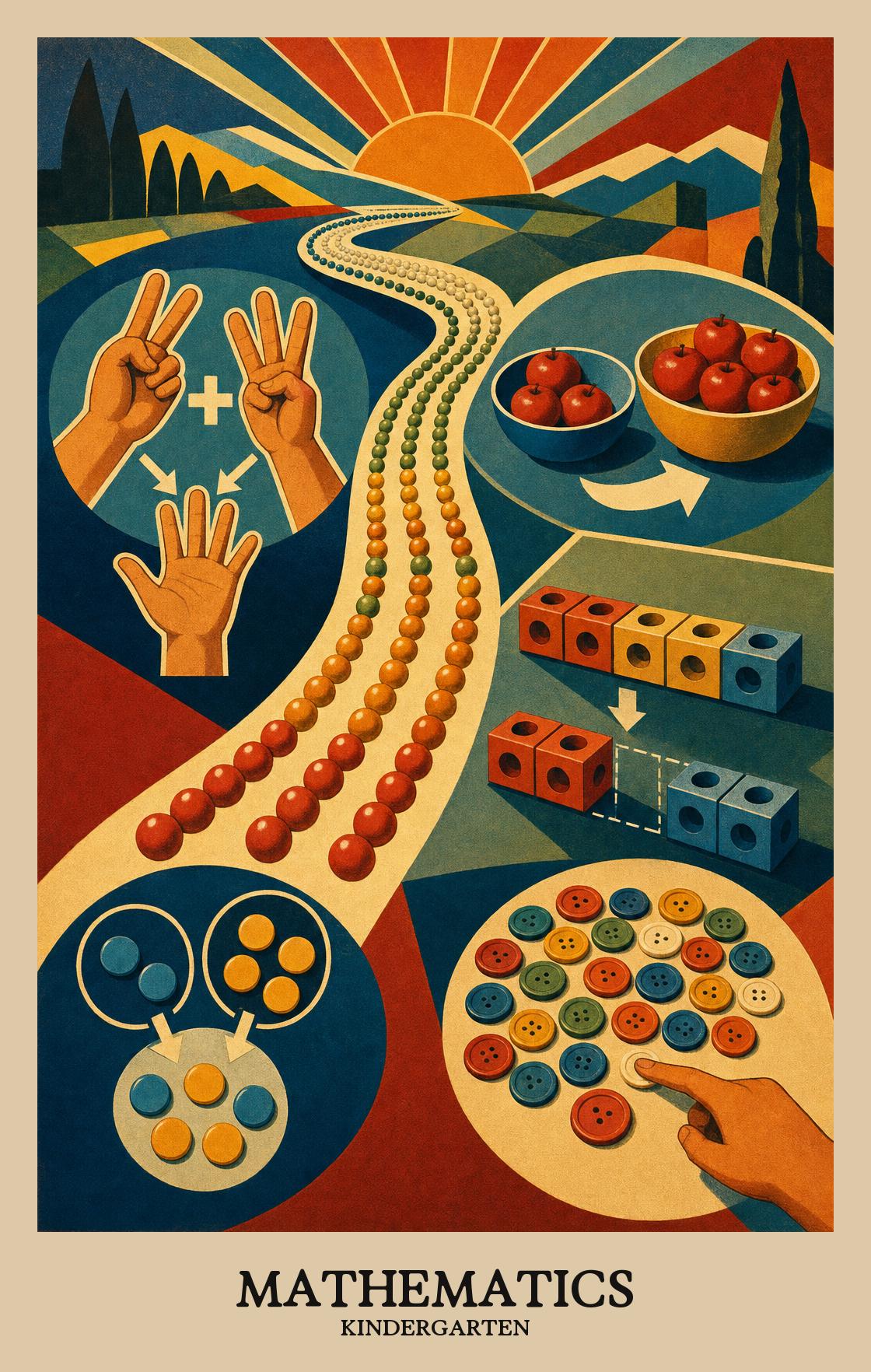
Students count out loud to higher numbers and learn that the last number they say tells how many. They start matching written numerals to small groups of objects.
Students line up two sets and decide which has more, less, or the same. They also figure out the number that comes right before or right after one they know.
Students sort buttons, blocks, and toys into groups and count each pile. They name everyday shapes, build bigger shapes from smaller ones, and use words like above, below, and next to.
Students compare objects by length, height, and weight using words like longer, taller, and heavier. They answer questions using picture graphs and simple charts they help build.
Students put small groups together and take some away to solve everyday problems. By the end of the year, sums and differences within 5 should come quickly without counting every finger.
Students see that numbers like 13 or 17 are made of one ten and some extra ones. They also learn to recognize a penny, nickel, and dime and name what each is worth.
Students keep trying when a math problem gets hard, ask for help when they need it, and listen to feedback. They also start learning to notice when something isn't working and try a different way.
Students look at a problem, figure out what it's asking, and keep trying even when the first attempt doesn't work. They check whether their answer makes sense before moving on.
Students connect real objects they can touch or count to the numbers and symbols that represent them. They move back and forth between a picture or story and the math that describes it.
Students explain why their answer makes sense, then listen to a classmate's thinking and say whether they agree or disagree. Backing up answers with reasons and questioning others' thinking are both part of the work.
Students use drawings, objects, or simple equations to show a real-life situation, like splitting a pile of blocks between two friends or counting apples on a table.
Students learn to pick the right tool for the job, like grabbing a ruler to measure instead of counting steps. They practice choosing between fingers, blocks, or a number line based on what the problem actually calls for.
Students say numbers, shapes, and measurements carefully and correctly. Getting the words right matters in math, so students slow down and check that what they say or write matches exactly what they mean.
Students notice patterns in what they see, like how all squares have four equal sides or how counting always goes in the same order. Finding that structure helps them solve new problems faster.
Students notice when the same steps keep showing up in a problem and use that pattern to work faster or check their answer. Spotting a shortcut because "this is just like last time" is the goal.
| Standard | Definition | Code |
|---|---|---|
| Display perseverance and patience in problem-solving | Students keep trying when a math problem gets hard, ask for help when they need it, and listen to feedback. They also start learning to notice when something isn't working and try a different way. | K.MP |
| Make sense of problems and persevere in solving them | Students look at a problem, figure out what it's asking, and keep trying even when the first attempt doesn't work. They check whether their answer makes sense before moving on. | K.MP.1 |
| Reason abstractly and quantitatively | Students connect real objects they can touch or count to the numbers and symbols that represent them. They move back and forth between a picture or story and the math that describes it. | K.MP.2 |
| Construct viable arguments and critique the reasoning of others | Students explain why their answer makes sense, then listen to a classmate's thinking and say whether they agree or disagree. Backing up answers with reasons and questioning others' thinking are both part of the work. | K.MP.3 |
| Model with mathematics | Students use drawings, objects, or simple equations to show a real-life situation, like splitting a pile of blocks between two friends or counting apples on a table. | K.MP.4 |
| Use appropriate tools strategically | Students learn to pick the right tool for the job, like grabbing a ruler to measure instead of counting steps. They practice choosing between fingers, blocks, or a number line based on what the problem actually calls for. | K.MP.5 |
| Attend to precision | Students say numbers, shapes, and measurements carefully and correctly. Getting the words right matters in math, so students slow down and check that what they say or write matches exactly what they mean. | K.MP.6 |
| Look for and make use of structure | Students notice patterns in what they see, like how all squares have four equal sides or how counting always goes in the same order. Finding that structure helps them solve new problems faster. | K.MP.7 |
| Look for and express regularity in repeated reasoning | Students notice when the same steps keep showing up in a problem and use that pattern to work faster or check their answer. Spotting a shortcut because "this is just like last time" is the goal. | K.MP.8 |
Students count, read, and write whole numbers up to 100. This is the foundation for every math skill that comes next.
Students count out loud from 1 to 100, in order, without skipping a number. This is the foundation for all the number work they'll do in elementary school.
Students count backward out loud, starting at 20 and working down to 1. This builds the number-order knowledge they need before subtraction makes sense.
Students count a group of up to 20 objects by touching or pointing to each one and saying the matching number out loud.
Students practice breaking a number like 7 into smaller parts (3 and 4, or 5 and 2) and putting parts back together to make the whole number again. This builds number sense for everything that comes next in math.
Students practice recognizing numbers like 13 or 19 on sight and writing them by hand. The focus is on numbers up to 20.
Students line up two groups of objects and say which has more, which has fewer, or whether they match. Groups can be anything up to 10 items: blocks, fingers, or coins.
Students look at two groups of objects and say which group has more, which has fewer, or whether they match. They practice this with groups of up to ten things.
Adding and subtracting numbers up to 5 quickly and without counting on fingers. Students know that 2 + 3 = 5 and 4 - 1 = 3 the same way they know their own name.
Students read, write, and count the numbers 0 through 9. This is the foundation every later math skill builds on.
Students spot a pattern that keeps repeating, like circle-square-circle-square, and figure out what comes next. This works with shapes, colors, or numbers.
Students look at a repeating pattern, like red-blue-red-blue, and say out loud why it works. They explain the rule, not just what comes next.
Students sort and compare shapes like circles, squares, and boxes by describing what they notice: how many sides, whether it rolls, whether it stacks. They use their own words, not formal terms.
Students use words like above, below, beside, and behind to describe where objects are. They learn to talk about position and location using everyday language.
Students compare objects by size: which is longer, taller, wider, or heavier. They learn that things can be measured in more than one way.
Students sort a small group of objects into groups by color, size, or shape. This is the first step toward understanding how data works.
Students sort real objects or answers into groups and show the results on a simple picture or bar graph. They read the graph to say which group has more, which has less, and how many are in each group.
Students learn to recognize a penny, nickel, and dime by sight and say how much each one is worth.
| Standard | Definition | Code |
|---|---|---|
| Whole numbers to 100 | Students count, read, and write whole numbers up to 100. This is the foundation for every math skill that comes next. | K.LP1.1.1 |
| Counting forward to 100 | Students count out loud from 1 to 100, in order, without skipping a number. This is the foundation for all the number work they'll do in elementary school. | K.LP1.2.1 |
| Counting backward from 20 | Students count backward out loud, starting at 20 and working down to 1. This builds the number-order knowledge they need before subtraction makes sense. | K.LP1.2.2 |
| Counting objects to 20 | Students count a group of up to 20 objects by touching or pointing to each one and saying the matching number out loud. | K.LP1.2.3 |
| Compose and decompose numbers within 20 | Students practice breaking a number like 7 into smaller parts (3 and 4, or 5 and 2) and putting parts back together to make the whole number again. This builds number sense for everything that comes next in math. | K.LP1.3.1 |
| Identify and write numerals to 20 | Students practice recognizing numbers like 13 or 19 on sight and writing them by hand. The focus is on numbers up to 20. | K.LP1.3.2 |
| Comparing objects up to 10 | Students line up two groups of objects and say which has more, which has fewer, or whether they match. Groups can be anything up to 10 items: blocks, fingers, or coins. | K.LP1.4.1 |
| Comparing numbers of objects in a set from 1-10 | Students look at two groups of objects and say which group has more, which has fewer, or whether they match. They practice this with groups of up to ten things. | K.LP1.4.2 |
| Fluency with addition and subtraction within 5 | Adding and subtracting numbers up to 5 quickly and without counting on fingers. Students know that 2 + 3 = 5 and 4 - 1 = 3 the same way they know their own name. | K.LP1.5.1 |
| Single-digit numbers within 10 | Students read, write, and count the numbers 0 through 9. This is the foundation every later math skill builds on. | K.LP1.6.1 |
| Repeating patterns with numbers and shapes | Students spot a pattern that keeps repeating, like circle-square-circle-square, and figure out what comes next. This works with shapes, colors, or numbers. | K.LP2.1.1 |
| Explain the rationale for the pattern | Students look at a repeating pattern, like red-blue-red-blue, and say out loud why it works. They explain the rule, not just what comes next. | K.LP2.1.2 |
| Identify, sort, classify, analyze | Students sort and compare shapes like circles, squares, and boxes by describing what they notice: how many sides, whether it rolls, whether it stacks. They use their own words, not formal terms. | K.LP3.1.1 |
| Positional words | Students use words like above, below, beside, and behind to describe where objects are. They learn to talk about position and location using everyday language. | K.LP3.1.2 |
| Measurable attributes of length, height, width and weight | Students compare objects by size: which is longer, taller, wider, or heavier. They learn that things can be measured in more than one way. | K.LP4.1.1 |
| Classify and sort up to 10 objects by attributes | Students sort a small group of objects into groups by color, size, or shape. This is the first step toward understanding how data works. | K.LP4.1.2 |
| Display and interpret categorical data with up to 10 data points on graphs | Students sort real objects or answers into groups and show the results on a simple picture or bar graph. They read the graph to say which group has more, which has less, and how many are in each group. | K.LP4.1.3 |
| Identify pennies, nickels and dimes and know the value of each coin | Students learn to recognize a penny, nickel, and dime by sight and say how much each one is worth. | K.LP4.2.1 |
Counting isn't just reciting numbers. Students count a group of objects and understand that the last number they say tells how many are in the whole group, up to 20.
Counting objects in a line or a neat group is straightforward. Counting objects scattered randomly on a table is harder. Students practice both, up to 20 objects in organized arrangements and up to 10 when things are spread out.
When students count a group of objects, the last number they say tells them how many there are total. It doesn't matter how the objects are arranged or what order they're counted in.
Students look at a number and name the one that comes right before it or right after it. For example, one less than 8 is 7, and one more than 8 is 9.
Students learn to recognize pennies, nickels, and dimes by sight and know what each coin is worth. A penny is 1 cent, a nickel is 5 cents, and a dime is 10 cents.
Students count up and back by ones, starting from any number up to 100. This builds the number-line sense they need before adding and subtracting.
Students count up to 100 by ones or by tens, then count backward from 20. It's the same skill as reading a clock face or counting coins out loud, just with numbers in order.
Students practice counting up from any number to 100 and counting back down from any number to 20. It builds the number-line thinking students need before they start adding and subtracting.
Students learn that numbers like 12 or 17 are made of one group of ten and some leftover ones. They practice building and breaking apart those numbers using objects or drawings.
Numbers from 11 to 19 are a group of ten plus a few extras. Students practice breaking these numbers apart and putting them back together to see how that leftover piece changes with each number.
Students count, write, and compare numbers up to 20. They show what each number means using drawings, objects, or a number line.
Students look at a written number and say what it is, or count a group of objects and write the matching number. This covers 0 through 20, including 0 for an empty group.
Students look at two groups of objects and decide which group has more, which has less, or whether both groups have the same amount.
Students learn what it means to put small groups together (addition), take some away (subtraction), and show that two amounts match (equality). They practice solving simple everyday problems using numbers up to 10.
Putting numbers together and taking them apart is a core idea in early math. Students use objects or drawings to show how a number like 7 can be split into 4 and 3, or how 5 and 2 combine to make 7.
Adding and subtracting within 10 using real-life situations. Students show what happens when objects are combined or taken away, using drawings, numbers, or fingers to represent the problem.
Students practice different ways to add and subtract numbers up to 10. They might count on their fingers, draw pictures, or use objects to figure out answers to simple problems.
Adding and subtracting numbers up to 5 quickly and without much help. Students solve simple everyday problems, like figuring out how many apples are left after eating two, using whatever counting method works for them.
| Standard | Definition | Code |
|---|---|---|
| Demonstrate and explain the relationship between numbers and quantities up to 20 | Counting isn't just reciting numbers. Students count a group of objects and understand that the last number they say tells how many are in the whole group, up to 20. | K.NR.1 |
| Count up to 20 objects in a variety of structured arrangements and up to 10… | Counting objects in a line or a neat group is straightforward. Counting objects scattered randomly on a table is harder. Students practice both, up to 20 objects in organized arrangements and up to 10 when things are spread out. | K.NR.1.1 |
| When counting objects, explain that the last number counted represents the… | When students count a group of objects, the last number they say tells them how many there are total. It doesn't matter how the objects are arranged or what order they're counted in. | K.NR.1.2 |
| Given a number from 1-20, identify the number that is one more or one less | Students look at a number and name the one that comes right before it or right after it. For example, one less than 8 is 7, and one more than 8 is 9. | K.NR.1.3 |
| Identify pennies, nickels | Students learn to recognize pennies, nickels, and dimes by sight and know what each coin is worth. A penny is 1 cent, a nickel is 5 cents, and a dime is 10 cents. | K.NR.1.4 |
| Use count sequences within 100 to count forward and backward in sequence | Students count up and back by ones, starting from any number up to 100. This builds the number-line sense they need before adding and subtracting. | K.NR.2 |
| Count forward to 100 by tens and ones and backward from 20 by ones | Students count up to 100 by ones or by tens, then count backward from 20. It's the same skill as reading a clock face or counting coins out loud, just with numbers in order. | K.NR.2.1 |
| Count forward beginning from any number within 100 and count backward from any… | Students practice counting up from any number to 100 and counting back down from any number to 20. It builds the number-line thinking students need before they start adding and subtracting. | K.NR.2.2 |
| Use place value understanding to compose and decompose numbers from 11–19 | Students learn that numbers like 12 or 17 are made of one group of ten and some leftover ones. They practice building and breaking apart those numbers using objects or drawings. | K.NR.3 |
| Describe numbers from 11 to 19 by composing | Numbers from 11 to 19 are a group of ten plus a few extras. Students practice breaking these numbers apart and putting them back together to see how that leftover piece changes with each number. | K.NR.3.1 |
| Identify, write, represent | Students count, write, and compare numbers up to 20. They show what each number means using drawings, objects, or a number line. | K.NR.4 |
| Identify written numerals 0- 20 and represent a number of objects with a… | Students look at a written number and say what it is, or count a group of objects and write the matching number. This covers 0 through 20, including 0 for an empty group. | K.NR.4.1 |
| Compare two sets of up to 10 objects and identify whether the number of objects… | Students look at two groups of objects and decide which group has more, which has less, or whether both groups have the same amount. | K.NR.4.2 |
| Explain the concepts of addition, subtraction | Students learn what it means to put small groups together (addition), take some away (subtraction), and show that two amounts match (equality). They practice solving simple everyday problems using numbers up to 10. | K.NR.5 |
| Compose (put together) and decompose | Putting numbers together and taking them apart is a core idea in early math. Students use objects or drawings to show how a number like 7 can be split into 4 and 3, or how 5 and 2 combine to make 7. | K.NR.5.1 |
| Represent addition and subtraction within 10 from a given authentic situation… | Adding and subtracting within 10 using real-life situations. Students show what happens when objects are combined or taken away, using drawings, numbers, or fingers to represent the problem. | K.NR.5.2 |
| Use a variety of strategies to solve addition and subtraction problems within… | Students practice different ways to add and subtract numbers up to 10. They might count on their fingers, draw pictures, or use objects to figure out answers to simple problems. | K.NR.5.3 |
| Fluently add and subtract within 5 using a variety of strategies to solve… | Adding and subtracting numbers up to 5 quickly and without much help. Students solve simple everyday problems, like figuring out how many apples are left after eating two, using whatever counting method works for them. | K.NR.5.4 |
Students spot and continue repeating patterns (like red, blue, red, blue) and describe simple time patterns, such as what happens every morning or every week. Patterns repeat no more than four steps.
Students build repeating patterns using numbers and shapes, then explain why the pattern works. They can also continue a pattern someone else started.
Students describe time patterns using everyday words like "first," "next," and "last" to talk about what happens during a school day or week.
| Standard | Definition | Code |
|---|---|---|
| Explain, extend, and create repeating patterns with a repetition, not exceeding… | Students spot and continue repeating patterns (like red, blue, red, blue) and describe simple time patterns, such as what happens every morning or every week. Patterns repeat no more than four steps. | K.PAR.6 |
| Create, extend, and describe repeating patterns with numbers and shapes | Students build repeating patterns using numbers and shapes, then explain why the pattern works. They can also continue a pattern someone else started. | K.PAR.6.1 |
| Describe patterns involving the passage of time using words and phrases related… | Students describe time patterns using everyday words like "first," "next," and "last" to talk about what happens during a school day or week. | K.PAR.6.2 |
Students look at real objects and describe how they compare by size, weight, or length. Then they read simple graphs to answer questions about what the data shows.
Students pick up two everyday objects, like a pencil and a crayon, and decide which is longer, shorter, heavier, or wider. They put objects in order and say how they are different.
Students sort a small group of objects into groups by color, shape, or size, then count how many are in each group and compare the counts.
Students gather information about everyday things, like favorite colors or types of pets, then read a simple chart or picture graph to answer questions about what they found.
| Standard | Definition | Code |
|---|---|---|
| Observe, describe, and compare the physical and measurable attributes of… | Students look at real objects and describe how they compare by size, weight, or length. Then they read simple graphs to answer questions about what the data shows. | K.MDR.7 |
| Directly compare, describe | Students pick up two everyday objects, like a pencil and a crayon, and decide which is longer, shorter, heavier, or wider. They put objects in order and say how they are different. | K.MDR.7.1 |
| Classify and sort up to ten objects into categories by an attribute | Students sort a small group of objects into groups by color, shape, or size, then count how many are in each group and compare the counts. | K.MDR.7.2 |
| Ask questions and answer them based on gathered information, observations | Students gather information about everyday things, like favorite colors or types of pets, then read a simple chart or picture graph to answer questions about what they found. | K.MDR.7.3 |
Students spot squares, circles, triangles, and other shapes in the real world, describe how they look, and compare them to each other. They also build or draw those shapes themselves.
Students sort and describe everyday shapes like squares, triangles, and boxes by counting their sides and corners. They compare how shapes are alike or different, even when a shape is flipped or bigger than usual.
Students use words like "above," "below," "next to," and "behind" to describe where something is. A block on top of a box or a chair beside a table are the kinds of problems they practice.
Students find circles, squares, and triangles in the world around them, then draw or build those same shapes to show what they noticed.
Students put smaller shapes together to build a bigger one, like fitting two triangles to make a square. This is an early building block for understanding how shapes relate to each other.
| Standard | Definition | Code |
|---|---|---|
| Identify, describe, and compare basic shapes encountered in the environment | Students spot squares, circles, triangles, and other shapes in the real world, describe how they look, and compare them to each other. They also build or draw those shapes themselves. | K.GSR.8 |
| Identify, sort, classify, analyze | Students sort and describe everyday shapes like squares, triangles, and boxes by counting their sides and corners. They compare how shapes are alike or different, even when a shape is flipped or bigger than usual. | K.GSR.8.1 |
| Describe the relative location of an object using positional words | Students use words like "above," "below," "next to," and "behind" to describe where something is. A block on top of a box or a chair beside a table are the kinds of problems they practice. | K.GSR.8.2 |
| Use basic shapes to represent specific shapes found in the environment by… | Students find circles, squares, and triangles in the world around them, then draw or build those same shapes to show what they noticed. | K.GSR.8.3 |
| Use two or more basic shapes to form larger shapes | Students put smaller shapes together to build a bigger one, like fitting two triangles to make a square. This is an early building block for understanding how shapes relate to each other. | K.GSR.8.4 |
End-of-grade mathematics assessment for grades 3 through 8, aligned to Georgia's state-adopted math standards.
Students count to 100, count backward from 20, and know written numbers up to 20. They add and subtract within 10, work fluently within 5, and can compare two small groups of objects to say which has more or less.
Count real things together: stairs, grapes, socks, blocks. Once counting to 20 feels easy, practice starting from a number in the middle, like counting on from 13. Counting backward from 20 while walking or cleaning up also helps.
Use objects students can touch, like cereal, coins, or blocks. Ask questions like, if you have 4 crackers and I give you 2 more, how many now? Keep totals at 10 or less and let students show the answer with their fingers or by moving objects.
Spend the first months building counting, cardinality, and number writing to 10, then push to 20. Layer in shapes, sorting, and patterns alongside number work. Save teen numbers as ten and some more ones, and fluency within 5, for the second half of the year.
Cardinality (knowing the last number counted is the total) and the teen numbers as ten and some more ones are the two stickiest. Plan to revisit both across the year with different objects and arrangements, not just one unit.
Only within 5. Students should add and subtract sums up to 5 quickly and accurately, using fingers, drawings, or quick mental pictures. Sums from 6 to 10 should be solved with strategies, not pure memorization.
Point out circles, squares, triangles, and cubes on walks and at the store. Make simple repeating patterns with snacks or toys and ask what comes next. Sort coins into pennies, nickels, and dimes, and say the value of each.
Students count to 100, write numerals to 20, and compare small groups using greater than, less than, or the same as. They solve real addition and subtraction stories within 10, and they can name common shapes and sort objects by an attribute.