Getting started as a reader
Students settle into first grade by stretching out the sounds in spoken words and matching them to letters. They write their name and short words by hand, and start reading simple books on their own.
This is the year reading clicks. Students sound out words with short and long vowels, blends, and silent-e patterns, then read whole sentences and short stories out loud with growing smoothness. Writing grows from single sentences into short pieces that tell a story, share facts, or give an opinion with reasons. By spring, students can read a simple book aloud and write a few connected sentences with capital letters, end marks, and spaces between words.
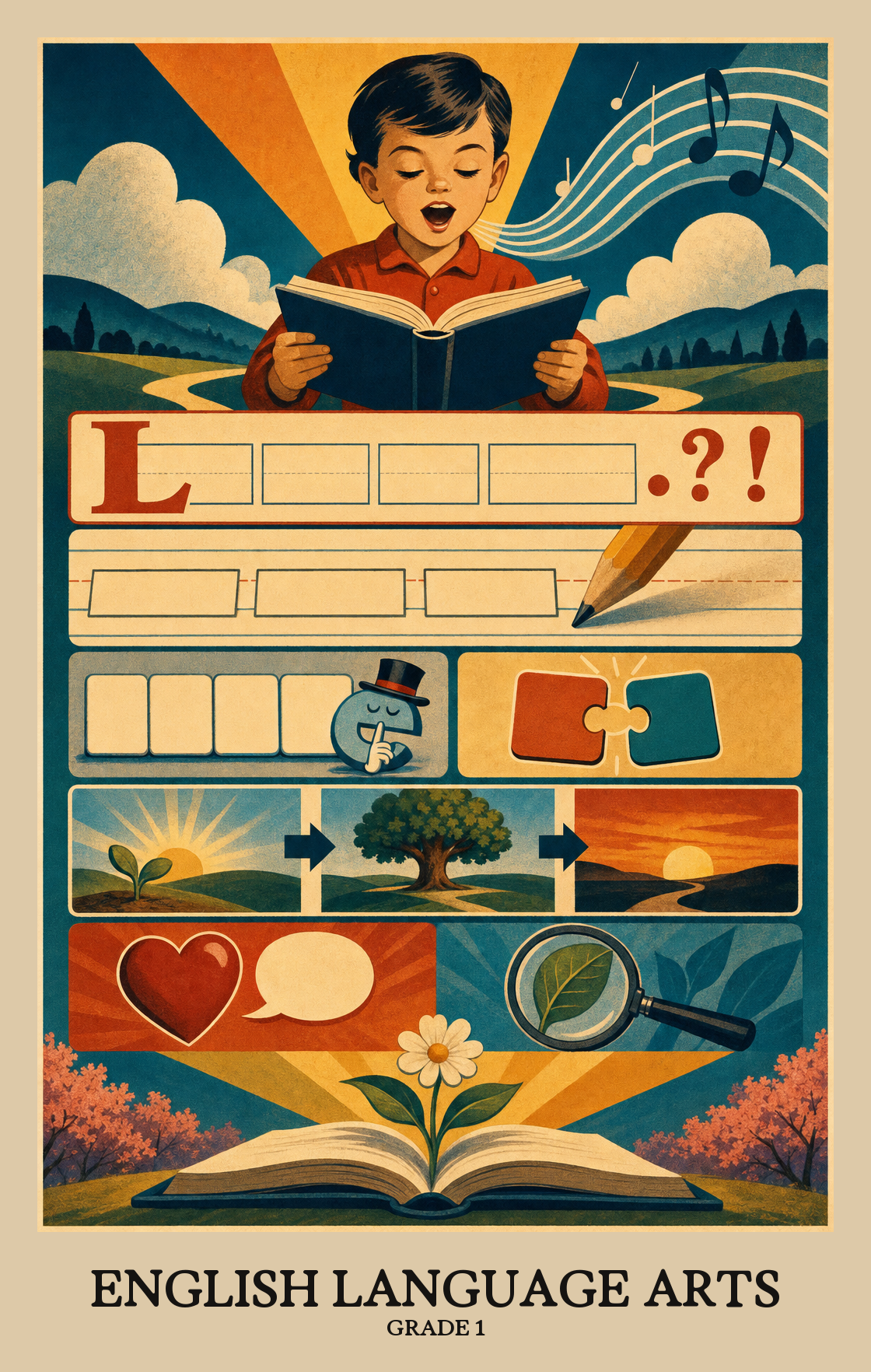
Students settle into first grade by stretching out the sounds in spoken words and matching them to letters. They write their name and short words by hand, and start reading simple books on their own.
Students learn the patterns behind short and long vowels, blends like st and tr, and pairs like sh and th. They use these patterns to read and spell one-syllable words, including common words they see everywhere.
Students move from sounding out each word to reading whole sentences with phrasing and expression. They reread when something does not make sense and grow a bank of words they recognize on sight.
Students read stories and figure out the characters, problem, and solution. They also read books that teach about a topic and notice the main idea and details. They start to tell the difference between a story, a fact, and an opinion.
Students write complete sentences with capital letters and end marks. They write short stories with a beginning, middle, and end, share facts about a topic, and give an opinion with reasons using words like and and because.
Students use plurals, action verbs, and simple verb tenses, and learn how a noun and verb need to match. They keep adding new words from books and lessons, and ask their own questions to research a topic of interest.
Reading starts with the basics. Students learn the sounds letters make, how words are built, and how those pieces come together so they can read sentences on their own.
Reading, writing, talking, and listening show up every day in first grade. These four habits connect everything students do with words, whether they're sounding out a sentence or sharing a story.
Students learn the rules of written and spoken English: how sentences are built, how punctuation works, and what words mean. They practice using those rules in their own reading and writing.
Students read, listen to, and talk about stories and nonfiction books to build knowledge and practice new skills.
| Standard | Definition | Code |
|---|---|---|
| Foundations (F) Students build a foundation for achieving dynamic literacy… | Reading starts with the basics. Students learn the sounds letters make, how words are built, and how those pieces come together so they can read sentences on their own. | 1.F |
| Practices (P) Students engage routinely in four literacy practices that ground… | Reading, writing, talking, and listening show up every day in first grade. These four habits connect everything students do with words, whether they're sounding out a sentence or sharing a story. | 1.P |
| Language (L) Students learn and apply the structures and conventions of… | Students learn the rules of written and spoken English: how sentences are built, how punctuation works, and what words mean. They practice using those rules in their own reading and writing. | 1.L |
| Texts (T) Students grow in their learning as they purposefully engage with… | Students read, listen to, and talk about stories and nonfiction books to build knowledge and practice new skills. | 1.T |
Students hear words and play with the sounds inside them. They break words into syllables, pull apart the individual sounds, and swap or blend sounds to make new words.
This standard is taught in kindergarten, not first grade. Students at this level are working on other reading and word skills.
This standard is marked kindergarten-only and does not apply to Grade 1. No content to display for this code at this grade level.
This standard is listed as kindergarten-only, so it does not apply to Grade 1. Students in Grade 1 work on other phonological skills at this level.
Students clap out or count the syllable chunks in a spoken word, then practice swapping, adding, or removing a chunk to make a new word.
Students practice breaking spoken words into individual sounds and blending sounds back together into words. This skill was introduced in kindergarten and keeps getting sharper in first grade.
Students practice breaking spoken words into individual sounds and blending sounds back together, keeping these skills sharp as they move through first grade.
Students practice hearing and working with word sounds they learned in kindergarten, like pulling apart or blending syllables and small sound chunks.
Students practice changing spoken words by adding, removing, or swapping a syllable. Say "cupcake," drop "cup," and you get "cake."
Students hear a word split into its opening sound and its ending chunk, then put them back together. For example, they blend "c" and "at" into "cat," or pull "cat" apart into "c" and "at."
Students hear a beginning sound and an ending chunk spoken aloud, then blend them into a full word. For example, a teacher says "bl" and "ock," and students say "block."
Students listen to a one-syllable word like "trip" and split it into its opening sounds and its ending chunk. They practice this with words that start or end with two or three consonants working together.
Students listen to a spoken word and pick out the individual sounds, like hearing three separate sounds in "cat." They can also swap or remove a sound to make a new word.
Students listen to a short word and pick out its beginning, middle, and ending sounds. This includes words where two letters make one sound, like the "sh" in "ship."
Students listen to one-syllable words and identify whether the vowel sound is short (like the "a" in "cat") or long (like the "a" in "cake"). This is done with spoken words only, not written ones.
Students listen to separate sounds spoken aloud and push them together into a word, then break a word back apart into its individual sounds. Words can have up to five sounds, including tricky pairs like "sh" or "str."
Students change sounds in short spoken words: swap the first sound in "cat" to make "bat," drop a sound to turn "slip" into "sip," or add a sound to turn "at" into "sat."
This skill is covered in kindergarten. By first grade, students have moved on to reading and writing words.
Students match letters to the sounds they stand for, then use those matches to read words and spell them. This is the building block for reading anything on a page.
Students match sounds to the letters that spell them. For example, they hear the sound "b" and connect it to the letter b on the page.
Students look at letter pairs like "sh," "ch," and "bl," say the sound those letters make together, and write words that use them.
Students learn that vowels like A, E, I, O, and U each make two sounds: a short sound like the "a" in "cat" and a long sound like the "a" in "cake." They practice hearing and saying the right vowel sound when reading and spelling words.
Students use letter-sound patterns they have learned to read unfamiliar words, both in sentences and on their own.
Students sound out short, one-syllable words by matching letters to their sounds. This covers common patterns like "cat," "cake," "clap," and "rain," including words that show up often in books.
Students spot the tricky parts of words that don't follow normal spelling rules, like "said" or "have," and practice reading them until they stick.
Students sound out made-up one-syllable words using common letter patterns. This checks whether students have learned the letter-sound rules, not just memorized real words.
Students break longer words into two parts (syllables) and use what they know about vowel sounds to read each part, then blend them together.
This standard was completed in kindergarten. First graders build on it through the other phonics skills listed here.
Students use what they know about letter sounds to spell words correctly, both in sentences and on their own.
Students spell short, one-syllable words by matching sounds to letters, covering patterns like "at," "stop," "cake," and "jump." This includes common words that show up often in early reading.
Students read and spell common words that don't follow normal spelling rules, like "said," "was," and "the." These words show up constantly in books, so students practice them until they stick.
Students spell made-up one-syllable words like "blift" or "stome" using the letter patterns they have learned. This shows they understand how sounds and letters fit together, not just that they memorized real words.
Students spell two-syllable words by breaking them into parts and using what they know about how syllables work. Think of words like "napkin" or "rabbit," where each part follows a predictable pattern.
This skill formally begins in 3rd grade. First graders focus on earlier phonics steps like letter sounds, blending, and simple word patterns.
Reading out loud (or quietly) with the right speed, steady accuracy, and feeling in their voice. Fluency is the bridge between sounding out words and actually understanding what a sentence means.
Students read aloud or quietly to themselves, fixing mistakes as they go to make sure the words and meaning come through clearly.
Students practice reading common words like "the," "said," and "because" until they can recognize them instantly, without sounding out each letter.
Students practice reading simple books and passages out loud, getting fewer words wrong each time. The goal is steady accuracy, not speed.
Students read sentences aloud with the right pauses, tone, and feeling, not just the right words. Good phrasing and expression show they understand what they just read.
Students catch their own reading mistakes and go back to reread a sentence when something doesn't make sense.
Students practice forming letters and words by hand, writing clearly enough for others to read.
Students practice forming clear, readable letters and words by hand, building the muscle control needed to write neatly on paper.
Students practice writing every letter of the alphabet, both capital and lowercase, until each one comes out the right shape every time.
Students write words so each letter is formed the same way every time, not just correctly once but consistently across the page.
Students practice leaving small gaps between each letter, wider gaps between words, and even larger gaps between sentences so their writing is easy to read across a full page.
Students write down spoken words and sentences by hand, keeping up with their own thoughts as they write. Speed and accuracy both matter here.
Students copy words or sentences by hand, forming each letter clearly. This is the first step toward writing their own ideas on paper.
Students practice writing letters and words by hand until forming them feels natural and steady, and gradually they write faster without losing accuracy.
This skill starts in 3rd grade. First graders focus on printing letters by hand rather than reading or writing in cursive.
This standard doesn't apply in 1st grade. Cursive handwriting starts in 3rd grade, so students aren't expected to write in cursive yet.
| Standard | Definition | Code |
|---|---|---|
| Phonological Awareness Students develop the ability to identify and produce the… | Students hear words and play with the sounds inside them. They break words into syllables, pull apart the individual sounds, and swap or blend sounds to make new words. | 1.F.PA |
| Rhyme This standard only applies to kindergarten | This standard is taught in kindergarten, not first grade. Students at this level are working on other reading and word skills. | 1.F.PA.1 |
| Words & Sentences This standard only applies to kindergarten | This standard is marked kindergarten-only and does not apply to Grade 1. No content to display for this code at this grade level. | 1.F.PA.2 |
| Compound Words This standard only applies to kindergarten | This standard is listed as kindergarten-only, so it does not apply to Grade 1. Students in Grade 1 work on other phonological skills at this level. | 1.F.PA.3 |
| Syllables Identify and manipulate syllables in spoken words | Students clap out or count the syllable chunks in a spoken word, then practice swapping, adding, or removing a chunk to make a new word. | 1.F.PA.4 |
| Reinforce as appropriate | Students practice breaking spoken words into individual sounds and blending sounds back together into words. This skill was introduced in kindergarten and keeps getting sharper in first grade. | 1.F.PA.4.a |
| Reinforce as appropriate | Students practice breaking spoken words into individual sounds and blending sounds back together, keeping these skills sharp as they move through first grade. | 1.F.PA.4.b |
| Reinforce as appropriate | Students practice hearing and working with word sounds they learned in kindergarten, like pulling apart or blending syllables and small sound chunks. | 1.F.PA.4.c |
| Add, delete, and substitute syllables in spoken words | Students practice changing spoken words by adding, removing, or swapping a syllable. Say "cupcake," drop "cup," and you get "cake." | 1.F.PA.4.d |
| Onsets & Rimes Blend and segment onsets and rimes in spoken words | Students hear a word split into its opening sound and its ending chunk, then put them back together. For example, they blend "c" and "at" into "cat," or pull "cat" apart into "c" and "at." | 1.F.PA.5 |
| Blend onsets and rimes of spoken one-syllable words with blends, digraphs | Students hear a beginning sound and an ending chunk spoken aloud, then blend them into a full word. For example, a teacher says "bl" and "ock," and students say "block." | 1.F.PA.5.a |
| Segment onsets and rimes of spoken one-syllable words with blends, digraphs | Students listen to a one-syllable word like "trip" and split it into its opening sounds and its ending chunk. They practice this with words that start or end with two or three consonants working together. | 1.F.PA.5.b |
| Phonemic Awareness Identify and manipulate the individual sounds in spoken… | Students listen to a spoken word and pick out the individual sounds, like hearing three separate sounds in "cat." They can also swap or remove a sound to make a new word. | 1.F.PA.6 |
| Isolate and pronounce initial, medial | Students listen to a short word and pick out its beginning, middle, and ending sounds. This includes words where two letters make one sound, like the "sh" in "ship." | 1.F.PA.6.a |
| Distinguish between short and long vowel sounds in spoken one-syllable words | Students listen to one-syllable words and identify whether the vowel sound is short (like the "a" in "cat") or long (like the "a" in "cake"). This is done with spoken words only, not written ones. | 1.F.PA.6.b |
| Blend and segment up to five phonemes, including consonant blends and digraphs… | Students listen to separate sounds spoken aloud and push them together into a word, then break a word back apart into its individual sounds. Words can have up to five sounds, including tricky pairs like "sh" or "str." | 1.F.PA.6.c |
| Add, delete, and substitute phonemes in spoken one-syllable words with three or… | Students change sounds in short spoken words: swap the first sound in "cat" to make "bat," drop a sound to turn "slip" into "sip," or add a sound to turn "at" into "sat." | 1.F.PA.6.d |
| Concepts of Print This big idea only applies to kindergarten | This skill is covered in kindergarten. By first grade, students have moved on to reading and writing words. | 1.F.CP |
| Phonics Students learn the relationships between the sounds of spoken language… | Students match letters to the sounds they stand for, then use those matches to read words and spell them. This is the building block for reading anything on a page. | 1.F.P |
| Phoneme-Grapheme Correspondences Identify and produce phoneme-grapheme… | Students match sounds to the letters that spell them. For example, they hear the sound "b" and connect it to the letter b on the page. | 1.F.P.1 |
| Identify and produce phoneme-grapheme correspondences for frequently used… | Students look at letter pairs like "sh," "ch," and "bl," say the sound those letters make together, and write words that use them. | 1.F.P.1.a |
| Identify and produce both long and short vowel sounds for A, E, I, O, U… | Students learn that vowels like A, E, I, O, and U each make two sounds: a short sound like the "a" in "cat" and a long sound like the "a" in "cake." They practice hearing and saying the right vowel sound when reading and spelling words. | 1.F.P.1.b |
| Decoding with Phonics Use grade-level phonics skills to decode words in context… | Students use letter-sound patterns they have learned to read unfamiliar words, both in sentences and on their own. | 1.F.P.2 |
| Decode regularly spelled one-syllable words with a variety of spelling patterns | Students sound out short, one-syllable words by matching letters to their sounds. This covers common patterns like "cat," "cake," "clap," and "rain," including words that show up often in books. | 1.F.P.2.a |
| Identify and decode parts of irregularly spelled words, including… | Students spot the tricky parts of words that don't follow normal spelling rules, like "said" or "have," and practice reading them until they stick. | 1.F.P.2.b |
| Decode one-syllable nonsense words with a variety of spelling patterns | Students sound out made-up one-syllable words using common letter patterns. This checks whether students have learned the letter-sound rules, not just memorized real words. | 1.F.P.2.c |
| Decode two-syllable words with basic patterns by applying knowledge of basic… | Students break longer words into two parts (syllables) and use what they know about vowel sounds to read each part, then blend them together. | 1.F.P.2.d |
| This progression ends in kindergarten | This standard was completed in kindergarten. First graders build on it through the other phonics skills listed here. | 1.F.P.2.e |
| Encoding with Phonics Use grade-level phonics skills to encode words in context… | Students use what they know about letter sounds to spell words correctly, both in sentences and on their own. | 1.F.P.3 |
| Encode regularly spelled one-syllable words with a variety of spelling patterns | Students spell short, one-syllable words by matching sounds to letters, covering patterns like "at," "stop," "cake," and "jump." This includes common words that show up often in early reading. | 1.F.P.3.a |
| Identify and encode irregularly spelled words, including high-frequency words | Students read and spell common words that don't follow normal spelling rules, like "said," "was," and "the." These words show up constantly in books, so students practice them until they stick. | 1.F.P.3.b |
| Encode one-syllable nonsense words with a variety of spelling patterns | Students spell made-up one-syllable words like "blift" or "stome" using the letter patterns they have learned. This shows they understand how sounds and letters fit together, not just that they memorized real words. | 1.F.P.3.c |
| Encode two-syllable words with basic patterns by applying knowledge of basic… | Students spell two-syllable words by breaking them into parts and using what they know about how syllables work. Think of words like "napkin" or "rabbit," where each part follows a predictable pattern. | 1.F.P.3.d |
| Decoding & Encoding with Phonics This progression begins in 3rd grade | This skill formally begins in 3rd grade. First graders focus on earlier phonics steps like letter sounds, blending, and simple word patterns. | 1.F.P.4 |
| Fluency Students read text aloud or silently with speed, accuracy | Reading out loud (or quietly) with the right speed, steady accuracy, and feeling in their voice. Fluency is the bridge between sounding out words and actually understanding what a sentence means. | 1.F.F |
| Oral & Silent Reading Fluency Demonstrate oral and silent reading fluency while… | Students read aloud or quietly to themselves, fixing mistakes as they go to make sure the words and meaning come through clearly. | 1.F.F.1 |
| Increase sight word vocabulary using decoding skills by reading grade-… | Students practice reading common words like "the," "said," and "because" until they can recognize them instantly, without sounding out each letter. | 1.F.F.1.a |
| Read a wide range of grade-level texts aloud with increasing accuracy | Students practice reading simple books and passages out loud, getting fewer words wrong each time. The goal is steady accuracy, not speed. | 1.F.F.1.b |
| Read a wide range of grade-level texts aloud with appropriate prosody | Students read sentences aloud with the right pauses, tone, and feeling, not just the right words. Good phrasing and expression show they understand what they just read. | 1.F.F.1.c |
| Self-correct while reading text | Students catch their own reading mistakes and go back to reread a sentence when something doesn't make sense. | 1.F.F.1.d |
| Handwriting Students develop print handwriting skills | Students practice forming letters and words by hand, writing clearly enough for others to read. | 1.F.H |
| Motor Skills & Letter/Word Formation Use fine motor skills to form legible… | Students practice forming clear, readable letters and words by hand, building the muscle control needed to write neatly on paper. | 1.F.H.1 |
| Form all uppercase and lowercase letters and words with accuracy and… | Students practice writing every letter of the alphabet, both capital and lowercase, until each one comes out the right shape every time. | 1.F.H.1.a |
| Form words with accuracy and consistency | Students write words so each letter is formed the same way every time, not just correctly once but consistently across the page. | 1.F.H.1.b |
| Use appropriate spacing between letters, words | Students practice leaving small gaps between each letter, wider gaps between words, and even larger gaps between sentences so their writing is easy to read across a full page. | 1.F.H.1.c |
| Transcription & Handwriting Fluency Use working memory to transcribe oral… | Students write down spoken words and sentences by hand, keeping up with their own thoughts as they write. Speed and accuracy both matter here. | 1.F.H.2 |
| Perform basic transcription skills | Students copy words or sentences by hand, forming each letter clearly. This is the first step toward writing their own ideas on paper. | 1.F.H.2.a |
| Build handwriting fluency by forming accurate letters and words with increasing… | Students practice writing letters and words by hand until forming them feels natural and steady, and gradually they write faster without losing accuracy. | 1.F.H.2.b |
| Read Cursive This progression begins in 3rd grade | This skill starts in 3rd grade. First graders focus on printing letters by hand rather than reading or writing in cursive. | 1.F.H.3 |
| Write Cursive This progression begins in 3rd grade | This standard doesn't apply in 1st grade. Cursive handwriting starts in 3rd grade, so students aren't expected to write in cursive yet. | 1.F.H.4 |
Students build the habit of reading with a purpose and writing with a plan. They learn to think of themselves as real readers and writers, not just students completing a task.
Students think of themselves as readers and writers, building habits and finding tools that help them read and write more confidently over time.
Students set their own reading and writing goals, check in on how those goals are going, and adjust them when something isn't working.
Students talk or write about the kinds of books and stories they like best and explain what makes those choices click for them, such as a favorite topic or a type of writing they enjoy.
Students pick books and writing topics that interest them, then read and write about ideas that connect to what they are learning in class.
Students practice a small set of reading and writing moves, like rereading a confusing sentence or adding details to a story, until those habits come naturally enough to use on their own.
Students read together, talk about stories, and share their own writing with the class. They listen when others share and give kind, helpful feedback.
Students practice reading and writing on their own, building the habit of working through a book or a sentence without waiting to be told what to do next.
Students take turns as speaker and listener, or writer and reader, with a clear reason in mind. They connect ideas inside one text, across two texts, or to their own life.
Students tell or write stories drawn from their own life or their imagination. This standard covers sharing experiences through pictures, words, or sentences.
Students use books and passages to learn new things, figure out how something works, or gather information to share with others.
Students practice understanding new ideas by reading about them and then writing or talking about what they learned.
Students make notes, sketches, or short written responses to help them think through what they read and figure out what they want to say.
Students read to find answers and write to share what they think, with the goal of solving a problem or helping someone decide something.
Students use reading strategies at every stage of a text: previewing before they start, checking their understanding as they go, and pausing after to think about what they read.
Before reading, students decide why they are reading and what they want to understand. While reading, they check whether the story or passage is making sense and slow down or reread when it does not.
Students quickly look over a text before reading it, noticing headings, sections, or pictures that might help them find what they need.
Students connect what they already know to what they read, noticing when something surprises them or fills a gap. Reading builds on old knowledge and adds new ideas to it.
Students pause while reading to picture what just happened or put a section into their own words, keeping track of the story as they go.
Before and during reading, students guess what happens next in the story or text, then check whether they were right as they keep reading.
Students read between the lines to figure out what a story or passage means beyond what it says out loud, then point to words or sentences from the text that support their thinking.
Students figure out the meaning of a word they don't know by looking at the words and sentences around it, or by recognizing a familiar root or piece of the word.
Students plan, draft, and revise their own writing for different reasons and different readers. They practice returning to a piece to improve it, not just finishing it once.
Students decide why they are writing, what they want to say, and who will read it before they start.
Students think ahead about how to set up their writing by choosing a format (like a story or a list) that fits what they want to say and who will read it.
Students practice coming up with ideas before writing by thinking about what they already know, reading to find new information, and talking with classmates.
Students pick the details that best support their writing plan and set aside ones that don't fit.
Students write a first draft by pulling their ideas together, choosing words that fit their purpose, and trying out writing moves they have seen in books.
Students look back at their own writing and ask whether it does what they meant it to do. They use feedback from a teacher or classmate to decide if the piece needs more work.
Students look back at their own writing, then make real changes: moving sentences around, swapping out weak words, or adding details that make the piece clearer and stronger.
Students read back what they wrote and fix spelling, capitalization, and punctuation so the writing follows the rules of written English.
Students think about who wrote something, who it was written for, and why. That helps them understand what they read and make better choices when they write.
Students learn to think about when and where a story comes from before reading or writing it. Knowing the time, place, and background helps them understand what a text means.
Students think about what they already know before reading or writing, and talk with classmates to figure out what background information matters most.
Students think about why an author wrote something and what a reader might want from it, paying attention to when, where, and why the text was made.
Students look at why a story or book was made and talk about how that changes the way a writer tells it and the way a reader feels about it.
Students learn why authors make choices, like picking certain words or pictures, to connect with readers and get a point across. They practice this by reading texts and making their own.
Students think about who wrote a story, who it is for, and why it was written. They use those details to figure out what a text is trying to do and whether it actually does it.
When reading, students think about who wrote the story and why. When writing, students decide what they want to say and who they are saying it to.
Students learn that authors make choices, picking certain words, details, and layouts because of who they expect to read the work. Reading and writing both ask students to think about why an author shaped a text the way they did.
Students notice how writers make choices, like picking certain words or repeating a phrase, and try those same moves in their own writing.
When students read a story or book, they notice the choices the author made, like why a sentence feels exciting or how the ending lands. This builds the habit of reading to see how a piece of writing works, not just what it says.
Students notice choices an author makes, like picking certain words or details, and explain how those choices help tell the story or make a point.
Students notice strong or surprising words in a story or book, then talk about why the author picked those words and what effect they have on the reader.
Students notice how an author builds sentences, like whether they are short and punchy or long and winding, and think about why those choices make the writing feel a certain way.
Students notice how a book or passage is set up, like whether it uses headings, repeating phrases, or pictures, and explain how those choices make the text easier to read or understand.
Students write with a reader in mind, making choices about words and details based on who will read the piece and why it was written.
Students practice writing stories, facts, and opinions by choosing words and details that fit their reader and their purpose.
Students choose specific words and phrases to shape how a reader thinks or feels. A first grader might pick a strong verb or a vivid detail to make their writing more convincing or memorable.
Students choose how to build their sentences so the writing sounds right for who will read it and does what the writer wants it to do.
Students practice putting their writing in an order that makes sense for readers, like using a beginning, middle, and end or adding a title so readers know what to expect.
Students notice how a book's pictures, font size, and layout help tell the story or explain an idea. When they write, they make the same kinds of choices to guide their reader.
Students try out different kinds of writing, like stories, poems, and how-to pieces, and notice how word choices and structure change the way a piece sounds and who it works for.
Students learn that a poem and a how-to book are built differently on purpose. The type of writing shapes what gets included and what gets left out.
Students sort what they read by type: is it a story someone made up, or does it explain something real? That question changes how the writing is organized, and students use that knowledge when they write too.
Students read and make texts that mix words with pictures, labels, or other visuals. They learn how authors choose those combinations on purpose to tell a story, explain something, or convince a reader.
Students talk, listen, and share ideas with classmates, in pairs, small groups, and full class discussions. The goal is to learn from each other, not just from the teacher.
Students work with classmates to finish a shared task, like building something together or deciding on an answer as a group.
Students come to group conversations ready to join in, not just listen. That means thinking about the topic ahead of time and being prepared to take part in the work.
Students help their group decide on rules, set a goal, and figure out how to get the work done before starting a shared project.
Students share their own ideas in group talk or projects, listen while others speak, and say something back about what they heard.
Students take turns talking with classmates to share ideas, ask questions, and work through problems together.
Students practice speaking and listening to fit the situation, whether sharing ideas with a partner or talking to the whole class.
Students say their ideas out loud in full sentences so classmates can follow along, and listen when others do the same.
Students pick the right way to share what they know, speaking, drawing, or writing based on who they're talking to and why.
Students practice changing how they speak, like slowing down to explain something or using a hand gesture to make a point, depending on who is listening and why.
Students ask questions when they don't understand and answer questions when others want to know more. This back-and-forth is how real conversations work.
Students memorize and say aloud poems or short speeches, building a store of language they can draw on when reading, writing, and talking about new ideas.
| Standard | Definition | Code |
|---|---|---|
| Engagement & Intention for Comprehension & Composition Students develop… | Students build the habit of reading with a purpose and writing with a plan. They learn to think of themselves as real readers and writers, not just students completing a task. | 1.P.EICC |
| Reader & Writer Identity Build an identity as a reader and writer, developing a… | Students think of themselves as readers and writers, building habits and finding tools that help them read and write more confidently over time. | 1.P.EICC.1 |
| Generate, understand, monitor | Students set their own reading and writing goals, check in on how those goals are going, and adjust them when something isn't working. | 1.P.EICC.1.a |
| Discuss or write about personal and academic reading and writing preferences… | Students talk or write about the kinds of books and stories they like best and explain what makes those choices click for them, such as a favorite topic or a type of writing they enjoy. | 1.P.EICC.1.b |
| Select, read, and write texts of personal interest and academic relevance to… | Students pick books and writing topics that interest them, then read and write about ideas that connect to what they are learning in class. | 1.P.EICC.1.c |
| Build a repertoire of comprehension and composition skills, strategies | Students practice a small set of reading and writing moves, like rereading a confusing sentence or adding details to a story, until those habits come naturally enough to use on their own. | 1.P.EICC.1.d |
| Participate in a community of readers and writers by developing group norms… | Students read together, talk about stories, and share their own writing with the class. They listen when others share and give kind, helpful feedback. | 1.P.EICC.1.e |
| Develop independence and autonomy as a reader and writer | Students practice reading and writing on their own, building the habit of working through a book or a sentence without waiting to be told what to do next. | 1.P.EICC.1.f |
| Engagement & Intention Engage in written or spoken dialogue as author and… | Students take turns as speaker and listener, or writer and reader, with a clear reason in mind. They connect ideas inside one text, across two texts, or to their own life. | 1.P.EICC.2 |
| Share real or imagined experiences by interpreting and constructing texts that… | Students tell or write stories drawn from their own life or their imagination. This standard covers sharing experiences through pictures, words, or sentences. | 1.P.EICC.2.a |
| Make use of texts to build knowledge, develop skills, make informed decisions | Students use books and passages to learn new things, figure out how something works, or gather information to share with others. | 1.P.EICC.2.b |
| Explain and learn concepts and processes by interpreting and constructing texts | Students practice understanding new ideas by reading about them and then writing or talking about what they learned. | 1.P.EICC.2.c |
| Interpret and construct texts to aid the analysis and evaluation of texts and… | Students make notes, sketches, or short written responses to help them think through what they read and figure out what they want to say. | 1.P.EICC.2.d |
| Consume and produce texts in order to solve problems or influence decisions | Students read to find answers and write to share what they think, with the goal of solving a problem or helping someone decide something. | 1.P.EICC.2.e |
| Comprehension Strategies Engage with a range of complex texts for a variety of… | Students use reading strategies at every stage of a text: previewing before they start, checking their understanding as they go, and pausing after to think about what they read. | 1.P.EICC.3 |
| Establish a purpose and set goals for reading, monitor comprehension | Before reading, students decide why they are reading and what they want to understand. While reading, they check whether the story or passage is making sense and slow down or reread when it does not. | 1.P.EICC.3.a |
| Scan and skim the text, making note of structures and sections that might be… | Students quickly look over a text before reading it, noticing headings, sections, or pictures that might help them find what they need. | 1.P.EICC.3.b |
| Draw from, compare, build | Students connect what they already know to what they read, noticing when something surprises them or fills a gap. Reading builds on old knowledge and adds new ideas to it. | 1.P.EICC.3.c |
| Summarize and visualize sections of the text to maintain understanding | Students pause while reading to picture what just happened or put a section into their own words, keeping track of the story as they go. | 1.P.EICC.3.d |
| Make and track predictions about the events and information likely to come next | Before and during reading, students guess what happens next in the story or text, then check whether they were right as they keep reading. | 1.P.EICC.3.e |
| Make, track, and support inferences about different levels of meaning within… | Students read between the lines to figure out what a story or passage means beyond what it says out loud, then point to words or sentences from the text that support their thinking. | 1.P.EICC.3.f |
| Determine the meanings of unfamiliar words and concepts by applying knowledge… | Students figure out the meaning of a word they don't know by looking at the words and sentences around it, or by recognizing a familiar root or piece of the word. | 1.P.EICC.3.g |
| Writing Processes Compose a range of texts for a variety of purposes and… | Students plan, draft, and revise their own writing for different reasons and different readers. They practice returning to a piece to improve it, not just finishing it once. | 1.P.EICC.4 |
| Establish a purpose and goals for writing and identify a target audience | Students decide why they are writing, what they want to say, and who will read it before they start. | 1.P.EICC.4.a |
| Plan how to organize the text by selecting modes, genres | Students think ahead about how to set up their writing by choosing a format (like a story or a list) that fits what they want to say and who will read it. | 1.P.EICC.4.b |
| Generate ideas for content by assessing prior knowledge, gathering information… | Students practice coming up with ideas before writing by thinking about what they already know, reading to find new information, and talking with classmates. | 1.P.EICC.4.c |
| Link ideas and information to the organization plan, highlighting ideas and… | Students pick the details that best support their writing plan and set aside ones that don't fit. | 1.P.EICC.4.d |
| Construct an initial draft by integrating ideas and information | Students write a first draft by pulling their ideas together, choosing words that fit their purpose, and trying out writing moves they have seen in books. | 1.P.EICC.4.e |
| Evaluate the text’s effectiveness based on self-review or feedback from others… | Students look back at their own writing and ask whether it does what they meant it to do. They use feedback from a teacher or classmate to decide if the piece needs more work. | 1.P.EICC.4.f |
| Make changes to the text based on self-evaluation or external feedback… | Students look back at their own writing, then make real changes: moving sentences around, swapping out weak words, or adding details that make the piece clearer and stronger. | 1.P.EICC.4.g |
| Edit the text, ensuring it adheres to the conventions of written language | Students read back what they wrote and fix spelling, capitalization, and punctuation so the writing follows the rules of written English. | 1.P.EICC.4.h |
| Situating Texts Students develop and apply a multilayered understanding of… | Students think about who wrote something, who it was written for, and why. That helps them understand what they read and make better choices when they write. | 1.P.ST |
| Context Develop and apply knowledge of key components of context such as… | Students learn to think about when and where a story comes from before reading or writing it. Knowing the time, place, and background helps them understand what a text means. | 1.P.ST.1 |
| Use prior knowledge, formal or informal research | Students think about what they already know before reading or writing, and talk with classmates to figure out what background information matters most. | 1.P.ST.1.a |
| Consider how context impacts the purposes of the author and the audience | Students think about why an author wrote something and what a reader might want from it, paying attention to when, where, and why the text was made. | 1.P.ST.1.b |
| Explore how context shapes the author’s decisions and the audience’s responses… | Students look at why a story or book was made and talk about how that changes the way a writer tells it and the way a reader feels about it. | 1.P.ST.1.c |
| Author, Audience, & Purpose Interpret and construct texts by developing and… | Students learn why authors make choices, like picking certain words or pictures, to connect with readers and get a point across. They practice this by reading texts and making their own. | 1.P.ST.2 |
| Develop and apply knowledge of author, audience | Students think about who wrote a story, who it is for, and why it was written. They use those details to figure out what a text is trying to do and whether it actually does it. | 1.P.ST.2.a |
| Draw from knowledge of author, audience | When reading, students think about who wrote the story and why. When writing, students decide what they want to say and who they are saying it to. | 1.P.ST.2.b |
| Draw from knowledge of how authors consider context and audience to determine… | Students learn that authors make choices, picking certain words, details, and layouts because of who they expect to read the work. Reading and writing both ask students to think about why an author shaped a text the way they did. | 1.P.ST.2.c |
| Author’s Craft Students apply knowledge of author’s craft to enhance the… | Students notice how writers make choices, like picking certain words or repeating a phrase, and try those same moves in their own writing. | 1.P.AC |
| Reading like a Writer Interpret texts through the author’s lens by identifying… | When students read a story or book, they notice the choices the author made, like why a sentence feels exciting or how the ending lands. This builds the habit of reading to see how a piece of writing works, not just what it says. | 1.P.AC.1 |
| Identify, apply, and analyze the literary, expository | Students notice choices an author makes, like picking certain words or details, and explain how those choices help tell the story or make a point. | 1.P.AC.1.a |
| Identify, apply, and analyze important, interesting | Students notice strong or surprising words in a story or book, then talk about why the author picked those words and what effect they have on the reader. | 1.P.AC.1.b |
| Explain, analyze, and evaluate how the author’s use of sentence structure and… | Students notice how an author builds sentences, like whether they are short and punchy or long and winding, and think about why those choices make the writing feel a certain way. | 1.P.AC.1.c |
| Describe, analyze, and evaluate the design and organization of the text… | Students notice how a book or passage is set up, like whether it uses headings, repeating phrases, or pictures, and explain how those choices make the text easier to read or understand. | 1.P.AC.1.d |
| Writing like a Reader Construct texts with the audience’s experience in mind… | Students write with a reader in mind, making choices about words and details based on who will read the piece and why it was written. | 1.P.AC.2 |
| Integrate literary, expository | Students practice writing stories, facts, and opinions by choosing words and details that fit their reader and their purpose. | 1.P.AC.2.a |
| Craft words and phrases in order to influence the responses, thoughts, decisions | Students choose specific words and phrases to shape how a reader thinks or feels. A first grader might pick a strong verb or a vivid detail to make their writing more convincing or memorable. | 1.P.AC.2.b |
| Make decisions about sentence structure and syntax in order to accommodate and… | Students choose how to build their sentences so the writing sounds right for who will read it and does what the writer wants it to do. | 1.P.AC.2.c |
| Organize texts by incorporating specific formats, structures, patterns | Students practice putting their writing in an order that makes sense for readers, like using a beginning, middle, and end or adding a title so readers know what to expect. | 1.P.AC.2.d |
| Text Design Consider the impact of text design on audience and purpose when… | Students notice how a book's pictures, font size, and layout help tell the story or explain an idea. When they write, they make the same kinds of choices to guide their reader. | 1.P.AC.3 |
| Explore and create texts in various modes and genres, developing and applying… | Students try out different kinds of writing, like stories, poems, and how-to pieces, and notice how word choices and structure change the way a piece sounds and who it works for. | 1.P.AC.3.a |
| Apply knowledge of how mode and genre impact what kinds of ideas and… | Students learn that a poem and a how-to book are built differently on purpose. The type of writing shapes what gets included and what gets left out. | 1.P.AC.3.b |
| Apply knowledge of how mode and genre impact how ideas and information are… | Students sort what they read by type: is it a story someone made up, or does it explain something real? That question changes how the writing is organized, and students use that knowledge when they write too. | 1.P.AC.3.c |
| Consume and produce multimodal texts, integrating a variety of genres, text… | Students read and make texts that mix words with pictures, labels, or other visuals. They learn how authors choose those combinations on purpose to tell a story, explain something, or convince a reader. | 1.P.AC.3.d |
| Collaboration & Presentation Students build and share knowledge as they engage… | Students talk, listen, and share ideas with classmates, in pairs, small groups, and full class discussions. The goal is to learn from each other, not just from the teacher. | 1.P.CP |
| Collaboration Collaborate with others to accomplish shared goals and projects | Students work with classmates to finish a shared task, like building something together or deciding on an answer as a group. | 1.P.CP.1 |
| Arrive to group discussions and collaborative meetings prepared to be an active… | Students come to group conversations ready to join in, not just listen. That means thinking about the topic ahead of time and being prepared to take part in the work. | 1.P.CP.1.a |
| Collaborate with others to determine group norms, establish goals and procedures | Students help their group decide on rules, set a goal, and figure out how to get the work done before starting a shared project. | 1.P.CP.1.b |
| Contribute to discussions and shared projects by offering ideas, listening to… | Students share their own ideas in group talk or projects, listen while others speak, and say something back about what they heard. | 1.P.CP.1.c |
| Work with others to discuss topics, investigate questions, solve problems | Students take turns talking with classmates to share ideas, ask questions, and work through problems together. | 1.P.CP.1.d |
| Presentation Use presentation skills to tailor communication to target… | Students practice speaking and listening to fit the situation, whether sharing ideas with a partner or talking to the whole class. | 1.P.CP.2 |
| Communicate clearly to present ideas, information | Students say their ideas out loud in full sentences so classmates can follow along, and listen when others do the same. | 1.P.CP.2.a |
| Integrate modes and genres most appropriate to purpose and audience | Students pick the right way to share what they know, speaking, drawing, or writing based on who they're talking to and why. | 1.P.CP.2.b |
| Vary tone, pace, and nonverbal gestures as appropriate to purpose and audience | Students practice changing how they speak, like slowing down to explain something or using a hand gesture to make a point, depending on who is listening and why. | 1.P.CP.2.c |
| Engage in dialogue with audiences by asking and answering questions | Students ask questions when they don't understand and answer questions when others want to know more. This back-and-forth is how real conversations work. | 1.P.CP.2.d |
| Build background knowledge by reciting all or part of significant poems and… | Students memorize and say aloud poems or short speeches, building a store of language they can draw on when reading, writing, and talking about new ideas. | 1.P.CP.2.e |
First graders study how sentences are built and punctuated. They practice using correct grammar, capitalization, and punctuation in their own writing.
Students practice the basic rules of English, like how to write a sentence, use punctuation, and speak clearly. These habits help students understand what they read and make themselves understood when they write or talk.
Adding -s or -es turns one thing into many. Students learn when each ending fits, so they can write "cats" or "boxes" instead of leaving the noun as-is.
Students practice changing verbs to show time and action, like turning "jump" into "jumping," "jumped," or "jumps." They learn how the ending of a word changes its meaning in a sentence.
Action verbs show what someone or something does. Students practice spotting and using words like "run," "jump," and "write" in their own sentences.
Adjectives describe nouns, and adverbs describe actions. Students use both in their writing to add detail, like "the big dog ran quickly."
Students sort words into two groups: common nouns like "dog" or "city," and proper nouns like "Spot" or "Chicago." Proper nouns always start with a capital letter.
Students write sentences using past, present, and future verb forms, such as "I walked," "I walk," and "I will walk." They practice matching the tense to when something happens.
Students practice choosing the right small word before a noun: "a," "the," "my," "this," "that," and similar words. Getting these right helps sentences sound natural and clear.
Students practice capitalizing proper nouns, the specific names of people, places, and things. A character named Maria or a city like Chicago always starts with a capital letter.
Students practice ending sentences with the right punctuation mark: a period for a statement, a question mark for a question, and an exclamation mark for something exciting.
Spelling a plural noun sometimes means changing the ending. Students learn that words ending in -y, like "berry" or "penny," become "berries" and "pennies" when there is more than one.
Students swap out names for words like "he," "her," and "mine" to avoid repeating the same name over and over in sentences they read and write.
Students practice words like "in," "on," "under," and "behind" that show where something is or when something happens. These small words help sentences make sense.
Students practice placing commas between items in a list and in dates, addresses, and letter greetings. For example, they learn to write "Monday, January 6" or "apples, oranges, and bananas" with commas in the right spots.
Contractions squish two words together with an apostrophe, like "do not" becoming "don't." Students also use an apostrophe plus s to show that something belongs to one person, like "the dog's bone."
Irregular plural nouns don't follow the usual "add an s" rule. Students learn to write words like "children," "feet," and "mice" as the plural form instead of "childs," "foots," or "mouses."
Students practice verbs that don't follow the usual past-tense rules, like changing "run" to "ran" or "eat" to "ate" instead of just adding -ed.
Students use connecting words like "and," "but," and "or" to link ideas together in a sentence, such as turning "I like dogs. I like cats." into "I like dogs and cats."
Sentences must have a subject and a verb to express a complete thought. Students practice spotting incomplete sentences and fixing them, then write their own complete sentences.
Students learn to spot when a sentence is complete or missing a piece, and to name what kind it is: a statement, a command, a question, or an exclamation.
Students practice writing different kinds of sentences so their ideas come across clearly. A statement, a question, and an exclamation each do different jobs on the page.
Singular and plural subjects need matching verbs. Students practice writing sentences where one cat "runs" but two cats "run," making sure the subject and verb fit together.
Students practice adding describing words to sentences, like "the big dog ran fast," to make their writing more specific and interesting.
This standard doesn't apply in Grade 1. It starts in 9th grade, so students won't see this skill until high school.
Students grow their word knowledge by reading, writing, and talking. They learn how words are built, what they mean, and how to figure out an unfamiliar word when they come across one.
Students learn new words from books, classroom lessons, and conversations, then practice using those words in talking and writing. The goal is to build a wider vocabulary across all kinds of topics.
Students grow their word bank by reading books and learning the names for things in science, social studies, and other subjects.
Students practice choosing and using the right words for the right moment, whether they are talking with a friend, answering a question in class, or writing a sentence.
Students use clues inside a word, like a familiar chunk or a small word hiding within it, to figure out what an unfamiliar word means.
Starting with a base word like "look," students notice how adding -s, -ed, or -ing changes its meaning. Recognizing these endings helps students read and understand new words on their own.
This standard doesn't apply in Grade 1. The skill it covers starts in 3rd grade.
Students practice adding endings like -s, -ed, and -ing to common root words to build new words, such as turning "walk" into "walked" or "walking."
This standard doesn't apply at Grade 1. It starts in a later grade.
Students look up unfamiliar words and connect new words to ones they already know. They practice this in different kinds of reading and writing, not just one.
Students use the words and sentences around an unfamiliar word to figure out what it means, even when one word can mean different things in different sentences.
Students sort words into pairs that mean the same thing (like happy and glad) or opposite things (like hot and cold).
Students sort action words that are close in meaning but not quite the same, like the difference between walk and march, or tiptoe and stomp.
Students look up a word they don't know in a picture dictionary or an online tool, with help from their teacher.
Students choose words that fit what they mean to say, using the vocabulary they know and how words connect to each other.
| Standard | Definition | Code |
|---|---|---|
| Grammar Conventions Students observe, analyze | First graders study how sentences are built and punctuated. They practice using correct grammar, capitalization, and punctuation in their own writing. | 1.L.GC |
| Grammar, Usage, & Mechanics Learn and apply conventions of Standard English… | Students practice the basic rules of English, like how to write a sentence, use punctuation, and speak clearly. These habits help students understand what they read and make themselves understood when they write or talk. | 1.L.GC.1 |
| Grammar: Form regular plural nouns by adding -s or -es | Adding -s or -es turns one thing into many. Students learn when each ending fits, so they can write "cats" or "boxes" instead of leaving the noun as-is. | 1.L.GC.1.5 |
| Grammar: Form and use verbs by adding -ing, -ed | Students practice changing verbs to show time and action, like turning "jump" into "jumping," "jumped," or "jumps." They learn how the ending of a word changes its meaning in a sentence. | 1.L.GC.1.6 |
| Grammar: Use action verbs | Action verbs show what someone or something does. Students practice spotting and using words like "run," "jump," and "write" in their own sentences. | 1.L.GC.1.7 |
| Grammar: Use adjectives and adverbs | Adjectives describe nouns, and adverbs describe actions. Students use both in their writing to add detail, like "the big dog ran quickly." | 1.L.GC.1.8 |
| Grammar: Use common and proper nouns | Students sort words into two groups: common nouns like "dog" or "city," and proper nouns like "Spot" or "Chicago." Proper nouns always start with a capital letter. | 1.L.GC.1.9 |
| Grammar: Form and use the simple verb tenses | Students write sentences using past, present, and future verb forms, such as "I walked," "I walk," and "I will walk." They practice matching the tense to when something happens. | 1.L.GC.1.10 |
| Usage: Use determiners | Students practice choosing the right small word before a noun: "a," "the," "my," "this," "that," and similar words. Getting these right helps sentences sound natural and clear. | 1.L.GC.1.11 |
| Mechanics: Capitalize proper nouns | Students practice capitalizing proper nouns, the specific names of people, places, and things. A character named Maria or a city like Chicago always starts with a capital letter. | 1.L.GC.1.12 |
| Mechanics: Use periods, exclamation marks | Students practice ending sentences with the right punctuation mark: a period for a statement, a question mark for a question, and an exclamation mark for something exciting. | 1.L.GC.1.13 |
| Grammar: Form plural nouns by changing -y to -ies | Spelling a plural noun sometimes means changing the ending. Students learn that words ending in -y, like "berry" or "penny," become "berries" and "pennies" when there is more than one. | 1.L.GC.1.14 |
| Grammar: Use personal pronouns | Students swap out names for words like "he," "her," and "mine" to avoid repeating the same name over and over in sentences they read and write. | 1.L.GC.1.15 |
| Grammar: Use frequently occurring prepositions | Students practice words like "in," "on," "under," and "behind" that show where something is or when something happens. These small words help sentences make sense. | 1.L.GC.1.16 |
| Mechanics: Use commas to separate items in a series and to format dates… | Students practice placing commas between items in a list and in dates, addresses, and letter greetings. For example, they learn to write "Monday, January 6" or "apples, oranges, and bananas" with commas in the right spots. | 1.L.GC.1.17 |
| Mechanics: Use apostrophes to form contractions and singular possessive nouns | Contractions squish two words together with an apostrophe, like "do not" becoming "don't." Students also use an apostrophe plus s to show that something belongs to one person, like "the dog's bone." | 1.L.GC.1.18 |
| Grammar: Form and use irregular plural nouns | Irregular plural nouns don't follow the usual "add an s" rule. Students learn to write words like "children," "feet," and "mice" as the plural form instead of "childs," "foots," or "mouses." | 1.L.GC.1.19 |
| Grammar: Form and use the past tense of irregular verbs | Students practice verbs that don't follow the usual past-tense rules, like changing "run" to "ran" or "eat" to "ate" instead of just adding -ed. | 1.L.GC.1.20 |
| Grammar: Use coordinating conjunctions to join words, phrases | Students use connecting words like "and," "but," and "or" to link ideas together in a sentence, such as turning "I like dogs. I like cats." into "I like dogs and cats." | 1.L.GC.1.21 |
| Syntax Recognize and compose coherent sentences that express complete thoughts | Sentences must have a subject and a verb to express a complete thought. Students practice spotting incomplete sentences and fixing them, then write their own complete sentences. | 1.L.GC.2 |
| Distinguish between complete and incomplete simple sentences | Students learn to spot when a sentence is complete or missing a piece, and to name what kind it is: a statement, a command, a question, or an exclamation. | 1.L.GC.2.a |
| Use a variety of simple sentences | Students practice writing different kinds of sentences so their ideas come across clearly. A statement, a question, and an exclamation each do different jobs on the page. | 1.L.GC.2.b |
| Use singular and plural subjects with matching verbs | Singular and plural subjects need matching verbs. Students practice writing sentences where one cat "runs" but two cats "run," making sure the subject and verb fit together. | 1.L.GC.2.c |
| With adult support, use adjectives or adverbs to add details or clarify meaning | Students practice adding describing words to sentences, like "the big dog ran fast," to make their writing more specific and interesting. | 1.L.GC.2.d |
| This progression begins in 9th grade | This standard doesn't apply in Grade 1. It starts in 9th grade, so students won't see this skill until high school. | 1.L.GC.2.e |
| Vocabulary Students engage in a wide range of written and spoken activities… | Students grow their word knowledge by reading, writing, and talking. They learn how words are built, what they mean, and how to figure out an unfamiliar word when they come across one. | 1.L.V |
| General, Academic, & Specialized Vocabulary Acquire and use general, academic | Students learn new words from books, classroom lessons, and conversations, then practice using those words in talking and writing. The goal is to build a wider vocabulary across all kinds of topics. | 1.L.V.1 |
| Acquire general, academic | Students grow their word bank by reading books and learning the names for things in science, social studies, and other subjects. | 1.L.V.1.a |
| Use grade-level general, academic | Students practice choosing and using the right words for the right moment, whether they are talking with a friend, answering a question in class, or writing a sentence. | 1.L.V.1.b |
| Word Analysis Acquire and apply word analysis skills to deconstruct and… | Students use clues inside a word, like a familiar chunk or a small word hiding within it, to figure out what an unfamiliar word means. | 1.L.V.2 |
| Identify frequently occurring root words | Starting with a base word like "look," students notice how adding -s, -ed, or -ing changes its meaning. Recognizing these endings helps students read and understand new words on their own. | 1.L.V.2.a |
| This progression begins in 3rd grade | This standard doesn't apply in Grade 1. The skill it covers starts in 3rd grade. | 1.L.V.2.b |
| Construct words using frequently occurring root words and inflectional endings | Students practice adding endings like -s, -ed, and -ing to common root words to build new words, such as turning "walk" into "walked" or "walking." | 1.L.V.2.c |
| This progression begins in 6th grade | This standard doesn't apply at Grade 1. It starts in a later grade. | 1.L.V.2.d |
| Meaning & Purpose Make connections between words and phrases and use reference… | Students look up unfamiliar words and connect new words to ones they already know. They practice this in different kinds of reading and writing, not just one. | 1.L.V.3 |
| Use context within and beyond a sentence to determine or clarify the meaning of… | Students use the words and sentences around an unfamiliar word to figure out what it means, even when one word can mean different things in different sentences. | 1.L.V.3.a |
| Identify the relationship between words and their synonyms and antonyms | Students sort words into pairs that mean the same thing (like happy and glad) or opposite things (like hot and cold). | 1.L.V.3.b |
| Distinguish shades of meaning among verbs that describe the same general action | Students sort action words that are close in meaning but not quite the same, like the difference between walk and march, or tiptoe and stomp. | 1.L.V.3.c |
| With teacher support, use a picture dictionary or digital resource to clarify… | Students look up a word they don't know in a picture dictionary or an online tool, with help from their teacher. | 1.L.V.3.d |
| Use knowledge of word relationships and learned vocabulary words and phrases… | Students choose words that fit what they mean to say, using the vocabulary they know and how words connect to each other. | 1.L.V.3.e |
Students learn that someone wrote every book, story, or article, and that the writer had a reason and a reader in mind. Recognizing that helps students think about why a text was made and who it was made for.
Authors write with a goal in mind, and they choose their words to fit the people they expect to read. Students look at a book or story and figure out what the author wanted to do and who they wrote it for.
Students look at a book, article, or story and figure out why it was written. Was it meant to entertain, inform, or share an opinion? They also think about who it was written for.
Students learn that messages can come in different forms: a book, a website, a podcast, or a photograph. Recognizing which form a message takes helps students understand how it works.
Students make something to share an idea, choosing from options the teacher picks, like writing on paper, recording a voice message, or drawing a picture.
Students learn that the person who wrote a book and the person telling the story inside it are not always the same. They practice spotting the difference between the author's voice and a character's voice.
Students figure out who is talking or telling the story at different moments in a book, whether it is a character, a narrator, or someone else.
This standard doesn't apply in Grade 1. Students will work on identifying author, purpose, and audience when they reach middle school.
This standard doesn't start until 3rd grade, so nothing is taught here in 1st grade.
This standard doesn't start until 6th grade, so it isn't part of 1st grade reading or writing work yet.
Students learn how writers organize ideas, from the way a sentence is built to the way a whole story or article is put together. This helps students understand why a text is shaped the way it is and how that shape carries meaning.
Students learn to spot how a text is put together, like how a story has a beginning, middle, and end. They use that same structure when they write.
Students learn to use parts of a book like the table of contents or a diagram to find information and understand what they're reading.
Pictures, headings, bold words, and page numbers aren't just decoration. Students learn what each feature does and why authors use them to help readers find and understand information.
Students learn to use words like "next" and "last" to put events in order when they write or tell a story.
This standard doesn't apply in Grade 1. Students begin working on this skill in 3rd grade.
Students spot vivid, descriptive words in stories and try using that kind of language in their own writing.
Descriptive words paint a picture with language. Students find words in a story or book that help readers see, hear, or feel what is happening, then explain why the author chose them.
Students choose words that paint a picture, like "enormous" instead of "big" or "glittery" instead of "shiny," to make their writing more interesting to read.
This standard doesn't apply in Grade 1. The skill it describes is introduced later, in middle school.
Students learn to recognize how different kinds of writing work: stories have characters and events, informational writing explains facts, opinion writing states a point of view, and poems use rhythm and word choice for effect.
Students look at how a story is built: who the characters are, what problem they face, and how events unfold. They also practice using those same story-building moves in their own writing.
Stories have characters, a setting, and key events. Students learn to spot those pieces in the stories they read, including any talking between characters.
A story's plot is what happens from beginning to end. Students find the problem a character faces and the moment it gets solved.
Students pick a main character from a story and explain how that character's words and actions connect to the lesson the story is teaching.
Students look at two characters from different stories and talk about how they are alike and how they are different. A grown-up helps guide the conversation.
Students write their own stories, real or made-up, with characters, a place, and things that happen, and wrap them up with an ending.
Students learn to read and write informational pieces by spotting how an author organizes facts, adds details, and explains ideas clearly.
Students find the main idea in a nonfiction book or article, then point to the sentences that back it up.
Students read a nonfiction passage and explain how two people, events, or ideas in it are connected, such as how one thing causes or leads to another.
This standard doesn't apply in Grade 1. Students will begin working on this skill in 3rd grade.
Students write a short informational piece that opens with a topic, backs it up with real facts, and ends with a closing sentence that wraps it up.
Students learn to recognize when a writer is trying to convince someone and practice doing the same in their own writing. This means noticing words that share a point of view and using those words to say what they think.
Students read opinion writing and point out what the author believes and the reasons given to back it up.
This standard isn't taught until high school. No skills are assessed here in Grade 1.
Students write a short opinion piece that names a topic, says what they think about it, and gives at least two reasons why, using words like "and" and "because" to connect their ideas.
This standard isn't taught in Grade 1. The skill it describes starts in 9th grade.
Students notice how a poem uses rhyme, repetition, or rhythm and try those same moves in their own writing.
Poems use tricks to make language musical. Students spot rhyming words, notice when several words start with the same sound, and find lines that repeat throughout a poem.
Students write short poems using simple words or phrases. The poems can rhyme, but they don't have to.
Students read, talk about, and gather information from books and other texts to answer questions and build knowledge about a topic.
Students pick a question they want answered, look it up in books or other sources, and share what they find. This is the start of real research.
Students pick a topic they want to know more about and come up with questions to guide their research. It's the first step in learning how to find answers on their own.
Students pick a topic they want to learn about, then find facts from books or websites and sort those facts into a simple chart or organizer. The goal is to gather real information and put it in order so it makes sense.
Students pick facts that fit the topic and share them by talking, drawing, or writing. The information needs to be true and connected to what the class is studying.
Students find the part of a book or article that answers a question, then look across more than one source to see how the ideas connect.
Students point to a specific part of a story or book to back up what they say or think about it.
Students look at different places to find information: books, websites, and conversations with people who know about a topic.
This standard doesn't apply in Grade 1. The research and analysis skills it describes are introduced later, starting in 5th grade.
| Standard | Definition | Code |
|---|---|---|
| Context Students explore the relationships and roles of authors, purposes | Students learn that someone wrote every book, story, or article, and that the writer had a reason and a reader in mind. Recognizing that helps students think about why a text was made and who it was made for. | 1.T.C |
| Purpose & Audience Explain how authors of texts use language for a specific… | Authors write with a goal in mind, and they choose their words to fit the people they expect to read. Students look at a book or story and figure out what the author wanted to do and who they wrote it for. | 1.T.C.1 |
| Identify the general purpose | Students look at a book, article, or story and figure out why it was written. Was it meant to entertain, inform, or share an opinion? They also think about who it was written for. | 1.T.C.1.a |
| Identify different modes of communication | Students learn that messages can come in different forms: a book, a website, a podcast, or a photograph. Recognizing which form a message takes helps students understand how it works. | 1.T.C.1.b |
| Create texts in teacher-selected modes | Students make something to share an idea, choosing from options the teacher picks, like writing on paper, recording a voice message, or drawing a picture. | 1.T.C.1.c |
| Authors & Speakers Investigate the relationships between authors and speakers… | Students learn that the person who wrote a book and the person telling the story inside it are not always the same. They practice spotting the difference between the author's voice and a character's voice. | 1.T.C.2 |
| Identify who is speaking or telling the story at various points in a text | Students figure out who is talking or telling the story at different moments in a book, whether it is a character, a narrator, or someone else. | 1.T.C.2.a |
| This progression begins in 6th grade | This standard doesn't apply in Grade 1. Students will work on identifying author, purpose, and audience when they reach middle school. | 1.T.C.2.b |
| This progression begins in 3rd grade | This standard doesn't start until 3rd grade, so nothing is taught here in 1st grade. | 1.T.C.2.c |
| This progression begins in 6th grade | This standard doesn't start until 6th grade, so it isn't part of 1st grade reading or writing work yet. | 1.T.C.2.d |
| Structure & Style Students build and apply knowledge about language and… | Students learn how writers organize ideas, from the way a sentence is built to the way a whole story or article is put together. This helps students understand why a text is shaped the way it is and how that shape carries meaning. | 1.T.SS |
| Organization Identify and use organizational structures to craft meaning | Students learn to spot how a text is put together, like how a story has a beginning, middle, and end. They use that same structure when they write. | 1.T.SS.1 |
| Identify and use various text features | Students learn to use parts of a book like the table of contents or a diagram to find information and understand what they're reading. | 1.T.SS.1.a |
| Use text features (e.g., illustrations, page numbers, bold print, headings) to… | Pictures, headings, bold words, and page numbers aren't just decoration. Students learn what each feature does and why authors use them to help readers find and understand information. | 1.T.SS.1.b |
| Use transition words or phrases, such as once upon a time, next | Students learn to use words like "next" and "last" to put events in order when they write or tell a story. | 1.T.SS.1.c |
| This progression begins in 3rd grade | This standard doesn't apply in Grade 1. Students begin working on this skill in 3rd grade. | 1.T.SS.1.d |
| Craft Identify and use descriptive and engaging language | Students spot vivid, descriptive words in stories and try using that kind of language in their own writing. | 1.T.SS.2 |
| Identify and explain the use of descriptive words in texts | Descriptive words paint a picture with language. Students find words in a story or book that help readers see, hear, or feel what is happening, then explain why the author chose them. | 1.T.SS.2.a |
| Use descriptive words to craft engaging texts | Students choose words that paint a picture, like "enormous" instead of "big" or "glittery" instead of "shiny," to make their writing more interesting to read. | 1.T.SS.2.b |
| This progression begins in 6th grade | This standard doesn't apply in Grade 1. The skill it describes is introduced later, in middle school. | 1.T.SS.2.c |
| Techniques Students identify and use narrative, expository, opinion | Students learn to recognize how different kinds of writing work: stories have characters and events, informational writing explains facts, opinion writing states a point of view, and poems use rhythm and word choice for effect. | 1.T.T |
| Narrative Techniques Identify and use narrative techniques to shape… | Students look at how a story is built: who the characters are, what problem they face, and how events unfold. They also practice using those same story-building moves in their own writing. | 1.T.T.1 |
| Identify techniques used to craft stories, including characters, setting, major… | Stories have characters, a setting, and key events. Students learn to spot those pieces in the stories they read, including any talking between characters. | 1.T.T.1.a |
| Identify a simple plot with a problem and solution | A story's plot is what happens from beginning to end. Students find the problem a character faces and the moment it gets solved. | 1.T.T.1.b |
| Describe traits of the main characters and explain how their words and actions… | Students pick a main character from a story and explain how that character's words and actions connect to the lesson the story is teaching. | 1.T.T.1.c |
| With adult support, compare and contrast characters and their experiences in… | Students look at two characters from different stories and talk about how they are alike and how they are different. A grown-up helps guide the conversation. | 1.T.T.1.d |
| Use knowledge of narrative techniques | Students write their own stories, real or made-up, with characters, a place, and things that happen, and wrap them up with an ending. | 1.T.T.1.e |
| Expository Techniques Identify and use expository techniques to shape… | Students learn to read and write informational pieces by spotting how an author organizes facts, adds details, and explains ideas clearly. | 1.T.T.2 |
| Identify techniques used to craft expository texts, including main topic and… | Students find the main idea in a nonfiction book or article, then point to the sentences that back it up. | 1.T.T.2.a |
| Describe the connection between two individuals, events, ideas | Students read a nonfiction passage and explain how two people, events, or ideas in it are connected, such as how one thing causes or leads to another. | 1.T.T.2.b |
| This progression begins in 3rd grade | This standard doesn't apply in Grade 1. Students will begin working on this skill in 3rd grade. | 1.T.T.2.c |
| Use knowledge of expository techniques to introduce a topic, supply facts about… | Students write a short informational piece that opens with a topic, backs it up with real facts, and ends with a closing sentence that wraps it up. | 1.T.T.2.d |
| Opinion Techniques Identify and use opinion techniques to shape understanding | Students learn to recognize when a writer is trying to convince someone and practice doing the same in their own writing. This means noticing words that share a point of view and using those words to say what they think. | 1.T.T.3 |
| Identify techniques used to craft opinion texts, including the author’s opinion… | Students read opinion writing and point out what the author believes and the reasons given to back it up. | 1.T.T.3.a |
| This progression begins in 9th grade | This standard isn't taught until high school. No skills are assessed here in Grade 1. | 1.T.T.3.b |
| Use knowledge of opinion techniques to create opinion pieces that introduce the… | Students write a short opinion piece that names a topic, says what they think about it, and gives at least two reasons why, using words like "and" and "because" to connect their ideas. | 1.T.T.3.c |
| This progression begins in 9th grade | This standard isn't taught in Grade 1. The skill it describes starts in 9th grade. | 1.T.T.3.d |
| Poetic Techniques Identify and use poetic techniques to shape understanding | Students notice how a poem uses rhyme, repetition, or rhythm and try those same moves in their own writing. | 1.T.T.4 |
| Identify and describe poetic techniques used to craft texts, including rhyme… | Poems use tricks to make language musical. Students spot rhyming words, notice when several words start with the same sound, and find lines that repeat throughout a poem. | 1.T.T.4.a |
| Use poetic techniques to create poems using simple words and/or phrases that… | Students write short poems using simple words or phrases. The poems can rhyme, but they don't have to. | 1.T.T.4.b |
| Research & Analysis Students use, discuss, analyze | Students read, talk about, and gather information from books and other texts to answer questions and build knowledge about a topic. | 1.T.RA |
| Research & Inquiry Build knowledge about the world by asking or generating… | Students pick a question they want answered, look it up in books or other sources, and share what they find. This is the start of real research. | 1.T.RA.1 |
| Ask questions about topics of interest for research | Students pick a topic they want to know more about and come up with questions to guide their research. It's the first step in learning how to find answers on their own. | 1.T.RA.1.a |
| Work collaboratively or individually to conduct research on a shared or… | Students pick a topic they want to learn about, then find facts from books or websites and sort those facts into a simple chart or organizer. The goal is to gather real information and put it in order so it makes sense. | 1.T.RA.1.b |
| Share relevant and accurate information through a variety of different modes | Students pick facts that fit the topic and share them by talking, drawing, or writing. The information needs to be true and connected to what the class is studying. | 1.T.RA.1.c |
| Curating Sources & Evidence Reference parts of texts to address a specific… | Students find the part of a book or article that answers a question, then look across more than one source to see how the ideas connect. | 1.T.RA.2 |
| Refer to parts of texts when supporting an idea, answer | Students point to a specific part of a story or book to back up what they say or think about it. | 1.T.RA.2.a |
| Explore various sources of information, including print, digital | Students look at different places to find information: books, websites, and conversations with people who know about a topic. | 1.T.RA.2.b |
| This progression begins in 5th grade | This standard doesn't apply in Grade 1. The research and analysis skills it describes are introduced later, starting in 5th grade. | 1.T.RA.2.c |
End-of-grade English language arts assessment for grades 3 through 8, aligned to Georgia's state-adopted standards.
Students should sound out short words on their own, read common sight words quickly, and read simple stories aloud with smooth phrasing. They should also be able to retell what happened and answer questions about the characters and the problem in the story.
Ask them to look at the letters and say each sound, then blend the sounds together. If the word is one they should just know by sight, like said or was, tell them the word and move on so they can keep enjoying the story.
Students write short pieces with a beginning, a few details, and an ending. Expect simple stories, short opinion pieces with a reason or two, and short pieces that share facts about a topic. Spelling will still be a mix of correct and sounded-out attempts.
Read a short book together every day. Let students read pages they can mostly handle, and read the harder parts aloud. Talk about the story for a minute after, asking what happened and what the characters were like.
Start with short vowels and simple consonant patterns, then move into blends, digraphs, silent e, and common vowel teams. By spring, students should be reading two-syllable words by breaking them into chunks. Keep sight word practice running alongside phonics all year.
Short vowel sounds, especially e and i, tend to need extra work. Silent e words and words with blends also trip students up. Plan for repeated practice with these patterns in both reading and spelling, not just one round of instruction.
Phonics and decoding need daily time, often 20 to 30 minutes. Build in short fluency practice with repeated reading of the same passage across the week. Comprehension grows during read-alouds of richer books than students can read on their own.
A ready student can read short grade-level passages smoothly, spell common words correctly, and write a few connected sentences on a topic. They can also retell a story with the main events in order and pick out the main idea of a short fact-based piece.
Some memorizing helps, especially for tricky words like said, friend, and because. For most other words, it is more useful to practice the sound patterns, so students can spell new words that follow the same rule instead of just the words on the list.